
The iPhone 13 mini still works well for daily Singapore use in 2026, but its value depends almost entirely on battery health. A used unit with a healthy battery is worth repairing or keeping, while a tired battery, damaged screen and locked account can quickly turn it into a parts-recovery candidate.
You may be holding one on the MRT, using it one-handed while carrying kopi, or staring at it in a drawer because you like the size but don't trust the battery anymore. The repair-versus-replace decision is more practical than a blanket “upgrade” recommendation. You need to assess the battery, screen, storage, account status and repair quality, then choose between continued use, repair, certified ReLoved ownership, trade-in, resale or parts recovery.
Table of Contents
- Why the iPhone 13 Mini Still Matters in Singapore
- Key Specs and What They Mean for Daily Use
- Common Faults and What Repair Really Costs
- Repair or Replace? A Decision Framework That Saves Money
- Safe Data Steps Before You Let the Phone Go
- Getting a Fair Trade-In or Buyback Quote in Singapore
- Why Certified ReLoved Beats a Private Resale
- When Upcycling and Parts Recovery Make More Sense
Why the iPhone 13 Mini Still Matters in Singapore
On a crowded MRT, the iPhone 13 mini stays easy to hold while you check messages, tap through banking apps or pull up a map. It slips into smaller pockets and feels less cumbersome outside a hawker centre than a larger phone. Its Singapore dimensions are 131.5 mm tall, 64.2 mm wide and 7.65 mm thick, and it weighs 141 g, according to Apple's Singapore comparison data.
That compact design is its strongest reason to remain in service. Choose it if light pockets and one-handed control matter more than maximum screen time or a large display. Apple lists the iPhone 13 mini as compatible with iOS 27, so software support still belongs in the ownership decision.
Condition decides, not age
A hairline crack and a battery that needs a daytime top-up do not automatically make the phone disposable. A battery replacement can restore a sound unit, especially when the cameras, storage and frame remain in good condition. Repairs become harder to justify when the phone has liquid exposure, several faults or a history of unreliable servicing.
A clean 256GB model is a different proposition. If it still takes strong photos, works on 5G and passes a careful inspection, it can move to another owner through trade-in or resale. That creates a practical route between continued use and parts recovery.
Singapore's smartphone ownership among residents reached 97% in the IMDA Singapore Digital Society Report 2023. An older premium phone can therefore still serve a second user, provided its condition and account status are clear. The device does not need to be fashionable. It needs to deliver dependable service, protect its owner's data and justify the resources required to keep it in circulation.
My rule: Don't replace an iPhone 13 mini just because it's older. Replace it when the cost and risk of keeping that specific unit exceed the value of a tested alternative.
Key Specs and What They Mean for Daily Use
A compact phone should earn its place in Singapore through daily usefulness, not nostalgia. The iPhone 13 mini's specifications show where it still works well and where battery condition should guide the lifecycle decision.
Start with the screen and size
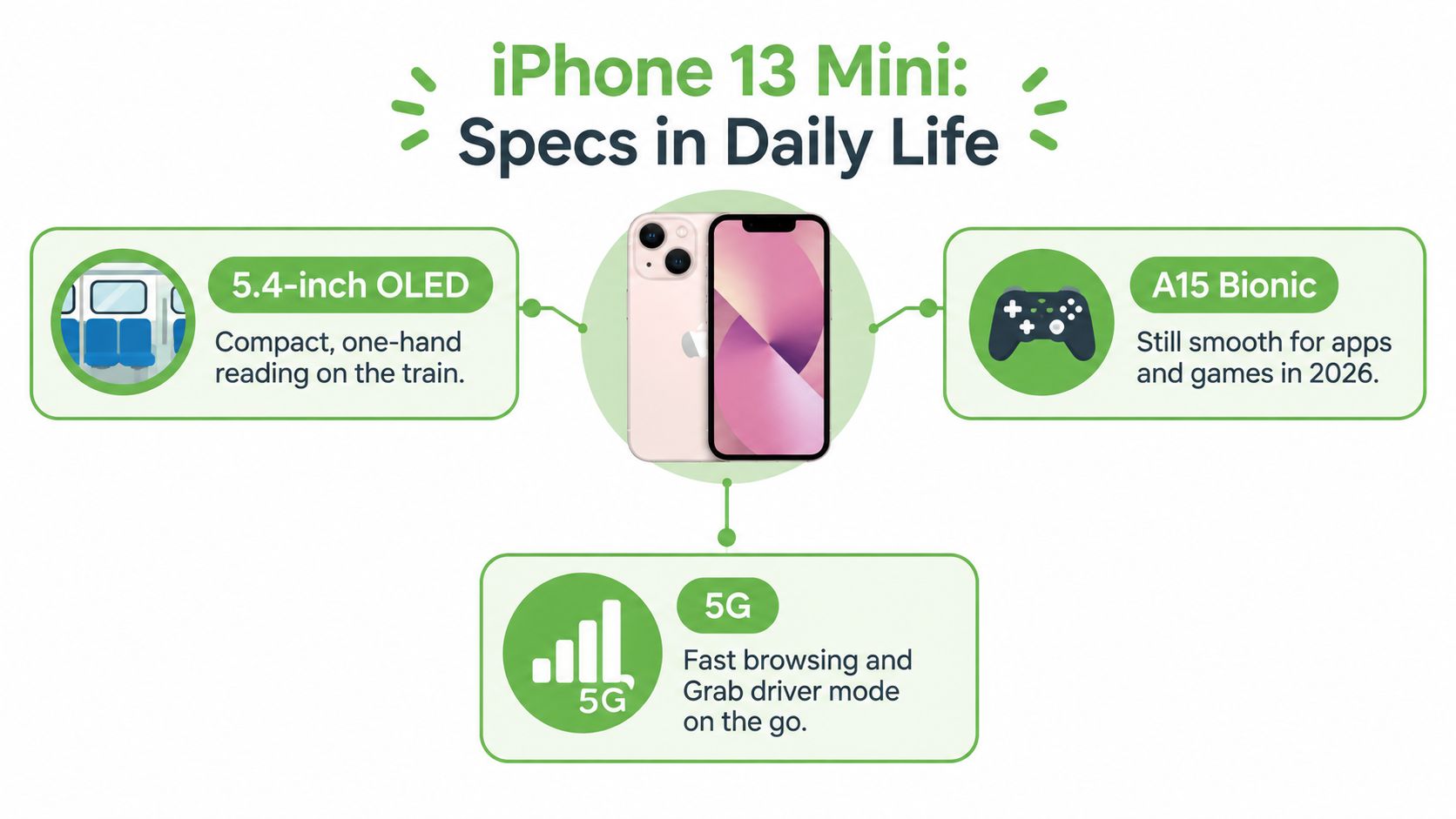
The 5.4-inch Super Retina XDR OLED display delivers a 2340 × 1080-pixel resolution at approximately 476 pixels per inch. Text remains sharp for MRT reading, maps and Grab driver mode, while the small body is easy to control with one hand. Apple lists typical outdoor brightness at 800 nits, HDR brightness at 1,200 nits, and a 28% increase in maximum outdoor brightness over the prior generation. (Apple's launch announcement)
The A15 Bionic chip handles messaging, banking, navigation, photography and everyday apps smoothly. 5G keeps a used unit compatible with newer mobile networks. Storage affects both daily comfort and resale appeal. The available tiers are 128GB, 256GB and 512GB. Choose more capacity for large photo libraries, video files or business applications.
Camera performance and protection
The dual 12-megapixel rear cameras record 4K video at up to 60 frames per second, enough for family clips, product content and travel footage. Owners working with Apple's higher-quality formats can use a macOS RAW editor for iPhone shots to manage files on a Mac.
Apple rates the battery for up to 17 hours of video playback. That figure describes a new or healthy battery, so a used phone with poor Battery Health will deliver less practical runtime.
The iPhone 13 mini carries an IP68 rating under IEC 60529, including resistance to a maximum depth of 6 metres for up to 30 minutes. (Apple's Singapore comparison data) This rating is not permanent waterproofing. Heat, humidity, worn seals and previous repairs increase liquid risk. Treat water exposure as a reason for inspection, especially before trade-in, certified ReLoved resale or parts recovery.
Common Faults and What Repair Really Costs
A weak battery is often the first repair decision for an iPhone 13 mini. Its non-removable lithium-ion battery cannot be replaced by the owner without opening the phone. Singapore listings show advertised replacement prices of approximately S$45 to S$110 from one provider and S$78 to S$118 from another. Treat these as commercial quotes, not proof of component quality or repair value.
The cheapest quote may use an aftermarket cell with uncertain Battery Health reporting or limited warranty cover. A higher quote may include a better component, careful fitting and post-repair checks. Ask which battery will be installed, whether Battery Health should report normally, how the phone will handle a non-genuine-part warning and what support applies if the replacement fails.
Separate cosmetic damage from functional faults
A small frame mark or cracked back can lower the phone's grade without stopping daily use. A cracked OLED panel, ghost touch or dead digitiser section affects both usability and resale value. Screen replacement usually costs more than battery work because the OLED is bonded, and the replacement module determines brightness, colour, touch response and buyer confidence.
Charging-port lint is cheaper to investigate than a damaged charging circuit. Have the technician inspect and clean the port before approving board diagnosis. Liquid exposure needs a different response. The IP68 rating does not prevent corrosion after a drop, seal wear or an earlier screen repair.
Ask before handing it over: Which part is being fitted, what warranty applies, will Face ID and True Tone be tested, and will the repair be recorded in the phone's service history?
Know when the fault is too deep
Face ID failure, baseband trouble, charging IC faults and corrosion can require board-level work. These jobs need specialist equipment and a written diagnosis, not a guess made at the counter. If the phone will not boot, the data may be worth more than the handset. Check data-recovery options before authorising a repair that could erase or damage the device.
A repair quote should list labour, parts, testing and warranty terms. Ask whether the shop will return the original component if you decline the work. For a structured overview of screen damage, part choices and repair considerations, read myhalo's guide to iPhone repair and LCD replacement. This gives you a better basis for choosing between repair, trade-in, certified ReLoved resale and parts recovery.
Repair or Replace? A Decision Framework That Saves Money
Battery Health gives you a useful starting point, but it isn't the whole answer. A phone above 85% battery health is generally worth continuing to use if the screen, cameras, charging and account status are clean. Between 80% and 85%, budget for replacement rather than treating the battery as a crisis. Below 80%, compare the repair cost with the value a fresh battery could add to the phone's usability and resale appeal.
| Phone condition | Repair cost threshold | Recommended action |
|---|---|---|
| Clean phone, battery above 85% | Avoid unnecessary repair spending | Keep using it or pass it to a family member |
| Battery between 80% and 85%, no major damage | Battery replacement quote is the main consideration | Keep using it if convenient, or plan a replacement |
| Battery below 80%, screen and cameras sound | Repair remains sensible if the total is below roughly half the certified ReLoved price for the same storage tier | Replace the battery and reassess |
| Cracked OLED, weak battery and uncertain repair history | Any quote approaching half of an equivalent certified ReLoved price | Replace the handset or trade it in honestly |
| Board fault, liquid corrosion or failed Face ID | No simple threshold, because diagnosis and data value dominate | Seek specialist assessment, then consider parts recovery |
The “half-price” rule is a guide, not a guarantee. Storage changes the calculation. A clean 512GB model may justify a repair that makes no sense for a damaged 128GB unit, while a phone with a working display can retain useful parts even if its logic board has failed.
Make the replacement comparison fair
Compare the repaired phone with a tested replacement of the same storage tier, not with a brand-new flagship. If you're also considering larger current models, a technical comparison such as iPhone 17e versus iPhone 17 can clarify whether you're paying for useful features or just accepting a larger body.
My recommendation is simple. Repair a clean iPhone 13 mini when the battery is the main weakness. Replace it when several expensive faults arrive together. Trade in or sell only after disabling account locks and documenting the condition.
Safe Data Steps Before You Let the Phone Go
Data protection starts before you visit a trade-in counter. A wipe that leaves Find My enabled can make the phone unusable for the next owner, while a rushed reset can remove photos, payment cards and work information before you've verified a backup.
Complete the account checks first
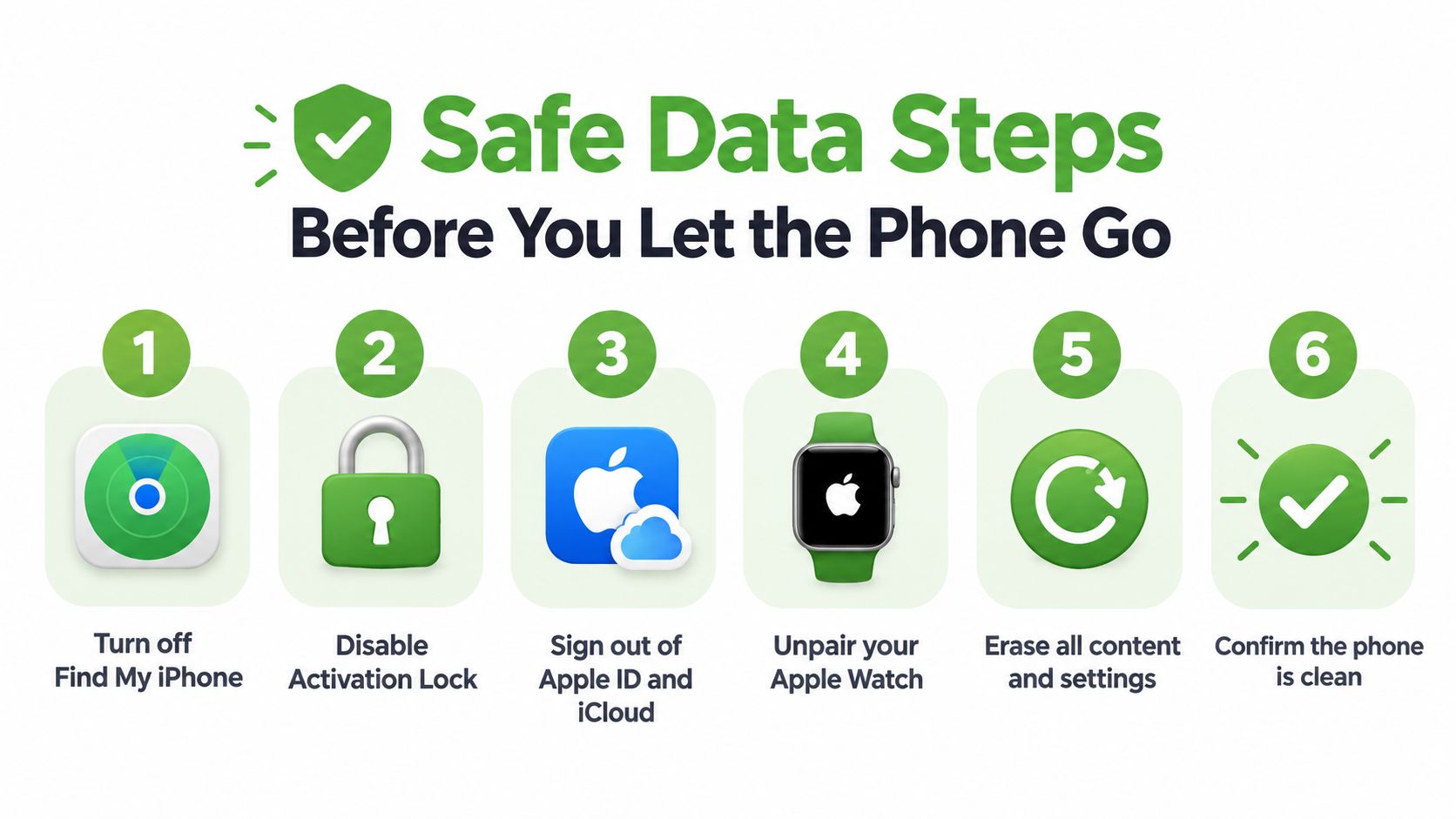
Use this order:
- Back up and verify: Create an encrypted local backup on a Mac or PC, then confirm that your important contacts, photos and messages can be restored. Apple's iPhone backup guidance explains the practical setup.
- Protect your contacts: If a backup is incomplete or contacts have disappeared, use a specialist guide such as restore contacts with Gini Help before wiping the device.
- Turn off Find My iPhone: This removes the location lock tied to your Apple Account.
- Disable Activation Lock: Sign out of Apple Account services and check that the phone no longer appears in your device list.
- Unpair accessories: Unpair an Apple Watch and remove any paired accessories that should move to your next phone.
- Remove connectivity profiles: Delete a carrier eSIM profile if you're transferring the number, and remove payment cards from Wallet.
- Erase everything: Use Settings to erase all content and settings. Don't settle for manually deleting a few photos and apps.
Ask for proof when the stakes are higher
A standard full erase is appropriate for most consumer handovers when the phone is no longer linked to your account. Businesses should request a certificate of data destruction and a documented chain of handling, especially where the device held customer, employee or financial data. That supports responsible handling under Singapore's personal data protection expectations and provides evidence for internal records.
Final check: After erasure, the phone should show the setup screen and shouldn't ask for your Apple Account. If it does, stop the handover and remove the lock.
Getting a Fair Trade-In or Buyback Quote in Singapore
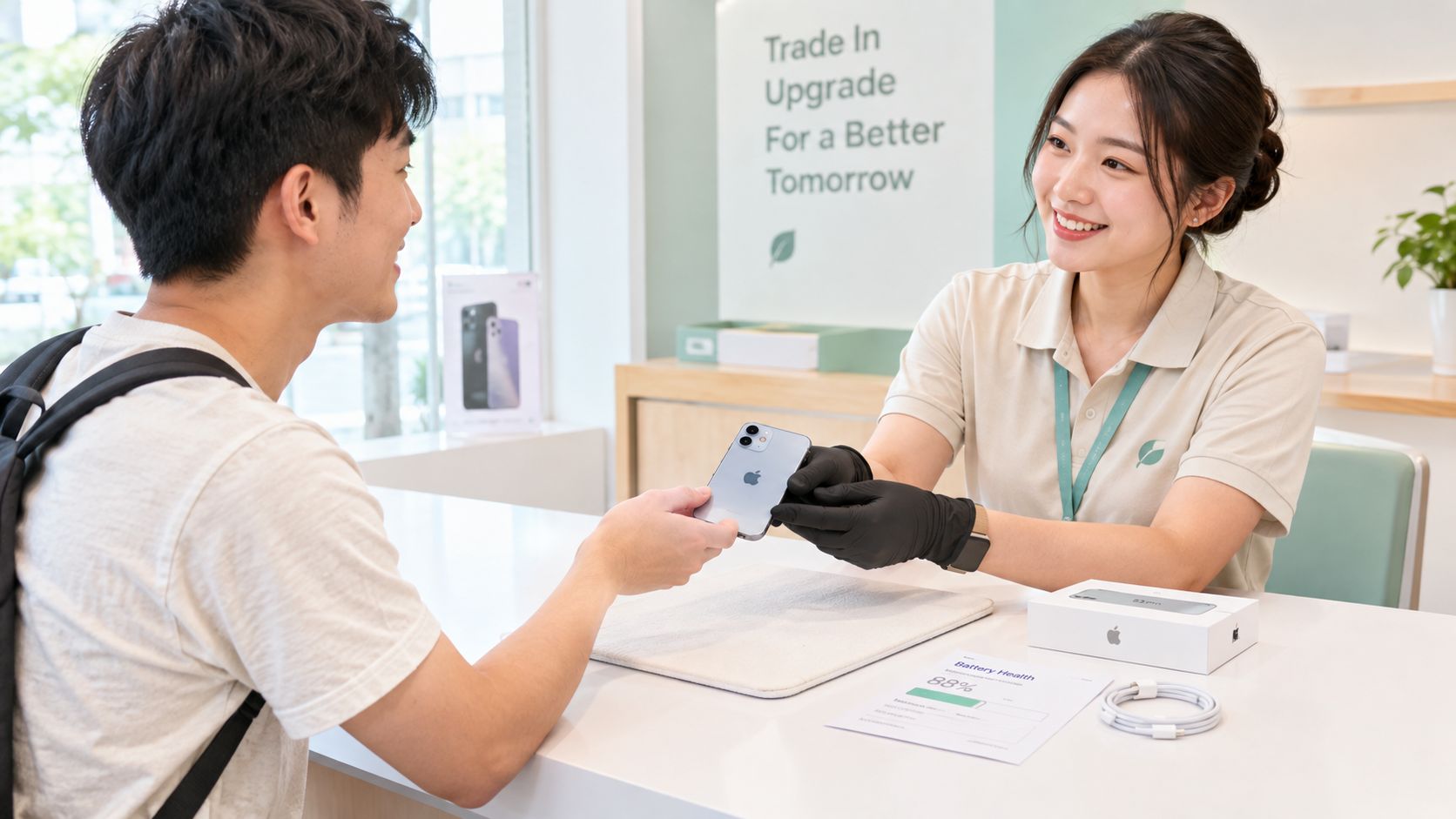
A trade-in quote reflects more than the model name. Assessors look at storage, cosmetic condition, battery health, Activation Lock status, repair history and included accessories. A 128GB phone with a clean screen and healthy battery can attract a different offer from a same-looking unit with a warning message, even if both power on.
Use the right selling route
An instant online quote is convenient and gives you a starting point, but the final amount may change after inspection. An in-store assessment at a central counter, such as Bugis Junction or Sim Lim Square, lets a technician test the screen, cameras, microphones, charging and account status directly. Peer-to-peer selling can produce more cash, but you carry the risk of no-shows, payment disputes, inaccurate descriptions and post-sale arguments.
Clean the phone, photograph defects accurately and record the battery condition before requesting quotes. Don't replace a battery purely to chase a higher offer unless the repair cost is lower than the likely improvement and you trust the replacement quality.
Choose transparency over the highest headline figure
A buyer who offers a clear grade, testing process, warranty and secure data handling may be safer than a private buyer offering an attractive but unverified amount. Certified ReLoved gives the next owner a tested device and gives the previous owner a controlled handover, which is especially useful when privacy matters more than squeezing out the last dollar.
For practical preparation advice, follow this phone trade-in guide for Singapore. The goal isn't to hide flaws. It's to present the phone accurately so the first quote doesn't collapse after inspection.
Why Certified ReLoved Beats a Private Resale
Private resale works for some sellers, especially if the iPhone 13 mini is sealed, has an uncommon storage tier, or you are willing to handle meetups, price haggling, and dispute risk. For most owners in Singapore, a certified ReLoved unit gives clearer value and less hassle than a fast listing on Carousell or Facebook Marketplace.
A proper refurbishment process should test the display, touch layer, cameras, microphones, speakers, buttons, charging, connectivity, biometric functions, and account status. It should also record battery condition, cosmetic grade, and any replaced components. A warranty and a return route matter because faults can show up after a short period of normal use.
Pay for confidence, not just the handset
The same storage capacity can land very differently once battery wear and repair history enter the picture. myhalo's ReLoved iPhone 13 mini listings show a 256GB unit at S$348 and another listing for the model starting from S$339. (myhalo product information) Treat those as listed retail examples, not trade-in promises. Final offers still depend on condition, stock, and test results.
Certified reuse also keeps a capable phone in circulation instead of pushing demand toward another newly manufactured device. myhalo's published carbon impact reporting says its reuse work avoided about 2,020 MTCO2e in 2024 across smartphones, laptops, tablets, and desktops. (myhalo sustainability information)
Private resale still makes sense if you can describe the phone accurately and manage the process yourself. Certified ReLoved is the cleaner choice when you want grading, testing, warranty support, and a controlled handover.
For buyers comparing ownership trade-offs, read this refurbished iPhone 13 guide. Buy the compact model if its size solves a real daily problem. Buy certified when reliability matters more than chasing the last dollar.
When Upcycling and Parts Recovery Make More Sense
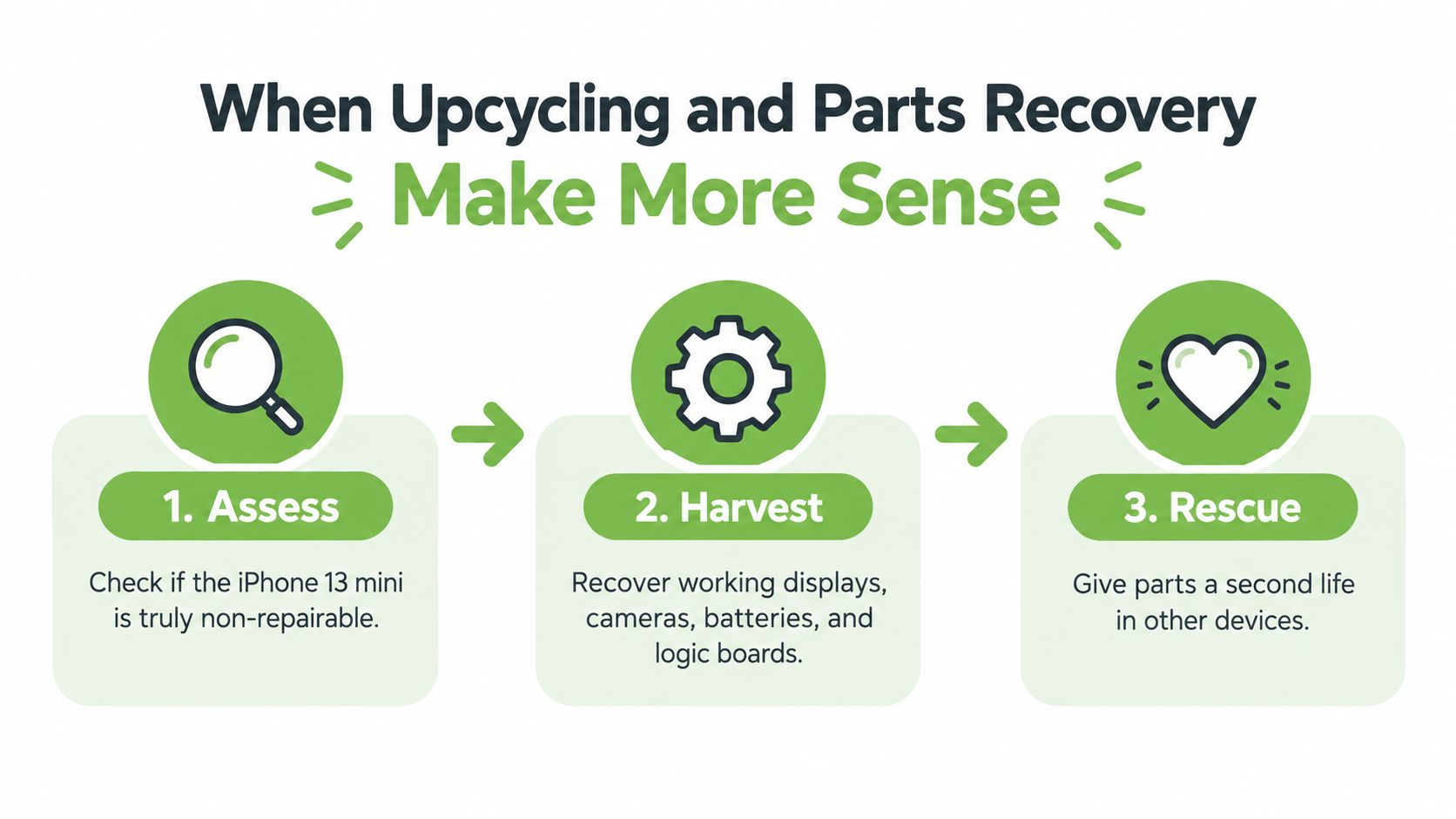
Some iPhone 13 mini units are not sensible repair projects. A phone may have severe corrosion, a damaged logic board, a shattered display and a swollen battery, or it may fail to boot after an unsuccessful repair. “Recycle it” is too vague for these cases. First establish whether the phone contains usable components and whether a specialist can handle them safely.
Recover value before sending material for recycling
A working display, camera module, battery or logic board may help rescue another compact phone. Parts harvesting keeps useful material in service and can produce a voucher for eligible items through an upcycle pathway. It also gives the owner a more useful outcome than leaving a dead handset in a drawer.
Singapore generates more than 60,000 tonnes of e-waste annually, and reporting on the underlying 2018 study cites a recycling rate of 6%. (The Straits Times reporting) More recent reporting says more than 34,000 tonnes were collected nationally from 2021 onward, with 2025 collections approaching 10,000 tonnes and collection points expanding to about 1,000. The same report cites a 2025 survey estimate of 2.9 million unused smartphones in Singapore homes, with 90% of respondents open to reuse, recycling or return if the process were simpler and secure.
Use a regulated route for batteries
The iPhone 13 mini's integrated lithium-ion battery must not go into general waste. The National Environment Agency's e-waste guidance describes Singapore's Extended Producer Responsibility system and public battery disposal routes, including designated 3-in-1 e-waste, battery-and-bulb and battery-only bins. NEA advises taping rechargeable-battery ends or wires to reduce short-circuit and fire risks, while leaking batteries should be sealed in a leak-proof bag or container.
Use this decision checklist:
- Working phone: Keep it, pass it to family or obtain a certified trade-in quote.
- Cracked but repairable phone: Compare the repair quote with an equivalent certified ReLoved replacement.
- Dead or corroded phone: Request a parts assessment and data check before regulated recycling.
- Phone containing sensitive information: Complete the secure erase process, or request documented data destruction before processing.
myhalo can help assess, repair, trade in, resell or upcycle an iPhone 13 mini, with secure data handling and lifecycle options for devices that no longer make financial sense to repair. Visit myhalo to choose a practical next step and clear that unused phone from your drawer responsibly.