
You've upgraded your phone, transferred your photos, and placed the old device in a drawer “for later”. Months pass. The drawer fills with older iPhones, a Samsung with a cracked screen, spare chargers and the uneasy feeling that factory-resetting everything might expose your private data. Selling on Carousell is possible, but taking photos, answering messages and arranging meet-ups can feel like a second job.
That's where phone trade-in in Singapore earns its place. A proper trade-in converts an unused device into cash, resale stock, refurbished equipment or recoverable parts, while giving you a clearer handover process. The key is choosing a partner that explains its valuation, protects your data and tells you what happens after collection. Here's how I'd approach the decision from upgrade day to payment.
Table of Contents
- Why Your Old Phone Is Worth More Than You Think
- How Phone Trade-In Works
- What Really Drives Your Trade In Quote
- Online Versus In Store Trade In In Singapore
- The myhalo Trade In Journey From Quote To Cash
- Data Security And Why It Should Be A Decision Criterion
- The Bigger Picture Of Trading In Your Phone In Singapore
- Your Pre Trade In Checklist And Next Step
Why Your Old Phone Is Worth More Than You Think
The phone you set aside after upgrading may still be worth a meaningful amount. Singapore trade-in listings show used devices ranging from hundreds of dollars to more than S$1,000, depending on the model, storage and condition, as shown in Singapore used-phone trade-in listings. Treat that range as a starting point, not a promise. Your actual quote depends on the device in your hand.
The common mistake is judging the phone by its age alone. Resale pricing follows current demand, usable specifications and the work needed before another person can use the device. A phone with good storage, a clear display and working biometric features can be suitable for resale or refurbishment. A damaged handset may still have value through repair or parts recovery.
Your concerns are valid. You may worry about family photos, banking apps or a buyer rejecting the device after handover. You may also compare the quote with the original purchase price. That comparison will mislead you. The market pays for present usefulness, not what you paid before.
Trade-in turns hassle into a defined transaction
A private sale can sometimes bring a higher offer, but you carry the workload. You write the listing, answer enquiries, check payment and arrange a meeting. A trade-in operator brings the quote, collection or drop-off, inspection and payout into one process.
That convenience has a real value. If you are comparing channels, judge the full outcome rather than the headline amount. A slightly lower quote may suit you better if it saves time, reduces meeting risk and gives you a clear handover record. myhalo's instant-quote route is built for this comparison, while its ReLoved pathway gives a usable phone a route back to another owner.
Here's what I'd do: check the trade-in quote before trying to sell privately. If the difference is small, choose the route with clearer inspection terms, data handling and payment timing. If you enjoy negotiating and want to chase the highest possible private-sale price, list the phone yourself.
Do not leave the device in a drawer while its resale demand changes. Record its condition fairly, compare the available route and decide based on the money and effort involved.
How Phone Trade-In Works
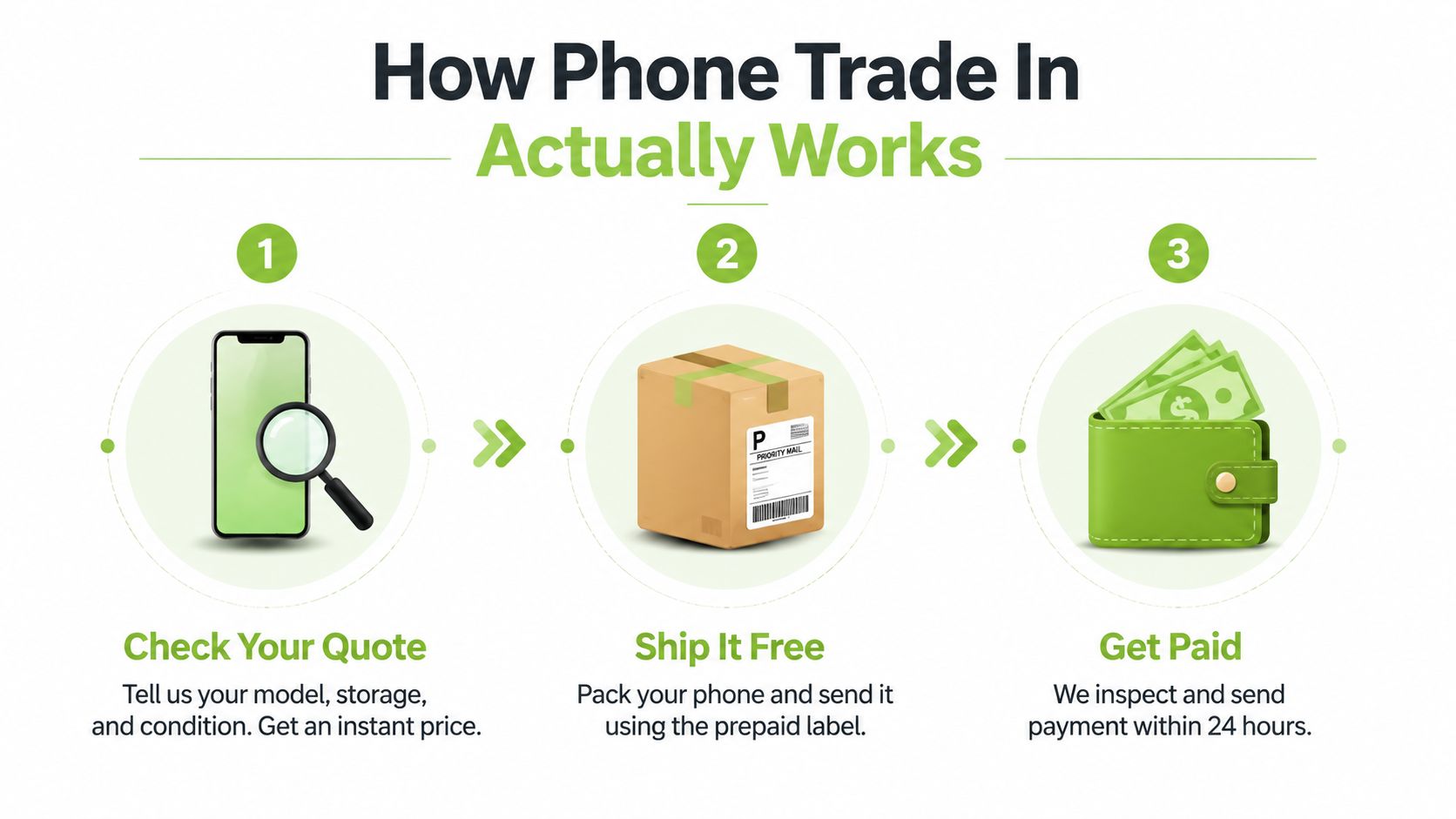
A phone trade-in is a resale and recovery process, not a bin for old electronics. You submit the model, storage capacity and condition. The operator returns an indicative valuation, checks the device after handover, then releases payment under the stated terms. Here's the decision that matters: choose a route that makes the quote, inspection and payout easy to verify.
The three people in the transaction
Three roles shape the handover:
- You, the seller: Give accurate details, remove your accounts and hand over the phone.
- The trade-in operator: Prices the device, verifies its condition, handles data procedures and selects the next route.
- The next user or recovery channel: A working phone may be refurbished for another owner. A repairable device may be restored, while an unsuitable one may provide parts or recyclable materials.
That second-life route matters in Singapore. After an upgrade, a phone can return to use, support a repair or provide recoverable components. myhalo's ReLoved pathway is designed for usable devices that can move towards another owner, while its instant-quote route gives you a clear starting point for comparing trade-in options.
How the quote becomes money
Payment usually follows one of two routes. A physical counter may provide instant cash or store credit, subject to its assessment. An online or courier process may pay by bank transfer or another digital method after inspection.
StarHub offers a local example. Its device trade-in process uses the phone's IMEI and a questionnaire to produce an estimate, then arranges handover and pays cashback within two working days after pickup.
Treat the first figure as indicative, not final. If the phone's condition differs from your answers, the amount may change. Read the inspection terms before accepting, keep the submitted details and save the confirmation. If I were choosing, I'd compare myhalo's quote and ReLoved route with the payout timing and inspection rules, then pick the option that gives the clearest path from handover to cash.
What Really Drives Your Trade In Quote
You request a quote expecting the model to decide the amount. In practice, the offer reflects whether the phone can move quickly to another owner, be refurbished at a reasonable cost or provide usable parts. Model demand, storage, appearance and functionality all shape that decision.
The Singapore used and refurbished smartphone market report tracks the used and refurbished smartphone segment through 2031, including historical and forecast revenue and volume. Its practical takeaway is clear: pricing follows the phone's likely secondary-market route, so condition grade, storage tier, repairability and expected resale demand affect the quote.
The five factors to check
| Factor | Typical impact on quote |
|---|---|
| Model and generation | High. Popular, newer models usually have stronger resale demand. |
| Storage capacity | Meaningful. Higher storage can make a device more attractive to the next owner. |
| Cosmetic condition | Meaningful. Cracks, deep scratches and dents can reduce resale value or add repair work. |
| Battery health | Relevant. A weak battery can mean replacement costs or a lower grade. |
| Functional checks | Required. Cameras, speakers, microphones, buttons, biometrics, charging and network functions determine usability. |
A recent iPhone in excellent condition with generous storage is easier to place through a ReLoved resale route than the same phone with a cracked display. A Samsung with cosmetic wear may still attract an offer if its cameras and charging work properly. Activation lock or major water damage can lead to rejection.
Spend effort where it changes the outcome
Clean the phone gently, record its condition accurately and test its main functions before requesting a quote. You can improve presentation, but cleaning will not fix a broken screen.
Do not replace an expensive component to chase a higher offer. Compare the repair cost with the likely increase in resale value first.
For a closer look at the variables behind resale pricing, read this guide to factors that affect mobile phone resale value. I'd request an indicative quote before spending anything, then compare cleaning, repair and private-sale options against the myhalo offer and ReLoved pathway. That gives you a clear decision before handing over the phone.
Online Versus In Store Trade In In Singapore
You have finished comparing your phone and are ready to sell. Online trade-in lets you check an estimate from home and arrange the handover around your schedule. In-store trade-in gives you a counter conversation, a physical inspection and immediate answers from staff.
| Dimension | Online trade-in | In-store trade-in |
|---|---|---|
| Quote speed | Enter your device details before committing to handover. | Staff assess the phone directly, but travel or waiting may be involved. |
| Convenience | Collection or shipping reduces errands and can fit around your day. | Face-to-face help is available at a physical counter. |
| Payout | Payment usually follows inspection and verification. | Cash, credit or an immediate offer may be available, depending on the operator. |
| Inspection | The final grade is confirmed after the phone arrives. | You can watch the checks and ask questions as they happen. |
Choose according to your real priority
Choose online if you already know the model, want a quick estimate and prefer not to visit a shop. Door-to-door collection makes this route easier, provided you package the phone securely and describe its condition accurately.
Choose in-store if you are unsure about the condition, want reassurance during handover or need to explain a fault in person. A staff member can examine issues that an online questionnaire may not capture clearly, although the offer still depends on the operator's assessment.
Keep reuse in mind before treating a working phone as waste. Singapore's National Environment Agency guidance on e-waste collection lists reuse, donation and designated collection options, so a functioning handset may have a better next step than immediate disposal.
Here's what I'd do: start online to get a written estimate, then use an in-person route if the phone has faults or the condition is difficult to describe. myhalo combines an online quote route with physical service options, including drop-off locations at Bugis Junction and Sim Lim Square. That hybrid approach lets you compare the price remotely while keeping a counter conversation available when you need it. It also fits the wider decision this guide recommends, moving from quote to handover and payment without relying on a generic channel.
The myhalo Trade In Journey From Quote To Cash
Start with the quote, not the courier booking. You want a written baseline that reflects your exact device, storage and declared condition before you hand it over.
A straightforward local workflow
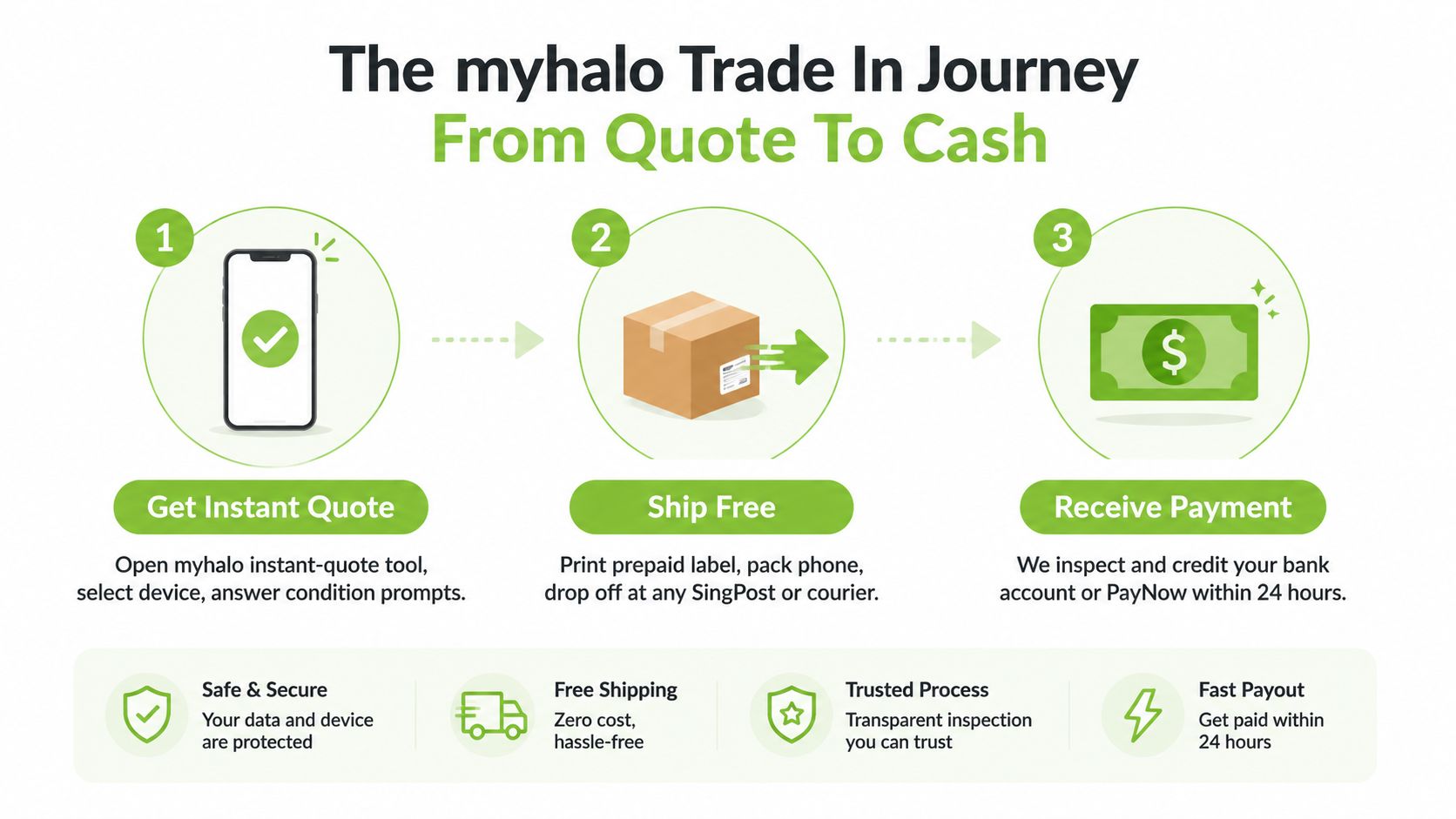
- Check the estimate: Open the myhalo phone trade-in service, select the model and answer prompts about screen condition, body condition, functions and battery health. The result is indicative, so save the quote and your answers.
- Arrange handover: Confirm the offer and choose the available collection or drop-off route. Pack the phone securely, remove personal accessories and keep the handover record.
- Let the operator grade it: The device is assessed against the information you supplied. A working phone can enter the ReLoved pathway for testing, grading, data erasure and resale. Devices that aren't suitable for resale may move towards repair, parts recovery or recycling.
- Review the final offer: If the inspection matches your declaration, payment is released through the stated method. If the condition differs, ask for the reason behind any counter-offer before accepting.
- Keep the paperwork: Retain the quote, inspection outcome, collection confirmation and payment record. These documents make the transaction easier to resolve if the final grade isn't what you expected.
The entire journey should feel visible. You should know what you declared, how the device moves through inspection and what happens if the operator disagrees with your condition assessment.
The workflow is also easier to understand when you can see it from start to finish:
Before you accept: Compare the confirmed payout, inspection rules, payment timing and return policy. A headline quote means little if the operator can change it without explaining why.
Data Security And Why It Should Be A Decision Criterion
Data security isn't a minor personal worry. The moment another party takes possession of your phone, that party becomes responsible for handling a device that may contain photos, contacts, messages, documents, saved accounts and authentication access.
A factory reset is an important step, but your preparation shouldn't stop at tapping “erase”. Sign out of Apple ID or Google Account, disable activation protections and remove your SIM or microSD card. Then ask the operator what happens to the device after collection and whether it provides confirmation of data destruction.
Look for a documented process
Professional device handling can include account unlinking, a secure erasure process, a factory reset and a record connecting the erased device to its processing history. The exact method depends on the phone and the operator's system, so don't assume that every buyer follows the same standard.
Singapore reporting on licensed recyclers describes data sanitisation and physical dismantling for data-bearing devices sent for recycling. The Straits Times explanation of device data safety notes processes such as removing storage components, degaussing hard disk drives and shredding solid-state drives so the data can't be recovered.
Samsung Singapore is also explicit about its own handling rules. Its trade-in frequently asked questions state that collected trade-in devices undergo a data wipe, while SIM and microSD cards left inside are destroyed upon receipt. Once the device has been collected and erased under that process, Samsung says the erased data can't be retrieved.
Red flags I wouldn't ignore
- No clear data policy: The operator can't explain when or how erasure occurs.
- No ownership check: The process doesn't address activation lock, account unlinking or proof of ownership.
- No handover record: You receive no confirmation of the device identifier or collection.
- No resolution path: The operator can't tell you what happens if the phone is rejected or the offer changes.
Read myhalo's guide to secure data destruction before handing over sensitive equipment. The best trade-in decision protects both the phone's resale value and the information that still lives on it.
The Bigger Picture Of Trading In Your Phone In Singapore
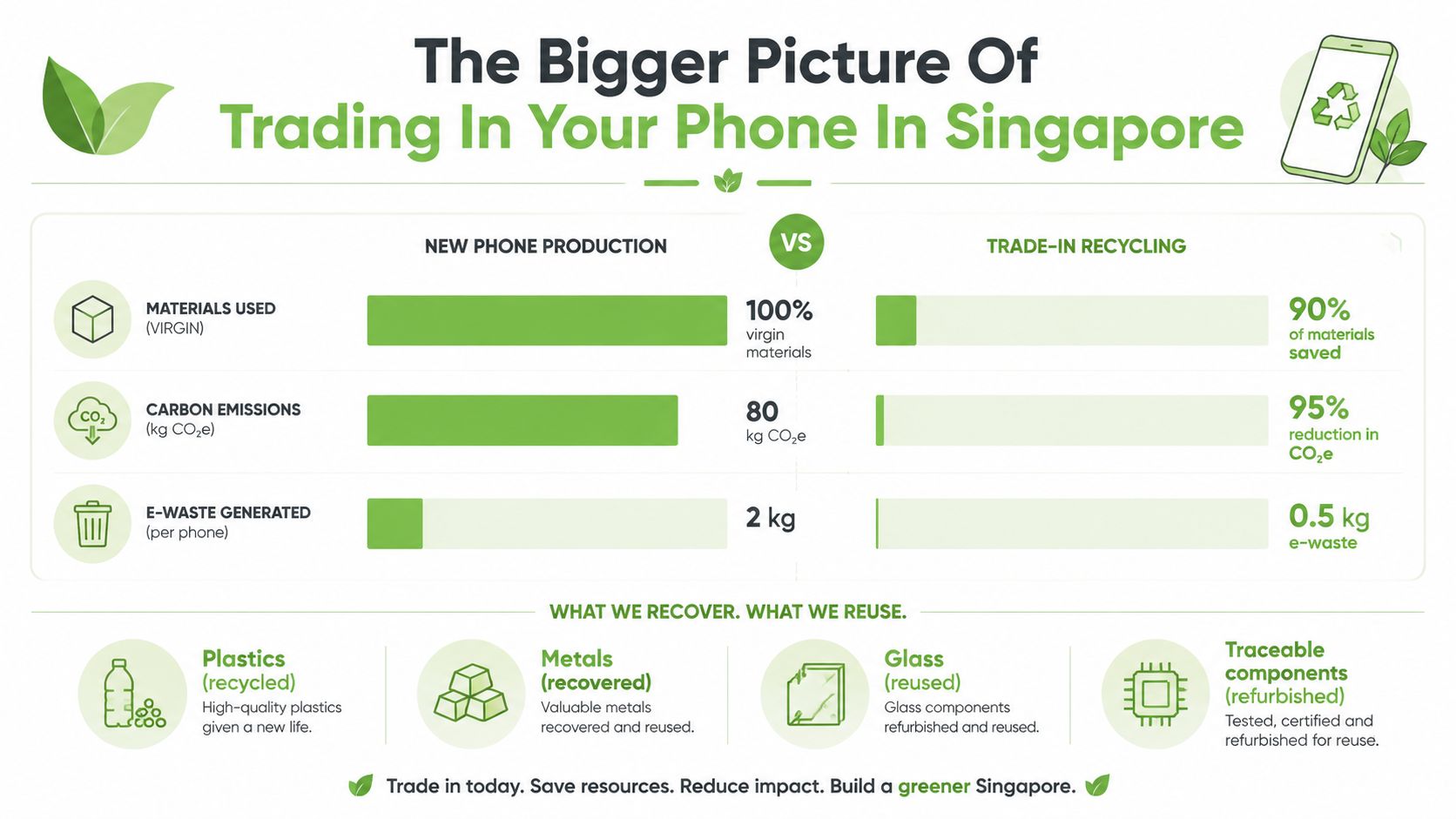
You have upgraded, the old phone is still working, and it is sitting in a drawer. Trading it in gives that device a clearer next use. A working handset can serve another owner, a repairable phone can return to service after component replacement, and a phone that cannot be resold may still provide parts or recoverable materials.
Singapore launched its first nationwide e-waste management system in 2021. Under that formal framework, producers take responsibility for collection and recycling. In a compact city where storage is limited, that makes responsible handover more practical than leaving old electronics untouched at home.
One local device-life business reported handling 960 smartphones in one reporting period and claimed approximately 2,020 MTCO2e of avoided emissions from rescue, relove and upcycling activities in 2024, as described in its Singapore trade-in and device-life information. These are company-reported figures, not an independent industry measure. They still show how individual handovers can connect with a wider circular-economy programme.
Ask what happens next
Before choosing a trade-in channel, ask for the phone's likely route:
- Refurbishment: Technicians test, grade and prepare an eligible phone for another user.
- Repair: Faulty components may be replaced when repair makes practical sense.
- Parts recovery: A non-resalable handset can support repairs of other devices.
- Recycling: Materials are recovered when reuse and repair no longer fit the device.
The environmental result depends on the model, condition, future use and processing route. Treat each operator's claims separately. Ask whether the service can explain resale, refurbishment, recycling partners and impact reporting. That answer helps you compare myhalo's instant-quote and ReLoved pathways with generic trade-in channels, from upgrade decision to final handover.
Keep the transfer record and choose an operator that explains what happens after collection. The wider benefit comes from extending device life where possible and sending unsuitable electronics through an appropriate recovery process.
Your Pre Trade In Checklist And Next Step
Spend a few minutes preparing the phone before you request collection. Good preparation protects your information, reduces avoidable disputes and gives the operator a cleaner basis for grading.
Back up and disconnect
Save photos, contacts, messages, authenticator access and app data to iCloud, Google or a computer. Don't forget banking apps and password-manager recovery details. Once the backup is complete, sign out of Apple ID or Google Account, disable Find My iPhone or Find My Device and turn off relevant activation protections.
Remove the physical SIM and any microSD card. If you use an eSIM, transfer or remove it through your carrier and confirm that the old phone no longer receives calls or messages. Perform a full factory reset, then check that the device restarts at the initial setup screen.
Check the phone honestly
Use a soft, dry cloth on the display and casing. Avoid harsh liquids, especially near ports, microphones and speakers. Test the following before declaring the condition:
- Display and body: Look for cracks, deep scratches, dents and lifting panels.
- Cameras and audio: Test front and rear cameras, speakers and microphones.
- Controls and biometrics: Check buttons, Face ID or Touch ID, and the charging function.
- Connectivity: Confirm that the phone can connect as expected and doesn't show an activation lock.
Take photos of the phone, serial number or IMEI, and the final reset screen. Save screenshots of the selected model, condition answers, quoted price, inspection terms and submission receipt. This creates a simple record of what you handed over.
What I'd do next
I'd start with myhalo's instant quote to establish a clear baseline, then compare the confirmed terms with credible Singapore alternatives. Don't compare only the largest advertised number. Check whether the price is adjusted after inspection, who pays for returns and how the operator handles data.
For a fuller preparation guide, use this mobile phone trade-in checklist for Singapore. When you're ready, use tracked handover, monitor the inspection and confirm payment. Never trade in a phone with activation lock still enabled or with uncertain ownership.
Ready to clear that drawer responsibly? Visit myhalo to get an instant phone trade-in quote, choose a convenient handover route and place your device into the ReLoved, repair or recovery pathway. Let's declutter your e-clutter safely and make your next upgrade part of a more convenient zero e-waste lifestyle.