
You're in an Orchard mall, looking at a newer iPhone and recalculating your budget. The phone in your hand is tempting, but your current device still works, and spending flagship money feels hard to justify. A refurbished iPhone 13 in Singapore offers a practical middle path, modern enough for everyday use without paying for features you may not need.
The sensible question isn't whether the phone is cheap. It's whether the device has been properly tested, whether the battery and warranty match the listing, and whether the seller can show a trustworthy chain of custody. If you're still weighing the wider case for buying refurbished electronics, the iPhone 13 is a useful example because Singapore's resale market now gives buyers several grades, storage options, and service levels to compare.
Table of Contents
- Why the Refurbished iPhone 13 Makes Sense in 2026
- What Refurbished Really Means in Singapore
- How a Refurbished iPhone 13 Should Be Tested and Graded
- Warranty and Certification You Should Insist On
- Real Refurbished iPhone 13 Prices and Where the Savings Come From
- Inspecting Your Refurbished iPhone 13 Before You Commit
- Trade-In, Buyback and Upcycle Pathways in Singapore
- Choosing the Right Refurbished Path for You
Why the Refurbished iPhone 13 Makes Sense in 2026
The iPhone 13 launched in 2021, but it doesn't feel like an antique in daily use. It offers 5G connectivity, a capable camera system, an OLED display, and enough performance for messaging, banking, streaming, navigation, and social media. For a buyer who wants an iPhone that feels current without chasing the newest release, that balance is compelling.
Singapore listings show the model settling into a mid-range refurbished segment. One local retailer lists a graded 128GB unit around S$328 and a 256GB unit around S$388, while other sellers list the model from about S$288 to S$379, depending on condition and seller. These figures come from Singapore refurbished iPhone listings, and they make the value proposition clear. The iPhone 13 is no longer priced like a luxury flagship, yet demand for Apple devices keeps it visible across local retail and online channels.
The real hesitation is usually the battery
Most buyers I speak to aren't worried about the A15 chip or camera quality. They're worried about receiving a phone with a tired battery, vague grading, or a warranty that disappears when something goes wrong. That concern is justified. A refurbished phone is only a good deal when the seller is transparent about what has been inspected and what remains covered.
Local listings already show how much condition and support can change the deal. One Singapore retailer advertises a reduction from S$627 to S$379, about a 39% discount, while other listings show discounts of 50% or more on selected variants, as documented by Singapore iPhone 13 retailer pricing. The discount is attractive, but the warranty terms and battery report matter as much as the headline price.
My recommendation is straightforward. Choose the refurbished iPhone 13 if you want a dependable everyday iPhone and you're prepared to inspect the listing properly. Treat it as a pragmatic, future-safe purchase, not as a consolation prize.
What Refurbished Really Means in Singapore
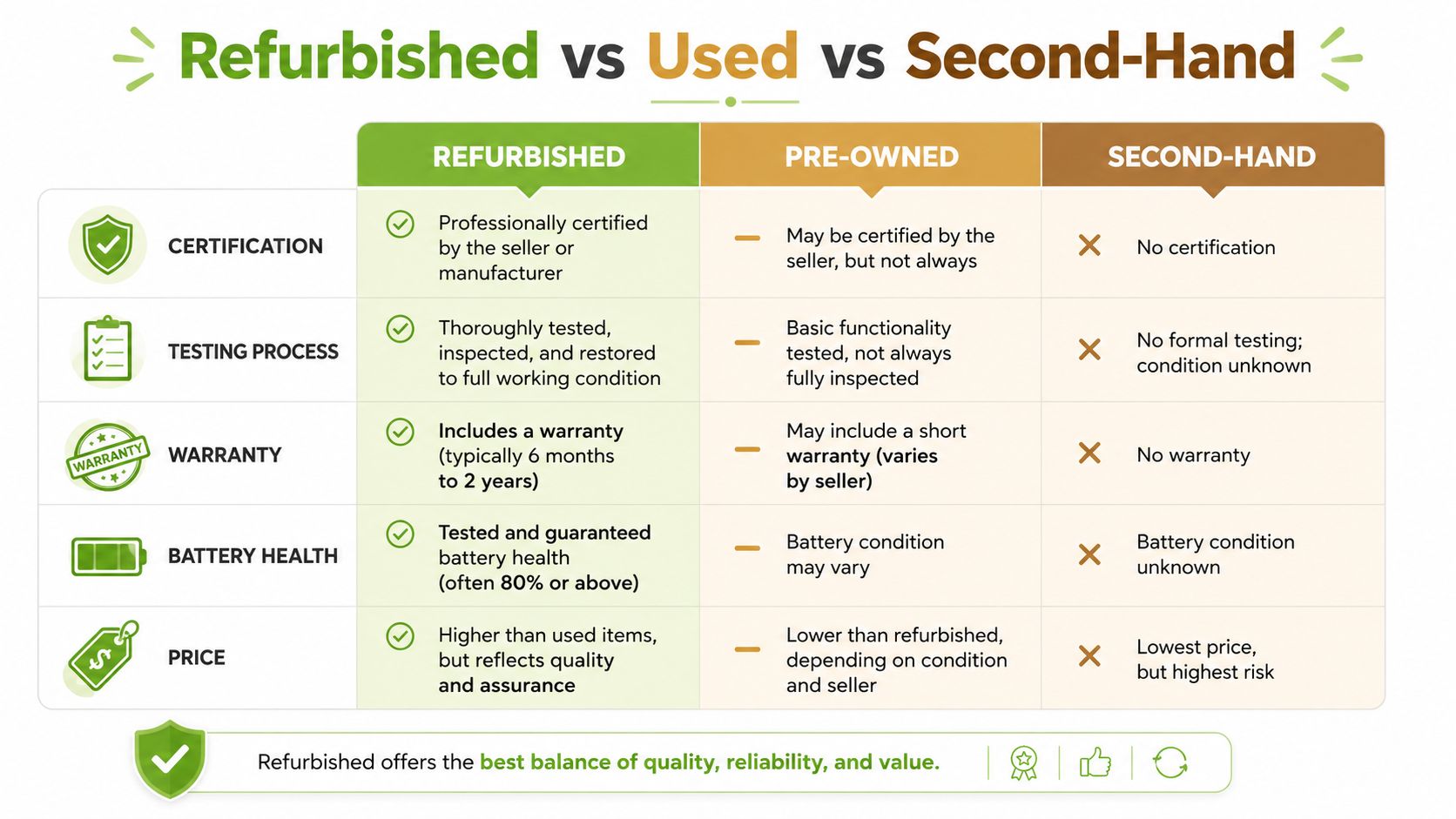
“Refurbished” should describe a process, not a marketing mood. A properly refurbished iPhone 13 has entered a workshop or organised resale operation where technicians record its condition, erase its previous owner's data, test its functions, replace faulty parts when necessary, clean it, grade its appearance, and sell it with defined warranty coverage.
That makes it different from a basic used or second-hand phone. A pre-owned device may have belonged to someone else and been resold. A second-hand listing can be perfectly good, but the seller may not have run a documented diagnostic or offered meaningful after-sales support.
Look for a traceable refurbishment process
Before paying, ask the seller to explain these stages:
- Device intake: The seller records the model, storage capacity, serial number, IMEI, and visible condition.
- Data sanitisation: The previous owner's account and personal content are removed, with Activation Lock cleared.
- Functional diagnostics: Technicians test the display, cameras, Face ID, microphones, speakers, buttons, charging port, wireless connectivity, and SIM function.
- Repair and replacement: Faulty components are repaired or replaced where appropriate.
- Cosmetic grading: The device is assigned a condition tier based on visible wear.
- Repackaging and warranty: The phone is cleaned, packed, and sold with written terms.
Singapore's local market commonly uses grades such as Pristine, Mint, and Satisfactory. A seller advertising these three tiers alongside a 30-day warranty shows a more structured approach than a casual listing, while an ISO9001-quality refurbishment claim indicates that the seller is presenting a quality-controlled process. You can compare how refurbished phones are assessed in Singapore before you start comparing prices.
What the grades mean in your hand
Pristine should mean very little visible wear, especially on the screen and frame. It's the grade to consider for a gift or for anyone who dislikes marks.
Mint may have light micro-scratches that disappear once you add a case. This is often the sensible choice for personal use because you're not paying as much for showroom cosmetics.
Satisfactory can show obvious scratches or small dents while remaining fully functional. It's appropriate for a budget buyer, but only when the battery condition, diagnostics, and warranty are clearly stated.
A Carousell seller can call a phone “refurbished” without providing any of this documentation. If the listing contains only attractive photos and a price, ask what was tested, who tested it, what was replaced, and what the warranty excludes. If the answers are vague, you're looking at a used phone with a refurbished label.
How a Refurbished iPhone 13 Should Be Tested and Graded
Battery health deserves priority because it's the component most likely to affect daily satisfaction after the phone's other hardware has been cleaned and checked. Singapore listings show different support structures, including a standard battery described as fully functional with a 3-month warranty, and another retailer's policy requiring battery health above 80% with a 6-month guarantee for defective batteries. You can review those examples in local iPhone 13 refurbished listings.
Apple Singapore uses 80% of original capacity as an operational threshold for battery replacement eligibility under AppleCare+, while normal battery wear isn't covered by the standard warranty. That doesn't mean every phone at 81% is a bargain. It means buyers should understand the difference between a phone that passes a seller's minimum and one that feels close to new.
Practical rule: Treat 80% as the floor to question, not the target to celebrate. A seller claiming “like new” should provide a much stronger battery result or explain that a new battery has been installed.
Functional testing should be boring and comprehensive
A proper technician should test:
- Charging: The port should accept a cable without looseness, intermittent connection, corrosion, or excessive debris.
- Audio: The earpiece, loudspeaker, and microphones should produce clear, balanced sound.
- Face ID: Enrolment and recognition should work without repeated failures.
- Cameras: Each camera should focus, capture images, record video, and show a clean lens.
- Touchscreen: Every area of the display should respond accurately, including the edges.
- Wireless functions: Wi-Fi, Bluetooth, mobile data, and SIM registration should operate normally.
- Physical controls: The volume buttons, side button, mute switch, and vibration function should respond correctly.
Cosmetic grading needs its own standard. A Pristine screen shouldn't carry noticeable scratches under angled light, a Mint frame may show fine marks, and a Satisfactory body may include visible wear. Camera lens clarity matters because a scuffed lens can affect photos even when the camera app works.
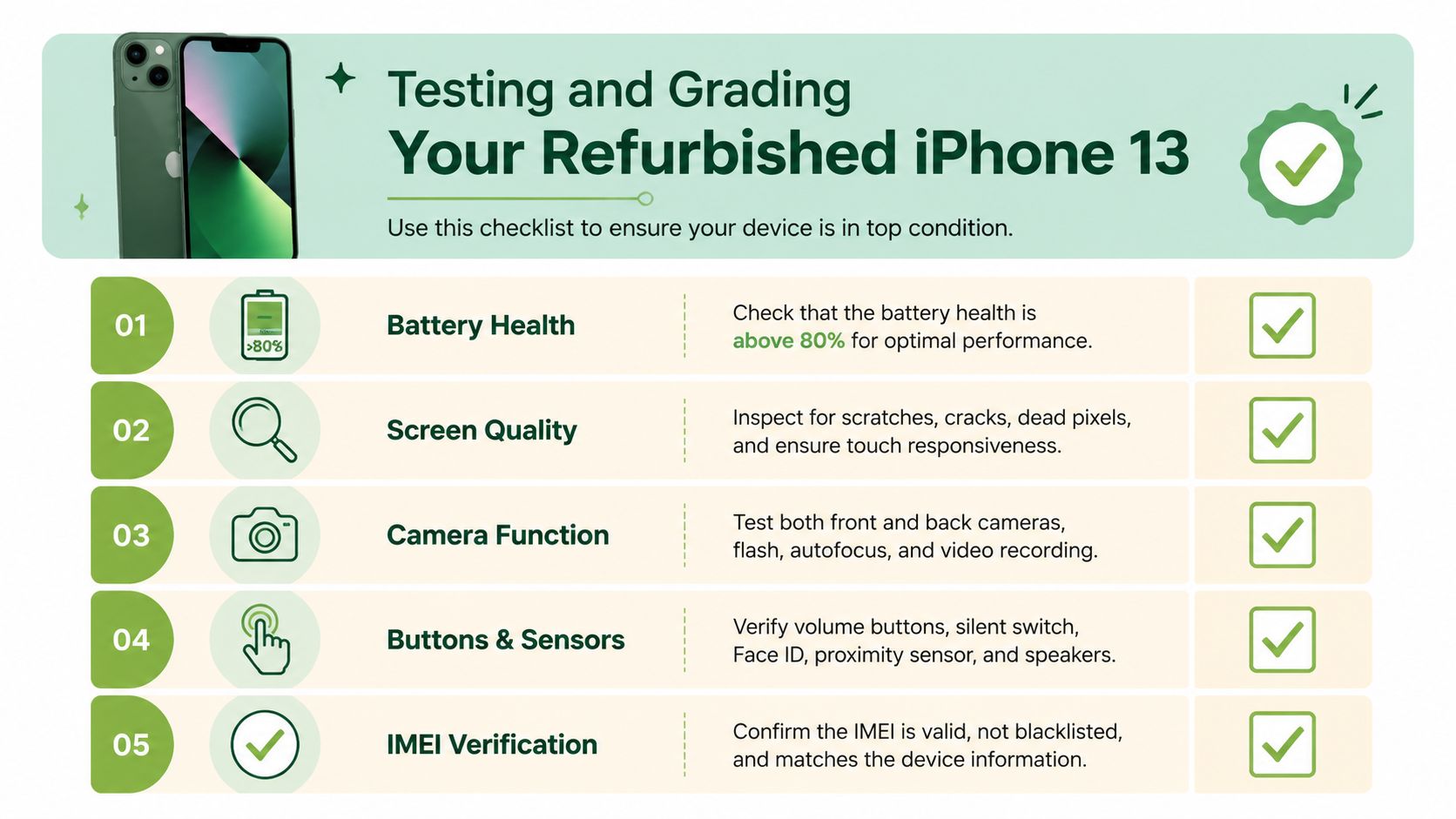
Ask for the IMEI clean-status confirmation, a written test report, and a battery report. Be careful with the phrase “fresh battery cycle count”. Sellers may not be able to provide a reliable cycle count for every replacement scenario, so ask how the figure was obtained rather than accepting a screenshot without context.
Warranty and Certification You Should Insist On
Warranty language is where many attractive listings become less attractive. A refurbished iPhone 13 can come through Apple's own certified programme, a structured local reseller, or an informal marketplace seller. Those routes don't offer the same accountability.
Apple Singapore states that its certified refurbished iOS devices receive a new battery and outer shell, and each Apple Certified Refurbished product includes a standard one-year limited warranty. That's the cleanest option for buyers who prioritise factory-backed presentation and coverage, although the price can be higher than independent refurbished stock.
A local graded reseller may offer stronger value if its warranty is written clearly. Check whether it covers battery failure, screen faults, motherboard issues, and other functional defects. Also check how the seller handles assessment, repair, replacement, and turnaround. A 12-month functional warranty sounds useful only if you know what “functional” includes.
Compare the coverage before comparing the price
| Tier | Coverage Scope | Duration | Repair SLA | Paperwork Required |
|---|---|---|---|---|
| Apple Certified Refurbished | Apple-backed limited warranty for eligible defects, with a new battery and outer shell | One year | Follow Apple's service process | Apple invoice, serial record, warranty confirmation |
| Structured local reseller | Defined functional coverage, depending on the seller's written terms | Varies by listing | Must be stated in writing | Invoice, warranty card, IMEI and battery report |
| Informal marketplace seller | Usually limited to whatever the individual promises | Varies or unclear | Often undocumented | Written agreement, seller identity, device details |
A seller on Carousell, Facebook Marketplace, or Telegram might own a good phone. That still doesn't create a reliable warranty. “I'll help if anything happens” isn't the same as a written claim process.
Before payment, match the serial number and IMEI on the invoice, request the warranty card, save the listing, and ask which events void coverage. Common exclusions include liquid damage, unauthorised repairs, physical impact, and jailbroken software. If the seller won't put the terms in writing, walk away.
Real Refurbished iPhone 13 Prices and Where the Savings Come From
Singapore pricing makes the iPhone 13 interesting because the model spans 128GB, 256GB, and 512GB configurations. Local used-device listings include an iPhone 13 512GB at S$408 and an iPhone 13 Pro 128GB at S$448, with listed battery-health examples of 100% and 93% on individual devices, as shown in Singapore used iPhone listings. Those are useful market reference points, but they aren't a universal price list.
I won't pretend there's one honest fixed price for every grade. Refurbished stock changes with storage, colour, battery condition, repair history, included accessories, warranty length, and seller overhead. A phone with a clean report and meaningful coverage can be better value than a cheaper unit with unknown internals.
A practical price-reading framework
| Storage | Pristine (SGD) | Mint (SGD) | Satisfactory (SGD) | Savings vs New (%) |
|---|---|---|---|---|
| 128GB | Ask for current listing | Ask for current listing | Ask for current listing | Compare live prices |
| 256GB | Ask for current listing | Ask for current listing | Ask for current listing | Compare live prices |
| 512GB | Ask for current listing | Ask for current listing | Ask for current listing | Compare live prices |
Use the Singapore mobile price list to establish a current reference before you decide whether a listing is discounted. The verified local examples above show why a buyer shouldn't rely on a generic claim such as “save hundreds”.
The saving usually comes from depreciation already absorbed by the first owner, lower retail overhead, simpler packaging, and cosmetic wear. A Satisfactory phone can be excellent for someone who uses a case and cares more about battery and function than a spotless frame. A Pristine unit should command more because the seller has to source or restore a cleaner device.
Storage changes the calculation too. The 256GB version gives heavier users more breathing room and can remain easier to resell than 128GB, while 512GB may suit people who keep large photo and video libraries. Don't pay the 512GB premium unless you'll use the capacity.
Inspecting Your Refurbished iPhone 13 Before You Commit
The first ten minutes with the phone should feel like a calm inspection, not an awkward formality. A legitimate seller should give you time to verify the device, and a private seller who refuses a basic check is giving you useful information.
Start with Apple's coverage checker at checkcoverage.apple.com. Confirm the model and coverage details, then make sure the device isn't tied to another person's account. Serial-number verification is helpful, but it isn't a substitute for checking the phone itself.
Run these checks in order
- Match identifiers. Compare the IMEI in Settings with the number shown on the SIM tray and the seller's paperwork. Any mismatch is a walk-away signal.
- Read the battery screen. Open Settings, then Battery, then Battery Health. On a graded unit, I'd ask for a discount or refuse if maximum capacity is below 85%, especially if the listing says Pristine.
- Inspect under angled light. Look for screen abrasions, bezel marks, dents, camera-lens scuffs, charging-port corrosion, and damaged speaker grilles.
- Test the essentials. Take photos with all four camera views, record audio, enrol Face ID, play sound through the speakers, and press every button.
- Connect locally. Pair Bluetooth, join Wi-Fi, and insert a SIM from a Singapore carrier to confirm registration and mobile service.
For a more detailed pre-payment routine, keep this refurbished phone deal inspection guide open on your phone while you shop.
Missing Activation Lock removal, tampered seals, unexplained battery readings, or a seller who won't allow an in-person test are enough reasons to leave.
A factory reset should happen before you take ownership, but don't confuse reset instructions with a complete chain of custody. Ask who handled the previous owner's data, whether the device went through a certified sanitisation process, and what evidence the seller can provide.
Trade-In, Buyback and Upcycle Pathways in Singapore
Buying refurbished works best when you also know how your current phone will leave your hands. Singapore offers several routes, and the right one depends on whether you want convenience, cash, or the highest chance of reuse.
A carrier or authorised retailer may offer trade-in credit against a new purchase. A buyback specialist may provide a cash quote after checking model, storage, battery condition, screen damage, and functionality. An upcycle route makes sense when repair is viable or when parts can help restore another device.
Choose the pathway that fits the device
- Carrier trade-in: Convenient when you're already upgrading, but compare the credit with independent offers before accepting it.
- Shop buyback: Useful when you want a direct quote and a defined handover process. Ask when payment is made and whether the quoted amount changes after inspection.
- Repair and reuse: Sensible for a working phone with a tired battery or fixable fault. Repair keeps more of the original device in service.
- Parts recovery: A damaged phone may still contain usable components. A responsible operator can harvest parts rather than send the whole unit straight to disposal.
For a clear overview of accepted devices, review what Apple takes back for recycling. The important point is data protection. Singapore's National Environment Agency advises consumers to back up personal content and factory reset devices before recycling, while data-bearing devices sent to licensed recyclers must undergo data sanitisation and physical dismantling. Ask who is licensed, how the wipe is performed, and whether a certificate is available.
Singapore generates about 60,000 tonnes of e-waste annually, while more than 34,000 tonnes were collected over the past four years, according to reported Singapore e-waste collection figures. Reuse is preferable when a phone can safely serve another owner.
A structured ReLoved-style process can return a phone to the market after data wiping, repair, testing, and re-grading. A documented Safe Data process protects personal information, while Save Data support can attempt recovery when a damaged device contains valuable photos or files. You can explore the practical phone trade-in process in Singapore before deciding whether to sell, repair, or recycle.
Choosing the Right Refurbished Path for You
The best refurbished iPhone 13 isn't the cheapest listing. It's the one whose condition, battery, paperwork, and warranty match the way you'll use it.
If this is your first refurbished phone
Buy through a certified or highly structured channel with a written warranty and a clear return process. Pay more for documentation if necessary. Your first purchase should teach you how refurbished buying works without forcing you to solve a dispute over missing parts or uncertain battery health.
Check the invoice, serial number, IMEI, condition grade, battery statement, warranty duration, exclusions, and return instructions before paying. If the seller can't explain the refurbishment process in plain language, choose another seller.
If you're buying a gift
Choose Pristine or a carefully presented Mint unit. Cosmetic condition matters more when someone else opens the box, so inspect the screen, frame, camera lenses, and packaging rather than focusing only on storage.
Retailer credibility matters here too. A gift recipient shouldn't have to chase an unknown marketplace seller if Face ID fails or the battery doesn't match the listing. Get a proper invoice and ensure the warranty can be used by the recipient.
If you're upgrading on a budget
A Satisfactory grade can be the smart pick. Accept visible wear, but don't accept unclear function or a missing warranty. Battery health should clear the seller's stated threshold, and you should still run the inspection checklist before completing the purchase.
The sustainability case is local, not abstract. Singapore generates about 60,000 tonnes of e-waste each year, and secure reuse gives a working phone another owner before disposal becomes necessary, as reported by The Straits Times. Refurbishment won't solve the entire e-waste problem, but it does make responsible consumption convenient.
For anyone retiring an old device, the next step is a documented handover. myhalo offers refurbished and ReLoved devices, repair, buyback, trade-in, secure data handling, and parts recovery through online services and physical counters in Singapore. It's a sensible route when you want one provider to handle the device's next chapter rather than leaving it in a drawer.
Ready to feel lighter and do good? Let's clear out those old devices together through myhalo's Declutter your e-clutter programme, with convenient support for trade-in, secure data handling, repair, and responsible reuse. Visit myhalo to explore refurbished iPhone 13 options and start your device's next chapter safely.