
Your current phone still works. Mostly.
The battery drops faster than it used to. Apps take that little bit longer to open. The camera is fine, but everything feels tired. So you start looking for a replacement, and then the price of a brand-new model snaps you back to reality. On top of that, buying from a random marketplace seller can feel risky. You’re not just wondering about scratches. You’re wondering if the battery is already worn out, and whether someone else’s data was wiped.
That’s why more people in Singapore are taking a closer look at refurbished phones. It’s a practical middle path between overspending on new and gambling on second-hand. Done properly, a certified refurbished phone can be a smart upgrade for your daily life, a safer choice for your privacy, and a more responsible step towards a zero e-waste world.
If you’ve ever felt torn between saving money and buying with peace of mind, you’re in the right place.
Table of Contents
- Welcome to the Joy of a Smarter Phone Upgrade
- Decoding Refurbished What Do Grades and Certifications Mean
- Your Data Stays Yours Our Safe Data Guarantee
- Finding a Great Deal Without Getting a Dud
- Your Checklist for Buying Refurbished Phones in Singapore
- Join the Circle Closing the Loop on E-Waste
- Your Questions Answered
Welcome to the Joy of a Smarter Phone Upgrade
A lot of phone upgrades start the same way. You open a few tabs, compare a few shiny models, then close them after seeing the total cost. That’s usually the moment refurbished phones Singapore shoppers start to make a lot more sense.
A certified refurbished phone isn’t a sad backup plan. It’s often the more balanced choice. You still get a device that’s been checked, tested, and prepared for another full round of daily use, but without the full financial sting of buying new. You also keep a perfectly usable device in circulation instead of pushing demand for another one to be manufactured.
Singapore’s interest in this space isn’t small. The refurbished mobile phones market in Singapore is valued at approximately USD 69.5 billion and is projected to grow to USD 132.5 billion, according to this Singapore refurbished mobile phones market outlook. That same outlook connects the growth to Singapore’s push towards zero e-waste outcomes and notes support from transparent platforms with AI-backed pricing and ISO-aligned data handling.
That matters because it shows something bigger than a shopping trend. People aren’t only hunting for lower prices. They’re choosing a more organised way to upgrade.
Buying refurbished can be a money decision, a convenience decision, and an environmental decision at the same time.
If you care about making your tech choices a little lighter on the planet, this guide on protecting Earth by buying second-hand or refurbished devices is a useful companion read.
The heart of it is simple. You shouldn’t have to choose between affordability and confidence. You can look for a phone that’s ready for everyday life, handled responsibly, and part of a wider zero e-waste spirit that makes doing good feel easy, not complicated.
Decoding Refurbished What Do Grades and Certifications Mean
Some confusion starts with the word itself. “Refurbished” gets used loosely, and that’s where buyers get stuck. One seller means professionally tested. Another seller means “it turns on”.
Why refurbished is not the same as used
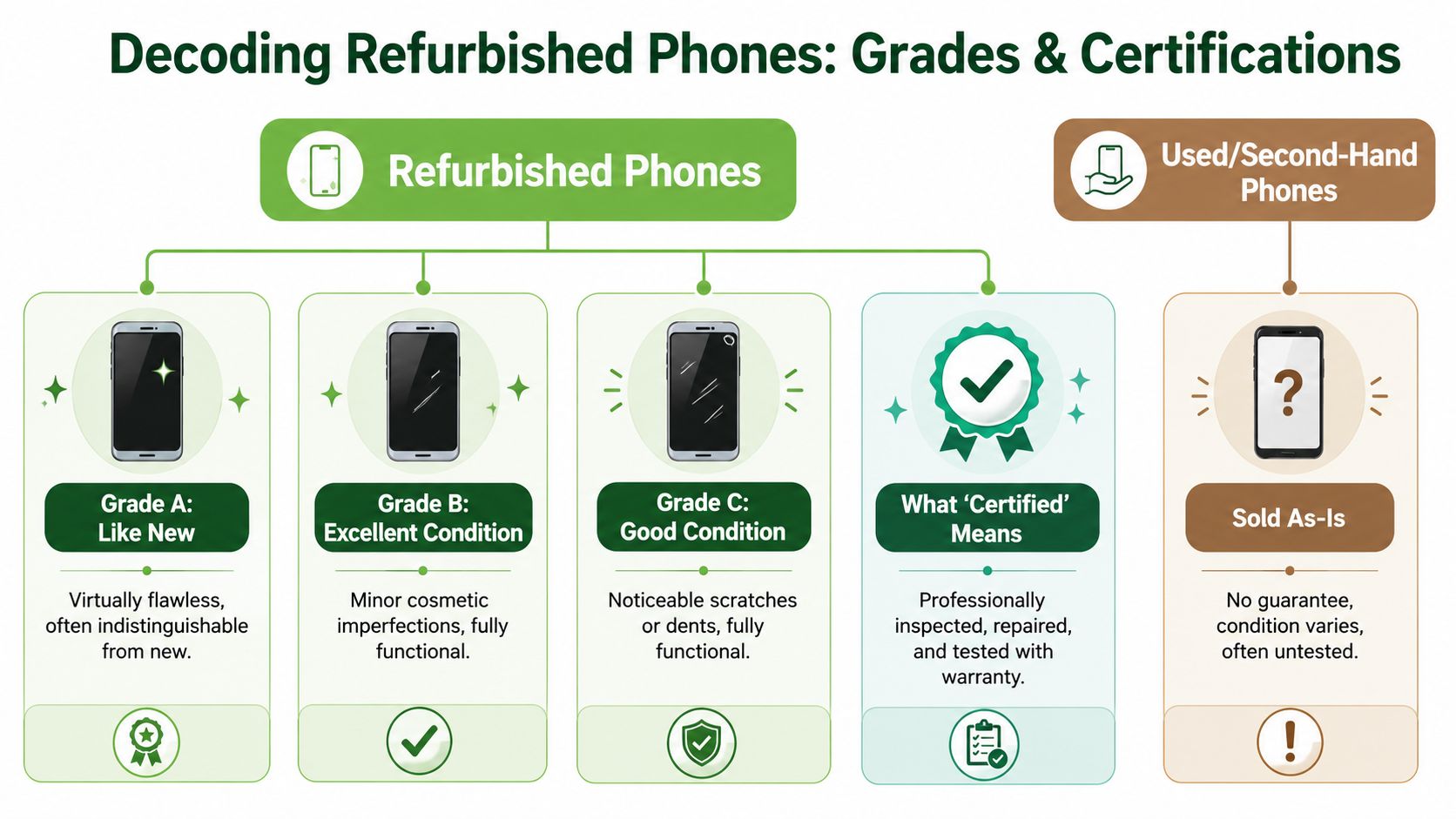
A used or second-hand phone is usually sold in its current condition. That could be fine, or it could hide battery wear, weak speakers, loose ports, or previous repairs that weren’t done well.
A refurbished phone should mean the device has been inspected and prepared for resale. In Singapore, professionally certified devices can undergo ISO-aligned diagnostics that include battery health verification, component stress testing, and data sanitisation. Quality control can also include replacing degraded batteries with ISO-compliant ones and using AI-driven diagnostics, while prices can be 30 to 60% lower than new units.
That last part is why certification matters. A lower price is nice. A lower price with a process behind it is much better.
For a deeper comparison, this guide on whether refurbished is better than used breaks down the buying logic clearly.
A simple grading guide
Most grading systems are really about cosmetics, not basic function. That’s an easy point to miss.
| Grade | Typical Condition | Best For |
|---|---|---|
| Grade A | Very clean appearance with little to no visible wear | Buyers who want a near-new look |
| Grade B | Minor cosmetic marks such as light scratches | Buyers who care more about value than perfection |
| Grade C | Noticeable wear such as visible scratches or small dents | Buyers focused on function first |
A Grade C phone can still be fully usable. A Grade A phone can still have battery questions if the seller only talks about looks. That’s why grade and certification shouldn’t be treated as the same thing.
What certification should include
A strong certification process should tell you more than “tested okay”.
Look for signs that the seller checks the parts that affect your day:
- Battery health: Not just whether it charges, but whether capacity is still fit for regular use.
- Component testing: Cameras, microphones, speakers, charging port, face or fingerprint recognition, and network connection.
- Data sanitisation: Proper erasure of previous user data, not just a quick reset.
- Repair quality: If something was replaced, the seller should be able to explain how and to what standard.
Practical rule: A cosmetic grade tells you how the phone looks. Certification tells you how carefully someone prepared it.
That’s the filter to keep in your head while shopping. The outside matters. The inside matters more.
Your Data Stays Yours Our Safe Data Guarantee
The quietest worry in the refurbished market is often the biggest one. The direct statement, “I’m afraid of residual data exposure,” is less common than the simple request, “I just want to be sure it’s safe.”
That’s the right instinct.
Why data wiping matters more than most buyers realise
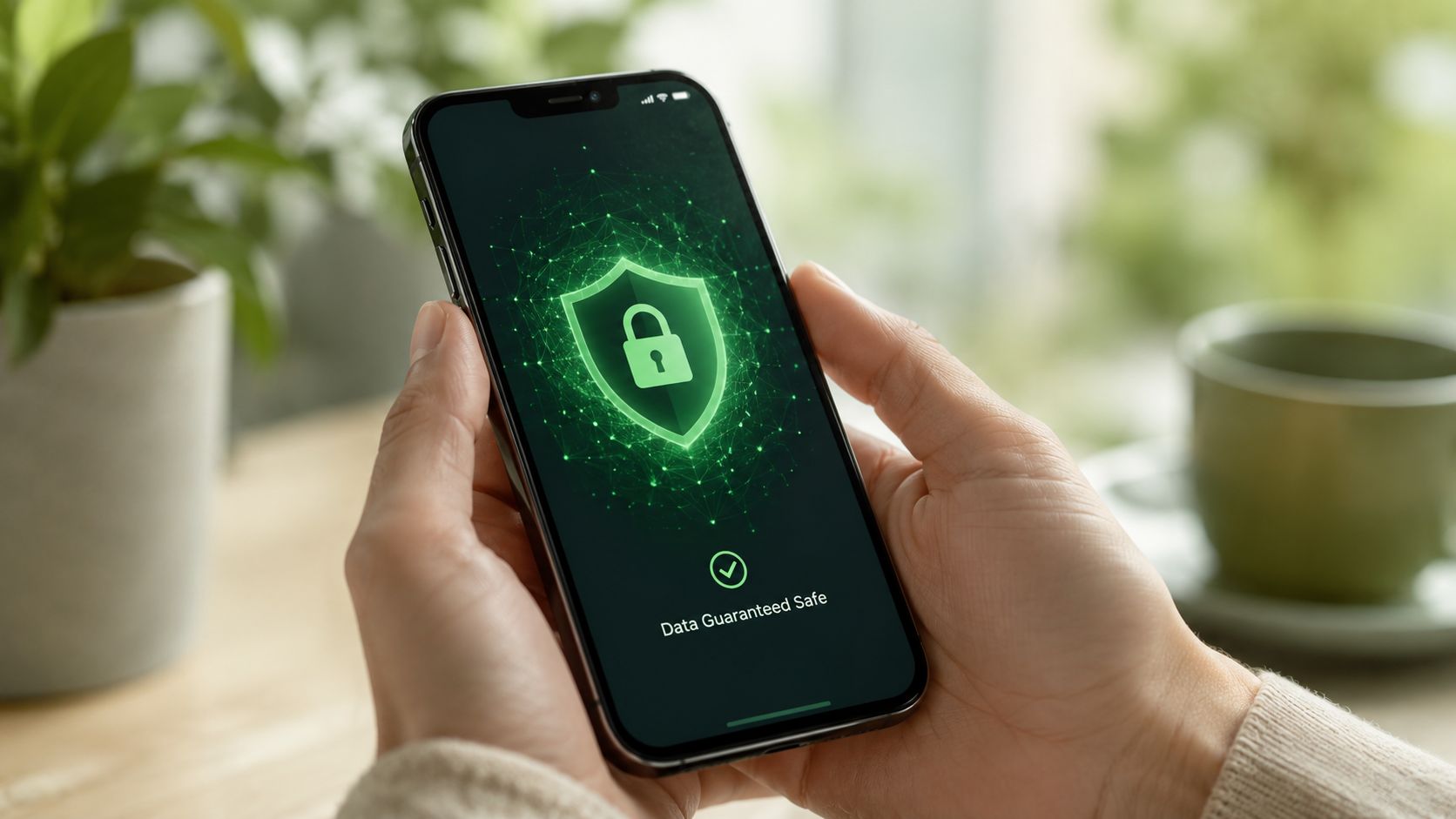
A phone carries photos, saved passwords, banking app access, chat history, email accounts, documents, and identity details. If a seller only does a basic reset, that may not give a buyer much confidence. The problem in Singapore is that many listings focus on condition, accessories, and warranty, while saying very little about how previous data was removed.
A key gap in the local market is transparency around data sanitisation. Existing content often focuses on physical inspection, while buyers trust manufacturer-certified programmes partly because they assure customers that devices are wiped clean. That same gap is highlighted in this Atome Singapore article about buying Apple refurbished products, which supports the concern that non-manufacturer channels rarely spell out equivalent verification clearly.
That’s not just a technical detail. It’s a trust issue.
What a proper sanitisation process looks like
A proper process should go beyond “factory reset completed”. Buyers should look for language that points to structured erasure, documented handling, and standards-based workflows. If a seller can explain that clearly, it usually means the process is real and repeatable.
A privacy-first approach should include:
- Secure erasure workflow: The device is processed with a method designed to remove prior user data completely.
- Handling discipline: The phone isn’t passed around casually during intake, repair, testing, and resale.
- Clear communication: The seller can explain what sanitisation means in plain language.
- Proof on request: For some device programmes, certificates or documented processes may be available.
If you want a practical look at how secure wiping fits into responsible reuse, this article on wiping out your data before recycling your device is worth reading.
When a seller is vague about data erasure, treat that as missing information, not a small detail.
This is where the Safe data idea matters so much. It turns an invisible process into a visible promise. You shouldn’t have to guess whether someone else’s digital life is still lingering on the device in your hand.
Finding a Great Deal Without Getting a Dud
A cheap listing can still be a poor deal. A slightly higher listing can be the safer buy if it includes proper checks, a usable warranty, and a fair exchange policy.
Price is only one part of the deal
A common first question is, “How much am I saving?” Fair question. But the sharper question is, “What exactly am I getting for that price?”
When you compare offers, look at the full package:
- Device condition: Is the grade described clearly, or is it just “good condition” with no detail?
- Battery transparency: Does the seller say anything useful about battery health?
- Testing scope: Are functions like camera, charging, and connectivity covered?
- After-sales support: If something feels off after two days, what happens next?
This is similar to how businesses think about pricing. A number only makes sense when you understand what sits behind it. That broader logic is explained well in this piece on understanding B2B pricing strategy, and the same principle works for consumers buying tech.
The warranty and exchange window test
A seller’s warranty policy tells you how much confidence they have in their own process. It also tells you how much room you have to test the phone in real life, not just under store lights.
In Singapore, purchases of certified refurbished phones from myhalo include a 30-day warranty and a 14-day exchange guarantee for Certified ReLoved and Certified EOL devices, according to the brand-new mobiles collection details. That kind of window gives buyers time to check charging behaviour, call quality, camera performance, app stability, and whether the phone fits their routine.
A short return policy can create pressure. You rush through the setup, miss a problem, and only notice it after the support window closes.
A refurbished phone should be testable in normal life. Home Wi-Fi, your charger, your SIM, your commute, your apps.
How to compare offers without getting distracted
Here’s a simple way to judge value without getting pulled in by the lowest sticker price:
-
Start with total protection
Check the warranty length and whether there’s an exchange option. A phone is easier to trust when the seller gives you room to confirm it behaves normally. -
Then review the quality signals
Read the product description slowly. Useful listings mention grading, battery checks, and testing standards. Weak listings lean on words like “mint” and “perfect” without process details. -
Only then compare price
Once two offers look comparable on protection and preparation, price becomes meaningful.
This is the difference between a bargain and a gamble. A strong deal saves money and reduces hassle. A weak deal only looks good at checkout.
Your Checklist for Buying Refurbished Phones in Singapore
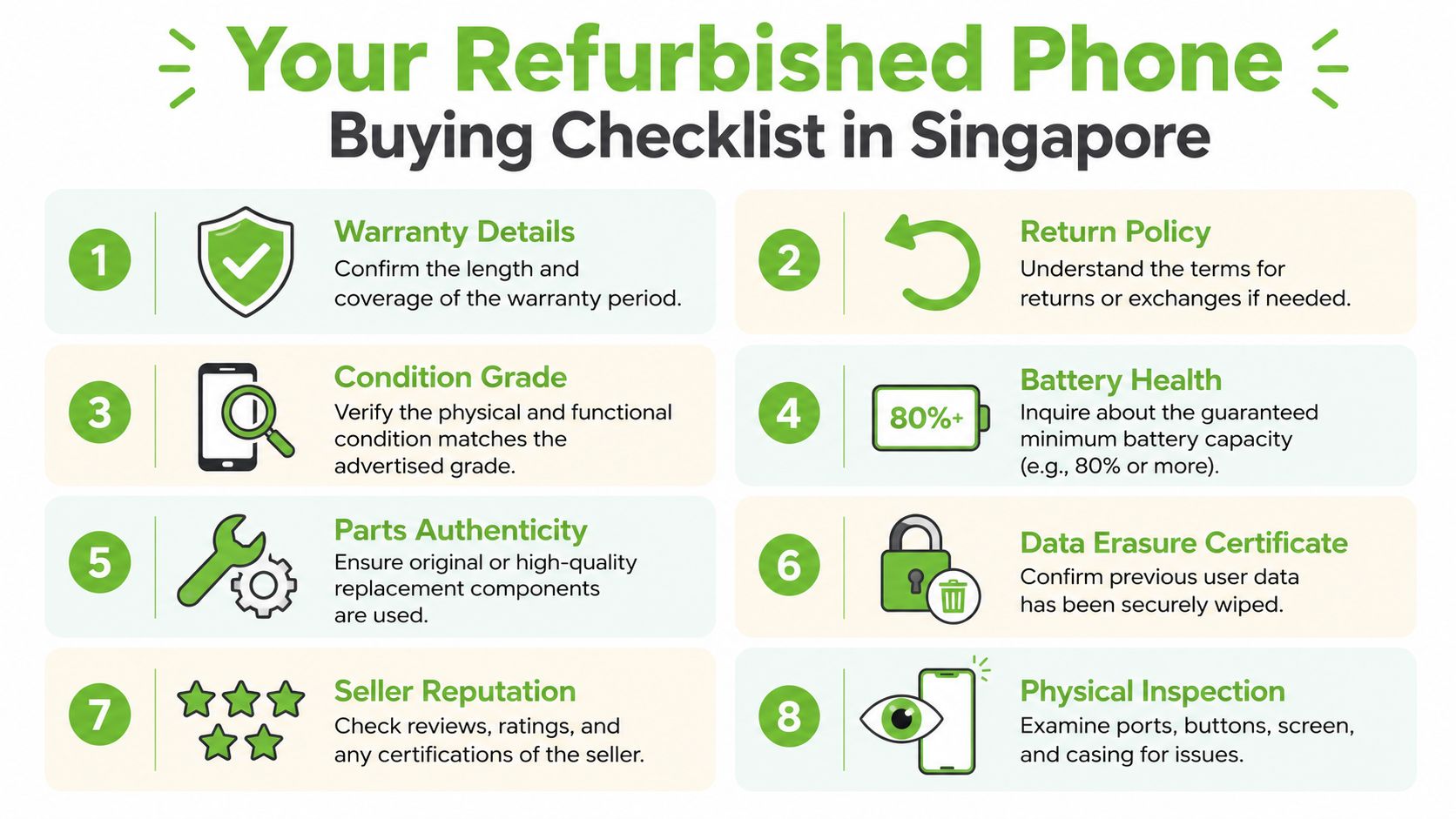
When you’re browsing refurbished phones Singapore listings, it helps to think like your own quality inspector. You don’t need a lab. You just need a calm checklist and a willingness to ask direct questions.
Check the seller before you check the phone
A reliable seller usually gives themselves away in the details. Before you even look at a specific device, look at the business behind it.
Use this shortlist:
- Read recent reviews: Look for comments about warranty support, device condition matching the listing, and how issues were handled.
- Confirm there’s a real location: A physical address gives you more confidence if you need help later. In Singapore, some buyers prefer stores they can visit at places like Bugis Junction.
- Look for process language: Good sellers explain grading, testing, and sanitisation in plain English.
- Check policy pages properly: Don’t stop at “warranty available”. Read what the warranty covers and how exchanges work.
- Ask one specific question: Battery health, data sanitisation, or parts replacement. The answer will tell you a lot about the seller’s seriousness.
The savings can be significant too. The Singapore platform offers up to 70% cost savings on refurbished IT devices compared to new equivalents, as stated on the myhalo shop. Savings are great, but this checklist helps you make sure the lower price still comes with quality.
Inspect the phone like a calm, picky buyer
Once the seller passes your first check, inspect the phone itself. Don’t rush this part.
Here’s a buyer-friendly routine:
- Open Battery settings: If the phone shows battery health information, check it. If it doesn’t, ask what verification was done before sale.
- Test the charging port: Plug in a cable and make sure it fits properly and charges consistently.
- Press every button: Volume, power, mute switch if available. Buttons should feel responsive, not mushy or delayed.
- Check cameras front and back: Take photos, switch lenses if the model has them, and record a short video.
- Inspect the screen carefully: Look for discolouration, flicker, touch issues, or dead areas.
- Test audio both ways: Play a voice note, make a call if possible, and try speaker mode.
- Verify network status: Ask whether the phone is not network-restricted and suitable for local carrier use.
- Match grade to reality: A Grade B phone with heavy dents is a warning sign. The listing should match what you see.
Buyer mindset: Don’t inspect the phone like you’re trying to reject it. Inspect it like you want to trust it for the next few years.
That small shift helps. You stop focusing only on flaws and start checking whether the device is ready for real daily life.
Join the Circle Closing the Loop on E-Waste
Buying refurbished doesn’t end with one transaction. It changes how you think about the whole life of a device.
A phone can move through several useful chapters. First owner. Trade-in. Repair. Refurbishment. New owner. Responsible parts recovery at end of life. That loop keeps useful tech in action for longer and keeps more devices out of drawers, bins, and waste streams.
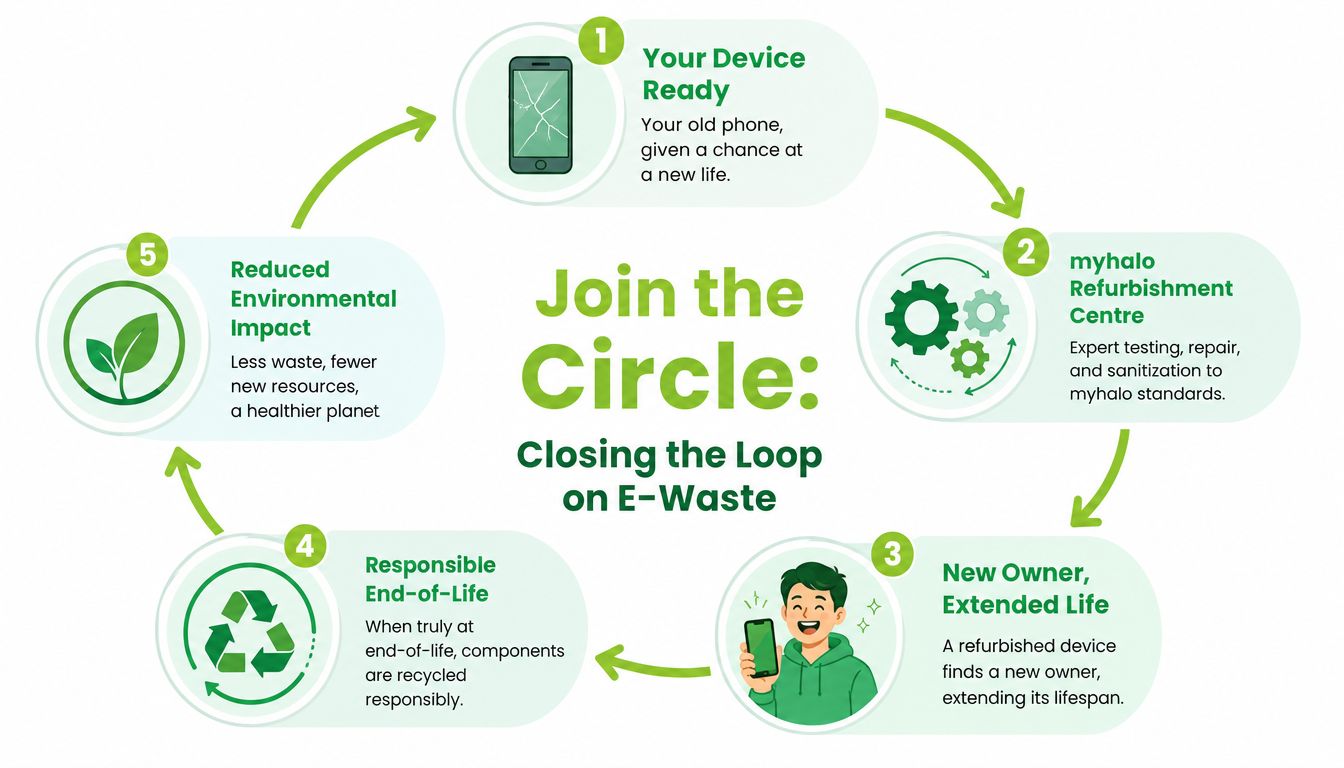
Your old phone still has a role to play
Many people buy a replacement phone and then leave the old one at home “just in case”. Months later, it’s still in a drawer with an old case and a tangled cable.
That’s exactly where e-clutter builds up.
A circular approach is more useful:
- Trade it in if it still has value: Someone else may be able to use it after refurbishment.
- Repair it if the issue is minor: A battery, charging port, or screen problem doesn’t always mean the phone is finished.
- Use it for parts if repair isn’t practical: One damaged phone can help revive another.
- Recycle it responsibly at true end of life: That’s the final step, not the first one.
If you want to explore the wider local picture, this guide to choosing a recycle company in Singapore gives useful context.
What a circular tech habit looks like
The zero e-waste mindset isn’t about perfection. It’s about making better default choices, more often.
That can look like this:
- Buy with a longer view: Choose a phone that suits your actual needs instead of chasing the newest release.
- Take care of what you own: Use a case, protect the screen, and replace parts early when needed.
- Pass devices on responsibly: Sell, trade in, or refurbish instead of storing unused tech indefinitely.
- Protect your privacy while doing it: Responsible reuse should always include secure handling of your data.
The myhalo community spirit is a natural fit. The goal is a zero e-waste world that feels accessible, exciting, and stress-free. Convenient, safe, responsible. Not preachy. Not complicated. Just a better loop for the devices we already own.
Your Questions Answered
Some questions only show up right before checkout. These are the ones I hear most often.
Can refurbished phones work well with Singapore telcos
Yes, if the phone is not carrier-locked and supports the network bands your carrier uses. Ask the seller to confirm compatibility with local carriers and whether the device has any network lock. That’s a simple question, and a good seller should answer it directly.
What should I ask about warranty claims in Singapore
Ask where you go if something goes wrong. Is there a physical service point, a mail-in process, or both? Also ask what counts as a warranty issue, how exchanges are handled, and whether accessories are included in any claim process.
Is a refurbished phone suitable for daily heavy use
It can be, especially if battery health has been checked properly and the device has gone through professional functional testing. Heavy users should pay extra attention to battery condition, charging stability, screen quality, and heat during setup and app downloads.
If a seller can explain their battery verification and data sanitisation clearly, you’re already asking the right questions.
Ready to upgrade more wisely and keep good tech in use for longer? Explore myhalo if you want a practical path into certified resale, trade-in, repair, and secure device handling that supports a zero e-waste lifestyle.