
You find an old phone behind a stack of receipts, a laptop that now refuses to hold a charge, and a power bank you can't quite remember buying. The sensible part of you wants to clear the drawer. The cautious part wonders whether the battery inside could leak, swell, or cause a fire, while another worry asks whether your photos and personal files are still recoverable.
That hesitation is completely understandable. A lithium ion battery can be safe to use, repair, reuse, or recycle, but the right choice depends on its condition. This guide will help you recognise the difference between ordinary ageing and genuine danger, handle old batteries safely in Singapore, and choose a sensible path from repair to responsible recovery. The aim is simple: less clutter, less anxiety, and a practical contribution to a zero e-waste lifestyle.
Table of Contents
- The Battery in Your Drawer Is Telling a Story
- How a Lithium Ion Battery Actually Works
- Why Every Battery Ages and How to Read the Signs
- When a Battery Becomes a Safety Concern
- Storage and Transport Rules That Actually Make Sense
- From Repair to Recycling Through to a Second Life
- A Caring Next Step With myhalo
The Battery in Your Drawer Is Telling a Story
You find an old phone behind receipts, a laptop that no longer holds a charge, or a power bank you barely remember buying. Each device carries two separate concerns: personal information you may want to protect and a battery that may have aged while sitting unused.
Start with the battery's condition. A phone that works normally may be suitable for assessment, repair, or certified reuse. A battery that is hot, swollen, leaking, cracked, or producing an unusual smell needs a different response. Stop using it, keep it away from charging, and avoid pressing, opening, or testing it yourself.
Singapore's e-waste challenge extends well beyond one household drawer. The country generates approximately 60,000 tonnes of e-waste annually, while only about 6% was recycled at the time of the cited policy discussion, according to Singapore's Ministry of Sustainability and the Environment. Lithium ion batteries contain recoverable lithium, cobalt, nickel, copper, and aluminium. Controlled recovery can return these materials to use and reduce the risks associated with improper disposal.
You do not need to identify the battery's chemistry at home. Check its condition, stop using anything that looks unsafe, protect your data, and choose a suitable repair or collection route.
A decluttering service can collect unused devices from your home or office, so the first step needs no technical knowledge. A data-safety service can help address privacy concerns before a device leaves your hands. Data recovery matters when a damaged phone or laptop holds irreplaceable photos or important files. Used together, these options turn a stressful drawer-clearing task into a practical process: assess the device, protect what matters, and send the battery or equipment to the right destination.
How a Lithium Ion Battery Actually Works
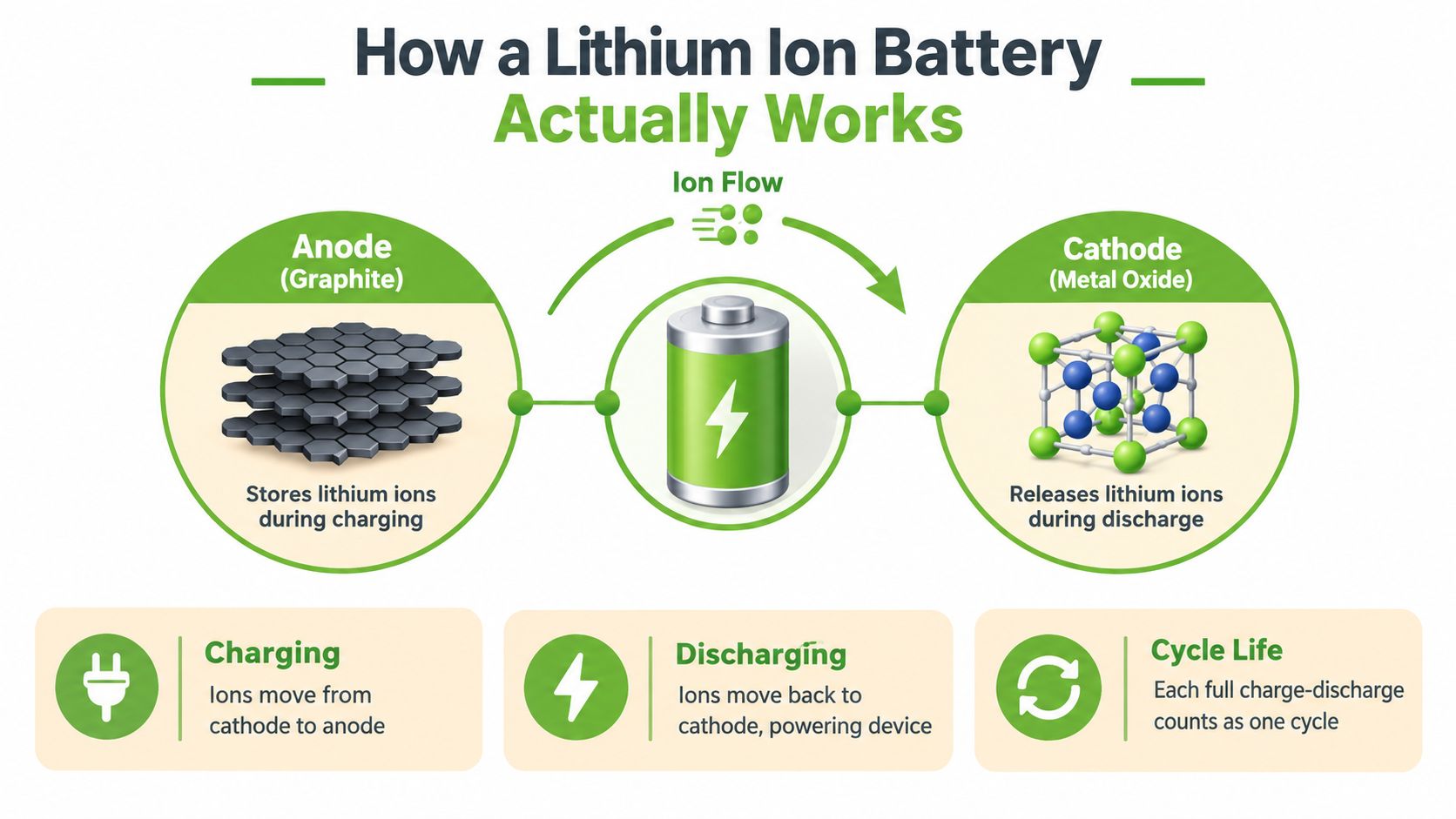
A lithium ion battery stores energy by moving tiny charged particles called lithium ions between two electrodes. One electrode is the anode, commonly made with graphite, and the other is the cathode, made from a lithium-containing metal oxide. An electrolyte between them allows ions to move while electrons travel through the device's external circuit.
A simple analogy is a water system. The battery is like a tank connected to a machine by pipes. During charging, energy pushes the “water” uphill into storage. During use, it flows back through the machine and does useful work. The ions move inside the battery, while electrons move through the phone, laptop, torch, or vehicle's circuit to power it.
Charging and discharging in plain language
- During charging, electrical energy drives lithium ions from the cathode towards the anode.
- During use, the ions move back towards the cathode. The electrons released through the external circuit power the device.
- During a cycle, some or all of that movement happens again. Repeated movement gradually changes the materials inside the cell.
This design made it possible to store substantial energy in a relatively compact package, which is why the same broad battery family appears in smartphones, laptops, power banks, electric vehicles, and stationary energy systems. The trade-off is sensitivity. Heat, physical damage, unsuitable charging equipment, and chemical ageing can affect performance and safety.
Cold conditions can make a battery seem weaker because chemical reactions slow down, so a device may temporarily show reduced performance. Heat is more concerning over time because it accelerates unwanted chemical reactions and places stress on the battery's protective systems. A drop can also damage internal layers even when the exterior looks fine, which is why later swelling or unusual heat deserves attention.
Singapore uses lithium ion batteries beyond personal gadgets. In October 2020, the country deployed a 2.4-megawatt/2.4-megawatt-hour lithium-ion energy-storage system at an SP Group substation through a partnership involving the Energy Market Authority and SP Group. It was described as Singapore's first utility-scale energy-storage system and could power more than 200 four-room HDB households for one day, as reported in the Energy Market Authority's media release. That project also tested battery performance and safety in Singapore's hot, humid, highly urbanised environment.
| Component | Plain-Language Role | Real-World Analogy |
|---|---|---|
| Anode, often graphite | Receives and stores lithium ions during charging | A tank that holds water |
| Cathode, a metal oxide | Releases and receives lithium ions as energy is used | The outlet side of the system |
| Electrolyte | Lets lithium ions move inside the cell | A pipe that allows water to flow |
| External circuit | Carries electrons through the device | The route that powers a motor or screen |
| Battery-management system | Monitors charging, temperature, and protection limits | A controller that prevents unsafe operation |
Understanding this movement makes battery ageing less mysterious. Each use adds chemical and physical stress, and the battery gradually becomes less able to hold and deliver energy. That isn't a moral failure or poor ownership. It's a normal part of the technology.
Why Every Battery Ages and How to Read the Signs
A laptop left in a cupboard can seem fine, then lose much of its runtime when you finally turn it on. Battery ageing continues during use and storage. Charging and discharging move materials inside the cell, while time, heat, and storage conditions gradually affect them even when the device is switched off. The result is a battery that holds less energy and delivers it less reliably.
Daily habits can add stress. Keeping a phone at full charge for long periods, playing demanding games while charging, leaving a device in a hot car, or storing a spare battery completely flat can all shorten its useful life. You do not need to monitor every percentage. Avoiding excessive heat and damaged charging equipment matters more than chasing a perfect charging routine.
The signs you can see in daily use
Ageing often appears first as a performance problem:
- Shorter runtime: A phone or laptop needs charging much sooner than before.
- Unexpected shutdowns: The device turns off although the display still shows charge remaining.
- Performance changes: It slows down, warms during ordinary tasks, or struggles under heavier workloads.
- Charging irregularities: Charging pauses, takes unusually long, or stops unless the cable is held at a particular angle.
- Physical changes: Changes such as a lifting back cover are covered in the safety section below.
Shorter runtime alone usually indicates degradation rather than an immediate emergency. Physical changes, leakage, unusual heat, or visible damage require a different response, so do not keep charging a device just because it still turns on.
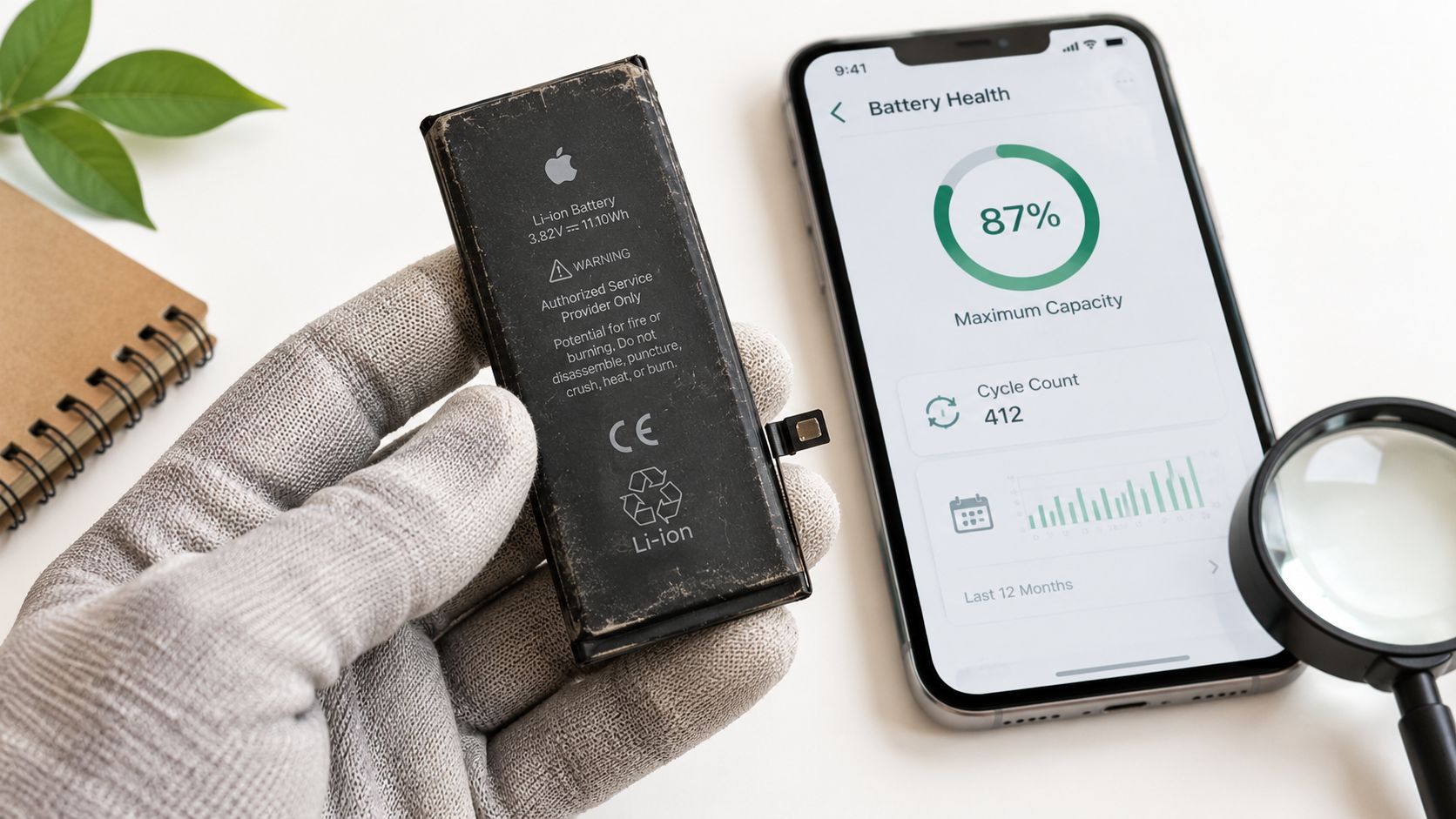
Replacing a worn battery is ordinary maintenance, like replacing a damaged charging port or worn keyboard. If the device remains useful, a qualified technician can assess whether replacement is sensible, whether another repair is needed, or whether the device should move to reuse or recycling.
For phones, laptops, and larger mobility batteries, battery replacement and recycling require attention to the battery's condition, not only the device's age. Larger packs may need more careful handling and should not be treated like general household waste.
Singapore's regulated system also gives households a clear route for end-of-life cells. The country's Extended Producer Responsibility framework, implemented in July 2021, requires regulated products including batteries to be collected and treated through licensed recycling facilities. Battery collection and recycling are part of Singapore's broader effort to keep these materials out of unsuitable waste streams.
If a phone or laptop has become frustratingly short-lived without the warning signs described in the next section, this practical guide to phone and tablet battery replacement in Singapore can help you compare the next steps. A careful assessment may preserve useful components and help you choose between replacement, repair, reuse, and recycling.
When a Battery Becomes a Safety Concern
An old battery isn't automatically a dangerous battery. The urgent boundary appears when internal damage causes heat, gas, swelling, leakage, or electrical instability. In severe cases, thermal runaway can create a self-accelerating chain of heating inside the cell, making the resulting fire difficult to extinguish.
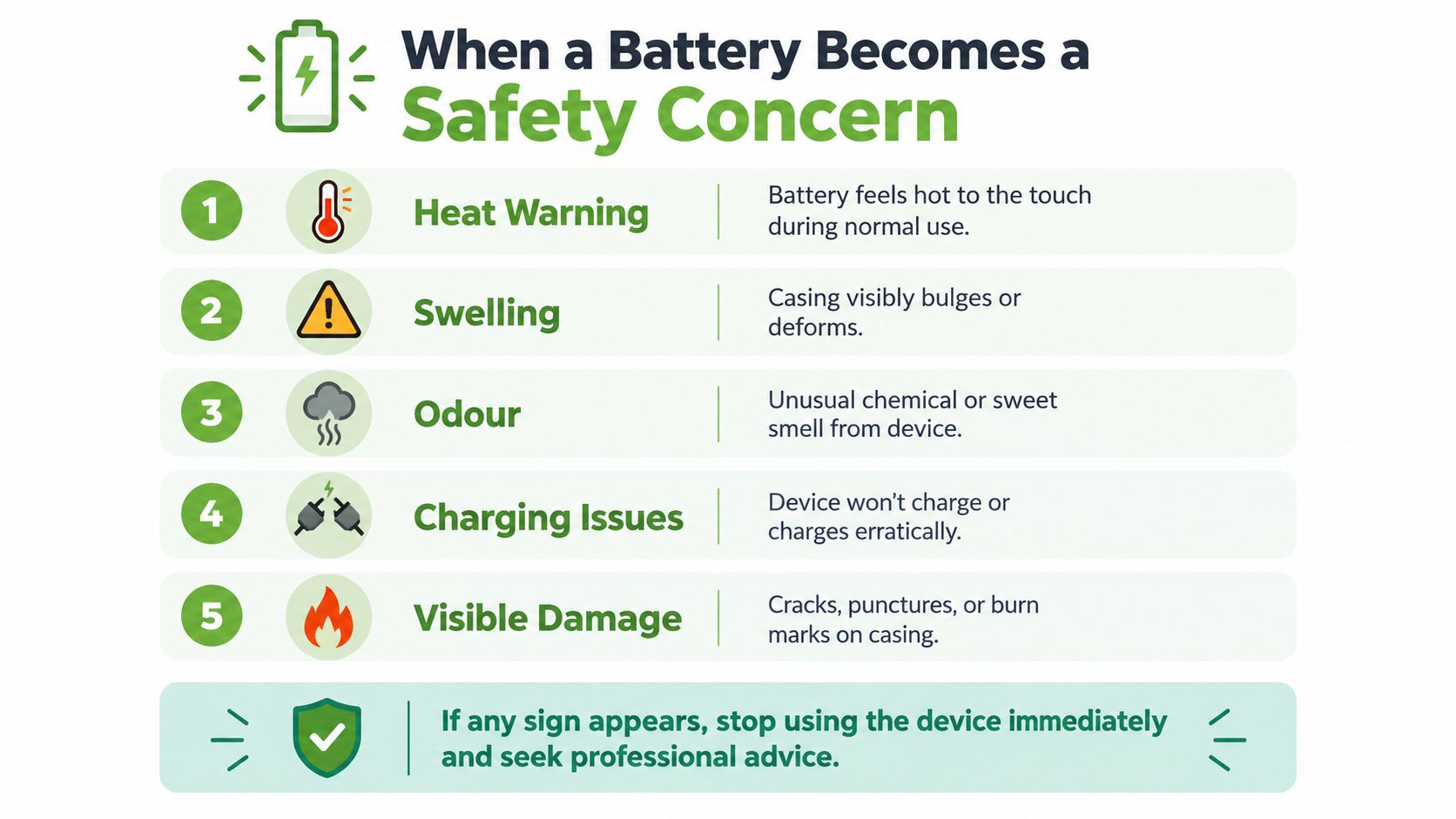
Stop using and charging a battery if you notice:
- Swelling: The phone's screen or back cover lifts, or a power bank bulges.
- Unusual heat: The battery becomes hot during ordinary use or while idle.
- Leakage: You see fluid, residue, or a damaged casing.
- Odd smells: A sweet or chemical odour comes from the device.
- Hissing, smoke, or popping: Treat these as urgent warning signs.
- Physical damage: Punctures, cracks, burn marks, or crushing suggest internal risk.
The Consumer Product Safety Office's lithium-ion battery guidance warns that damaged, swollen, leaking, or unusually hot batteries shouldn't be charged or used. Internal damage can create short circuits, thermal runaway, and fires that are difficult to extinguish.
If a battery is already smoking, burning, or producing intense heat, move away and contact emergency services. Don't puncture it, squeeze it, open the casing, or pour water into a device while trying to investigate. For a swollen but stable device, stop charging, keep people and flammable materials away, and seek professional guidance about isolation and collection.
A slightly degraded phone battery and a swollen e-bike pack shouldn't receive the same treatment. The first may be suitable for a planned replacement. The second may contain more stored energy and may have suffered physical or electrical damage, so it needs a specialist route rather than routine resale, disassembly, or a household recycling bin.
Singapore's tracked fire data reinforces the need for calm, practical handling. The Singapore Civil Defence Force reported that 4 of Singapore's 226 vehicle fires in 2025 involved EVs, while battery-related electrical faults were identified as the primary cause category for vehicle fires, according to the Ministry of Sustainability and the Environment's parliamentary reply. This does not mean lithium ion batteries are unsafe. It means damaged cells, incompatible equipment, and poor handling deserve respect.
Replacement parts also need scrutiny. A battery that fits physically may still have the wrong electrical characteristics, protection circuitry, or quality controls. For a clear explanation of why genuine laptop batteries matter, look for guidance that distinguishes a properly matched replacement from an unknown or modified pack.
If an iPhone's display is lifting or its body is visibly swelling, use this iPhone battery swelling guide for the next safe decision. Don't press the screen down, continue charging, or place the phone in a pocket or bag where heat and pressure can build.
Storage and Transport Rules That Actually Make Sense
Good storage is mostly about preventing heat, short circuits, pressure, and accidental charging. A spare battery should stay in a cool, dry place away from direct sunlight, heaters, and combustible clutter. Keep it in a protective container where metal objects can't touch its terminals.
Loose batteries in a handbag are a poor combination with keys, coins, clips, or other metal items. Contact across the terminals can create a short circuit, generating heat before you've noticed what happened. Original packaging, a separate pouch, or an appropriate battery case gives the terminals physical protection.
A practical home checklist
- Inspect first. Don't store a battery that is swollen, leaking, cracked, unusually hot, or badly damaged.
- Separate it. Keep batteries away from coins, keys, tools, paper, and other easily heated materials.
- Avoid extremes. Choose a cool, dry location rather than a hot car, window ledge, or damp storeroom.
- Protect terminals. Tape exposed terminals or wires before moving a battery for collection, using a method that doesn't damage the pack.
- Use the right route. Send rechargeable batteries through dedicated e-waste collection, an appointed operator's depot, or an arranged collection service.
Rechargeable batteries must not go into general waste or ordinary blue recycling bins. Singapore's public waste guidance warns that the single-stream recycling system can't sort them, and mechanical crushing at materials-recovery facilities can ignite batteries and contaminate an entire truckload. The Consumer Product Safety Office also advises taping terminals or exposed wires to suppress short-circuit current, while leaking cells should be isolated in leak-proof packaging.
| Situation | Do | Don't |
|---|---|---|
| A healthy spare battery | Keep it protected in a cool, dry place | Leave it loose beside keys or coins |
| A battery going for collection | Tape terminals and follow the collector's instructions | Put it into a blue recycling bin |
| A leaking battery | Isolate it in leak-proof packaging and seek dedicated collection | Handle it casually or place it with ordinary waste |
| A swollen or hot device | Stop charging and obtain professional guidance | Press the casing flat or continue using it |
| Returned business devices | Segregate batteries and record their condition | Stack unknown packs in a cardboard box |
Workplaces face a different scale of risk because many devices can add up to a substantial stored-energy load. Singapore's Fire Code addresses larger quantities through fire-rated compartments, limits on maximum stored energy within each compartment, higher-discharge-density sprinkler systems, and mechanical ventilation to disperse flammable gases, as described by the Ministry of Home Affairs.
That means an office managing returned laptops, trade-in stock, repair inventory, or power banks needs more than a shelf and a cardboard carton. Businesses should separate damaged items, control access, monitor storage conditions, and use an appropriate fire-safety design rather than improvising bulk storage.
Active-mobility batteries also need compatibility checks. Singapore's proposed requirements described by the Ministry of Transport would require sellers to display details such as compatible device models, voltage, and capacity, while targeting batteries advertised or sold for incompatible personal mobility devices, power-assisted bicycles, or mobility vehicles. A replacement pack isn't interchangeable just because its connector looks similar.
From Repair to Recycling Through to a Second Life
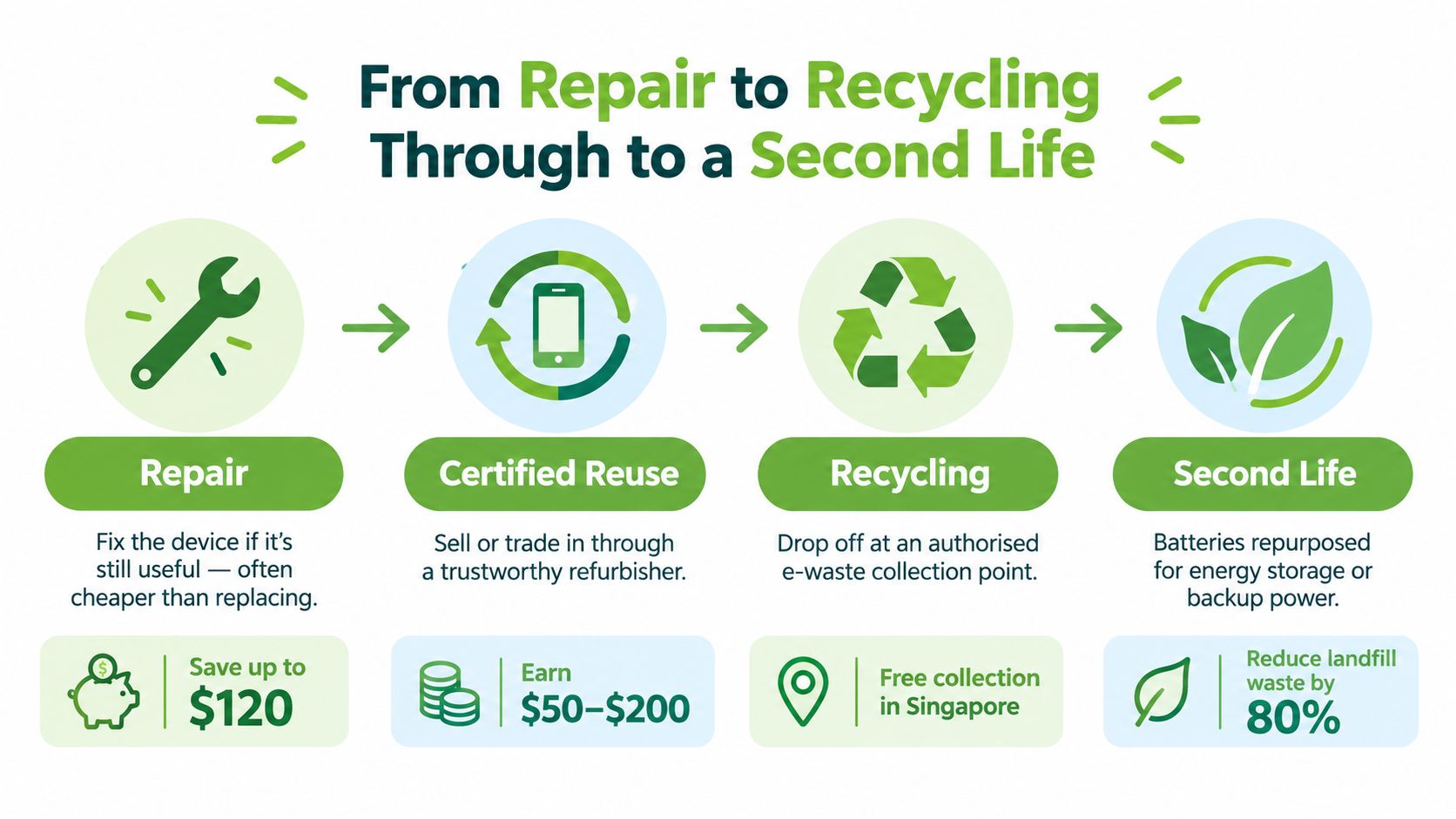
The most sustainable destination for a battery isn't always immediate recycling. If the device is safe and useful, repair can preserve the most value. If the device no longer suits its owner but remains functional, certified reuse can keep the whole product in service. Only after safe reuse and repair options are exhausted should material recovery become the main path.
Start with the highest-value safe option
- Repair: A slow but physically sound laptop may need a battery replacement, charging-port repair, or diagnostic check.
- Certified reuse: A working phone can be assessed, securely wiped, graded, and passed to another user.
- Second life: A suitable battery may be repurposed for backup or energy storage, but only after testing its capacity, internal resistance, thermal history, physical condition, chemistry, and battery-management system.
- Material recovery: A damaged, degraded, untraceable, or unsuitable pack should go to a qualified processor that can recover useful metals safely.
Singapore's TES-B facility illustrates what controlled recovery can achieve. It was designed to process 14 tonnes of lithium-ion batteries per day and had an annual recycling capacity of 5,000 tonnes. The plant can recover more than 90% of precious metals from spent lithium-ion batteries, while its extraction rate for lithium and cobalt is nearly 99%, producing feedstock that can return to new battery manufacturing, according to the Ministry of Sustainability and the Environment.
Reuse still needs evidence. A household can't safely assume that an old e-bike battery is suitable for a home energy project only because it still accepts a charge. A professional assessment must establish whether the battery's internal condition and protection systems support another use. If damage or missing history makes that uncertain, controlled recycling is the safer choice.
Singapore-based research also shows how recovery methods can evolve. NTU researchers reported a process using solvents derived from discarded fruit peels to extract cobalt, lithium, nickel, and manganese from spent batteries. An earlier NTU study recovered more than 90% by weight of precious metals from processed lithium-ion battery waste and used the recovered materials to make new batteries, as described by NTU's battery research coverage.
The practical decision is a cascade, not a slogan. Use it safely if it remains sound. Repair it if repair preserves useful life. Choose certified reuse when another person can use the complete device. Consider second life only with proper testing. Recycle through a licensed or designated route when damage, degradation, or uncertain history rules out the earlier options.
myhalo's Declutter your e-clutter, Repair and Rescue, ReLoved, and Upcycle pathways reflect these different outcomes, from extending a device's useful life to harvesting parts and directing unsuitable batteries towards responsible recovery. For household guidance on battery recycling in Singapore, check the collection route before you pack up a device.
A Caring Next Step With myhalo
Keeping old devices because you're worried about privacy or safety is normal. The next step can still be simple: check the condition, protect your data, repair what's safe to repair, and send damaged batteries through a designated e-waste route. NTU's work on recovering battery materials with fruit-peel-derived solvents shows that even spent cells can contribute to a circular supply chain, rather than becoming an afterthought.
For a safe replacement assessment, you can also explore battery replacement near you. myhalo connects Safe data, Save data, Declutter your e-clutter, and certified ReLoved options so your next decision can protect your privacy, your space, and Singapore's zero e-waste vision.
Ready to feel lighter and do good? myhalo can help you assess ageing devices, arrange battery-related repair, protect personal data, and move unsuitable electronics towards responsible recovery. Visit myhalo or drop in at Bugis Junction or Sim Lim Square to clear out those old devices together.