
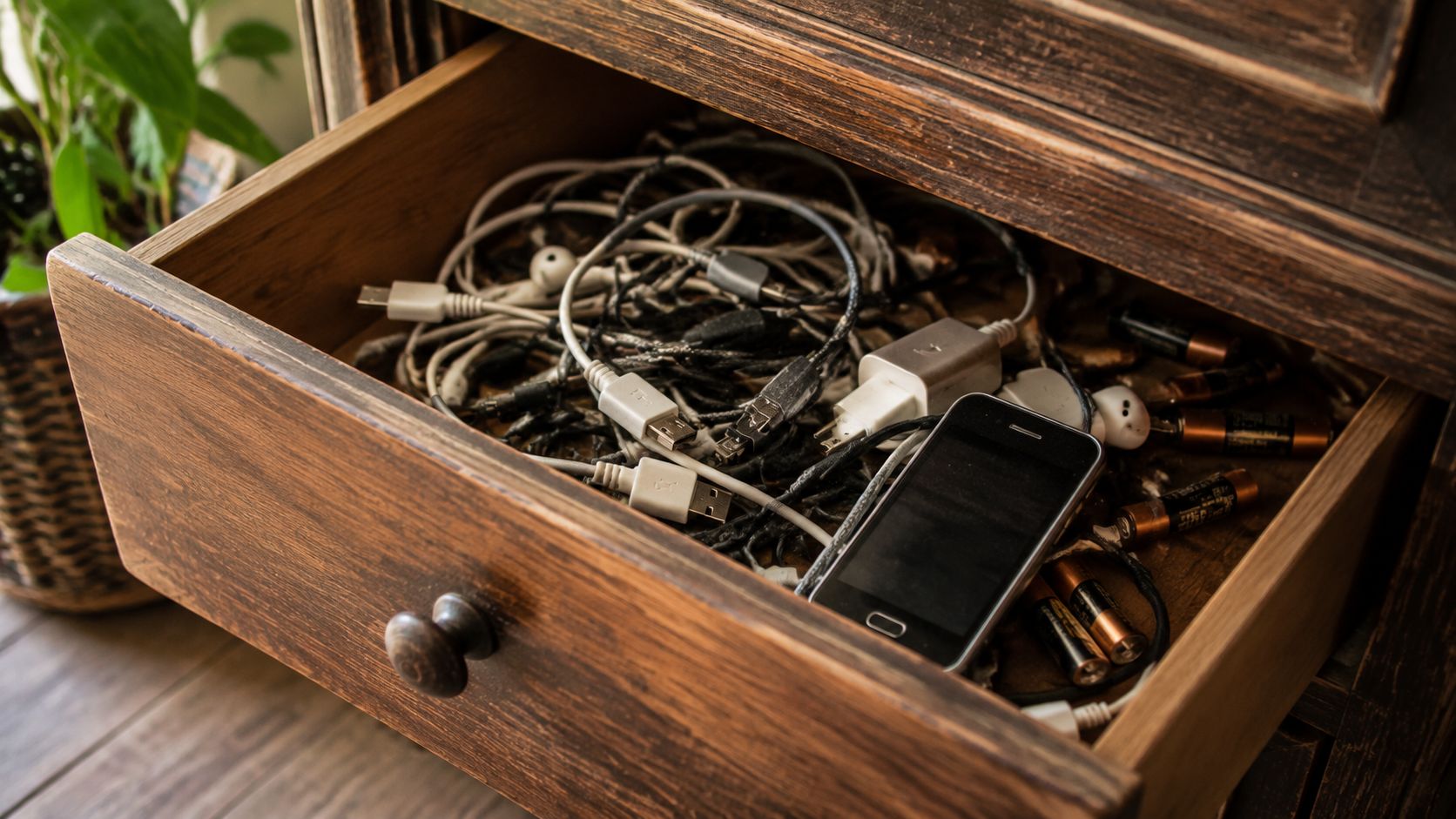
That drawer by the front door has a way of collecting life's leftovers, an old phone with family photos, a few loose AA batteries, a power bank that no longer holds charge, and a charger you can't even remember buying. This isn't ignored due to indifference; rather, it's because there's uncertainty about proper disposal, and the data on a device can feel too personal to hand over casually.
The good news is that battery recycling in Singapore is far less mysterious than it seems. Small household batteries, built-in phone batteries, and laptop packs do not all follow the same route, and once you see the difference, the whole process becomes much easier to manage. If you've ever kept an old device “just in case”, or paused because you were worried about privacy, you're in the right place.
Table of Contents
- That Drawer of Old Batteries and Gadgets We All Have
- Why Recycling Batteries is a Big Win for Our Planet
- Not All Batteries Are Created Equal A Simple Guide
- How to Handle Old Batteries Safely at Home
- Where to Recycle Batteries and E-Waste in Singapore
- The myhalo Way A Zero E-Waste Lifestyle Made Easy
- Your Battery Recycling Questions Answered
That Drawer of Old Batteries and Gadgets We All Have
The usual scene is painfully familiar. There's a tangle of old cables, maybe a retired gaming controller, a tablet you haven't opened in years, and a handful of batteries rolling around like tiny loose change. You mean to clear it out on a weekend, then the questions start, especially around whether a device still contains your photos, chats, or work files.
The drawer problem is really a sorting problem
A lot of people don't need more motivation, they need a clearer route. A drawer of leftovers feels messy because it mixes two different decisions, what can be recycled as a small household battery, and what needs separate handling as part of a phone, laptop, or power bank. Once you split those two paths, the task gets lighter.
If you've ever kept an old device because you wanted to salvage a project idea, that's normal too. A simple example is someone building a retro gaming setup who wants to reuse an old console or small parts instead of throwing them out, and resources like building a Retropie system show how old hardware can get a second life. That same reuse mindset is exactly what makes battery recycling feel less like disposal and more like thoughtful decluttering.
Practical rule: start by separating loose household batteries from anything that has a screen, circuit board, or built-in battery.
A calm, step-by-step approach also helps with privacy anxiety. You don't need to solve everything in one go, and you certainly don't need to guess. You just need a safe place for the loose batteries, and a separate plan for the device itself.
Why Recycling Batteries is a Big Win for Our Planet
Recycling batteries matters because these items are not just trash, they're made of materials that can be recovered and used again. Singapore has already shown that this is not a tiny side effort. SK tes's Tuas facility, described as Southeast Asia's first battery recycling plant, can process up to 14 tonnes of lithium-ion batteries per day, which is about 280,000 smartphone batteries source. That scale says a lot about how serious the local system has become.
Recycling turns one discarded battery into a resource stream
When a battery is processed properly, the goal is to recover useful metals instead of sending everything to waste. In Singapore's local recycling setup, that includes nickel, lithium, and cobalt through a hybrid mechanical and hydrometallurgical flow source. For everyday users, that means your old device isn't just leaving your home, it's entering a system designed to pull value back out of it.
This is also why battery recycling fits into a broader circular-economy mindset. The idea isn't just to throw away less, it's to keep materials moving through new products for as long as possible. For a friendly overview of why tech waste matters in general, this guide on the benefits of tech waste recycling is a useful companion read.
Recycling is a small household habit with a large industrial back-end.
If you're choosing greener habits across your daily life, that same mindset can spill into transport too. Reading about green electric ride options is a nice reminder that low-waste choices often work best when they're practical, not complicated. Battery recycling works the same way, it becomes easier when the system around it is easy to use.
Not All Batteries Are Created Equal A Simple Guide
The biggest confusion in battery recycling Singapore is simple, but important, small household batteries are not the same as the batteries inside phones, laptops, tablets, and power banks. A remote control battery and a phone battery both store energy, but they don't travel through the recycling system in the same way. Treating them as identical can create safety issues and sorting mistakes.
Small household batteries and device batteries follow different routes
NEA's public guidance makes the distinction very clear. Public e-waste bins are for small household batteries like AA, AAA, and button cells, while laptop and smartphone batteries are not accepted in those bins and need a separate recycling channel source. That means the size of the battery and whether it is loose or built into a device both matter.
A simplified perspective is as follows:
| Battery type | Typical examples | Best approach |
|---|---|---|
| Small household batteries | AA, AAA, 9-volt, button cells | Use approved battery bins or e-waste collection points |
| Lithium-ion device batteries | Phones, laptops, tablets, power banks | Follow a separate collection route for regulated e-waste |
Why the split matters in real life
A loose AA battery is like a single parcel. A laptop battery is more like a component inside a sealed machine. The first can usually be dropped into designated public collection points, while the second needs care because it's part of a larger device and may require a different handler. That's why “battery recycling” is not one universal action in Singapore, it depends on what kind of battery you have in your hand.
The useful habit is to pause before you throw anything away. If it's a loose household cell, follow the public battery route. If it came out of a device, or is still inside one, treat it as regulated e-waste and check the right collection channel.
How to Handle Old Batteries Safely at Home
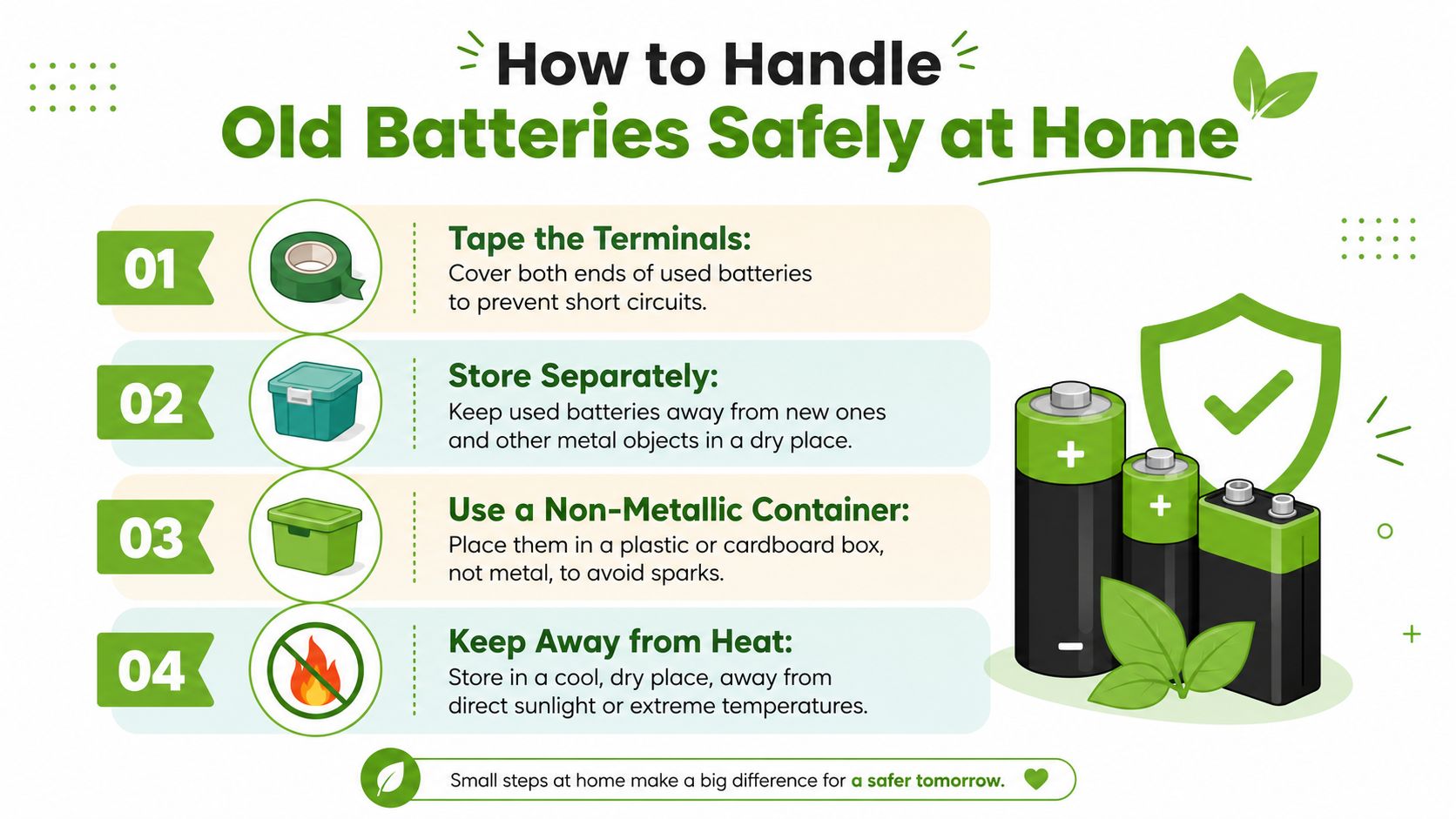
Before you leave home with a used battery, a few simple precautions make the whole process safer. This doesn't need to feel technical or intimidating, it's really about preventing accidental contact and keeping batteries stable until you hand them over. Small steps now can save you from a messy drawer later.
Four easy habits that make a real difference
- Tape the terminals. Cover the ends of used batteries so they don't touch metal objects or each other.
- Store them separately. Keep used batteries away from fresh batteries and from coins, keys, and other metal items.
- Use a non-metal container. A plastic or cardboard box is a safer holding spot than a metal tin.
- Keep them cool and dry. Heat and sunlight are not friends of old batteries, so pick a stable spot indoors.
A swollen or puffy battery deserves extra caution. If it looks misshapen, don't press it, don't puncture it, and don't keep it mixed in with other items. Set it aside carefully and arrange proper handling through a licensed route.
Singapore's battery recycling framework is built around safe collection and controlled treatment, not casual dumping. Under the Resource Sustainability Act 2019, producers are responsible for collection and recycling, and recyclers must recover at least 50% of raw materials from the batteries they process source. That rule explains why good sorting and safe handoff matter so much.
For readers who want the technical side of safe battery design, designing reliable polarity protection is a useful reference on why batteries need careful handling at the circuit level too. For most households, though, the practical takeaway is much simpler, keep used batteries separate, taped, and dry.
If you've ever wondered whether phone battery care should be part of the same routine, it should. A helpful local explainer on phone battery care tips and replacement in Singapore can make that part feel a lot less stressful.
Where to Recycle Batteries and E-Waste in Singapore
Singapore gives you more than one route, and that's a good thing. Different items need different handling, so the best drop-off point depends on whether you're holding loose batteries, a single gadget, or a larger pile of e-waste. The system is broad enough that individuals can readily locate a convenient option.
| Recycling Option | Best For | What's Accepted | Key Benefit |
|---|---|---|---|
| Public battery bins | Loose household batteries | AA, AAA, button cells, and similar small cells | Easy and familiar for everyday disposal |
| Retailer and collection points | Small regulated e-waste | Batteries and small e-waste items where accepted | Convenient neighbourhood access |
| ALBA depot at Tuas | Larger regulated e-waste | Bigger items and device-related e-waste | Direct free drop-off option |
| Doorstep collection | Bulkier household e-waste | Larger e-waste arranged through the service | Convenient when carrying items is hard |
The collection route depends on item size
NEA says used household batteries such as AA and AAA can go into a 3-in-1 e-waste bin, a battery-and-bulb bin, or a battery-only bin provided by ALBA E-Waste Smart Recycling Pte Ltd, and that these batteries are sent to licensed e-waste recycling facilities for proper treatment source. That makes loose battery disposal straightforward.
For larger e-waste, Singapore also offers on-demand doorstep collection for a fee through ALBA's service channels and a free drop-off option at ALBA's depot at 20 Tuas Loop source. If you're dealing with a box of old devices, this matters more than hunting for a tiny bin.
Choosing the easiest path for your home
A good rule is to sort by category first, then by convenience. Loose batteries belong in battery-specific collection. Device-integrated batteries, such as the ones inside laptops and phones, need a separate e-waste path. If you're not sure where a specific item goes, check a simple local guide like battery recycling near me before you leave the house.
Helpful shortcut: if it has a screen, a charger, or a built-in battery, don't assume it belongs in a small battery bin.
That one habit prevents a lot of confusion. It also keeps your recycling trip calm, because you're matching the item to the right channel instead of trying to force everything into one bin.
The myhalo Way A Zero E-Waste Lifestyle Made Easy
Recycling is a good outcome, but reuse and repair are even better when they're possible. That's the heart of a zero-e-waste mindset, keep devices in use for as long as they still make sense, and only move them into recycling when they reach end of life. The most sustainable device is often the one that doesn't need replacing yet.
Repair, reuse, and secure handling work better together
Singapore's battery and e-waste system is already more advanced than a simple drop-box model. That's why services built around repair, resale, buyback, and upcycling fit so naturally into the local sustainability picture. They keep usable devices circulating instead of sending them straight to processing.
For anyone worried about privacy, data protection has to be part of the same conversation. Myhalo's own data wipe and recycling process speaks directly to that concern, and it reflects a real need among people who don't want personal files left behind on old devices. That confidence matters just as much as convenience.
Decluttering feels easier when the process is structured
A device sitting in a drawer doesn't help anyone. A clear pathway for assessment, repair, resale, or responsible disposal is what turns clutter into action. That's also why a service model that includes secure data handling is so valuable, because it removes the fear that often stops people from letting go of old tech.
The best sustainability habit is the one you'll follow through on. If the process feels safe, simple, and local, people are much more likely to do the right thing with phones, laptops, tablets, and accessories they no longer use.
Your Battery Recycling Questions Answered
Can I throw batteries in the regular rubbish bin? No. Used batteries should go through the proper collection route, because the battery recycling system exists to handle them safely and recover materials instead of mixing them with general waste.
Do phone and laptop batteries go into public battery bins? No. NEA's guidance says public bins are for small household batteries like AA, AAA, and button cells, while batteries from phones and laptops need a separate recycling channel source.
What if my battery is swollen? Treat it carefully, don't squeeze it, don't puncture it, and keep it separate until you can hand it to the right licensed handler. A damaged battery is not a normal household item, and it deserves extra caution.
What about bigger e-waste? Singapore has an official doorstep collection option for a fee and a free drop-off point at 20 Tuas Loop for larger items source.
Do I need to wipe my data first? Yes, if the item is a smart device, protect your privacy before recycling or handing it over. That step is part of responsible device disposal, not an optional extra.
Ready to feel lighter and do good? Let's clear out those old devices together! Check out our Declutter your e-clutter program today and see how convenient it is to make a positive splash for our environment.