
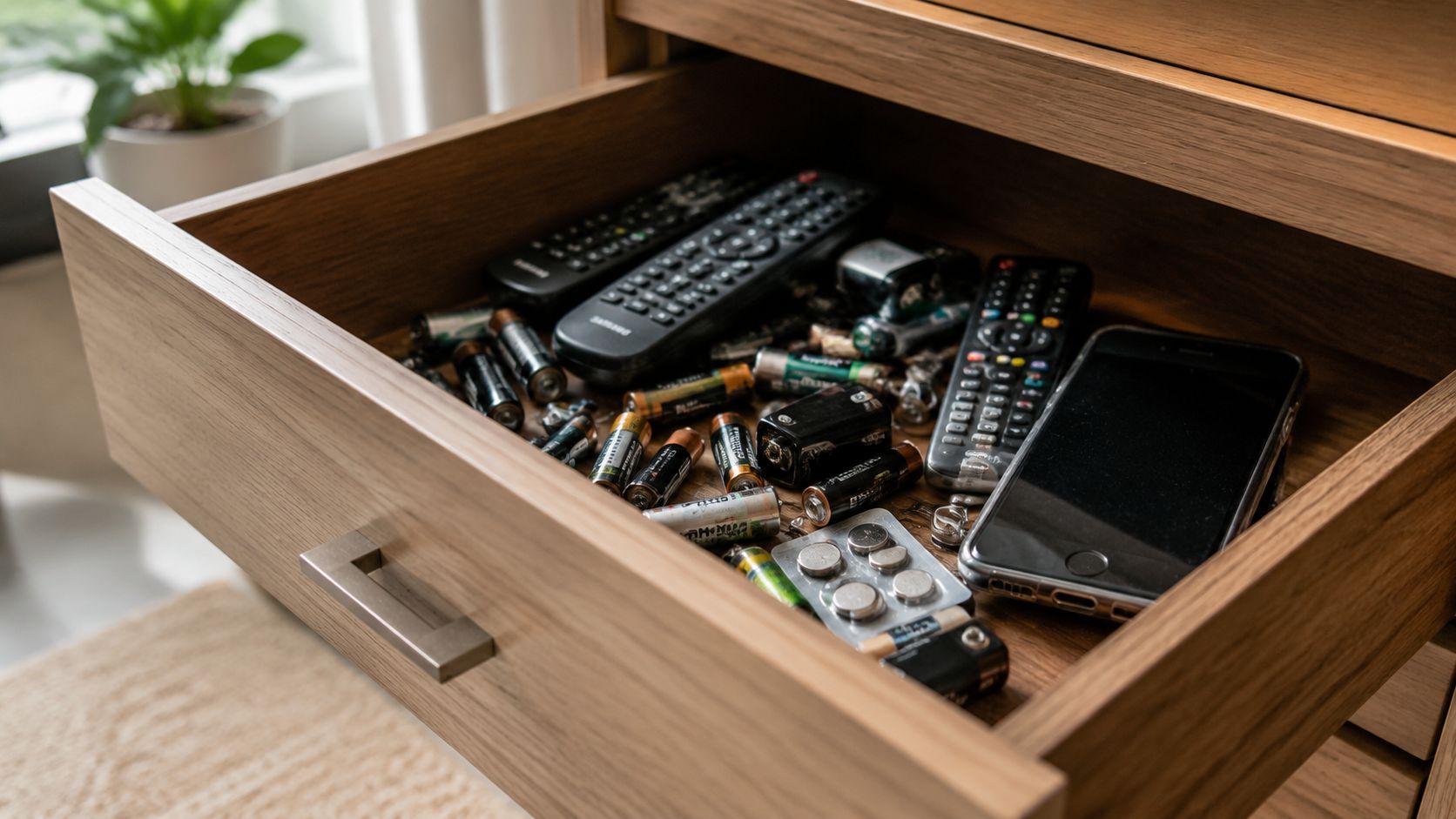
That little drawer in the kitchen, study, or bedroom side table probably looks familiar. A few loose AA batteries from the TV remote. A button cell from an old thermometer. A dead power bank. Maybe even an old phone or laptop you’ve kept because you weren’t sure where the battery should go, or whether your photos and messages were still inside.
If you’ve searched for Battery recycling near me and still felt unsure, you’re not alone. In Singapore, battery recycling sounds simple until you realise different batteries follow different rules. The biggest point of confusion is this: the batteries you pop into a remote are handled differently from the batteries built into your phone, laptop, or tablet.
That’s why a tidy, step-by-step approach helps. Once you know what you’re holding, how to make it safe, and where it should go, recycling becomes much easier. It can even feel good. One small decluttering job, done properly, and your home feels lighter straight away.
Table of Contents
- Why That Drawer of Old Batteries Feels So Complicated
- First Things First Know Your Batteries
- Safety Prep The Most Important 30 Seconds
- Finding Your Local Drop-Off Point in Singapore
- For Businesses and Big Decluttering Projects
- What Happens After You Drop Them Off
- Your Recycling Questions Answered
Why That Drawer of Old Batteries Feels So Complicated
Most homes have one. It starts with good intentions. You remove a battery from a wall clock, tell yourself you’ll recycle it later, and place it in a drawer. Then a dead wireless mouse battery joins it. Then a cracked old phone. Then a laptop that no longer holds charge.
The confusion usually begins because all of these items look like “batteries”, but they don’t belong in the same place. In Singapore, only AA, AAA, and button cells are accepted in standard public e-waste bins, while smartphone and laptop batteries are rejected, as explained by the NEA guidance on where to recycle e-waste. That catches many people off guard.
It also explains why so many people hesitate. If you’ve ever wondered whether a phone battery can go into the same bin as a remote-control battery, that’s the exact point where many households get stuck.
The two problems hiding in one drawer
One problem is sorting. A loose AA battery is not the same as a lithium-ion battery sealed inside a phone or laptop.
The other problem is risk. The same NEA page notes a 35% rise in battery-related bin fires in 2025 across Singapore town councils, linked to improper disposal and confusion around battery handling in ordinary waste streams. That makes this more than a clutter issue.
Practical rule: If a battery powers a phone, laptop, tablet, or power bank, pause before treating it like a normal household battery.
Why people keep old devices for too long
Many people don’t just worry about recycling. They worry about what’s still inside the device. Family photos, work emails, app logins, saved documents, payment details. That’s why old phones and laptops often sit untouched for months or years.
If that sounds familiar, this wider guide to decluttering old tech for a zero e-waste lifestyle in Singapore is a useful next read. It helps turn “I’ll deal with it later” into a clear plan.
First Things First Know Your Batteries
Before you look for a drop-off point, sort what you have. You don’t need a chemistry degree. You just need to spot a few familiar shapes and uses.
The easy split that matters most
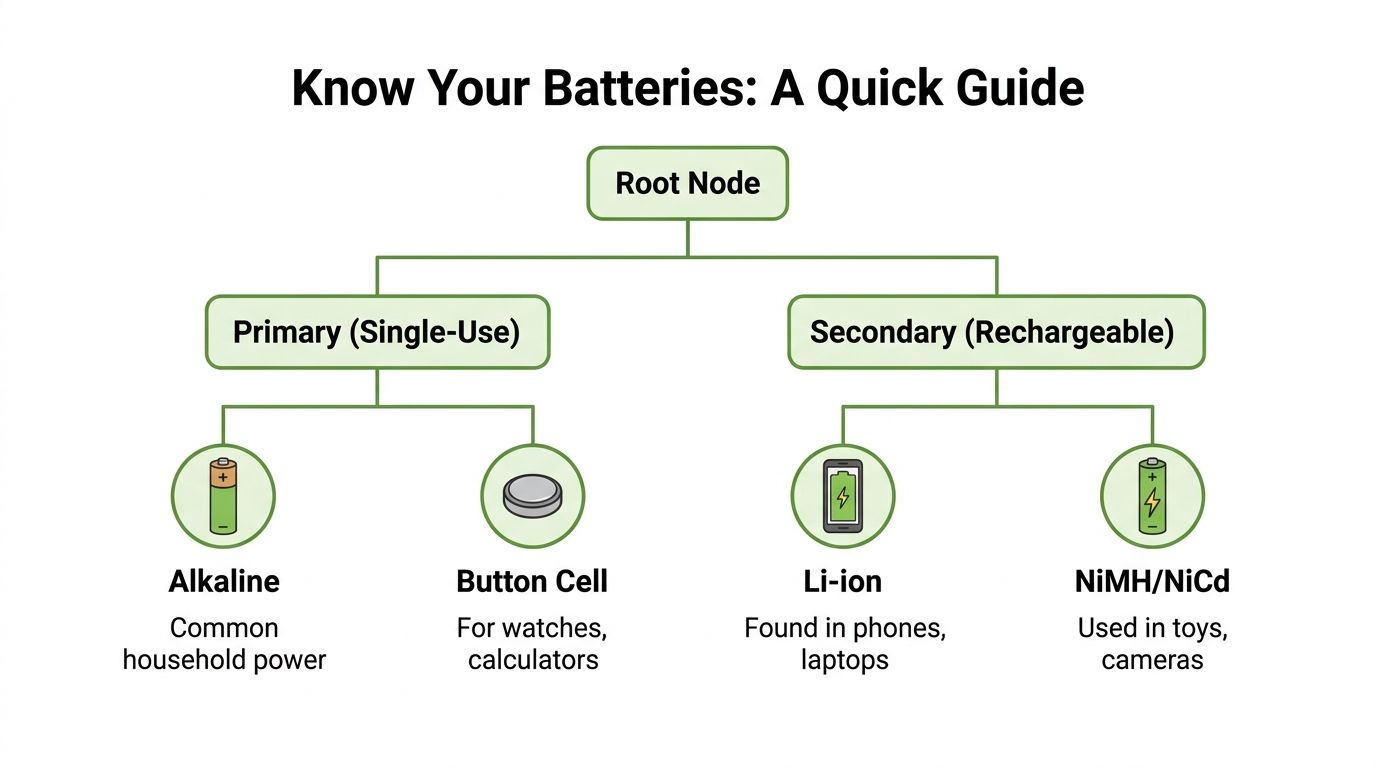
The fastest way to sort your drawer is to create two groups.
| Battery group | What it often looks like | Common examples at home |
|---|---|---|
| Single-use batteries | Loose cylinders or coin-shaped cells | TV remote batteries, wall clocks, toys, watches |
| Rechargeable batteries | Either marked rechargeable or built into a device | Camera batteries, rechargeable AAs, phones, laptops, tablets, power banks |
That first split is enough to get started. Then you can make smaller piles.
A simple sorting method at home
Start with the easy wins.
- AA and AAA batteries. These are the slim cylinders immediately recognizable. You’ll find them in remotes, clocks, toys, torches, and wireless accessories.
- Button or coin cells. Small, round, shiny batteries. They’re common in watches, calculators, hearing aids, and small medical or household gadgets.
- Rechargeable loose batteries. These may look like AA batteries but are labelled rechargeable and often come from cameras, game controllers, or small electronics.
- Built-in lithium-ion batteries. These live inside devices such as smartphones, tablets, laptops, wireless earbuds, and power banks. If removing the battery requires tools, assume it needs more careful handling.
A helpful clue is the device itself. If the battery came from a simple household item and lifts out easily, it usually belongs in the small-battery category. If it came from a personal tech device, especially one that stores files or accounts, treat it differently.
A dead remote battery is mainly a disposal question. A dead phone is a disposal question and a data question.
If you’re sorting with children or older family members, keep the language simple. “Remote batteries here. Watch batteries here. Anything from a phone, laptop, or power bank in a separate pile.” That works well.
Why this step saves time later
People often search Battery recycling near me before they’ve identified what they have. That leads to mixed results and more uncertainty. Sorting first makes the next step much quicker because you’re no longer looking for one answer. You’re matching each battery type to the right pathway.
Safety Prep The Most Important 30 Seconds
Sorting is helpful. Safety is essential.
What to do before any drop-off
Before disposing of used batteries in Singapore, individuals should tape the terminals, store them in a cool, dry place, and separate rechargeable from non-rechargeable batteries.
That sounds technical, but the routine is quick:
- Cover the contact points with tape. On AA or AAA batteries, tape the ends. On a 9V battery, cover the terminals on top. On device batteries, cover any exposed metal contacts.
- Keep them in a non-metal container. A small cardboard box or plastic tub works well.
- Store them somewhere dry and shaded. A cool shelf beats a hot window ledge or the inside of a car.
- Keep battery types apart. Don’t mix everything loosely together.
Why this quick step matters
Loose batteries can touch one another. When metal contacts meet, they can short-circuit. That creates heat, and heat is exactly what you don’t want in a drawer, a collection bin, or a transport container.
This short prep also makes your drop-off smoother. You won’t need to stand at a collection point wondering whether your batteries are safe enough to hand over.
Treat terminal taping like fastening a seat belt. It takes seconds, and it protects everyone handling the item after you.
Finding Your Local Drop-Off Point in Singapore
Once your batteries are sorted and taped, the final question becomes practical. Where should each pile go?
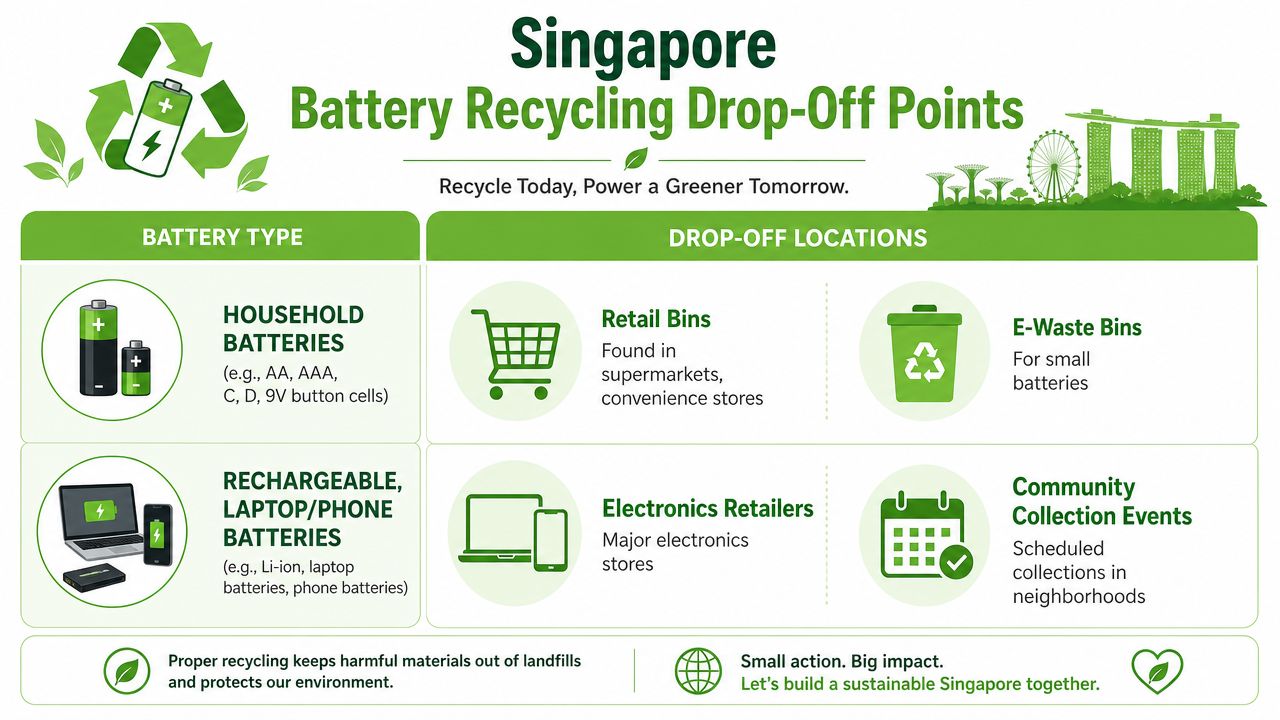
Singapore’s collection network has grown a lot. The country expanded its e-waste infrastructure to 1,000 collection points as of 2025, and that scaled to 1,057 by June 2026. That makes battery recycling more accessible across the island.
Where common household batteries usually go
For AA, AAA, and button cells, public e-waste collection options are usually the most straightforward route. These are the batteries many people mean when they search for Battery recycling near me.
A simple checklist helps:
- Check accepted items first. Small household batteries are commonly the easiest fit for standard battery or e-waste collection streams.
- Bring only the right types. Keep your loose household batteries separate from larger tech items.
- Carry them in a small pouch or box. This keeps taped batteries together and easy to hand over.
If you want a broader overview of local recyclers and collection pathways.
Where device batteries need extra care
Most generic guides become fuzzy on this point. A phone battery and a AA battery are not the same recycling task, even though both are called batteries.
If the battery is inside a phone, laptop, tablet, smartwatch, or power bank, don’t think only about disposal. Think about the full item. The device may still hold personal files, account access, and reusable parts. It may also be suitable for repair, trade-in, part harvesting, or secure processing before any recycling happens.
That’s why it helps to sort drop-off options by context:
| What you have | Best first question | Why it matters |
|---|---|---|
| Loose AA, AAA, button cells | Is this accepted in a public battery collection stream? | These are usually simple disposal items |
| Old phone or laptop | Does the device still contain data or reusable value? | Privacy and reuse matter before recycling |
| Swollen, damaged, or hot battery | Who can handle this safely? | Damaged batteries need extra caution |
Don’t reduce an old laptop to “just a battery problem”. It may also be a privacy problem, a repair opportunity, or a reuse opportunity.
For Businesses and Big Decluttering Projects
A home drawer is one thing. An office storeroom is another.
Why office battery disposal is different
Businesses often deal with batteries inside fleets of devices. Laptops issued to staff. Spare smartphones. Tablets used at counters or events. Backup accessories. Once you’re managing retired equipment at scale, the job stops being a casual clean-up task and becomes part of asset management.
Singapore’s regulatory environment matters here. Under the Extended Producer Responsibility framework, enacted via the Resource Sustainability Act 2019 and the Resource Sustainability (E-waste Recyclers) Regulations 2021, battery producers are legally required to manage collection, recycling, and safe disposal of all consumer and non-consumer electric vehicle batteries, including reporting obligations and the use of licensed recycling facilities, as outlined in the analysis of Singapore’s battery recycling framework.
For organisations, that’s a reminder to use documented, compliant pathways rather than ad hoc disposal.
What a practical disposal plan looks like
A useful internal plan usually includes a few parts:
- Inventory first. List what’s loose battery waste and what’s whole equipment.
- Separate data-bearing devices. Phones, tablets, and laptops should never be treated like a bag of spent AA cells.
- Choose partners with traceable processes. That matters for governance, risk, and internal reporting.
- Keep staff instructions simple. “Do not place device batteries in general waste” is clearer than long policy language.
If you’re comparing options, this resource on responsible e-waste solutions for businesses is a useful external read alongside internal policy planning. For teams handling end-of-life computers, phones, and related assets, a structured corporate IT asset disposition service also fits this category of planning because it treats disposal as a controlled business process, not a last-minute clear-out.
What Happens After You Drop Them Off
People are more likely to recycle when they can picture what happens next.
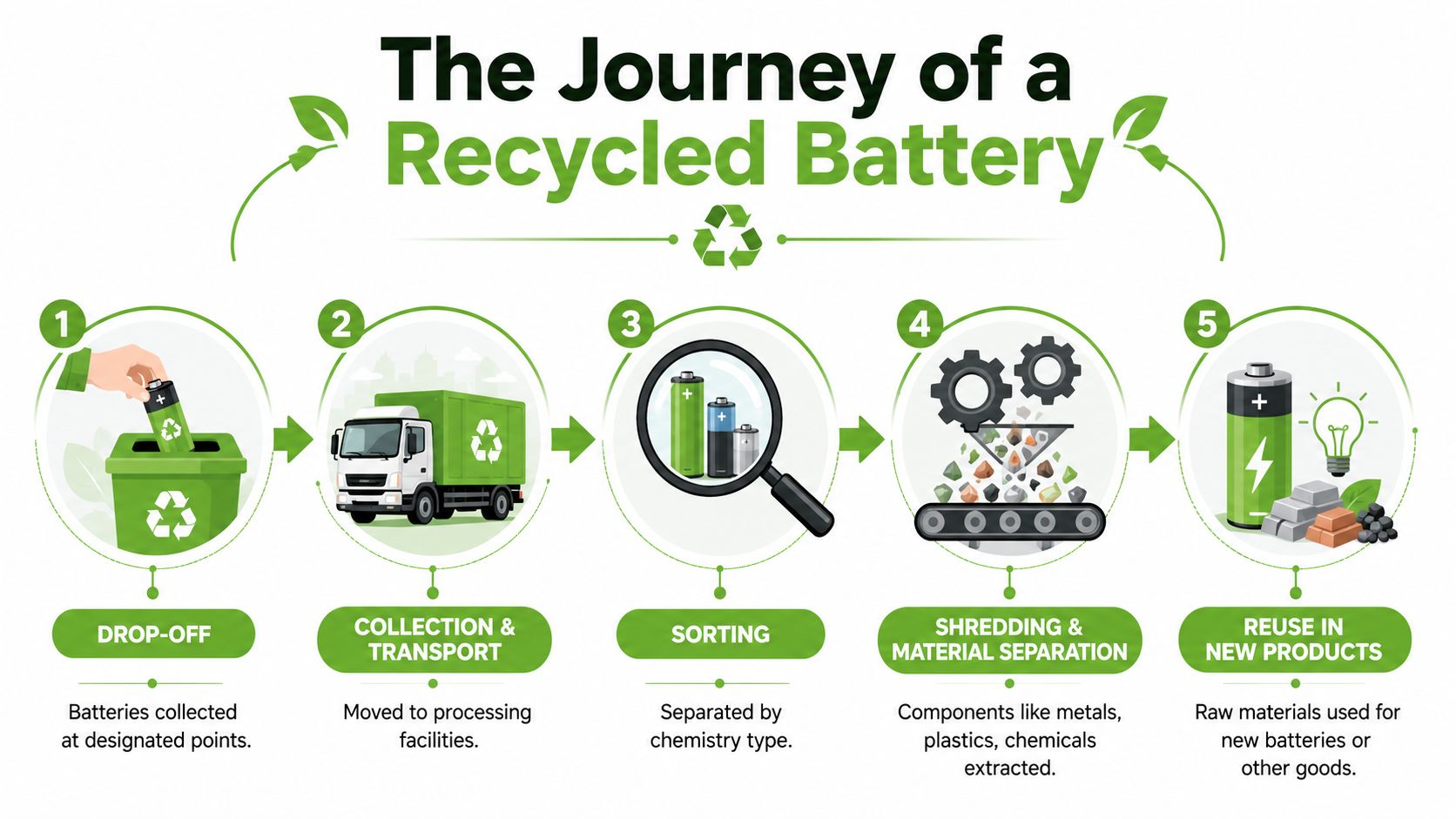
The battery’s next journey
After collection, batteries are typically sorted by type because different chemistries need different handling. From there, facilities dismantle, shred, and separate materials for further recovery and reuse.
That process can sound industrial, but the outcome is surprisingly hopeful. Valuable materials don’t have to stay locked inside dead batteries forever.
Why Singapore’s recycling story is exciting
Singapore has some impressive local innovation in this area. A Singaporean plant using solvents derived from fruit peels, invented by scientists at Nanyang Technological University, has achieved a recovery rate exceeding 90% of precious metals, including lithium, cobalt, nickel, and manganese, from shredded lithium-ion batteries, according to the overview of battery recycling technology using fruit peel-derived solvents.
That means your old battery can become part of a resource recovery story, not just a waste story.
A recycled battery doesn’t disappear. It enters another chapter, where useful materials are recovered for future products.
If you’d like the broader picture of how electronics move through reuse and recycling pathways, this explainer on how to recycle your e-waste shows where batteries fit within the larger journey.
Your Recycling Questions Answered
Can I throw just a few batteries in the regular bin
It’s better not to. Even a small number of batteries can create safety risks when they’re crushed, punctured, or mixed with general waste. Household convenience isn’t worth the hazard.
What’s different about a battery inside a phone or laptop
A loose battery is one item. A phone or laptop is a whole device with storage, accounts, files, and components. That’s why device disposal needs more thought. You’re not only deciding where the battery goes. You’re deciding how the device is handled safely and privately.
Does one small drop-off really matter
Yes. It keeps risky items out of the wrong waste stream, supports proper material recovery, and makes your home less cluttered at the same time. One bag of old batteries may feel tiny, but community habits are built from small actions done repeatedly.
If you’ve been putting this off, start with the easiest pile tonight. Collect the AA and AAA batteries. Tape the terminals. Separate the old phone and laptop into a different tray. Small steps are how a zero e-waste habit begins.
Ready to feel lighter and do good? myhalo makes it easy to clear out old devices through a convenient, safe, and responsible approach to zero e-waste living. If you’ve got phones, laptops, tablets, or other data-bearing tech sitting at home, their Declutter your e-clutter programme helps you let go without stress, while Safe data protects your privacy and Save data supports recovery when precious files still matter. Join the community and take that first cheerful step towards a tidier home and a cleaner Singapore.