
A lot of us have one. A drawer with an old phone, a cracked tablet, tangled charging cables, a laptop that still switches on but feels too slow to use. You meant to sort it out months ago, but then a familiar worry pops up. What if your photos, messages, banking details, or work files are still inside?
That hesitation is completely reasonable. Old tech isn’t just clutter. It’s personal, valuable, and sometimes confusing to deal with. Some devices still have resale value. Others can be repaired, reused for parts, or handled through secure recycling. The challenge is knowing which path makes sense and how to do it without risking your data or adding waste.
A good recycling company in Singapore shouldn’t just take devices away. It should help you move each item through the right next step in its lifecycle, whether that’s trade-in, repair, refurbishment, secure data destruction, or final material recovery. That’s how a zero e-waste mindset works. It looks beyond the bin and asks a better question: what is the most responsible and useful next life for this device?
If you also enjoy sorting and valuing old items before letting them go, the collectible valuation guide offers a simple way to think about condition and worth. Similar thinking helps with electronics too. A scratched phone with a healthy motherboard may still have meaningful value. For a local example of how people turn old tech into a safer, more useful outcome, this guide on selling your old phone, tablet or laptop in Singapore shows how the process can work in practice.
Table of Contents
- That Drawer of Old Gadgets Has a Bright Future
- The E-Waste Challenge in Our Singaporean Community
- Discover All the Services a Recycling Company Can Offer
- How to Choose the Right Recycling Partner in Singapore
- Your Step-by-Step Recycling Pathway for Homes and Businesses
- The myhalo Promise A Model for Zero E-Waste
That Drawer of Old Gadgets Has a Bright Future
A phone from your uni days. A power bank that may or may not still charge. Earbuds with only one side working. A family laptop nobody wants to use, but nobody wants to throw away either. These are the little “drawer orphans” that pile up because each one carries a tiny decision.
Some people hold on because they’re worried about privacy. Others don’t want to waste something that still has life left in it. Many do not know whether a recycling company in Singapore can do more than basic disposal. That uncertainty keeps devices stuck at home, gathering dust while their value and usefulness slowly fade.
The problem isn’t laziness
Individuals aren’t avoiding action because they don’t care. They’re pausing because old electronics sit at the intersection of three real concerns:
- Private data: Old phones and laptops may still contain passwords, photos, chats, and documents.
- Financial value: A used device might still be worth something, even if it’s imperfect.
- Environmental impact: Sending reusable tech straight to destruction wastes parts, materials, and effort already built into it.
Practical rule: If a device still powers on, charges, or has salvageable parts, don’t assume “recycling” means immediate shredding.
That’s where a zero e-waste approach feels refreshing. Instead of treating every old gadget as rubbish, it treats each item like a decision tree. Can it be repaired? Traded in? Refurbished? Used for parts? Recycled responsibly only when those higher-value options are no longer possible?
A brighter way to declutter
Think of tech decluttering as less like taking out the trash and more like sorting a small collection. A recent phone may go toward a trade-in. A damaged laptop might still support data recovery or parts harvesting. A device beyond repair can still move into certified end-of-life handling.
That shift matters emotionally too. People often feel guilty about old devices, as if they’ve “failed” to recycle properly. You haven’t. You just need a process that feels safe, organised, and realistic.
When a recycling partner makes privacy clear, explains your options in plain language, and helps you choose the next best use for each item, decluttering becomes lighter. It can even feel satisfying. One drawer cleared. One less worry sitting in the house. One more device kept on a better path.
The E-Waste Challenge in Our Singaporean Community
Singapore’s e-waste story isn’t only about bins and collection drives. It’s about participation at home, where many devices begin their long pause in cupboards, storerooms, and desk drawers before they become waste at all.
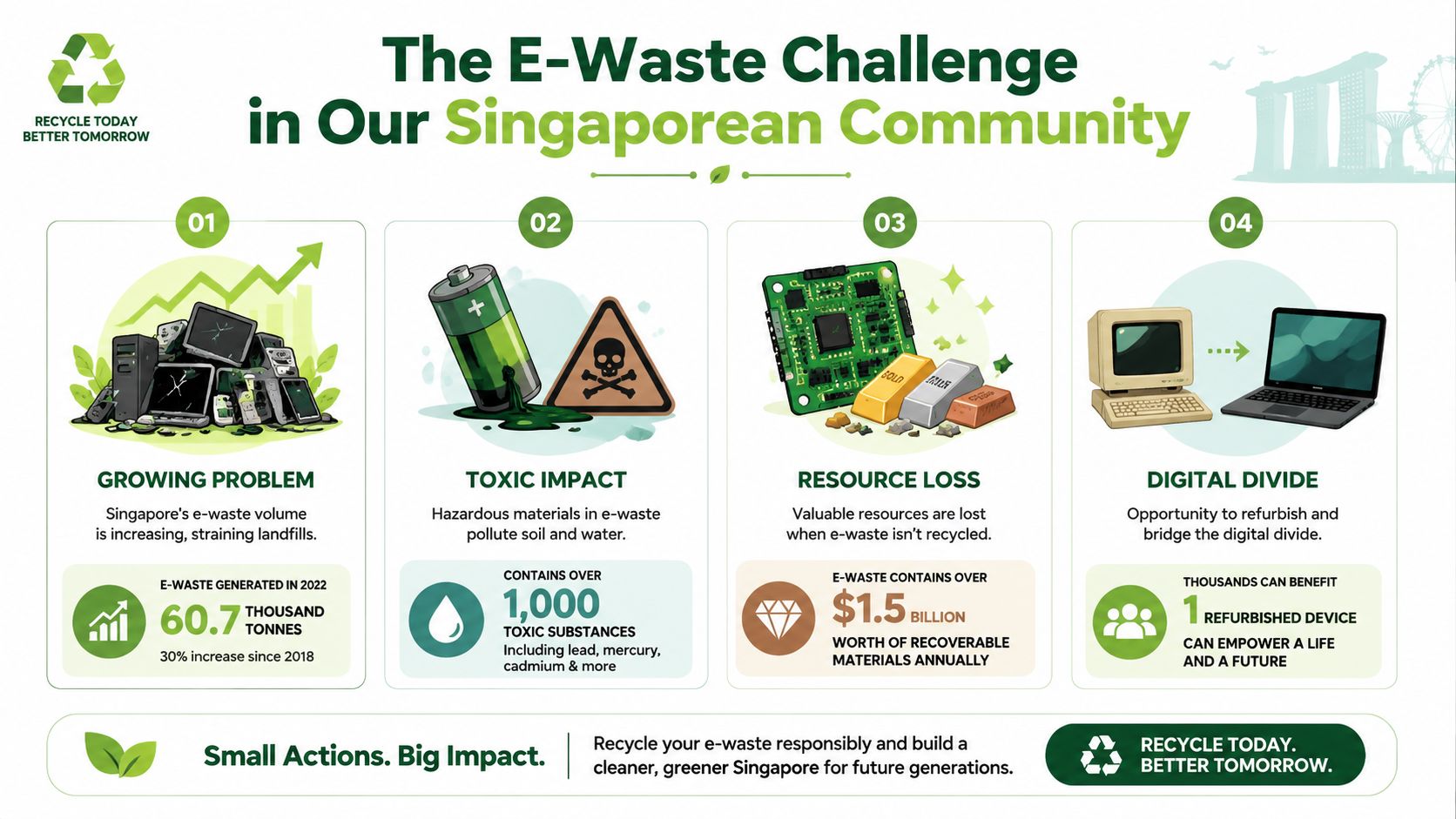
In 2024, Singapore’s overall recycling rate stood at 50%, down from 52% in 2023 and 60% in 2014, while the household recycling rate fell to 11%, down from 12% in both 2022 and 2023. The same report also noted that Singapore generates about 60,000 tonnes of e-waste annually, and only one in ten young Singaporeans successfully recycles according to The Straits Times coverage of Singapore’s domestic recycling decline.
What counts as e-waste
E-waste includes more than old phones. It can mean laptops, tablets, desktop parts, keyboards, chargers, batteries, monitors, earbuds, and small digital accessories. If it runs on electricity or stores data, it usually belongs somewhere in this conversation.
What makes e-waste different from ordinary rubbish is its mix of risk and value. Devices may contain hazardous materials that need proper handling. At the same time, they can also contain usable components and recoverable materials.
Why home recycling matters so much
When household recycling drops, the issue isn’t just volume. It’s missed opportunity. A forgotten drawer of electronics represents useful hardware that could be repaired, reused, resold, or stripped for parts before any final recovery stage.
That’s one reason “how to recycle” isn’t enough anymore. We also need to ask what happens after collection. Does the company prioritise reuse? Does it separate working devices from dead ones? Does it handle batteries and data-bearing items properly? For readers interested in the wider sustainability responsibilities businesses face, this overview of 2026 packaging regulations for SMEs offers a useful parallel in how compliance and waste handling are becoming more structured across sectors.
Better outcomes start before the truck arrives. The most important sorting decision often happens at the moment you choose who will handle the device.
There’s also a practical gap between intention and action. People may want to recycle but feel stuck on security, convenience, or trust. That’s why community education matters. A page like myhalo’s e-waste impact resource helps turn the issue from an abstract environmental problem into a set of personal choices with local consequences.
For Singapore, the challenge isn’t only generating less waste. It’s directing old tech into the highest-value next step instead of letting it drift into storage, contamination, or unclear disposal.
Discover All the Services a Recycling Company Can Offer
Many people hear “recycling company Singapore” and think of one simple action. You hand over a dead device, and someone breaks it down. That does happen, but it’s only one small part of the picture.
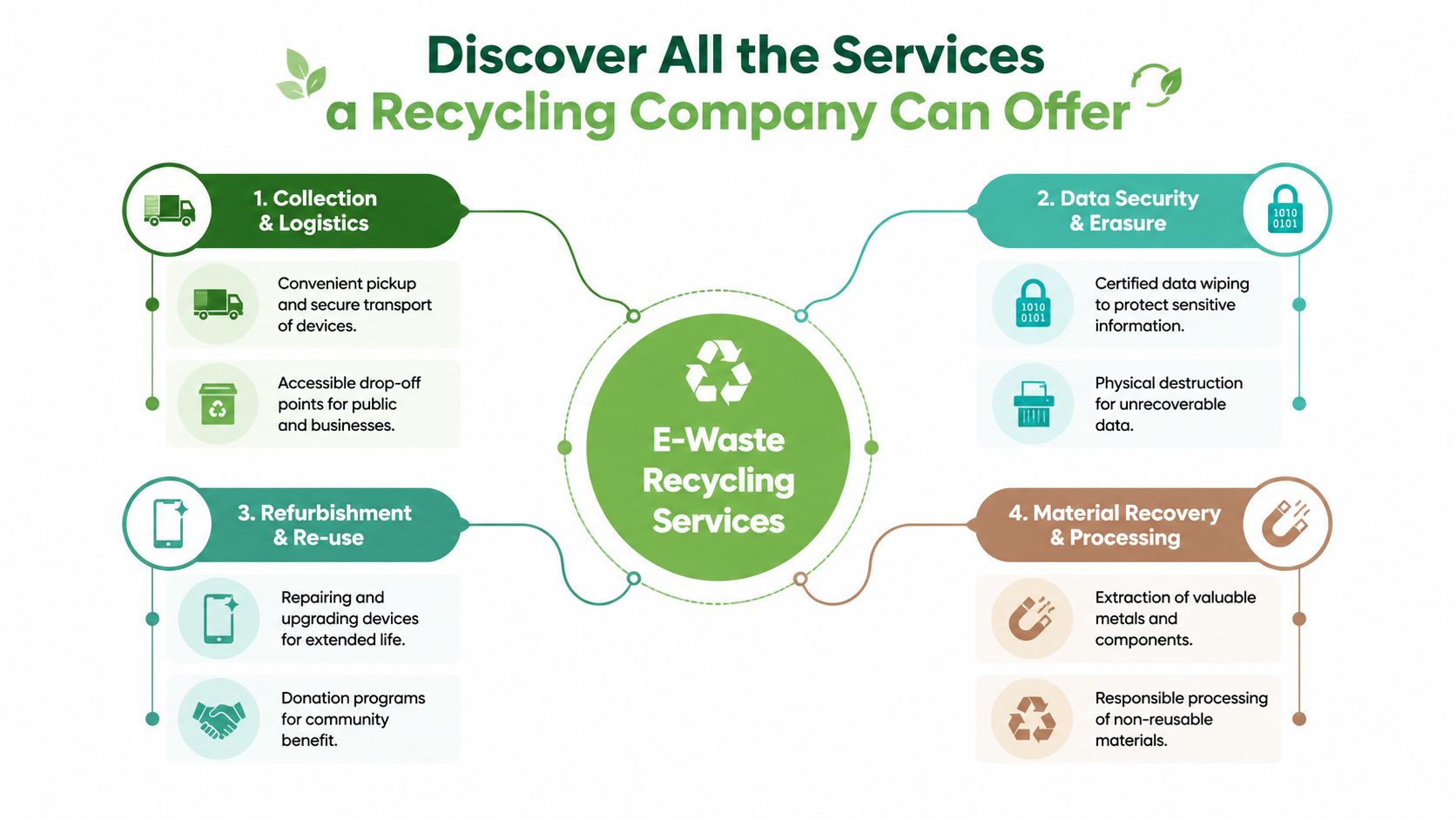
A modern electronics recycler can sit across the entire device lifecycle. It can collect, assess, erase data, repair, refurbish, resell, recover parts, and only then recycle what cannot be used again.
The reuse-first ladder
Not all outcomes are equal. From a zero e-waste viewpoint, the best path is usually the one that keeps the device useful for the longest time.
Here’s the ladder in plain language:
-
Repair
If a battery, screen, port, or board issue can be fixed, the device stays in use. -
Reuse through trade-in or resale
If the device still works well, someone else can use it next. -
Refurbish
If it needs testing, cleaning, small repairs, or grading first, it may still be suitable for certified resale. -
Upcycle for parts
Even when the full device isn’t worth restoring, parts may help rescue another device. -
Material recovery
When nothing above is viable, responsible recycling recovers what materials it can.
That order matters. Reusing one smartphone in Singapore saves about 72.4kg of CO₂e, while reusing a laptop saves about 247.5kg of CO₂e, according to myhalo’s carbon impact accounting. That’s why repair and reuse deserve first consideration.
What different services actually do
A few service types confuse people because the names sound technical. Here’s a cleaner translation.
Repair and rescue
This is for devices that are still worth saving. Maybe your phone battery drains too quickly, your laptop keyboard has failed, or your tablet won’t boot. Repair keeps the same device in use and avoids a premature end.
Trade-in and buyback
This is the financial value path. Instead of leaving a working device idle, you exchange it for cash or credit. That’s useful when you’re upgrading and want a practical, low-friction next step.
Certified refurbished sales
Refurbished devices are pre-owned items that have been checked, tested, and prepared for resale. This part of the ecosystem matters because every trade-in needs a destination. If nobody buys restored devices, fewer devices get saved.
Secure data destruction
This is the trust layer. Before reuse, refurbishment, or recycling, stored data has to be properly erased or destroyed. If you want a simple consumer-facing explanation, this guide on how data is wiped before device recycling breaks down why this step comes first.
IT asset disposition for organisations
Businesses often deal with batches of laptops, desktops, drives, and phones. They need chain-of-custody, inventory handling, certificates, and secure processing. The device may be old, but the compliance risk is very current.
A quick way to think about your options
| Device condition | Most likely next step | Why it matters |
|---|---|---|
| Working and recent | Trade-in or resale | Preserves value and extends use |
| Working but slow | Repair or refurbishment | Keeps the product useful |
| Broken with salvageable parts | Upcycling | Supports other repairs |
| Data-sensitive and obsolete | Secure erasure then processing | Protects privacy first |
| Beyond recovery | Responsible material recycling | Last step, not first |
A recycling company earns trust when it can explain why your device belongs in one pathway and not another.
The big idea is simple. A good electronics recycler doesn’t just remove devices. It helps each device land in the most responsible next use.
How to Choose the Right Recycling Partner in Singapore
Not every provider handles old tech the same way. Some focus on collection. Some specialise in business compliance. Some can repair and refurbish. Others may say the right words about sustainability but offer very little detail about process.
If you’re choosing a recycling company in Singapore, don’t start with marketing claims. Start with proof.
Start with proof, not promises
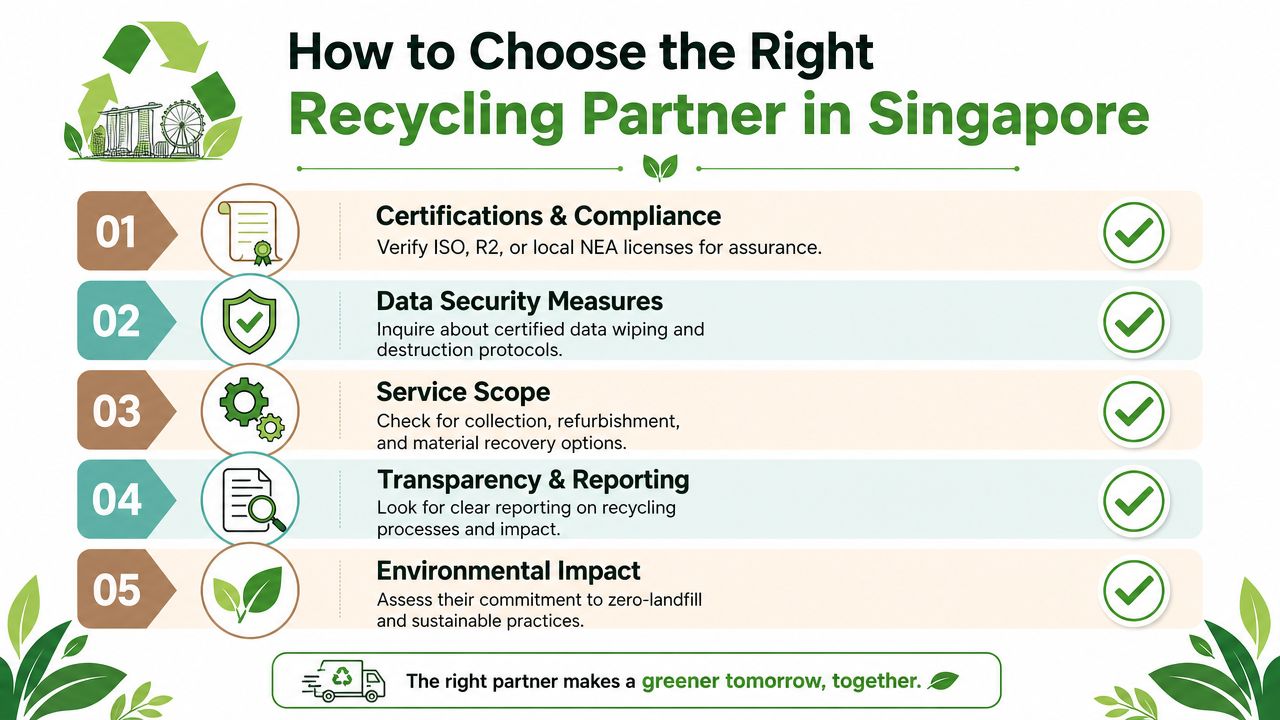
A strong sign is visible compliance. Singapore-based e-waste handlers may operate under NEA licensing categories for general or toxic waste collection, and some facilities also use standards tied to data destruction, battery recovery, and traceability. On the processing side, GLC Recycle describes R2v3 and ISO-certified lithium battery recovery processes, ISO-aligned data destruction, certificates on request, and documented carbon impact accounting, including about 2,020 MTCO2e in avoided emissions reported by circular economy initiatives.
That kind of detail matters because it turns broad green claims into checkable operating practice. You’re not just hearing “we recycle responsibly.” You’re hearing how devices are handled, how batteries are processed, whether data-bearing assets are erased before material recovery, and whether documentation exists.
Five questions worth asking
Use these questions when you compare providers.
-
What happens to my data first: Ask whether devices are wiped, destroyed, or both, and whether a certificate is available when needed. If the answer is vague, keep looking.
-
Do you prioritise reuse before destruction: A zero e-waste partner should be able to explain when it repairs, refurbishes, resells, or harvests parts before moving to final recycling.
-
Which licences or standards support your process: Look for NEA licensing where relevant, and ask whether the company follows recognised operational standards for secure handling and traceable recovery.
-
Can you explain your chain of custody: This matters for businesses and for anyone handling sensitive personal devices. You want to know who receives the device, where it goes, and how the handoff is documented.
-
How transparent is the value conversation: If a device still has worth, the pricing method should be understandable. If it has no value, the company should explain why.
Checklist mindset: If a recycler can’t explain its process in plain English, that’s already useful information.
A second clue is service range. Companies that can assess devices across repair, reuse, data destruction, and end-of-life handling often make better decisions than firms built around a single outcome. One example is myhalo, which offers repair, trade-in, refurbished resale, IT asset disposition, and secure data management within the same device lifecycle flow. That doesn’t automatically make it right for every situation, but it does show what a fuller-service model looks like.
Finally, watch for the hidden gap in many websites. They explain collection, but not what happens afterwards. For eco-conscious households and corporates alike, that missing middle is where the most important decision sits.
Your Step-by-Step Recycling Pathway for Homes and Businesses
Individuals often don’t need more theory. They need a calm, practical sequence. The good news is that the pathway gets much easier once you split it into two situations: your home devices and your organisation’s assets.
A common anxiety sits right at the centre of both. Consumers and SMEs in Singapore often ask whether recycling companies properly erase device data before recycling, yet there isn’t a central public registry showing which firms offer certified erasure with certificates, as noted by NEA’s recycling resources and the wider gap around data-handling visibility. That uncertainty is why process matters so much.
For your home
Start small. Don’t wait until you’re ready to clear the whole house.
-
Gather by category
Put phones together, laptops together, cables together, and accessories together. This makes it easier to see what may still be useful. -
Decide what you need from each item
One device may need secure erasure. Another may be worth selling. A broken laptop may be more important for its files than for the hardware itself. If you suspect there’s data you still need, speak to data recovery experts before agreeing to destructive processing. -
Check basic condition
Does it power on? Charge? Show a screen? Have swelling, heat damage, or battery issues? You don’t need to diagnose it fully. You just need enough detail to ask the right service provider the right question. -
Choose the pathway
Use trade-in for devices with resale value, repair for usable hardware, and secure recycling for items that are at end of life. -
Book a safe handover
If you want a local walkthrough of drop-off and collection options, this guide on how to recycle your e-waste gives a practical overview.
Don’t mix sentimental urgency with disposal urgency. Recover your files first if the data matters more than the hardware.
For your business
Corporate disposal needs a tighter chain of custody. A storeroom full of retired laptops is not just clutter. It may contain personal data, company records, customer information, and unmanaged compliance exposure.
A practical business pathway often looks like this:
- Inventory first: Record device type, user group, and whether storage media is present.
- Separate by policy: Some assets can be redeployed, others remarketed, others destroyed.
- Confirm data treatment: Ask exactly how erasure or destruction is carried out and whether certificates are issued.
- Plan logistics: Decide whether pickup, on-site segregation, or staggered disposal works best.
- Keep documentation: Save records for internal governance, procurement, and audits.
Some teams make the mistake of seeing recycling as the final action only. In reality, the most important business decision happens earlier, when IT, procurement, and management agree on what “retired” means for each asset class.
That’s why the right partner isn’t just a collector. It’s a process partner that can support security, reuse, reporting, and end-of-life handling without leaving grey areas behind.
The myhalo Promise A Model for Zero E-Waste
One useful way to judge any recycling company in Singapore is to ask whether its operating model reflects the full lifecycle we’ve covered so far. Does it help people recover value, protect privacy, extend product life, and avoid unnecessary waste? Or does it move devices out of sight?
Why idle devices matter
According to myhalo’s internal surveys, working Singaporean adults own an average of 3.3 inactive small electronic devices at home, many of which are partially functional or non-functional and still contain important data, as shared through myhalo’s published campaign materials. That single fact explains a lot. Homes aren’t empty of recyclable tech. They’re full of paused decisions.
The zero e-waste mindset takes those paused decisions seriously. An old device isn’t only “waste waiting to happen”. It may be a candidate for repair, a trade-in, a source of spare parts, or a secure recycling case that needs proper data handling first.
What a zero e-waste model looks like in practice
The strongest examples usually combine several services rather than relying on one endpoint. That includes:
- Declutter your e-clutter: A structured way to move unused tech out of homes and offices without treating every item as scrap.
- Safe data: A clear privacy-first pathway so people can let go of devices without guessing what happens to their files.
- Save data: Recovery support for devices whose contents matter more than their resale value.
- ReLoved devices: Refurbished products that keep useful electronics in circulation instead of pushing them straight into destruction.
There’s another detail worth noticing. myhalo states that all ReLoved devices go through a 30-point quality check before sale, according to its ReLoved FAQ page. That kind of testing shows how reuse becomes credible. A second-life device needs process behind it, not just a label.
The myhalo Promise: We believe that joining the zero e-waste movement should feel good and be completely effortless. Through our Safe data guarantee, your privacy is perfectly protected, while our Declutter your e-clutter program makes recycling your old devices completely convenient, safe, and responsible.
If you want to see that lifecycle idea in a more visual format, this short video gives extra context:
The deeper lesson isn’t about one brand alone. It’s about what good looks like in this space. A thoughtful recycling partner doesn’t force every device into the same outcome. It builds a route for each item that respects data, value, repairability, and final recovery.
That’s what makes zero e-waste feel realistic. Not perfect behaviour. Just better next steps, repeated often enough that drawers start emptying, devices keep helping people longer, and far less useful material gets lost along the way.
Ready to feel lighter and do good? Let’s clear out those old devices together. Explore myhalo and take the next step towards a convenient, safe, and responsible zero e-waste lifestyle.