
Most water-damaged phone repairs in Singapore fall between roughly S$65 and S$470 for cleaning and component work, but the bill climbs fast toward S$600 to S$1,500 once the logic board is involved, so the repair-or-replace call is really about how deep the corrosion has gone. If the phone is a higher-value model, that decision gets sharper, because Apple's Singapore out-of-warranty replacement pricing runs from roughly S$649 to S$1,539, which sets a practical ceiling for how much many owners should spend before they stop and rethink.
Table of Contents
- That Sinking Phone Moment
- What Water Damaged Phone Repair Cost Looks Like
- DIY vs Professional Repair in Singapore
- How Providers and Insurers Assess Water Damage
- When Replacement, Trade-In, or Refurb Beats Repair
- Smart Ways to Cut Cost and Protect Your Data
- Your Next Step and the myhalo Path
That Sinking Phone Moment
You grab your phone with wet hands, hear the splash, and for one second you pray it's fine because the screen is still on. That tiny window matters more than many realise, because the next move can keep the repair bill small or push it into board-level territory.
The best case I see in Singapore is simple moisture, a quick power-off, and a cleaning job that stops the mess before corrosion spreads. The worst case is a phone that keeps charging, keeps heating, and keeps drinking in residue while the owner delays. That's how a manageable visit turns into a much uglier quote.
Practical rule: the phone should be treated like a live electrical item, not a damp accessory. Power it down first, then decide what's worth saving.
Liquid type matters too. Clean water is annoying, but sugary drinks and salt water leave residue that sticks to connectors and board traces far more aggressively. The longer the phone stays powered, the more likely that residue becomes damage, not just contamination.
Here's the mindset I'd use if this happened on your commute or at home tonight. Don't panic, don't test-charge it, and don't assume the first working screen means the inside is fine. If the device still matters to you, the next hour is about preserving repair options, data, and whatever resale value is left.
For a plain-English walkthrough of what happens right after a phone gets wet, this internal guide is the right companion to keep open while you act: what happens when your phone gets wet.
What Water Damaged Phone Repair Cost Looks Like
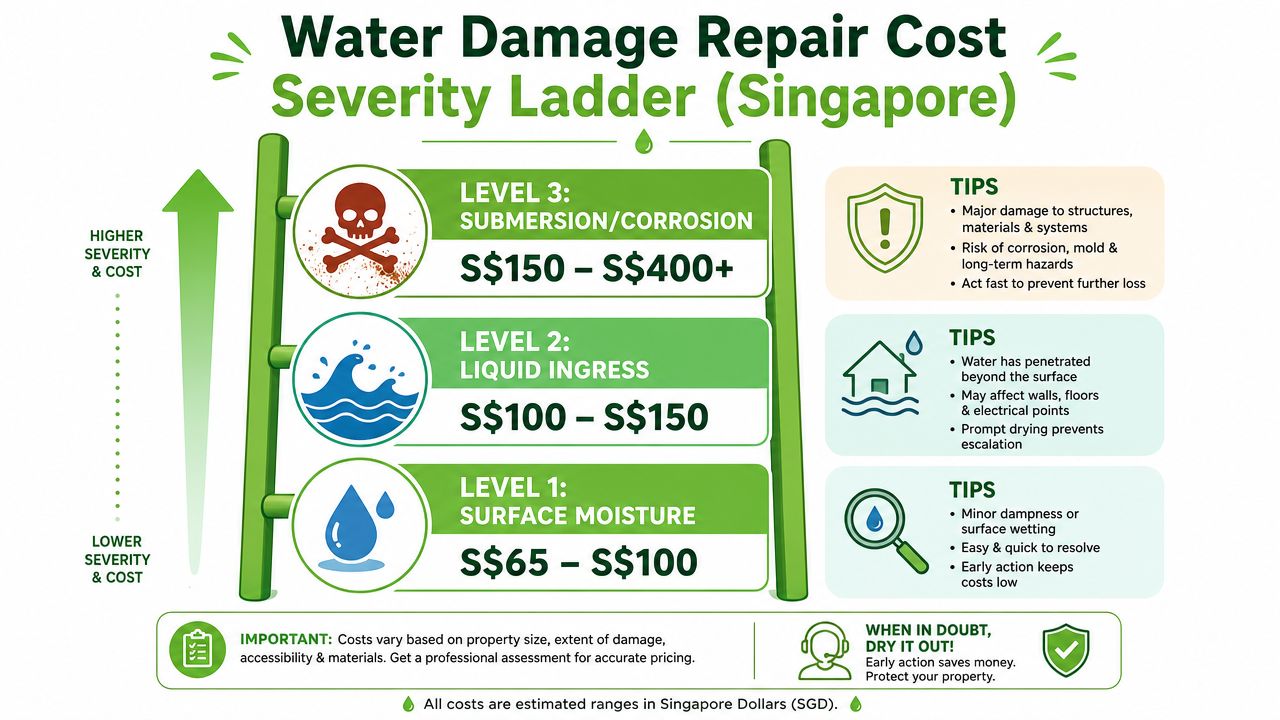
A water damaged phone repair cost is best read as a severity ladder, not a flat price list. If the phone only needs ultrasonic cleaning and a proper inspection, the quote stays near the low end. Once corrosion reaches power rails or the motherboard, the bill jumps fast because the labour, risk, and parts involved are completely different. International repair guides place basic cleaning and drying around $49 to $150, logic-board work around $150 to $599+, and more involved liquid-damage jobs can climb much higher when board work is required, which lines up with the Singapore planning band of roughly S$65 to S$470 before model-specific parts are added. GadgetMates
The three tiers that actually matter
The low tier covers diagnosis, cleaning, and a proper look inside. You pay for the shop to open the handset, clear residue, and check whether the damage stopped at the surface. The middle tier usually means a part swap, such as a charging flex, battery, or another subassembly that took the hit. The top tier is motherboard contamination, and that is where the quote starts to look uncomfortably close to replacement.
That split matters in Singapore because the same spill can mean very different decisions for different phones. A lower-end Android phone often gets written off once the estimate creeps up, because the remaining resale or replacement value is too low to justify board-level work. A flagship iPhone owner is more likely to pay for heavier repair because the device is worth more to save, and Apple's Singapore out-of-warranty replacement fees run from about S$649 to S$1,539 depending on model, including S$1,539 for the iPhone 15 Pro Max. That range explains why one owner says yes immediately and another walks away. Apple Singapore pricing
Bottom line: if corrosion is still localised, cleaning and a few parts make sense. If the board is involved, the quote stops being a repair quote and starts becoming a value judgment.
A sensible quote should spell out diagnostics, ultrasonic cleaning, labour, and any parts the shop expects to replace. Deeper board repair, microsoldering, and data recovery should be called out separately, especially if the phone no longer boots cleanly.
Singapore owners should read the quote as a decision tree. First, is the handset worth saving as a phone. Second, is the data worth paying extra to recover. Third, if the numbers are ugly, does a refurbished replacement or trade-in make more sense than pouring money into a board that may fail again. For a practical parts check, see this guide to phone repair parts.
If a shop cannot tell you whether the issue is surface moisture, liquid ingress, or corrosion on the board, the estimate is too vague to trust. In that case, you are not buying a repair. You are gambling on a vague promise.
DIY vs Professional Repair in Singapore
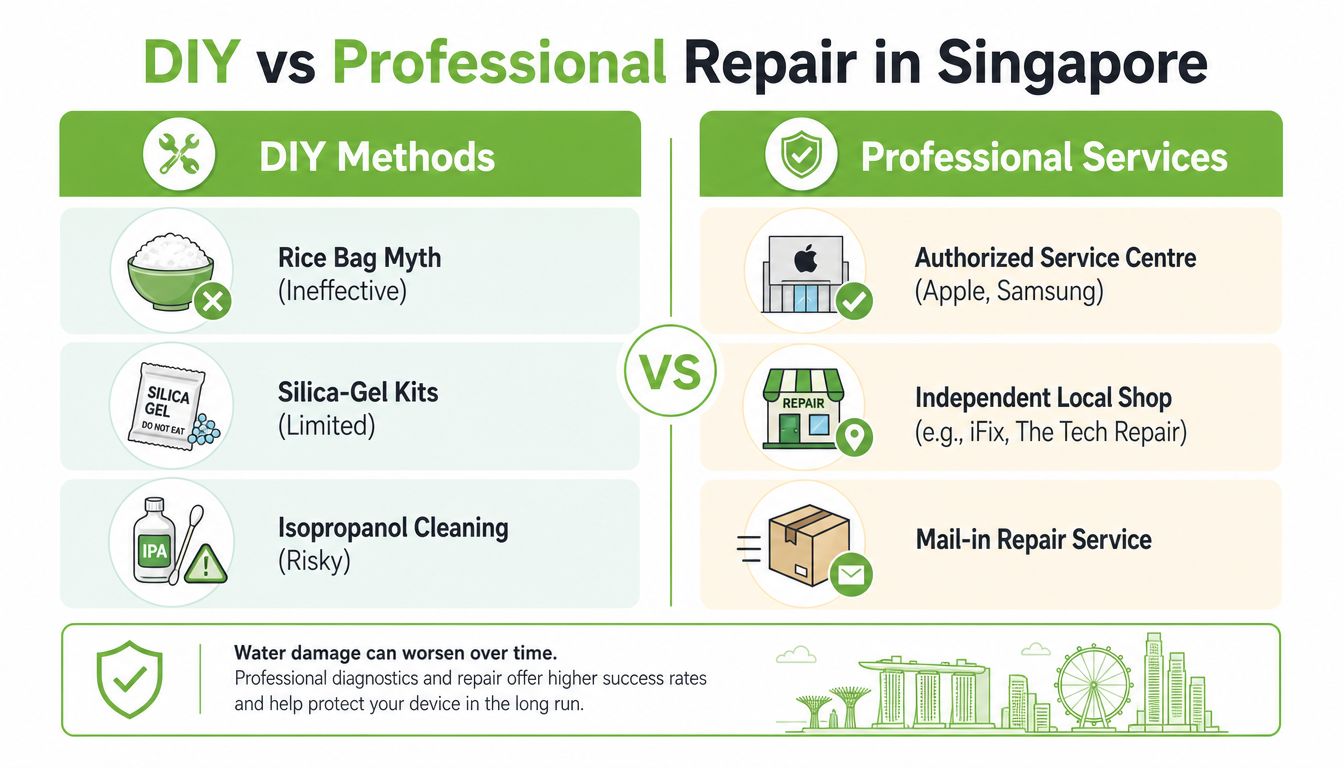
DIY works only in a narrow window, and people usually overestimate how wide that window is. If the phone was splashed with clean water, powered off fast, and hasn't shown weird charging behaviour, a careful drying approach can buy time. If the device is already warm, flaky, or rebooting on its own, DIY is mostly procrastination dressed up as action.
What makes sense and what doesn't
The rice-bag myth is still popular because it feels cheap and tidy. It's also weak medicine. Silica gel is better than rice for moisture control, but it still doesn't clean corrosion off connectors or board traces. Isopropanol can help in controlled hands, but used badly it adds risk rather than removing it.
Professional repair is where the detailed work happens, because the technician can inspect for residue, open the device, and decide whether cleaning is enough. That's why a proper diagnostic visit often costs more than a DIY kit, and why a S$100+ professional inspection can save money if it prevents you from turning a small cleaning job into a board repair. The downside of DIY failure is simple, it can move the handset from a low-cost clean into a much higher-cost repair path.
If you're comparing service types, think in severity, not branding. Authorised centres make sense when you want manufacturer handling and are prepared for the higher price tag. Independent local shops are often where owners go for component-level triage. Specialist board-level labs sit at the far end of the spectrum when the phone is already behaving like an electrical fault, not a surface spill.
For parts knowledge, this internal guide is useful before you decide whether to open the device or leave it alone: phone repair parts.
Practical rule: DIY is for buying time, not for proving the phone is fine. If symptoms are already changing, let a technician look before corrosion spreads.
One option Singapore owners can consider is myhalo's Repair and Rescue service, which is built around device assessment and component-level fixes. That matters most when you need a professional reading of whether the phone is worth saving or whether you're better off moving to another path.
How Providers and Insurers Assess Water Damage
A shop doesn't guess on a liquid-damaged phone, it checks for evidence. On iPhones and many Samsung devices, the Liquid Contact Indicator, or LCI strip, can show whether moisture has reached the inside, and that's one of the first things a technician will check. The charging port, SIM tray, and visible corrosion around connectors tell the rest of the story.
What the first diagnostic usually looks like
The process is straightforward. The technician does a visual inspection, checks the LCI, opens the phone if needed, then scans for corrosion on the board and major subassemblies. After that comes the repair path, which may be simple cleaning, a parts swap, or a deeper board-level job if power management or other circuits have been hit. If the phone is dead, that internal check matters even more, because the problem may be much deeper than the outer shell.
Manufacturers and insurers usually look at the same damage through different lenses. Manufacturers often treat liquid damage as out-of-warranty unless the coverage terms say otherwise, while insurers focus on whether the claim fits the policy and which workshop is approved. If you want the first quote to be accurate, bring the model, IMEI, liquid type, time since incident, and the current symptoms. That saves everyone from vague guesswork.
The more precise your story, the better the estimate. “Dropped in tap water at 8 pm, powered off at 8.05 pm, now won't charge” is useful. “It got wet” is not.
For readers trying to understand accidental damage coverage, this page is worth a look: water damage accidental damage. It helps frame the difference between a repair assessment and a coverage decision.
The technician's job is to separate recoverable damage from hidden damage. Your job is to stop the phone from worsening before that assessment happens.
When Replacement, Trade-In, or Refurb Beats Repair
When the quote starts climbing, stop treating it like a repair bill and compare it against the phone's actual value. In Singapore, the right question is whether you should spend more on fixing a wet handset than on moving to a certified refurbished set or cutting your losses altogether. The cleanest ceiling is the device's replacement value, and on the Apple side that spread is wide enough to make the decision obvious once the quote gets too close to the top tier.
| Severity tier | Typical SG cost | Repair or replace? |
|---|---|---|
| Surface moisture, clean-up only | S$65 to S$100 | Repair |
| Liquid ingress with parts replacement | S$100 to S$470 | Usually repair, if the phone still has strong value |
| Corrosion, board work, data recovery | S$600 and up | Replace or trade in, unless the data is critical |
Use the quote as a decision tree, not a flat number. If the repair starts eating most of the phone's current value, replacement usually makes more sense. If the quote is already beyond what a comparable certified refurbished phone costs, repair stops being the sensible play. At that point, you are paying to keep an old device alive when the money could have gone toward a cleaner replacement path.
For the insurance side of the same judgment, compare actual cash value and replacement cost is a useful reference. The wording comes from claims language, but the logic is the same, compare what the phone is worth now against what it costs to get back to usable condition.
A trade-in can be the better exit when the phone is no longer worth fixing. If the device still powers on, or if it has enough remaining value after liquid exposure, a trade-in Singapore route can turn a damaged handset into cash or voucher value instead of leaving it to decay in a drawer. That is the smarter move when the repair quote is chasing the phone's resale value rather than preserving something worth saving.
If the phone is badly corroded, dead, or already past the point where repair feels responsible, refurb or buy-back is the cleaner answer. You keep the decision tied to value, not hope.
Smart Ways to Cut Cost and Protect Your Data
The first hour after liquid contact is where significant savings happen. Power the phone off, don't charge it, remove the SIM and case, and wipe the outside gently. Skip heat, skip rice, and skip the urge to “test” whether it still works, because every one of those habits can make the final bill worse.
First moves that actually help
If the phone is still alive, your goal is to keep it from becoming more damaged before a technician opens it. If you have a backup option available, use it carefully, but only if the device is behaving normally and doesn't need to stay powered down for safety. If it's already unstable, keep it off and go straight to diagnosis.
- Power off immediately: Don't let current run through wet circuits.
- Do not charge it: Charging a wet phone is a great way to worsen shorting and corrosion.
- Remove SIM and case: Let moisture escape and keep accessories from trapping liquid.
- Wipe the exterior gently: Use a dry cloth, no aggressive heat.
For anyone worried about family photos, work files, or chat histories, data comes first when the phone is dead or unstable. That's where a specialist data-recovery path makes sense before any repair that might overwrite storage or worsen board damage. If you need a general reminder of why backup habits matter before disaster hits, this guide is useful: protect your mobile data.
Ways to keep the quote under control
Ask for a diagnostic-only price first. Request ultrasonic cleaning as a standalone service if the damage looks minor. Get two or three workshop views if the phone still has value, because the pricing gap between clean-up, parts replacement, and board work can be wide.
Practical rule: don't approve a repair until the shop explains what damage they found, what's being replaced, and what the next cost jump would be if the board is worse than expected.
If the repair estimate feels heavy, compare it against the cost of a trade-in plus a certified refurbished replacement. That move often makes more sense than sinking money into a tired phone with hidden corrosion. myhalo's Save data service also matters here, because a dead phone with recoverable files is a different problem from a dead phone with no data value.
Your Next Step and the myhalo Path
Use one simple decision flow. If the phone only has minor moisture and it's still working, clean it and monitor it. If it's dead but the data matters, prioritise recovery first. If the quote is high enough to rival replacement, trade it in and move to a certified refurbished device instead of paying for a repair that doesn't make financial sense.
That approach fits the way myhalo handles device life cycles. Repair and Rescue is there for component-level fixes, Save data is there when photos and documents matter more than the handset, Safe data handles certified erasure, and certified ReLoved devices give you a replacement path that doesn't feel wasteful. For people who want to stay practical and responsible at the same time, that's the cleanest route.
If you're standing at the point where the phone is wet, the cost feels unclear, and you don't want to guess wrong, get it looked at early. Bring the device in, ask for a clear diagnostic, and make the decision based on corrosion, data, and real replacement value, not hope.
Your precious files and memories matter to us. Whether you need to protect your privacy with Safe data or rescue lost files with Save data, our caring team is right here to help. Reach out to us today through myhalo and choose the lightest-touch option for your phone, your data, and your wallet.