
That second phone in the kitchen drawer still switches on. The photos are old, the case is scuffed, and you keep meaning to deal with it. Listing it yourself means photos, chats with strangers, and a worry that your messages are still on the device. Throwing it out feels worse, because a working phone shouldn't become waste.
A phone buy back is the calmer middle path. You hand the phone over, the provider checks it, and you leave with cash, store credit, or a voucher. The phone is then reused, taken for parts, or recycled on a proper route. That is what Declutter your e-clutter is for, alongside Safe data, so you can let go without fearing a leak.
You don't have to become an e-waste specialist first. The offer, the payout, the route for an unsold phone, and the proof that your data is gone all fit on one afternoon. The best result isn't always the biggest cash figure. It's a clear record that your data is gone, plus a clear next life for the phone.
Table of Contents
- What a Phone Buy Back Is and How It Works
- How Buy Back Quotes Are Worked Out
- Is a Phone Buy Back Worth It? Pros and Cons
- Buy Back Routes Compared and Where Unsold Phones Go
- Spotting a Trusted Buyer Before You Sell
- Wipe Your Phone and Take the Next Step
What a Phone Buy Back Is and How It Works
You set an old phone on the counter. It still switches on. A phone buy back is the exchange that follows: the provider checks the device against your description and pays you in cash, store credit, or a voucher.
A buy back works like a used-car desk, only smaller. A phone that runs well can be resold. One that does not can still give up a screen, a battery, or a board. Payment should come with two proofs. Your data was erased, and the phone has a clear route: resale, parts, or responsible recycling. The highest cash offer, on its own, is not the full result.
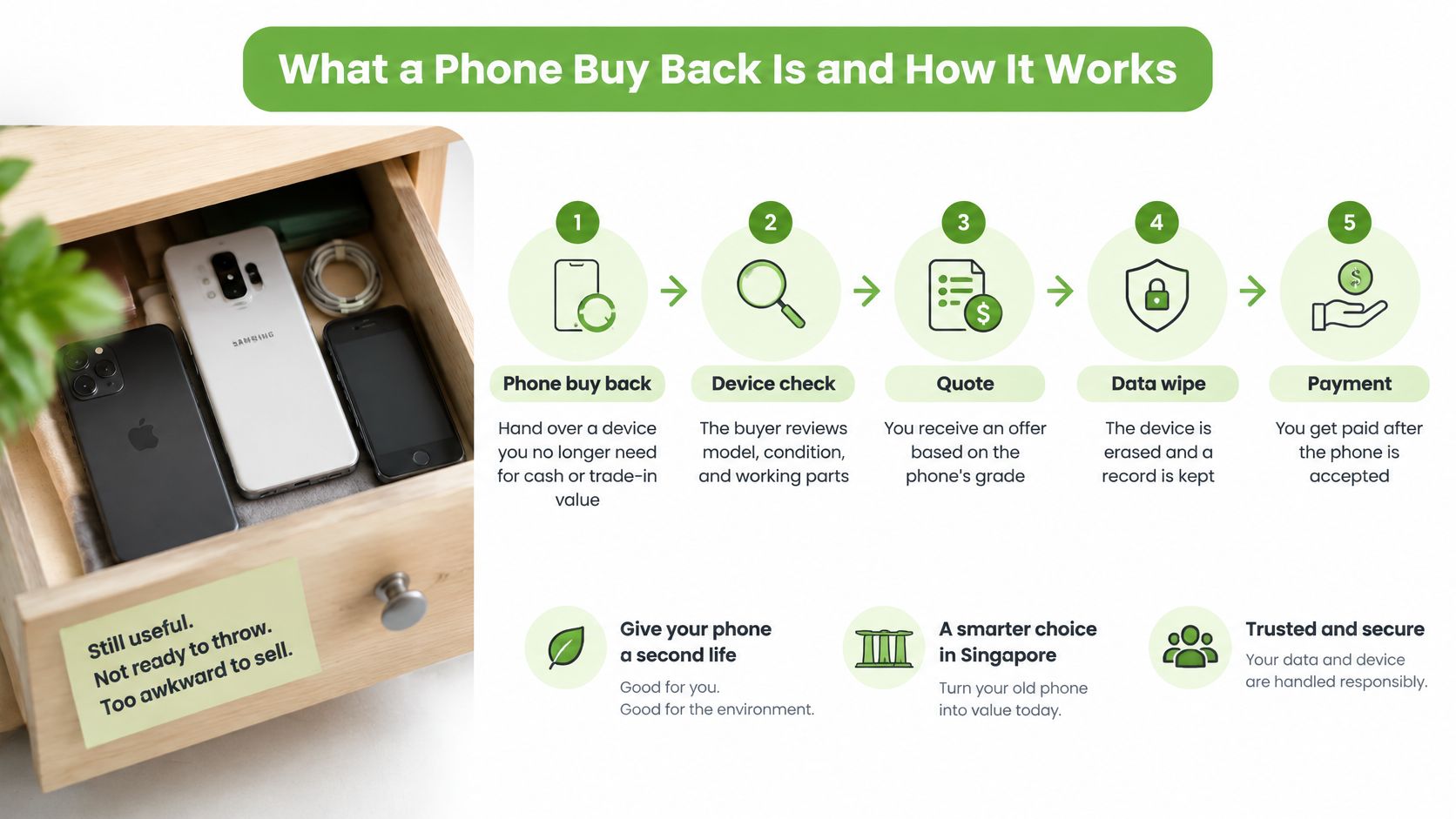
The handoff is a short sequence.
- Get a quote. Share the model, storage size, and condition.
- Bring it in or post it. A shop counter or a collection slot is the handoff.
- Let them inspect it. They confirm the offer against what you described.
- Get paid. Payment follows once you accept that confirmed offer.
- The phone moves on. It is erased, then resold, repaired, or recycled.
Erased means photos, messages and signed-in accounts are removed, so the next holder cannot open them. Ask for proof of that wipe, and for the route if the phone is not resold.
Why so many homes have a spare
Phones are nearly universal in Singapore homes. Many households also keep older handsets they no longer use, stored away instead of recycled. Cupboards fill up.
Offices hit the same snag with laptops and monitors. A plain walk-through of how IT equipment buyback works shows the same idea at a larger scale: intake, a value check, then reuse or recovery instead of a general-waste bin.
Open Settings and note the model and storage size. You'll use both when you test a quote.
How Buy Back Quotes Are Worked Out
Two phones with the same name on the box can land very different offers. The buyer isn't pricing the logo. They're pricing what they can resell, repair, or harvest.
What moves the number
Model and age set the ceiling. A recent flagship has buyers. A five-year-old mid-range phone often doesn't. Storage size matters next, because a 256 GB unit sells faster than 64 GB of the same model. Condition grade is the big swing: light wear is one price, a cracked back is another.
Working parts count on their own. Battery health, a bright screen, and a charging port that holds a cable all support a resale grade. A phone locked to a carrier, or still sitting behind activation lock (the setting that ties the phone to your Apple ID or Google account), is harder to pass to the next person, so the offer drops. A box, cable, and charger can nudge it back up. If you want the longer list of resale factors, our note on what affects a phone's resale value sits beside this.
| Grade | What it looks like | Typical effect on quote |
|---|---|---|
| Like new | No marks, working battery, original box and accessories | Highest quote for the model |
| Good | Light scratches, battery holds a full day | Modest reduction |
| Fair | Visible dents or cracked back, all functions work | Larger reduction; parts value counts |
| Faulty | Screen, camera or charging does not work | Valued closer to parts value |
| Dead or water-damaged | Will not power on | Parts or recycling value only |
A two-year-old flagship, two ways
Say the phone is a two-year-old flagship. The back glass is cracked, the screen is clear, and it charges and calls normally. That is a fair grade. You won't see the like-new figure, but the phone can still be repaired and resold, so the offer stays in resale territory.
The same model with a dead battery and a cracked screen is a different object. A buyer can't put it on a shelf tomorrow. The quote leans on parts: a usable camera, board, or housing. That isn't a trick. It's the grade you would have picked if the scratches and the dead battery were described up front.
At myhalo, instant trade-in quotes cover Apple devices, Samsung devices, and gaming laptops. An AI pricing algorithm turns those inputs into a real-time offer so you can see the number before you travel.
Practical rule: If the quote falls at inspection, the grade changed. Describe marks, battery life, and locks honestly, then check that the offer matches the grade you picked.
Is a Phone Buy Back Worth It? Pros and Cons
A buy back suits you when you want a fast, low-effort exit. It stops being the right tool when you want the most money from a popular recent model and you're happy to do the selling yourself.
Speed and ease. An instant quote plus a drop-off or collection replaces photos, listings, and meetups.
Less clutter. Phones that have sat unused for a year can leave the drawer in one trip instead of another month of "I'll list it".
A proper route. When the provider reuses the phone or certifies recycling, it stays out of general waste.
Documented erasure. A written wipe can be safer than an informal sale, where you only have the buyer's word.
The trade-offs are real.
A lower payout. In-demand recent models usually earn more in a private sale.
A revised offer. If the grade you described was too generous, the number drops at the counter.
Little or no cash. A low or zero quote may not pay you, even though the phone still has environmental value.
Proof gaps. Risk stays if the provider can't show how your data was erased.
Choose a buy back when you value speed and proof of erasure. Choose a private sale when the phone is recent, in good condition, and worth the effort. Our guide on when to trade in your phone helps you time that choice.
Buy Back Routes Compared and Where Unsold Phones Go
Pick the route before you chase the biggest number. Cash, credit, a private buyer, a free drop-off, and a parts pathway don't do the same job.
| Route | How you are paid | Speed | Data handling | Best for |
|---|---|---|---|---|
| Buy back to a specialist | Cash after an instant quote | Often same day | Provider should erase and certify | Working phones you want gone quickly |
| Trade-in with a retailer | Credit towards a new phone | At point of purchase | Ask the store for an erasure record | Upgrading in the same store |
| Private sale | Highest possible price for in-demand models | Days to weeks | You wipe it yourself; trust the buyer | Recent flagships in good condition |
| Recycling drop-off | No payment | Immediate | Confirm certified destruction with the collector | Phones with no resale value |
| Upcycle pathway | Voucher for eligible items | After the device is logged and tested | Certified erasure before parts are harvested | Devices too damaged to resell whole |
What you give up on each route
Buy back or trade-in is quick, and it usually pays less than a private sale. You trade some cash for a shorter afternoon and a business that should record the wipe.
A private sale can earn the most on a popular recent model. You supply the photos, the meetup, and the trust. If the buyer ghosts you, that time is gone.
A recycling drop-off pays nothing. It does keep a dead phone out of the rubbish chute, which matters once resale value has gone.
An upcycle route harvests usable parts so another device can be repaired. You may get a voucher rather than cash. Our quality checks on devices we handle are the same idea: test first, then decide whether the whole phone or only its parts should move on.
Our buy back pays cash against your device after an instant quote. Where the phone can't be resold whole, upcycling extends what is left of it, and those parts can rescue other devices.
The pile already in Singapore homes
The scale is easy to underestimate. The National Environment Agency reported that Singapore generates more than 60,000 tonnes of e-waste a year, about 11 kilograms per resident, and that 60% of residents either didn't know or were unsure how to recycle it. The same study found that only 6% of household e-waste was sent for recycling, while residents more often sell or trade in higher-value items such as phones.
A 2025 survey cited by TelcoNews Asia estimated 2.9 million unused smartphones in Singapore homes. The main barriers were data privacy and the lack of convenient return options, while 90% said they would consider reuse, recycling, or return if the process were simpler and more secure.
There is a formal fallback when resale isn't realistic. Singapore's Extended Producer Responsibility system for e-waste began in July 2021, with NEA appointing ALBA E-waste Smart Recycling to coordinate collection. By June 2024, NEA reported more than 20,000 tonnes collected and recycled, across more than 870 collection points. Mobile phones and tablets sit in the regulated ICT category, so a phone that nobody will buy still has a legal collection route.
If nobody buys the phone
Work in this order. Reuse comes first, because a working phone keeps the most of its value. Parts come next, when one fault blocks a resale but the board, screen, or battery can repair something else. Certified recycling is last, when reuse and parts aren't honest options. A zero-dollar quote can still be worth accepting if that route is written down. You didn't earn cash. You did stop a usable board from riding out with kitchen rubbish.
Take the highest offer only when the proof of erasure matches what the phone holds. Ask, in plain words, where any phone that isn't bought will end up.
Spotting a Trusted Buyer Before You Sell
Judge the buyer before the phone leaves your hand. A friendly counter isn't the test. The paperwork is.
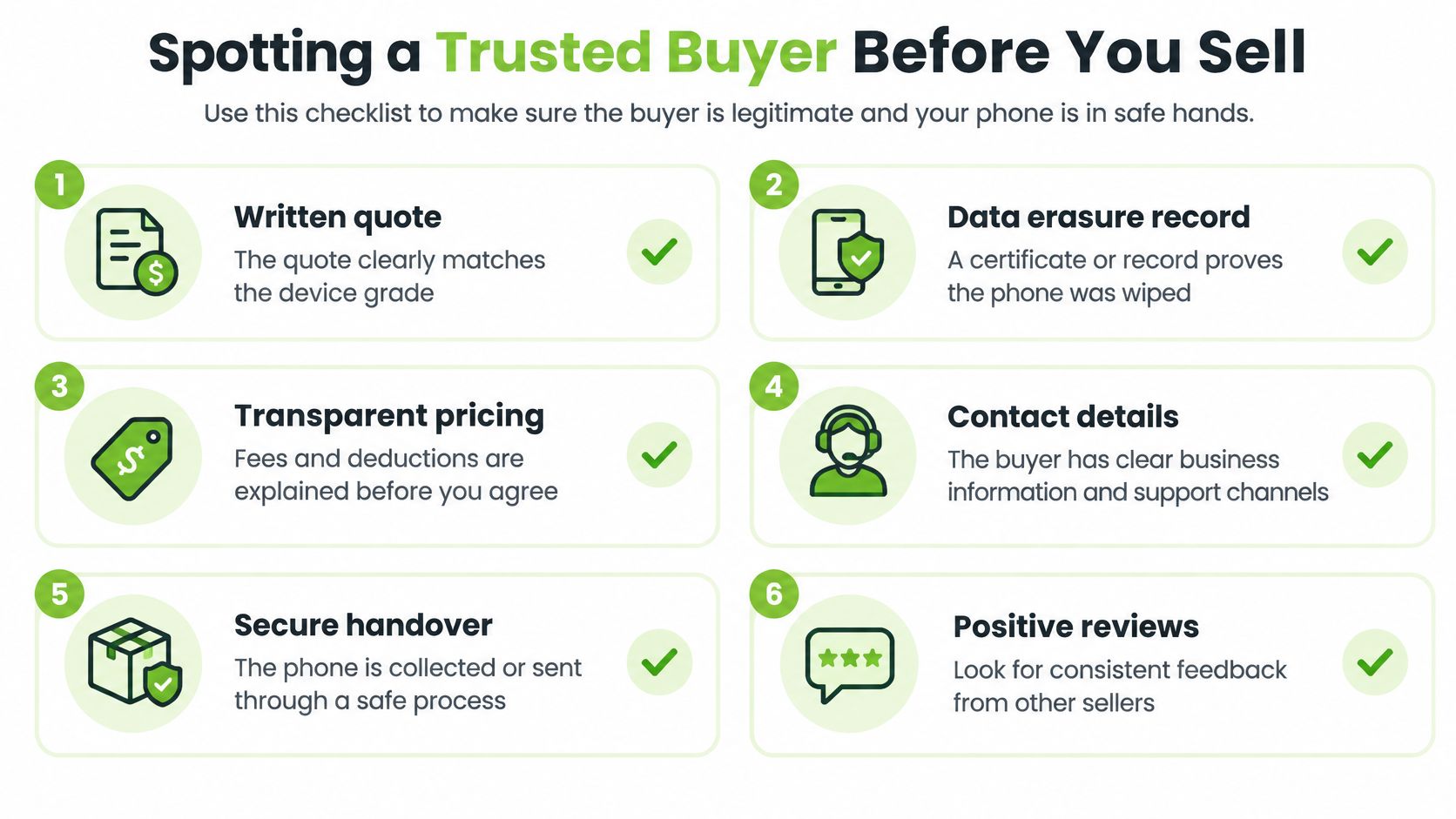
A written quote that matches the grade. If you said "fair, cracked back", the offer shouldn't assume "like new" and then collapse later.
Documented erasure. Ask for a certificate or a record, not a spoken "we'll wipe it".
A chain of custody. That phrase means a paper trail linking the device identifier, the intake condition, how it was sanitised, the check that the wipe worked, and the final route. If a record breaks, nobody can tell you where your data went.
A stated downstream route. Reuse, parts, or certified recycling should be named before you agree.
A real handover. Drop-off or collection should come with an address you can visit, not only a chat account.
A rejection policy. You should know whether a refused phone comes back to you, goes to parts, or goes to recycling, and whether that needs a second yes from you.
Why the paperwork matters
Singapore's Personal Data Protection Commission states that the PDPA Protection Obligation under Section 24 requires organisations to make reasonable security arrangements against unauthorised access, use, disclosure, copying, modification, disposal, or similar risks. When storage media is redeployed, exchanged, or disposed of, personal data must be securely deleted, erased, or destroyed so it can no longer identify someone. A buyer who can't explain their method is a red flag, whether you're handing over one phone or a small office fleet.
We run this as a zero e-waste platform: upcycle, rescue, and relove devices in a way that stays convenient, safe, and responsible. You can get an online instant quote, then drop a phone at Bugis Junction or Sim Lim Square. Data handling is ISO-aligned, and certificates are available on request. Sellers have left around a 4.9-star rating across more than 1,000 Google reviews, which is a useful cross-check beside the paperwork, not a substitute for it.
The myhalo Promise: Joining a zero e-waste habit should feel good and stay easy. Safe data keeps your privacy protected, and Declutter your e-clutter makes clearing old devices convenient, safe, and responsible.
Red flags
A vague wipe. "We wipe everything" with no method and no record.
Cash and no receipt. You can't match a phone to a payout later.
A quote far above the market that asks you to ship the phone before anyone inspects it.
Wipe Your Phone and Take the Next Step
Do the wipe yourself even when the buyer will erase it again. Your copy of the memories stays with you. Their record shows the next person didn't inherit your accounts.
- Back up photos, messages, and files to a cloud account or a computer. That backup is the copy you keep. The phone should hold nothing you still need.
- Sign out of your Apple ID or Google account and turn off activation lock. The next owner shouldn't boot into a screen that only your password can clear.
- Remove the SIM, any memory card, and eSIM profiles. Those can hold contacts and login data outside the main storage, so a reset of the phone alone misses them.
- Factory reset, then watch it restart. You want the setup screen, the one a new phone shows, not your home screen.
- Write down the date, the buyer, and any erasure certificate. A note in your email is enough for a personal phone. Match it to the serial or IMEI so the record belongs to that device.
If the phone will not switch on
A factory reset can't be trusted when the phone won't boot. You can't see the setup screen, and you can't confirm the accounts are gone. Encrypted storage, a dead board, or a water-damaged handset all sit in that gap.
NEA requires licensed e-waste recyclers to make sure data on data-bearing equipment is permanently erased or destroyed before reuse or downstream processing. Where that erasure can't be verified, physical destruction of the storage or the board is the safer end. Ask for the record that ties the device identifier, the intake condition, the method, the verification, and the final disposition. Our note on secure data destruction spells out what that record should contain.
A verbal "it's gone" is fine for a personal phone with nothing sensitive, when you already signed out and you saw the setup screen. It isn't fine for work mail, banking tokens, medical files, or anything your employer would audit.
Work phones and your next move
Hand a company phone to your IT team, not to a buyer you found alone. Ask them for a documented certificate. They should remove management profiles and accounts before the device is sold, upcycled, or destroyed. We repair, buy, and sell smart devices in Singapore, so a phone that fails the wipe can still be assessed rather than left in a drawer.
Then take these four steps.
- Note the model, storage size, and grade.
- Compare at least two routes from the table above, cash against convenience.
- Check the buyer against the six-point list: quote, erasure record, custody trail, downstream route, real address, and rejection policy.
- Book a drop-off or collection only after those three feel solid.
If the phone is too tired for a cash offer, our Upcycle service gives a $30 voucher for de-cluttering e-clutter, and the usable parts can help another device stay in service.
Ready to feel lighter and do good? Let's clear out those old devices together. Check out our Declutter your e-clutter programme today and see how convenient it is to make a positive splash for our environment.
We buy phones for cash after an instant quote, and we erase them with a record you can keep. If a device is past resale, upcycling and certified recovery still keep it out of general waste. Visit myhalo and bring that drawer of old phones into a zero e-waste habit that stays simple.