

iPhone motherboard repair in Singapore typically costs S$120 to S$800, while starting diagnostic and microsoldering fees are around S$90 to S$158 before GST, depending on the model. The final invoice depends on the failed circuit, repair complexity, parts availability, and the technician's diagnosis.
A dead iPhone can feel like a small disaster, especially when it holds family photos, work files, messages, and years of personal history. You may be wondering whether the problem is just a charging port, a tired battery, or something deeper inside the logic board.
The good news is that a non-booting iPhone isn't automatically destined for the recycling bin. Component-level repair can sometimes rescue the original board, preserve your data, and extend the useful life of the rest of the phone. The important step is understanding what you're paying for before approving any work.
Table of Contents
- Understanding the True iPhone Motherboard Repair Cost
- Key Factors That Influence Your Final Repair Quote
- Repair vs Replacement and AppleCare+ Alternatives
- Protecting Your Privacy and Data During Board Repairs
- How to Vet Local Repair Shops and Request Transparent Quotes
- Extending Device Life for a Zero E-Waste Future
Understanding the True iPhone Motherboard Repair Cost
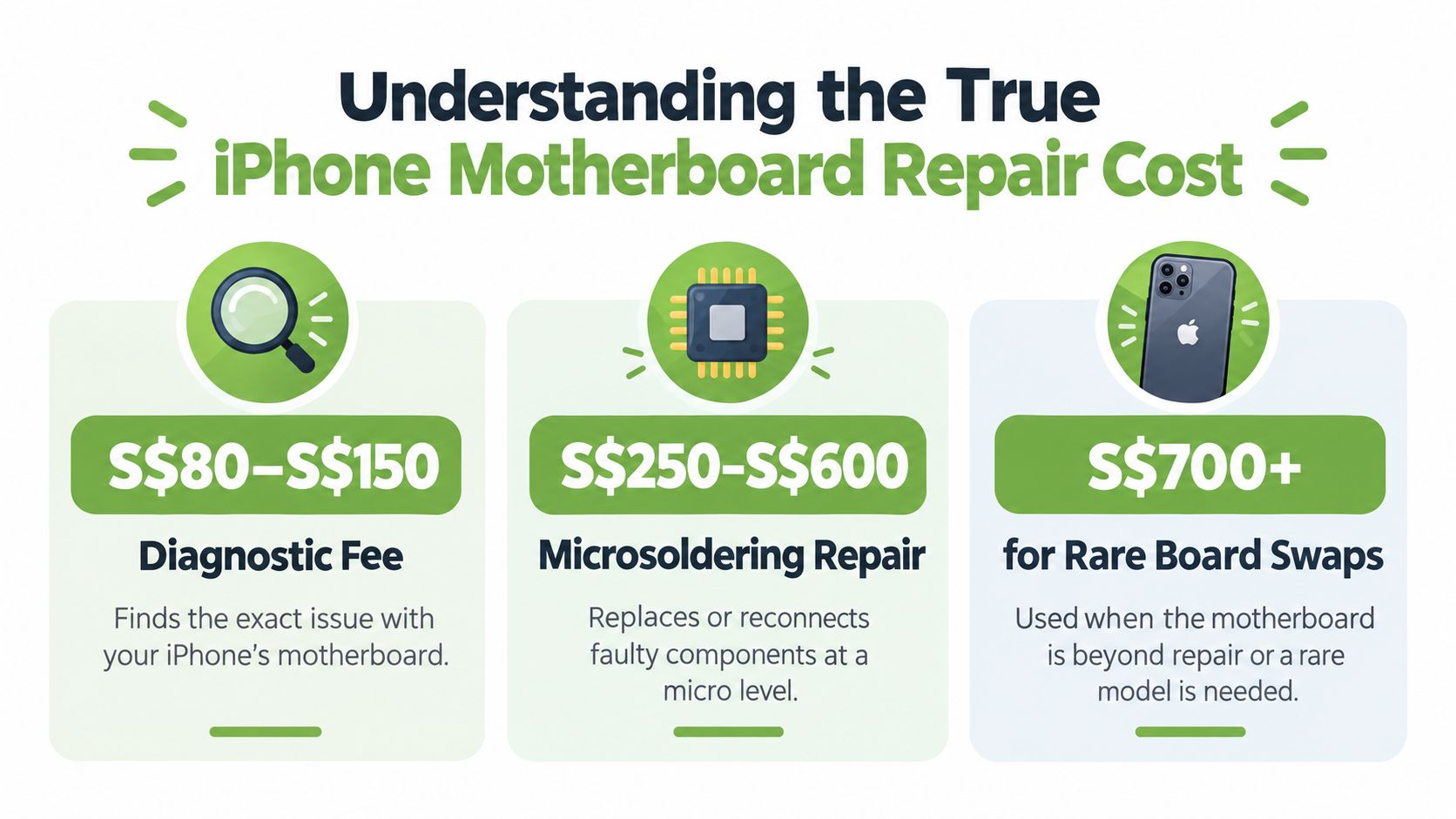
A screen replacement is usually easier to price because the technician replaces one recognisable assembly. Motherboard repair is different. The logic board is more like a dense city than a single part. Thousands of tiny routes carry power and data between chips, storage, charging circuits, cameras, audio functions, wireless systems, and security features.
A technician must first locate the failed route or component. That may involve a charging IC, a damaged power rail, an audio circuit, NAND storage, a shorted capacitor, or another board-level fault. The board is examined under magnification, tested with specialist equipment, and repaired with precision microsoldering. The quote reflects that investigative work, not just the price of a replacement component.
A Singapore repair-cost report places board-level or logic-board work at approximately S$120–S$800, with an expected turnaround of 3–7 days. The same range reflects differences in the failed component, microsoldering complexity, technician bench time, and replacement-part availability. You can review the broader Singapore iPhone repair cost guide for additional context.
What the starting price usually means
A separate Singapore service listing gives indicative starting prices of S$90 for older iPhones, S$108 for iPhone X–13 models, and S$158 for iPhone 14–17 models, before Singapore's 9% GST. After GST, those figures become approximately S$98.10, S$117.72, and S$172.22, respectively, as shown in the Singapore motherboard repair pricing reference.
These are starting points, not guaranteed totals. A straightforward component restoration may stay near the lower end, while corrosion, a missing chip, severe board damage, or a difficult data-preservation requirement can push the cost much higher.
Practical rule: Treat the first price as an entry point for diagnosis, not as a promise that every motherboard fault costs the same.
Before choosing a shop, compare the quote structure with the shop's repair scope. A guide to mobile phone repair in Singapore can also help you understand how board repair differs from more familiar services such as screen, battery, and charging-port replacement. For comparison, businesses looking beyond device repair may find a similar need for transparent itemised estimates in resources covering pricing for commercial cleaning. The industries differ, but the principle is useful: know which labour, materials, and diagnostic steps are included.
Key Factors That Influence Your Final Repair Quote
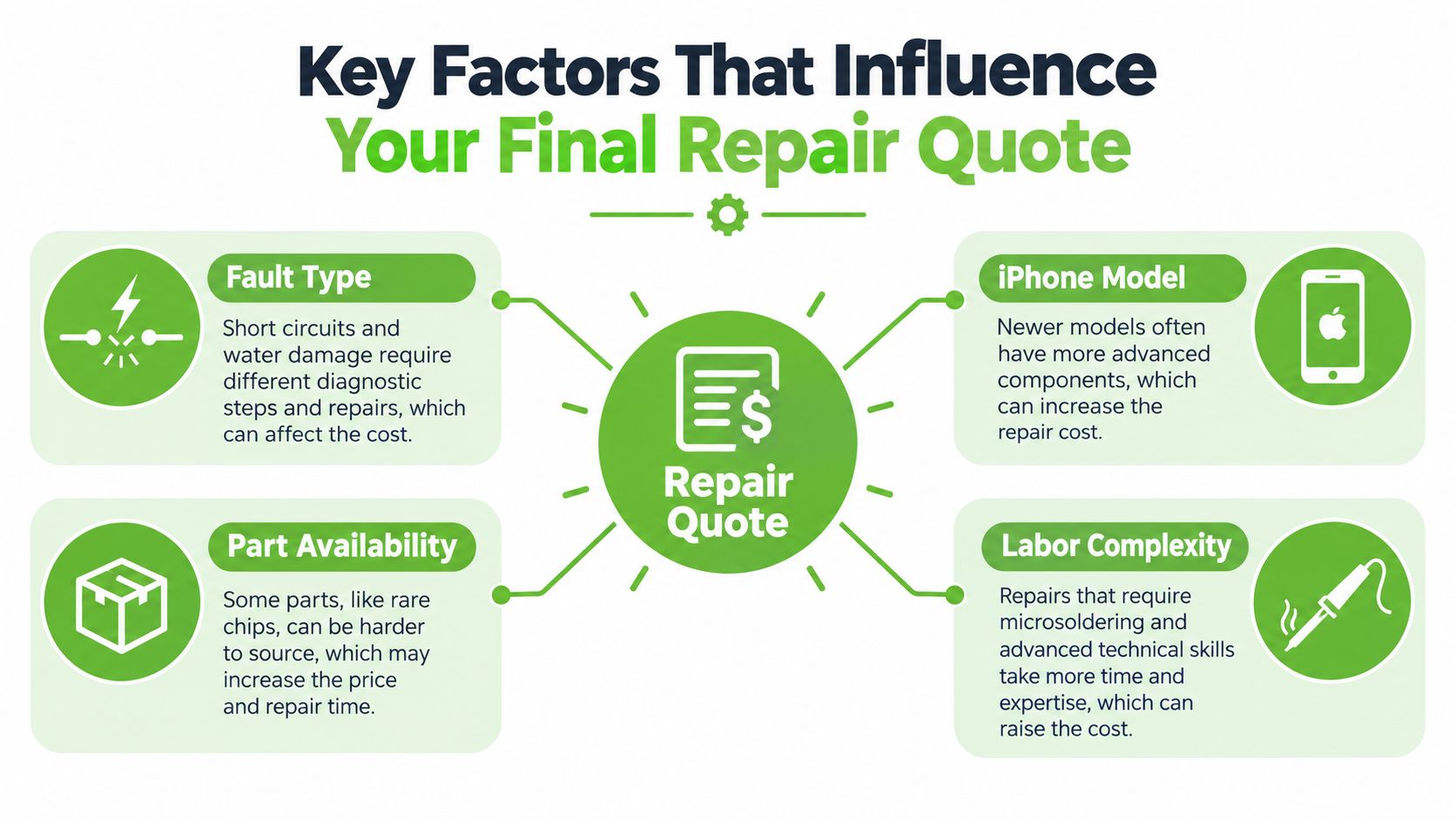
The symptom you see is only the opening clue. A phone that won't charge, a phone stuck in a boot loop, and a phone with failed Face ID may all have different causes inside the board.
Think of the logic board as a city with separate transport routes. If one road is blocked, traffic may stop in one district. If a central power route is damaged, the entire city may go dark. The technician's job is to identify the blocked route before deciding whether a small repair is possible.
Fault type changes the work involved
Charging faults may involve the charging IC, the port circuit, a power-management area, or a shorted component. A boot loop may point towards storage, power delivery, software interaction, or another board subsystem. Audio, Wi-Fi, Face ID, and camera problems each require a different diagnostic path.
Liquid exposure adds another layer. Water and contaminants can affect several circuits at once, while corrosion may continue even after the phone appears dry. Tell the technician exactly what happened, including exposure to rain, a sink, a pool, or spilled drinks. Hiding liquid damage doesn't protect the phone. It makes diagnosis less accurate.
Model and parts availability matter
Newer iPhones usually carry higher minimum charges, as reflected in the Singapore starting prices above. Their boards may also use more specialised layouts and less readily available components. A rare chip or donor part can increase waiting time and the final quote.
Published prices may also exclude GST. Confirm whether the quotation includes Singapore's 9% GST, rather than calculating the total from a headline starting price alone.
Labour is more than soldering
Microsoldering requires controlled heat, a steady hand, magnification, and a clear understanding of the surrounding circuitry. Removing one damaged component without harming nearby parts can take careful preparation and testing.
Ask the shop to separate these items in writing:
- Diagnostic work: What tests will be performed before repair approval?
- Microsoldering labour: Is board-level labour listed separately from parts?
- Replacement components: Are parts original, donor, or compatible alternatives?
- Data recovery: Is any data-focused work included, or charged separately?
- No-fix policy: What happens if the board cannot be repaired?
The motherboard replacement guide can help clarify why a component repair and a complete board replacement aren't interchangeable options. A component repair aims to preserve the original board. A board swap changes the central hardware and may create data-access, pairing, or security complications.
Repair vs Replacement and AppleCare+ Alternatives
The smartest repair decision isn't based on the original purchase price. Compare the written quote with the iPhone's current resale value, replacement cost, age, battery condition, and the personal value of the data stored on it.
A Singapore repair analysis gives a clear example. It considers a S$250 logic-board repair for an iPhone X with an estimated value of around S$150, concluding that the repair doesn't make financial sense on resale value alone. The same analysis notes that logic-board and severe water-damage jobs can quickly exceed that value. You can read the full iPhone repair value analysis before making a decision.
Data can change the calculation completely. A phone containing irreplaceable photos, business records, or messages may justify repair even when the resale maths looks poor. A working phone also preserves its screen, cameras, battery, enclosure, and other usable parts, which avoids replacing an entire device unnecessarily.
AppleCare+ offers a more predictable route for eligible accidental damage. Apple's Singapore AppleCare information lists two-year plans starting from S$199, with prices varying by model. It lists a S$42 service fee for screen or back-glass damage and a S$148 service fee for other accidental damage, including liquid damage. Check your plan status and applicable fee before approving an uncovered board repair through the AppleCare+ Singapore service information.
| Scenario | Best Path Forward | Why It Makes Sense |
|---|---|---|
| The phone is newer, otherwise functional, and the board fault is repairable | Request component-level repair | You may preserve the original device and avoid replacing working assemblies |
| The phone is older and the quote is close to or above its resale value | Compare repair with a certified replacement | The repair may not be financially sensible on resale value alone |
| The phone contains irreplaceable photos or files | Prioritise data-preserving diagnosis | Personal data can be worth more than the handset's market value |
| You have active AppleCare+ coverage | Check the applicable service fee first | A fixed covered charge may be easier to budget than an uncovered diagnosis |
| The board has severe corrosion or multiple failures | Request a no-fix assessment | Further work may cost more than the device is reasonably worth |
Protecting Your Privacy and Data During Board Repairs
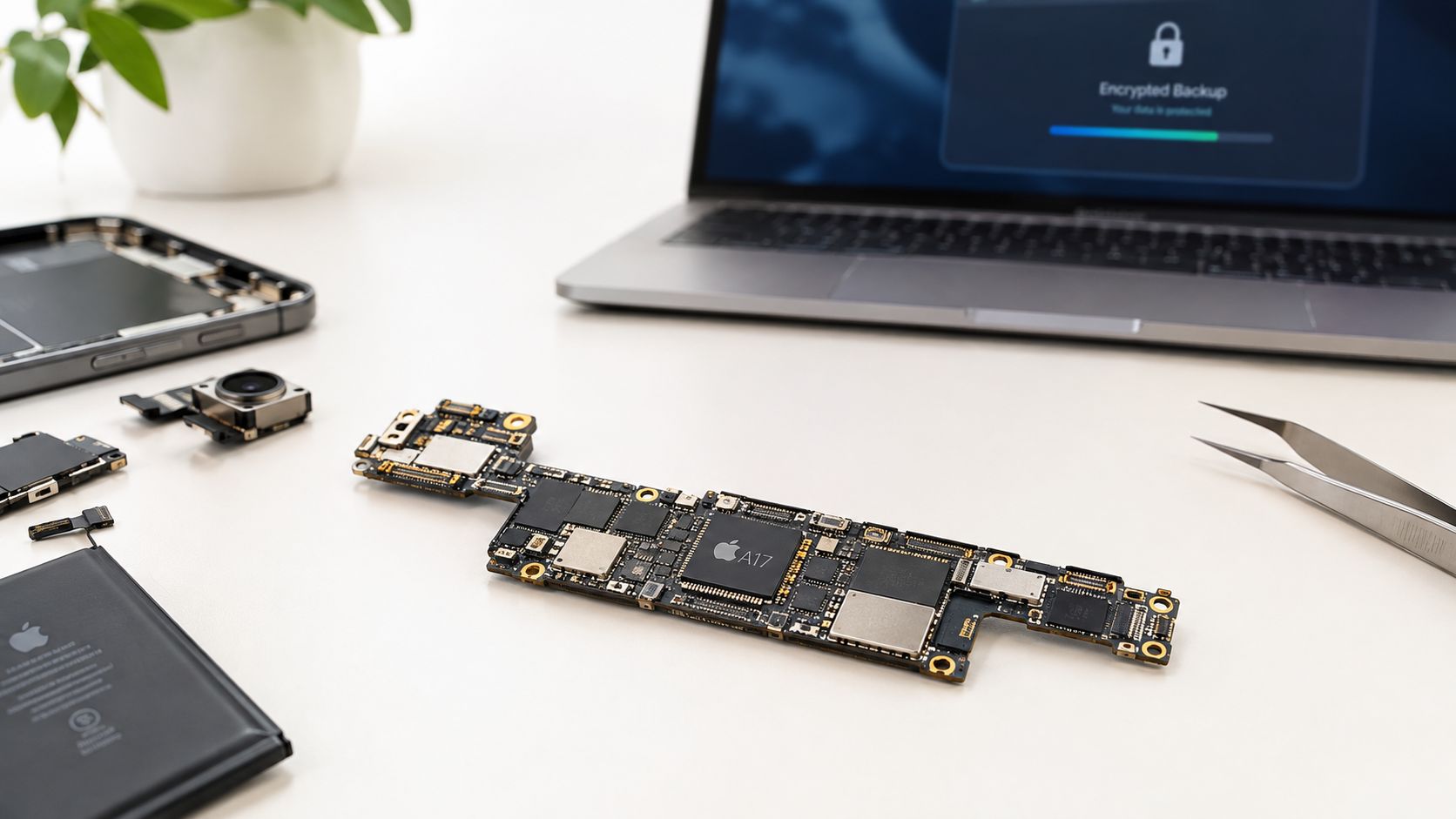
A motherboard repair is also a data-security decision. Your photos and files aren't floating separately inside the phone. They remain associated with the original device hardware and storage circuitry, so changing the board can affect access to the data even if the replacement board makes the handset operate again.
Component-level microsoldering has an important advantage in data-sensitive cases. When a technician repairs the original board, the work aims to preserve the existing storage, security-related circuitry, and device identity. A complete board swap may restore a working phone, but it can also leave you with a factory-reset device and no practical access to the information that was on the original board.
Questions to ask before handing over the phone
Tell the repairer that data preservation is a priority. Ask whether the original board will remain in the device, whether Face ID is expected to remain functional, and whether the shop will attempt repair before recommending a board swap.
You should also ask how staff handle passcodes, backups, diagnostic access, and any temporary copies of files. A trustworthy process explains what access is necessary and limits it to the work being performed. For broader guidance, review this resource on secure data management.
Back up the iPhone if it still starts and you can do so safely. If it won't boot, don't keep repeatedly powering it on or charging it just to test the screen. Repeated testing can complicate a fault, particularly where liquid exposure or a short circuit is involved.
The most useful written protections include:
- Data-preservation request: State that the original board and stored data must be retained where technically possible.
- Face ID clarification: Ask whether Face ID will be tested and whether the repair may affect it.
- Access policy: Confirm who can view the phone and how passcodes or diagnostic access are handled.
- No-fix terms: Get any diagnostic or unsuccessful-repair fee in writing.
- Warranty details: Confirm what the warranty covers and whether corrosion-related failure is excluded.
For a visual explanation of board-level work, watch the following repair video after reviewing the written questions above:
How to Vet Local Repair Shops and Request Transparent Quotes
Singapore gives you plenty of ways to seek a repair opinion, from neighbourhood counters to specialist benches around Bugis Junction and Sim Lim Square. Convenience matters, but the cheapest headline figure shouldn't be your only filter. Board repair quality depends on diagnosis, equipment, workmanship, data handling, and what happens if the first repair attempt doesn't succeed.
Start with the symptoms and timeline. Write down when the issue began, whether the phone was dropped, whether it was exposed to liquid, and what happened immediately beforehand. This gives the technician a better starting point than saying the iPhone is “dead”.
A practical vetting checklist
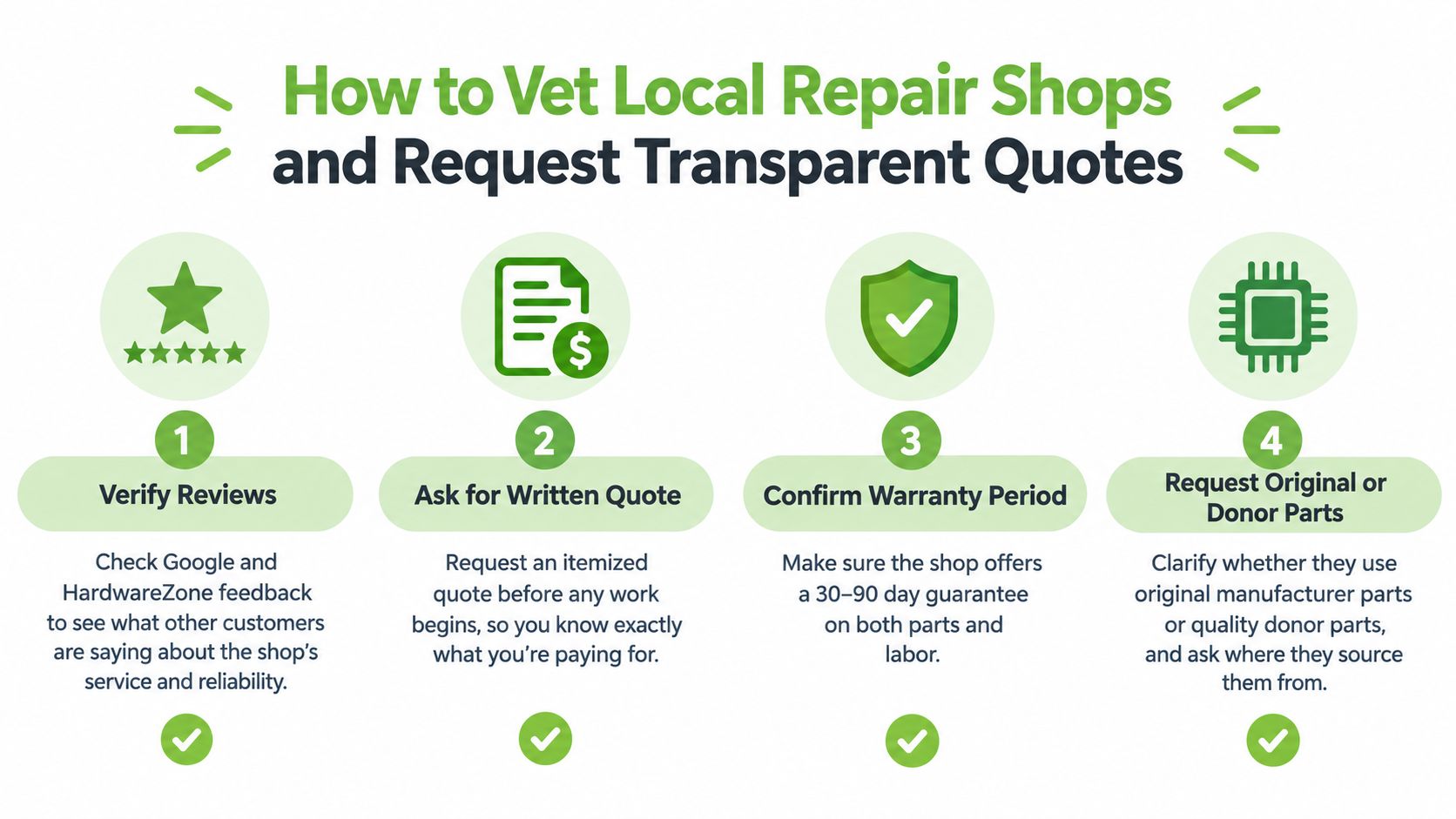
Check relevant feedback. Look for reviews that mention motherboard work, data recovery, corrosion, or no-fix handling. Feedback about screen replacements alone doesn't prove that a shop performs microsoldering.
Request an itemised quote. Ask for separate lines for diagnosis, board labour, replacement components, data recovery, GST, and any no-fix fee. A written estimate makes it easier to compare shops fairly.
Confirm the repair scope. Ask whether the technician will repair the original board or replace it. Also clarify whether parts are original, donor, or compatible, and whether Face ID and stored data are expected to remain intact.
Get aftercare terms. Ask for the warranty period, exclusions, testing process, and what happens if corrosion returns. Liquid damage can continue to affect a board after an apparently successful repair.
Prepare the device carefully
Back up the phone when possible, remove accessories, and record its visible condition before drop-off. Disclose liquid exposure even if the iPhone still works. If the phone contains sensitive business or personal information, ask about secure handling and data destruction if the repair is abandoned.
A simple written template can keep the conversation organised. This downloadable template for quotes can be adapted to record the diagnosis, scope, parts, labour, taxes, warranty, and approval status.
Don't approve an open-ended repair. Set a maximum amount or require confirmation before additional work begins. That one step protects your budget while giving the technician enough room to investigate the board properly.
Extending Device Life for a Zero E-Waste Future
Repairing a logic board can be a financial choice, but it can also be a practical act of environmental care. Singapore's wider e-waste challenge gives that decision added weight. A 2018 National Environment Agency estimate cited in Singapore e-waste reporting put the country's electronic-waste generation at about 60,000 tonnes per year, equivalent to roughly 73 mobile phones' worth of e-waste per resident annually. At that time, only about 6% was being recycled, according to the Singapore e-waste reporting and repair context.
A repaired iPhone keeps more than the logic board in use. It can preserve the screen, battery, cameras, frame, speakers, and enclosure, while avoiding the material and energy demands of replacing the whole device. Even when repair isn't viable, responsible parts recovery and recycling are better outcomes than leaving a dead phone forgotten in a drawer.
The decision still needs to be honest. A high-end repair may exceed the value of an older iPhone, especially if the battery and other components are already worn. A newer phone, a device that remains otherwise functional, or a handset holding important data may justify the work. Ask for a diagnosis, compare the quote with the replacement options, and choose the path that protects both your finances and your information.
A convenient route away from e-waste
A repair and rescue service can assess whether component-level work is possible before you commit to a replacement. If the phone can't be saved, responsible pathways may include data recovery, certified resale, parts harvesting, or secure recycling. Safe data handling matters at every stage, particularly when you hand over a device that still contains personal information.
The zero-e-waste approach is simple: repair what can be repaired, reuse what still has value, recover parts where possible, and destroy data securely before disposal. You can learn more about clearing unused devices through decluttering old tech for a zero-e-waste Singapore.
Repairing one iPhone won't solve the entire e-waste problem, but it does keep a useful device in circulation and turns a stressful failure into a more responsible choice. With a clear quote, careful data protection, and a repairer who explains the options, doing right by your wallet and the planet can feel refreshingly straightforward.
Your precious files and memories matter to us. Whether you need to protect your privacy with Safe Data or rescue lost files with Save Data, the team at myhalo can support repair, recovery, secure handling, and responsible next steps. Reach out today before a damaged iPhone becomes permanent data loss or unnecessary e-waste.