

A cracked screen in Singapore commonly costs between $50 and $300, depending on the issue, and trusted providers often complete standard repairs within 30 minutes to 2 hours. If your phone has just slipped onto the pavement, the right next step is usually a proper diagnosis, not an instant replacement.
You may be standing outside an MRT station with glass spreading across the display, or watching your battery fall from full to empty before lunch. Perhaps the phone still turns on, but the touch response is unreliable and your banking apps, work messages, photos, and authentication codes are all trapped inside. That worry is completely understandable.
Singapore has a nearly universal smartphone audience. The IMDA Singapore Digital Society Report 2023 records smartphone ownership among 97% of residents, including 89% of seniors aged 60 and above. A repair decision therefore affects far more than a single gadget. It can preserve your daily routine, protect your data, and keep a useful device in circulation.
This guide approaches mobile phone repair in Singapore through three practical questions: what has failed, whether repair makes financial sense, and what happens to your data and device afterwards. It also connects that decision to myhalo's goal of making a zero e-waste lifestyle convenient, safe, and responsible.
Table of Contents
- When Your Phone Breaks in Singapore, What Comes Next
- Common Mobile Phone Repair Types and What They Involve
- Understanding Repair Costs and Turnaround Times in Singapore
- Data Security and Warranty Protection During Repair
- Repair or Replace: Deciding What Makes Sense for Your Phone
- How to Choose a Trusted Mobile Phone Repair Provider in Singapore
- Why myhalo Stands Out for Mobile Phone Repair and Beyond
- Your Next Step Toward a Repair That Feels Right
When Your Phone Breaks in Singapore, What Comes Next
A phone can fail at the least convenient moment. It may land face-down, lose battery during your commute, charge only when the cable is held at one angle, or stop responding without warning. Seeing a cracked display naturally raises questions about the camera, battery, and internal components too.
Start by preventing further damage. Keep the device away from moisture, avoid pressing exposed glass, and stop forcing a damaged charging port. If the phone still works, back up important files before handing it over. If it stays off, request a diagnosis and ask how your data can be preserved before approving any reset.
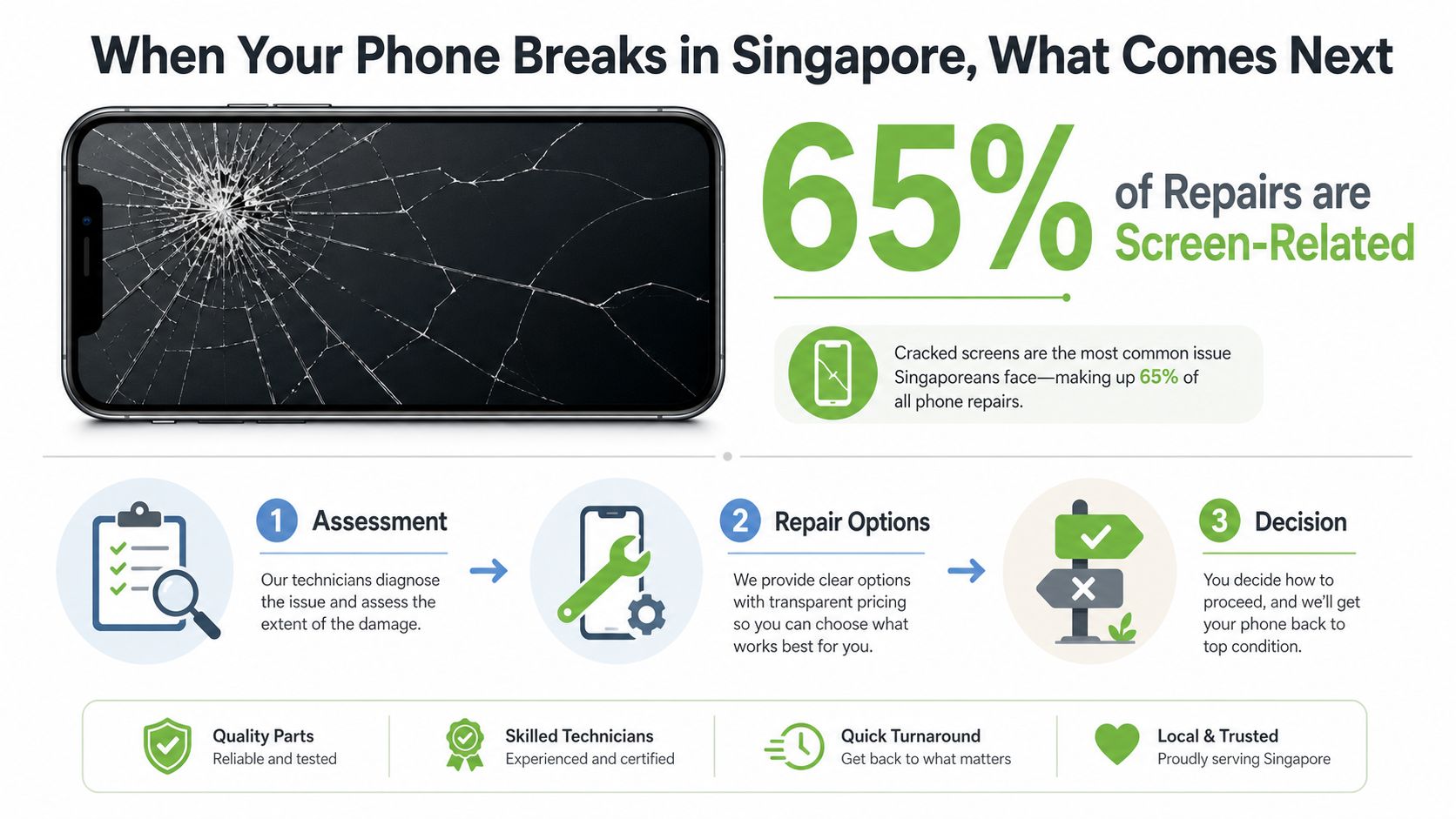
This guide to what you can do after breaking your phone offers a calm sequence:
- Record the symptoms: Check whether the screen displays an image, touch responds, and the phone accepts a charge.
- Protect your information: Back up the device when possible and remove sensitive access before drop-off.
- Request a diagnosis: A visible crack can exist alongside display, connector, or board damage.
- Compare the options: Ask about repair, trade-in, refurbishment, and parts recovery.
Practical rule: A phone that turns on may still be unsafe to use. Flickering, dead touch zones, swelling, or exposed components need prompt attention.
Repair also supports Singapore's circular economy. The country has generated more than 60,000 tonnes of e-waste each year, equivalent to about 11 kg per person, according to the National Environment Agency's e-waste information. Keeping a repairable phone in service preserves its remaining value and delays disposal. It also creates a natural next step for myhalo's zero e-waste lifestyle, where repair, refurbishment, and responsible recovery can work together.
Common Mobile Phone Repair Types and What They Involve
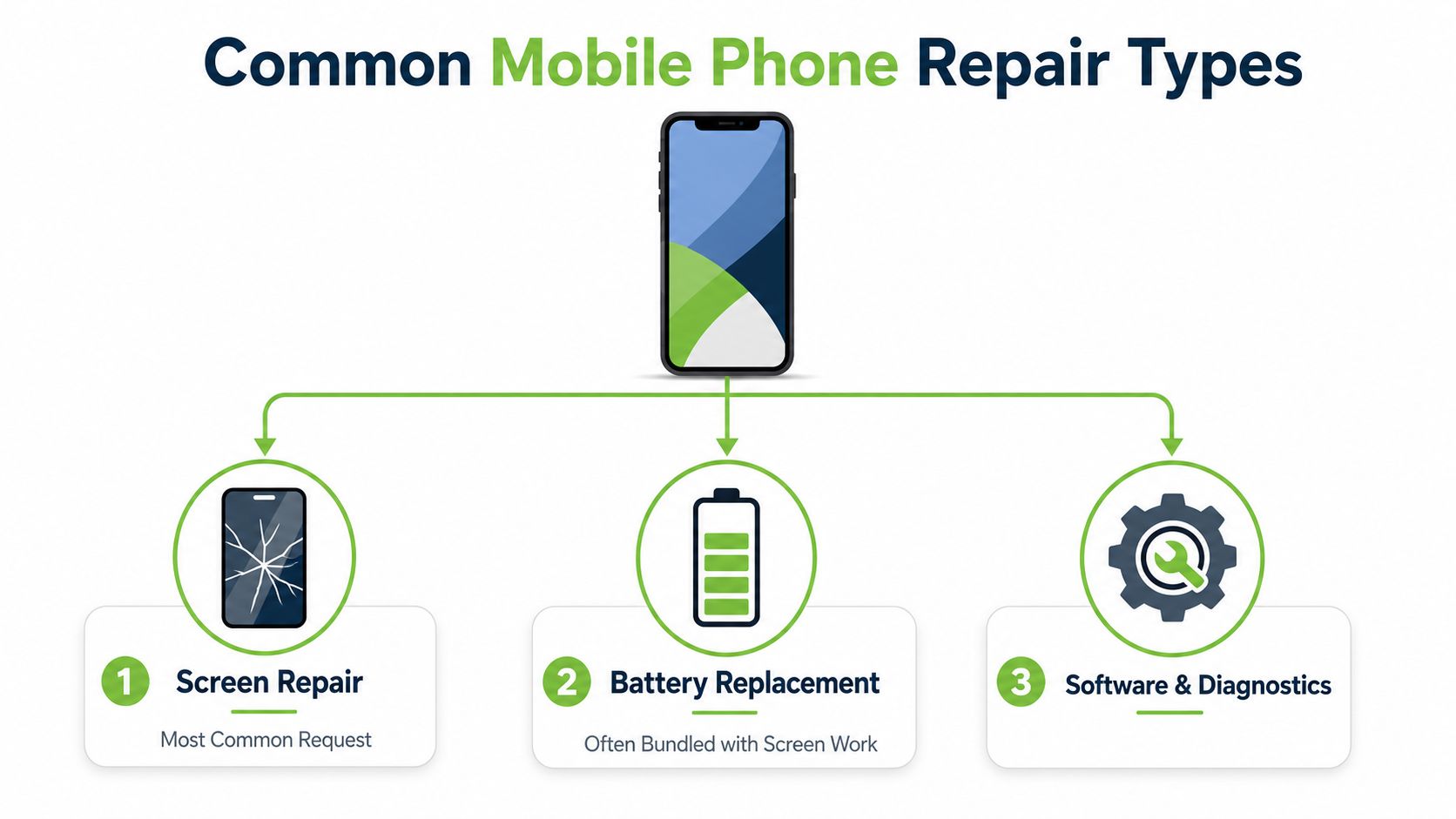
Most repair conversations begin with a symptom, not a technical diagnosis. “The phone won't charge” might mean pocket lint in the port, a worn connector, a failing battery, liquid damage, or a board fault. A careful technician separates those possibilities before replacing a part.
Screen replacement
A screen repair may involve more than changing the top layer of glass. If the picture is clear and touch works everywhere, the damage may be limited. Black patches, flickering, green lines, ghost touches, or dead zones suggest that the display assembly or digitiser has also suffered impact.
The technician should check the frame, front camera, sensors, and touch response before fitting a replacement. Ask whether the proposed part is a complete display assembly and what testing is included afterwards. The phone repair parts guide can help you understand why part quality matters.
Battery replacement
Lithium-ion batteries wear as they go through charging cycles. A Singapore repair source recommends considering replacement when battery health drops below 80%, a threshold associated with noticeable runtime and stability problems, as explained by Phone Doctor Singapore's battery repair guidance.
Look for rapid drain, unexpected shutdowns, unusual heat, or a battery that appears swollen. A good assessment also checks the charging system, because changing the battery won't solve a damaged port or board fault.
Charging, camera, audio, and software faults
Charging ports collect debris and can develop loose connections. Camera modules may lose focus after a drop, while speakers and microphones can suffer from impact or liquid exposure. Software diagnostics can identify failed updates, storage corruption, or app conflicts that mimic hardware failure.
The repair process should finish with functional testing. That means checking charging, touch, cameras, speakers, microphones, biometric features, connectivity, and any other function affected by the original fault.
Understanding Repair Costs and Turnaround Times in Singapore
Repair quotes vary because phones vary. The model, part availability, damage severity, and component quality all affect the final price. A screen assembly for a premium handset may require a different process from a battery swap on an older budget device.
For a practical starting point, common repair work in Singapore generally falls within these broad expectations:
| Repair situation | Typical cost guidance | Typical timing |
|---|---|---|
| Screen or display issue | $50 to $300, depending on the issue | 30 minutes to 2 hours at trusted providers |
| Battery replacement | Within the same broad repair market, depending on model and part | Often completed during the same visit |
| Charging or connector fault | Depends on whether the problem is contamination, the port, or the board | Diagnosis comes before a reliable estimate |
| Board-level or liquid-related damage | Quote depends on internal findings | May require additional working time |
The $50 to $300 range and 30-minute to 2-hour turnaround apply as general expectations for common repairs, not promises for every device. A complex fault can take longer, especially if the technician needs to source a component or investigate damage beneath the visible symptom.
You can also compare your quote with this phone screen repair price guide. The useful question isn't just whether a shop is cheap. Ask what part is included, whether labour and testing are covered, and what happens if the technician finds additional damage.
A transparent provider should explain the diagnosis, quote, part type, expected timing, and warranty before work begins.
Be cautious if a shop gives a firm price without inspecting the phone, refuses to explain the part grade, or adds unexplained charges after opening the device. A written intake record protects both sides and makes the decision easier.
Data Security and Warranty Protection During Repair
Handing over a phone can feel more personal than handing over a laptop. Your photos, messages, contacts, banking apps, work files, and login codes may all be within the same small device. That concern isn't excessive. It should shape the provider you choose.
Before repair, back up what you can, remove the SIM card and memory card if applicable, sign out of sensitive apps where practical, and disable biometric access temporarily. Ask whether the technician needs your passcode. Many hardware repairs can be tested without opening every personal account, although the exact requirements depend on the fault.
Singapore's e-waste framework requires licensed recyclers to permanently erase or destroy data stored on data-bearing devices before reuse, recycling, disposal, or transfer. The requirement is supported by the Singapore Statutes Online framework, and non-compliance can attract a fine of up to S$10,000. Relevant records must also be retained for five years, as outlined in Singapore's compliance guidance on data erasure.
Those rules mainly address end-of-life handling, but they show why data procedures deserve attention throughout a device's lifecycle. Ask how the provider records your device, limits access, and documents any later transfer, recycling, or destruction. Chain-of-custody documentation is especially relevant when a phone cannot be repaired.
For physical destruction, Singapore's licensed recycling process gives a clear example. A CNA report on device data sanitisation describes hard disk drives being degaussed and solid-state drives being shredded, alongside sanitisation and dismantling. A smartphone may follow a different technical pathway, so ask for the provider's specific process rather than assuming all devices are handled identically.
Warranty protection matters too. Keep the receipt, intake condition, diagnosis, and written warranty terms. Confirm whether the warranty covers the replacement part, workmanship, or only the same reported fault.
Repair or Replace: Deciding What Makes Sense for Your Phone
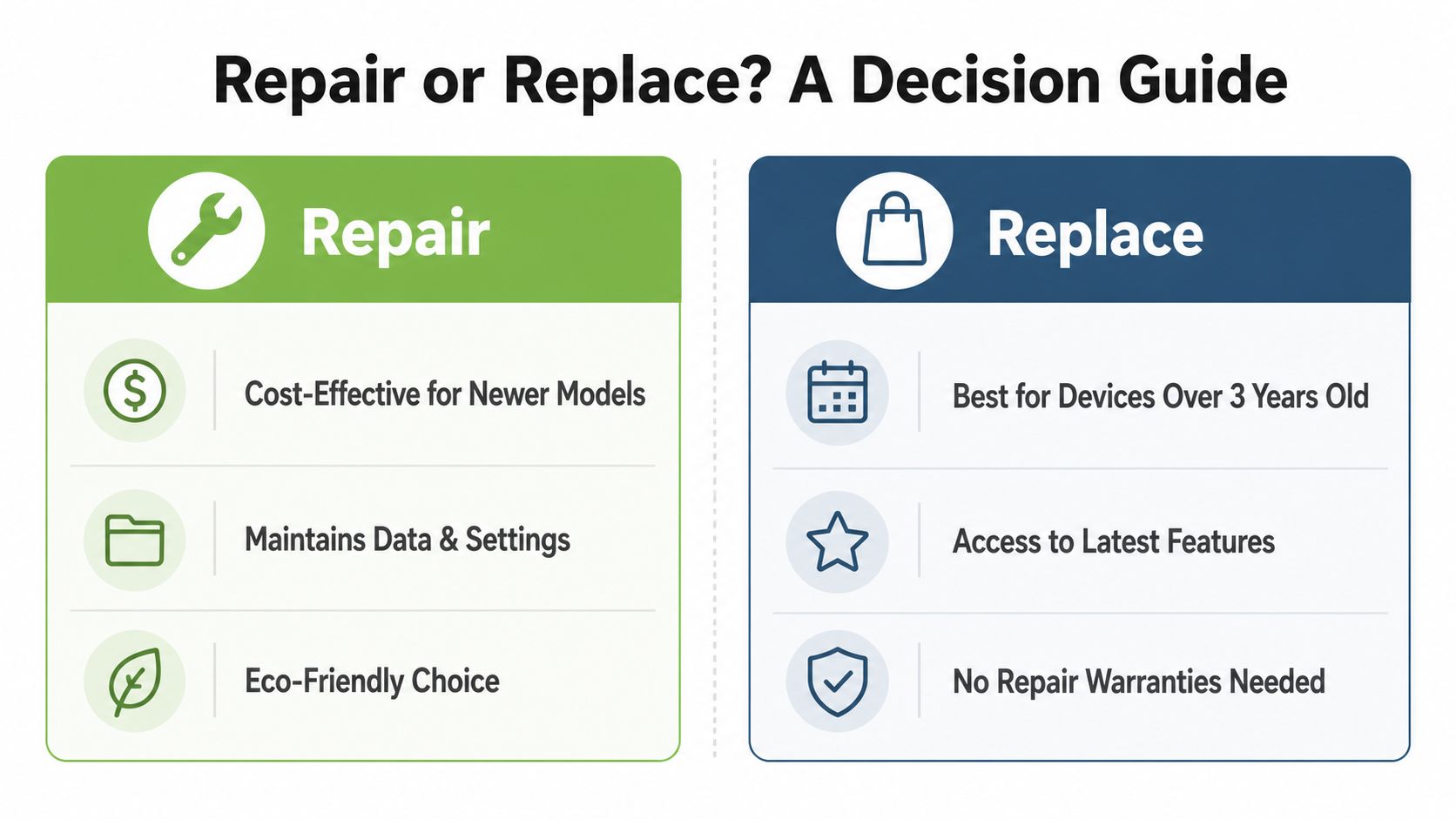
A cracked screen does not automatically mean you need a new phone. If one part has failed while the phone still supports your daily routine, repair may be the more practical choice. Replacement becomes more reasonable when several unrelated faults appear, the device no longer runs the apps you need, or a board problem makes the result uncertain.
Start with the phone's role in your life. A newer daily phone with a damaged display and reliable performance presents a different decision from an older handset with battery, charging, camera, and storage problems. Compare the repair quote with the full cost of a suitable replacement, including data migration, accessories, and the disruption of setting up another device.
A practical decision filter
| Repair is more suitable when | Replacement or refurbishment is more suitable when |
|---|---|
| The fault is isolated to a screen, battery, or port | Several hardware faults are appearing together |
| The phone still handles your daily work and communication | The device no longer supports your practical needs |
| The frame and board remain stable | The board is unreliable or liquid damage is extensive |
| The repair restores dependable use | The repair outcome is uncertain after diagnosis |
Repair also extends the time a phone stays in use. Extending a phone's useful life from three to five years is associated with up to a 31% reduction in annual carbon footprint, according to The Straits Times' coverage of device lifespan extension. The benefit therefore includes the phone's continued usefulness, not only the immediate repair bill.
When replacement can still support a circular choice
A phone that is not worth repairing can still have value. Singapore's e-waste collection efforts show why responsible handover matters, with substantial volumes collected over recent years, as noted earlier.
Trade-in, refurbishment, and parts harvesting can keep useful materials in circulation when a full repair is impractical. A damaged phone may still provide a working camera, display, battery, or another component for a future repair. Materials that cannot be reused can enter an appropriate recycling route.
Ask what happens after handover. The answer should cover whether the phone will be repaired, refurbished, dismantled, or recycled, and how your data will be protected during that process. That wider view connects a personal repair decision with Singapore's circular economy goals and makes a zero-e-waste approach, such as myhalo's, a natural next consideration.
How to Choose a Trusted Mobile Phone Repair Provider in Singapore
A trustworthy repair provider makes the decision easier by explaining the work before asking you to approve it. You shouldn't need to understand motherboard diagrams or display technology to receive a fair quote.
Use this checklist when comparing providers:
- Read detailed reviews: Look for comments about diagnosis, communication, part quality, and how the shop handled problems. A star rating alone doesn't explain the service.
- Ask about the warranty: Find out what the warranty covers, how long it lasts, and whether exclusions apply to liquid damage, bent frames, or new impact.
- Request a written quote: The document should name the fault, proposed repair, part type, labour, testing, and any possible extra charges.
- Discuss data handling: Ask whether the repair needs a passcode, how access is limited, and what happens if the phone is later traded in or recycled.
- Check the intake record: Make sure existing scratches, dents, cracks, and accessories are recorded before handover.
- Ask about the next step: A responsible provider should offer a clear route for trade-in, buyback, refurbishment, or recycling if repair isn't worthwhile.
A shop that pressures you to approve work immediately may be prioritising the transaction over your decision. You can ask for time to back up your data and compare options.
Location and convenience matter, particularly if the problem needs physical inspection. Online quoting can be useful for an initial estimate, while an in-person assessment may reveal frame distortion, corrosion, or connector damage that photographs don't show.
Why myhalo Stands Out for Mobile Phone Repair and Beyond
A repair service becomes more useful when it helps with the entire device journey, not only the part replacement. myhalo combines repair and rescue diagnostics with trade-in, buyback, refurbished device sales, data recovery, secure data handling, and upcycling pathways. That gives customers another option when the original phone can be fixed, reused, or responsibly dismantled.
The platform uses an AI-backed pricing algorithm to produce real-time quotes for repairs and trade-ins. It also operates physical counters at Bugis Junction and Sim Lim Square, alongside online options for customers who prefer to begin remotely.
One service, several possible outcomes
A device assessment may lead to:
- Repair: Restore an isolated fault and continue using the phone.
- Data recovery: Attempt to retrieve important files from a failed device.
- Trade-in or buyback: Convert an unwanted phone into value rather than leaving it unused.
- Refurbishment: Prepare a working device for another owner.
- Upcycling: Harvest usable components to support other repairs.
- Secure recycling: Process the remaining materials through a responsible route after data protection.
A repair quote isn't always the end of the conversation. A phone with a damaged board may still contain useful parts, while a phone that works but no longer suits you may serve another user after testing and grading.
myhalo's Safe Data and Save Data programmes address two common worries. Safe Data focuses on privacy and secure destruction, while Save Data supports recovery work when valuable files or memories are at risk. The company also reports avoiding approximately 2,020 metric tonnes of CO2e in 2024 across smartphones, laptops, tablets, and desktops, as stated in its publisher information.
The wider goal is a zero e-waste world, approached through convenient choices: repair where sensible, reuse where possible, recover data when needed, and recycle securely when no further use remains.
Your Next Step Toward a Repair That Feels Right
You don't need to decide everything while staring at a cracked display. Begin with the symptom and the phone's condition. Does it turn on? Does touch work? Does it charge safely? Is the battery swelling, overheating, or shutting down unexpectedly?
Then protect the information that matters. Back up photos and contacts, remove sensitive cards and accounts where practical, photograph the phone's condition, and ask the provider to record the fault before work starts. These small actions make the handover calmer and give you a clearer record if the repair becomes more complicated.
Questions to ask before approval
Which repairs do Singapore shops handle most often? Screen replacements, battery swaps, and charging-port work are common requests. Software diagnostics, camera repairs, speaker or microphone work, and liquid-related assessments may also be appropriate, depending on the symptoms.
How long does a typical repair take? Common repairs often fall within the 30-minute to 2-hour window described earlier. Complex board-level work or liquid damage requires a separate diagnosis, and the provider should explain the expected timing rather than promise an instant result.
Is data guaranteed to be safe during repair? No provider should ask you to rely on a vague promise. Ask what access is needed, whether the device is logged at intake, and how data is handled if the phone cannot be repaired. Singapore's rules require licensed recyclers to erase or destroy data before reuse, recycling, disposal, or transfer, and a responsible service should be able to explain its own process clearly.
If the phone cannot be repaired
A failed repair assessment doesn't mean the device has no value. Usable components may be harvested for another phone, while the remaining materials can move through a proper recycling channel. You may also compare a refurbished replacement with a brand-new phone, or explore a trade-in and buyback route that keeps the old device out of your drawer.
The right decision protects more than your budget. It protects your files, your time, and the useful materials already inside the phone. That is the heart of responsible mobile phone repair in Singapore, a practical service that can also support a lower-waste way to use technology.
Your precious files and memories matter. Whether you need to protect your privacy with Safe Data or rescue lost files with Save Data, myhalo can help with repair assessment, data recovery, secure device handling, trade-in, and responsible next steps. Reach out today and give your phone, and the information inside it, the care it deserves.