
You've got a drawer full of old phones, a laptop tucked under the bed, and perhaps a tablet connected to memories you're not quite ready to revisit. You know the devices could still help someone, but two worries hold you back: Will my data really be gone, and will this device be handled responsibly?
Selling used electronics in Singapore doesn't have to mean choosing between convenience, privacy, and the planet. With the right checks, you can recover value, protect your information, and give working technology another useful chapter.
Table of Contents
- Your Tech Journey From Clutter to Conscious Choice
- Finding the Right Path for Your Device
- Protecting Your Digital Life Before Selling
- Understanding what your device is worth
- Making Your Sale Count for Our Planet
Your Tech Journey From Clutter to Conscious Choice
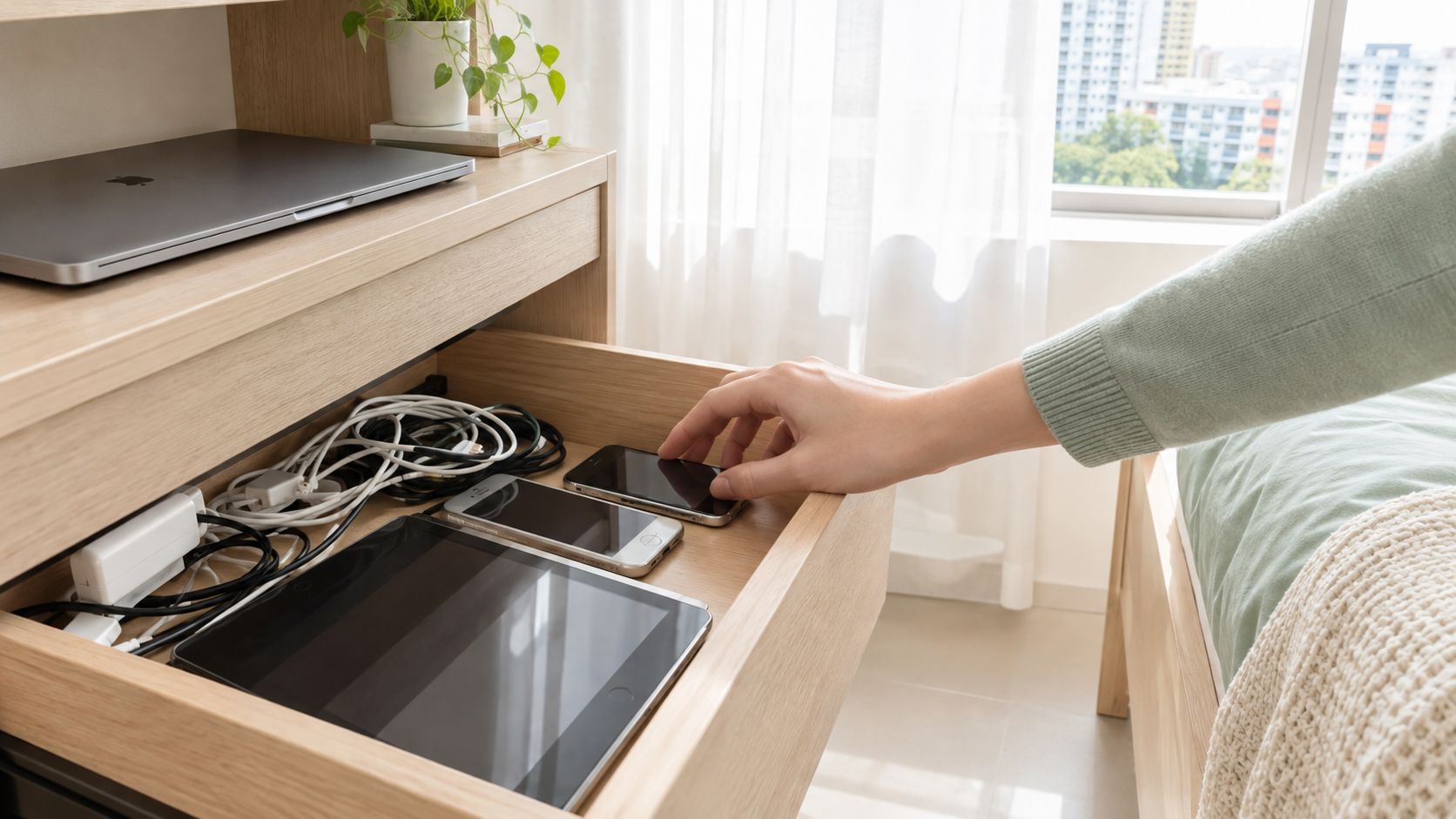
A phone sits in a drawer beside an old tablet. A laptop waits under a desk, still holding photos, messages, or work files. You may want to sell these devices in Singapore, yet two worries can stop you: Will my data really be gone, and will the device be handled responsibly?
Singapore households use a wide range of personal technology. 99.1% of resident households owned a mobile phone in 2023, while laptop ownership reached 71.7% and tablet ownership reached 51.5%, according to Singapore's digital society statistics. An unused device is therefore part of a common cycle of upgrades, replacements, inherited equipment, and technology that no longer suits daily routines.
The difficult part is often emotional. Old phones may contain banking apps, private messages, family photos, or work documents. A damaged laptop can raise another question: should it be repaired, sold, donated, or recycled? These concerns are reasonable. Data privacy and environmental responsibility deserve clear answers before you hand anything over.
Start with a calmer definition of value
A used device can hold several kinds of value:
- Financial value: A working phone, laptop, or tablet may bring cash or store credit.
- Practical value: Repairing or passing it on can extend its useful life.
- Parts value: A damaged device may provide components for another repair.
- Privacy value: A documented sanitisation process helps reduce risks linked to stored information.
- Environmental value: Reuse delays disposal and keeps materials in circulation.
This broader view makes the decision easier. The highest offer may not be the right choice if the buyer cannot explain how storage will be erased or where an unusable device will go. A clear process works like a checklist before a journey. It helps you confirm both personal safety and responsible handling.
At myhalo counters in Bugis Junction and Sim Lim Square, the Declutter your e-clutter approach focuses on clearing unused technology from homes and offices while keeping the process convenient, safe, and responsible. For a planned household clear-out, see this guide to decluttering old tech in Singapore.
A useful mindset: You're choosing an old gadget's next destination, not simply throwing it away.
A phone may be repaired, resold, or used for parts before recycling is needed. A laptop may support another student, family, or worker. If reuse is no longer possible, Singapore's formal e-waste system offers a more organised route than general rubbish.
Finding the Right Path for Your Device
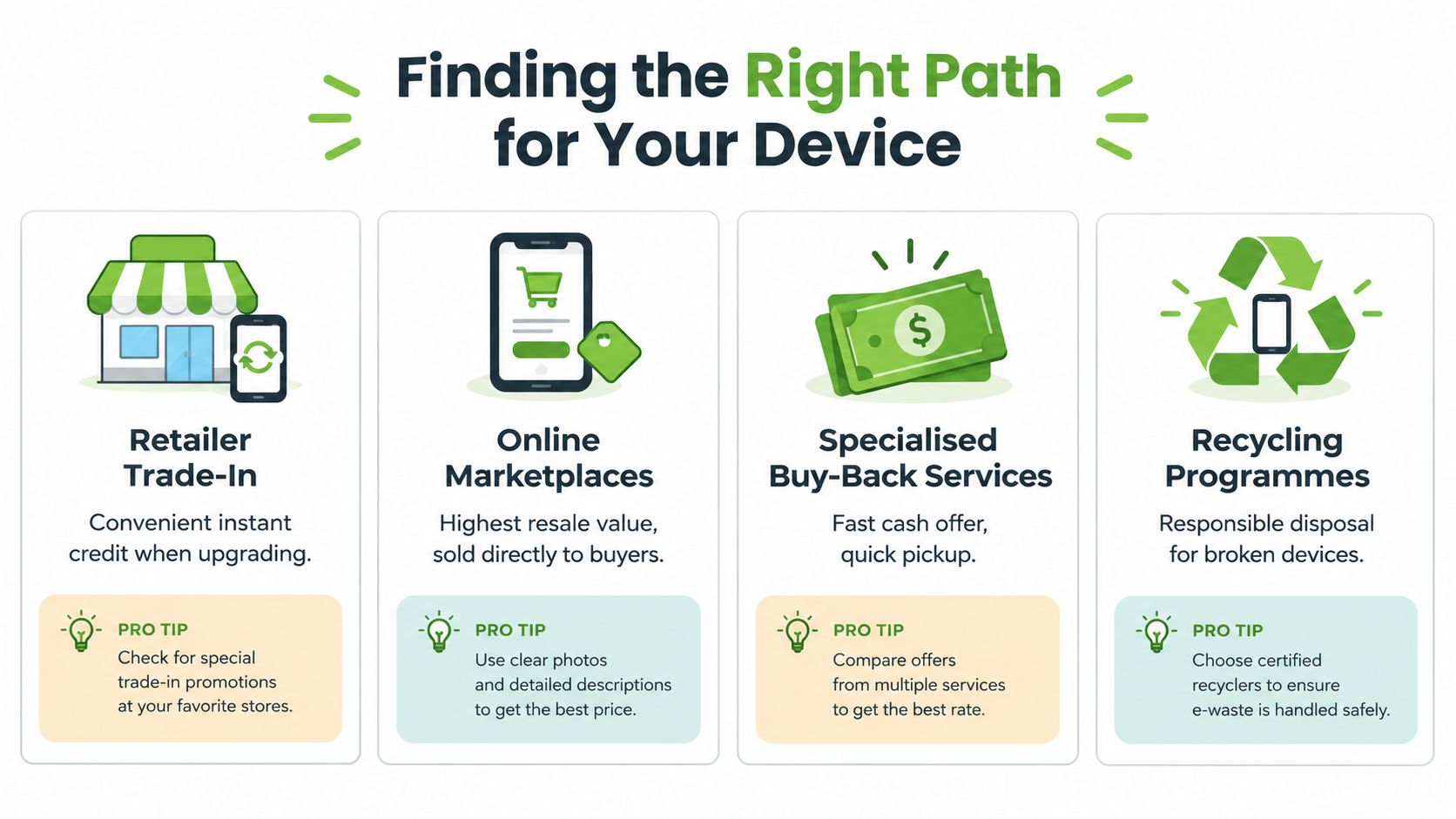
There isn't one perfect way to sell every device. The right route depends on condition, urgency, privacy needs, effort, and what you want in return.
Retailer trade-ins
Trade-in programmes suit people who are already upgrading. You hand over an eligible device and receive credit or a reduction connected to a new purchase. The process can feel straightforward, but check the conditions carefully:
- Device eligibility: Some programmes accept only selected brands or models.
- Assessment rules: The final value may depend on physical condition and whether the device powers on.
- Data responsibility: Confirm whether the retailer wipes the device and what evidence is available.
- Convenience: This route works well when you want to complete an upgrade in one visit.
Trade-in credit may be more useful than cash if you're buying a replacement immediately. It may be less suitable if you're clearing several unrelated devices or want an open-market comparison.
Specialised buyback services
A buyback service can suit a working iPhone, Samsung phone, MacBook, tablet, or gaming laptop when you want a faster process. Services such as myhalo offer online and in-store assessment options, with quotes based on device details and condition.
Before accepting an offer, ask whether the quoted amount is conditional on a physical inspection. Also ask how the service handles data sanitisation, repair, resale, parts harvesting, and recycling. A clear answer helps you compare the whole service, not just the headline price.
Online marketplaces
Marketplace resale can give you more control over the listing, price, photos, and buyer conversation. It can work well for a sought-after gaming laptop or a device with complete accessories, but you'll handle the workload yourself.
You'll need to write an accurate description, respond to messages, arrange payment, and choose a safe handover. Never share passwords or allow a buyer to rush you into an unclear payment arrangement. If you're researching broader product opportunities or resale categories, this resource on finding winning ecommerce niches can help you think about demand without treating every device as equally easy to sell.
Recycling and corporate asset routes
A broken device with no realistic repair path belongs in an appropriate e-waste channel, not general rubbish. For companies, schools, and organisations clearing multiple computers, specialised IT Asset Disposition, or ITAD, services provide inventory records, sanitisation documentation, and final-disposition records.
Singapore's formal e-waste system collected more than 20,000 tonnes by June 2024, with over 800 collection points available island-wide under the Extended Producer Responsibility scheme, as reported by the National Environment Agency. The system supports responsible disposal, but reuse should still be considered first when a device can safely continue working.
Protecting Your Digital Life Before Selling
A device can be physically ready for sale while still carrying sensitive information. Your old phone may contain login sessions, saved cards, private photographs, authentication apps, and location history. A company laptop may hold customer records, source code, staff information, or confidential files.
The Singapore PDPC warns that incomplete disposal of personal data on electronic media can create a data breach. Its guidance identifies cryptographic erasure, dedicated overwriting software, and physical destruction as possible controls, as explained in its guidance on disposing of personal data.
Use a three-stage handover process
1. Inventory the device first. Record the make, model, serial number, storage media, condition, ownership, and intended outcome. If the device has a removable drive or memory card, list that separately. This prevents a storage medium from disappearing during a busy clear-out.
2. Recover what matters. Back up photographs, contacts, documents, and authenticator information before resetting anything. If a damaged phone or failed laptop contains important files, a data recovery service may be more appropriate than repeated restart attempts. myhalo's Save data service is designed for recovery attempts involving precious memories, files, and essential data.
3. Sanitise before handover. Remove accounts, sign out of services, disable device tracking, and perform the appropriate secure erasure process. For organisations, the PDPC describes sanitisation as an irreversible process that makes personal information unrecoverable before media is reused, exchanged, or disposed of.
A factory reset is a useful consumer step, but it shouldn't be treated as universal proof that every storage scenario is safe. SSDs, failed drives, removable media, and devices locked by an unknown account may need specialist treatment. Where secure deletion isn't possible, the drive should be quarantined for physical destruction rather than passed to a buyer.
Practical rule: If you can't account for the storage medium, you can't yet account for the data.
Ask for evidence, not reassurance
A responsible buyer or service provider should be able to explain:
- What method they use: For example, dedicated overwriting software, cryptographic erasure, or physical destruction.
- Who performs it: Ask whether the process is handled internally or by a downstream provider.
- What gets recorded: The device identifier, operator, date, method, and final disposition should be traceable.
- What certificate is available: Request written confirmation for business assets and higher-risk devices.
You can also read this practical resource on preparing computers for secure recycling before arranging a corporate clear-out. For more local guidance, keep this secure data destruction guide handy.
myhalo's service model includes documented data handling and certificates on request. That kind of evidence may be worth more than accepting a slightly higher offer from an unknown buyer who can't describe what happens after handover.
Understanding what your device is worth
The moment you decide to sell used electronics in Singapore, two worries often appear together: “Will I get a fair price?” and “What happens to my data?” A clear valuation helps with the first concern, while honest preparation supports a safe handover.
A realistic offer starts with the device, not its original cost. Model, age, storage capacity, condition, battery health, accessories, repairability, and current demand all affect its value. Portable devices often have a wider resale audience than older desktop towers, especially when they remain useful for study, work, communication, or entertainment.
Read the condition honestly
A scratched screen, swollen battery, unreliable charging port, missing key, or account lock can change the assessment quickly. Disclosing these problems early is less stressful than discovering them during inspection, when an initial quote may be reduced or withdrawn.
Collect the charger, original cable, box, stylus, keyboard, mouse, and other matching accessories if you still have them. Wipe the exterior gently, photograph the device in good light, and list anything that does not work. These details help a buyer decide whether the unit belongs in resale, repair, or parts recovery.
| Factor | Impact on Price | Preparation Tip |
|---|---|---|
| Model and age | Newer and sought-after models generally attract stronger interest | Record the exact model and storage capacity |
| Physical condition | Cracks, dents, stains, and missing parts can reduce the offer | Photograph flaws and describe them clearly |
| Battery health | Weak batteries can affect usability and repair decisions | Check battery information where the device provides it |
| Functionality | Faults in charging, cameras, ports, screens, or keyboards affect assessment | Test the main functions before requesting a quote |
| Accessories | Complete matching accessories can make the device easier to resell | Gather chargers, cables, boxes, and compatible extras |
| Data status | Unknown accounts or inaccessible storage can block safe resale | Remove accounts and arrange proper sanitisation |
| Repair potential | A repairable device may retain more value than a dead unit | Obtain a repair assessment before writing it off |
Compare offers with the full outcome in mind
Get more than one reference point. Compare an instant quote, an authorised trade-in programme, and marketplace listings for similar models in similar condition. A marketplace asking price only indicates what a seller hopes to receive. It does not confirm a completed sale.
Repair first when the fault is clear, the device remains useful, and the cost makes practical sense. Sell as-is when there is a realistic resale path but you do not want to manage the repair. Choose parts recovery or recycling when the device is unsafe, locked, severely damaged, or uneconomical to restore.
A Singapore mobile price list can provide a useful starting reference. Confirm the exact model, storage capacity, condition, and battery status before comparing it with an offer.
Privacy also belongs in the value calculation. A slightly lower offer from a service that documents sanitisation and responsible handling may protect you from more risk than an uncertain cash handover. Once your data is secured and the device's next route is clear, the price becomes easier to judge calmly.
Making Your Sale Count for Our Planet
A device that reaches another user doesn't need to be manufactured again immediately. A repairable laptop can return to work. A phone with a damaged camera may still provide useful parts. Even a device beyond salvage can enter a proper material recovery route instead of sitting in general rubbish.
Singapore's EPR system began on 1 July 2021 under the Resource Sustainability Act. ICT equipment is one of the regulated product classes, and producers carry responsibility for arranging collection and proper treatment of covered products at end of life. The NEA's e-waste guidance distinguishes reuse, repair, donation, resale, and recycling as different paths.
Choose the next life before the last resort
Ask three simple questions:
- Does it work safely? Sell, donate, or continue using it.
- Could a repair restore it? Get a repair assessment before discarding it.
- Is it beyond salvage? Use an organised e-waste collection or recycling route.
Batteries and damaged electronics shouldn't go into general waste or blue recycling bins. A collection point may accept certain categories, so confirm that the outlet handles your specific item before making the trip.
myhalo's circular services processed smartphones, laptops, tablets, and desktops and achieved approximately 2,020 MTCO2e in avoided emissions in 2024. That figure reflects the value of keeping devices and components in circulation through repair, reuse, and related circular pathways.
You can also use this guide to where to recycle electronics in Singapore when an item can't reasonably be sold or repaired. Responsible selling isn't just a private transaction. It's a small community action that supports a future where technology stays useful for longer and recycling happens only when it's genuinely needed.
Ready to feel lighter and do good? Let's clear out those old devices together. Check out our Declutter your e-clutter programme and see how convenient it is to make a positive splash for our environment.
myhalo offers device buyback, repair, data recovery, secure data destruction, and responsible reuse pathways for phones, laptops, tablets, and other electronics in Singapore. If you're ready to protect your privacy while clearing your e-clutter, visit myhalo to explore an online quote or arrange support.