
You've got the old devices sorted into a corner cupboard again. The laptops were upgraded, the phones are half-used, a few monitors still work, and every box feels like it might contain something sensitive, something valuable, or both. That's exactly where IT asset disposition services help, because they turn that awkward pile of retired tech into a clear, documented, and safe next step for your office.
For Singapore teams, the worry isn't just clutter. It's data left behind on drives, the question of whether a device can be reused, and the very real need to show your DPO, procurement lead, or auditor that the handover was handled properly. A good ITAD process makes that feel less like a headache and more like a routine part of zero e-waste operations, with privacy, resale, and recycling all handled in the right order.
Table of Contents
- Why Old Office Tech Needs a Plan
- What IT Asset Disposition Services Cover
- Singapore E-Waste Rules and Pressure
- Reuse Refurbish Harvest or Recycle
- Meeting PDPA and Certification Needs
- How myhalo Delivers Hybrid ITAD
- Choosing an ITAD Partner and SLA
- Common Singapore ITAD Questions
Why Old Office Tech Needs a Plan
A typical Singapore office grows a small graveyard of end-of-life devices without meaning to. One team upgrades its laptops, another changes phones, the finance department keeps a stack of old peripherals “just in case”, and someone is still not sure whether the monitors were wiped before storage. That mix of data risk, residual value, and pure clutter is why IT asset disposition services exist in the first place.
The simplest way to think about it is this. Old office tech is never just old office tech. A retired laptop can still hold customer files, internal emails, cached credentials, and personal data. At the same time, it may still have enough value to be reused, refurbished, or broken down for parts instead of being treated like generic scrap.
Practical rule: if a device can still power on, it deserves a value check before anyone assumes it's waste.
That's especially relevant in Singapore, where office space is tight and storage rooms fill up fast. If nobody owns the end-of-life process, devices tend to sit longer than they should, which makes handover messier and documentation weaker. A structured ITAD flow gives you a clean answer to the most common office problem, which is, “What do we do with all these retired machines now?”
For teams moving equipment around during office changes or relocations, it also helps to follow careful handling practices for fragile tech. A useful general reference is tips for moving electronics safely, because the same care that protects devices in transit also protects their resale value and reduces damage before disposition.
The warm takeaway is straightforward. Convenient, safe, responsible handling makes it easier to clear e-clutter without panic, and it supports the myhalo Promise of keeping device retirement calm instead of chaotic.
What IT Asset Disposition Services Cover
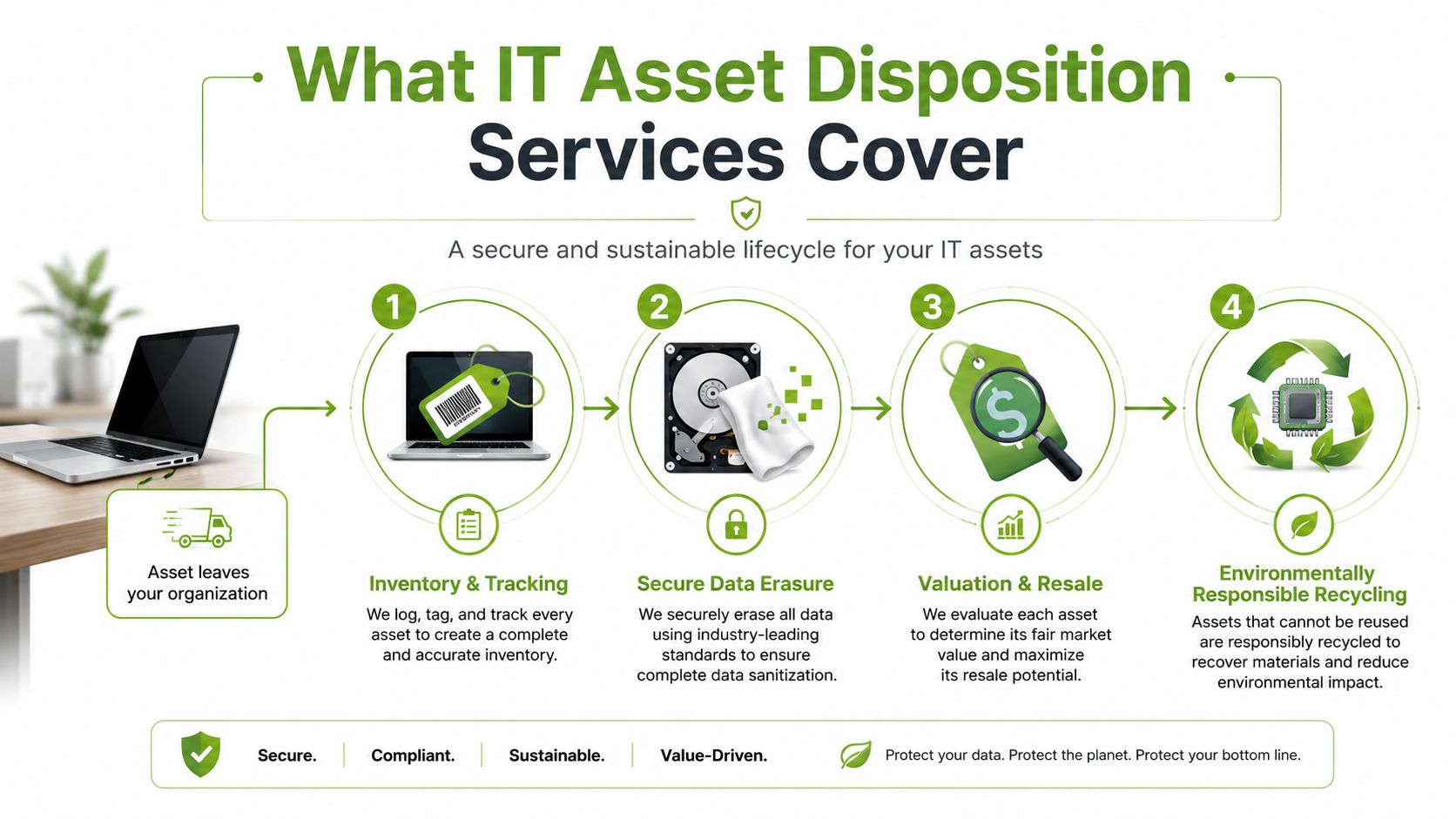
Think of each retired device as carrying a passport. The moment it leaves the desk, it should be logged, followed, checked, and either cleared for a second life or sent to responsible recycling with a traceable record. That's the core idea behind IT asset disposition services, and it's why the process is more than a simple pickup.
The device passport starts with inventory
The first step is identifying what's leaving the office. Asset-level tracking matters because a company doesn't want “three boxes of mixed IT stuff”, it wants a clear record of each laptop, drive, phone, and accessory. That record creates the foundation for a documented chain of custody, which is what lets an organisation prove the item was handled properly from collection to final outcome.
Data sanitisation comes before reuse
A device can't be resold just because it still turns on. It needs verifiable data erasure first, and the method should fit the media type and risk level. That is why ITAD workflows separate reusable devices from destruction-only media, because some assets can be cleared and purged, while others need physical destruction and proof.
Good evidence beats vague reassurance. If the record can't show what happened to the device, the process is incomplete even if the device is gone.
Testing, valuation, and final routing
After sanitisation, the asset can be tested. A working laptop with decent battery health may be fit for resale or redeployment. A device with partial failure may still have value in parts harvesting. If neither route makes sense, the asset moves into certified recycling so materials can be recovered properly.
For readers who prefer the broader lifecycle view, the process also fits the standard sequence of inventory, collection, transport, data destruction, refurbishment, recycling, and final disposition, as described in the wider ITAD guidance from IT asset disposition services. The point is not to memorise jargon. It's to see the flow as one connected system, where each step protects the next one.
Singapore E-Waste Rules and Pressure
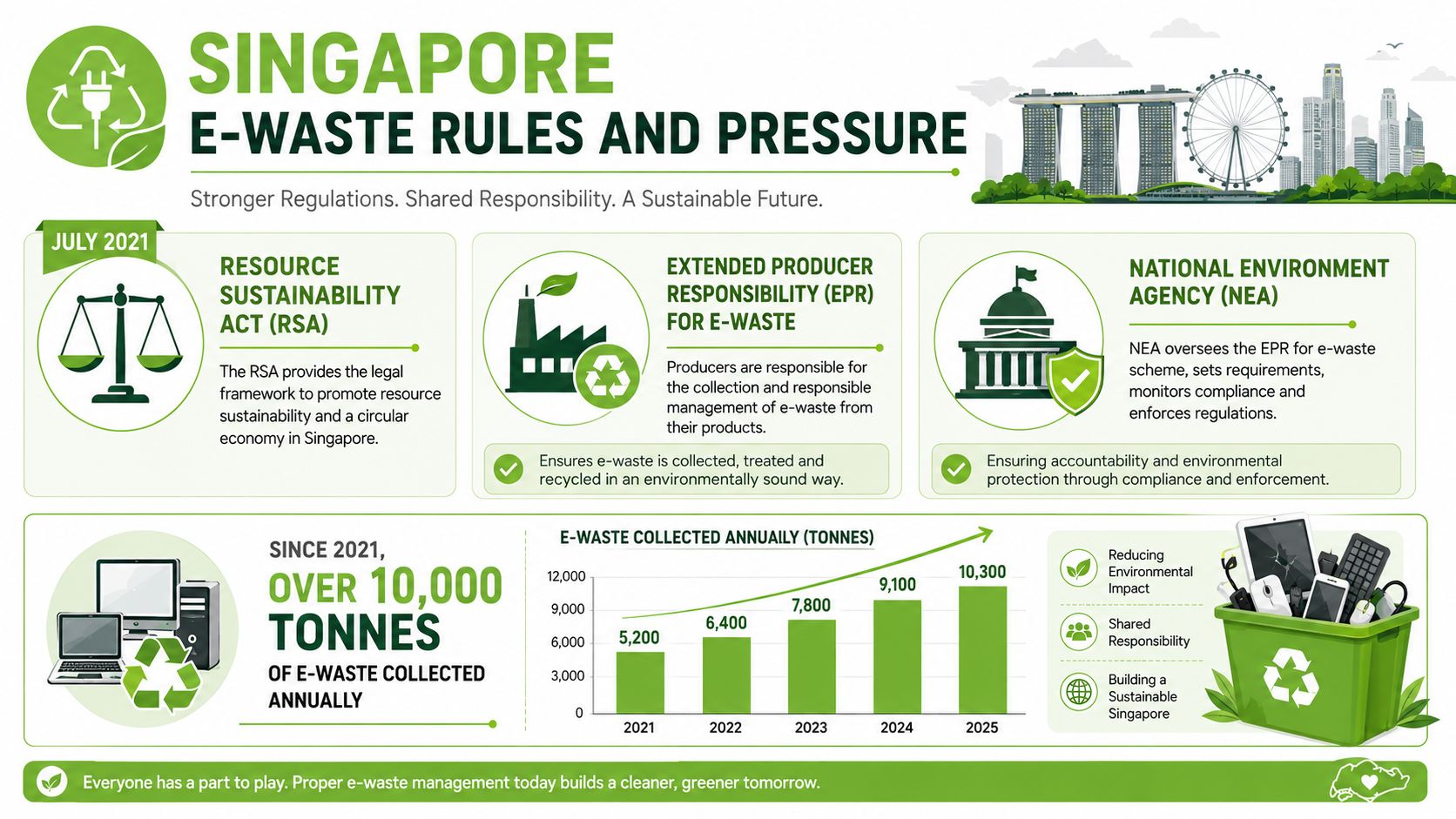
Singapore's ITAD story is shaped by policy, not just convenience. The Resource Sustainability Act took effect in July 2021, and the national Extended Producer Responsibility system made producers responsible for collection and treatment of regulated consumer and ICT products. For corporate teams, that means retired laptops, drives, and peripherals sit inside a regulated waste environment, not a casual throwaway pile, and the right response is secure, documented handling under Singapore's e-waste framework. The policy backdrop is described in NEA-linked market context for Singapore ITAD.
Why the national waste picture matters
NEA reported that Singapore generated about 60,000 tonnes of e-waste in 2021, which works out to roughly 7.5 kg per person if divided by the population estimate in the brief. NEA has also said e-waste generation is expected to rise as device ownership and replacement cycles continue. That matters because corporate endpoints don't disappear when they are retired, they become part of a broader materials and compliance stream that needs control.
The zero-waste backdrop is real
Singapore launched the Zero Waste Masterplan in 2019, and Semakau Landfill is projected to reach capacity by 2035. Those two facts explain why reuse-first ITAD is more than a nice sustainability story. In a compact city-state, every useful device that gets a second life eases pressure on disposal systems and supports better resource use.
NEA also reported that the overall domestic recycling rate fell to 12% in 2023, while paper recycling was around 32% and plastics were about 5%. Those household figures are not the same as corporate IT handling, but they show the bigger reality Singapore works within. When everyday recycling participation is weak, organisations have even more reason to treat old equipment carefully and keep it in a controlled recovery path.
For readers looking at Singapore's broader waste journey, myhalo's local overview on e-waste for a zero-waste Singapore sits in the same policy context. The main idea is simple. In Singapore, reuse, certified resale, parts recovery, and secure recycling are not optional extras, they are the practical answer to a limited landfill future.
Reuse Refurbish Harvest or Recycle
Many ITAD guides stay too vague regarding this. Singapore teams don't usually have one neat pile of identical laptops. They have mixed fleets, older monitors, damaged chargers, gaming devices, phones, tablets, and a few awkward one-off machines that don't fit a clean resale story. The right path depends on condition, volume, testing cost, and how much handling the item needs before it becomes useful again.
| Path | Best-fit assets | Why in SG context |
|---|---|---|
| Reuse | Recent laptops, phones, tablets, peripherals that still perform well | Keeps useful devices in circulation and reduces pressure on storage space |
| Refurbish | Working devices that need battery, cosmetic, or component fixes | Extends life instead of replacing hardware too early |
| Parts harvest | Mixed-condition units, partial failures, non-standard assets | Useful when resale economics are weak but components still have value |
| Recycle | Broken, unsafe, or non-repairable electronics | Supports material recovery when reuse is no longer sensible |
The practical benchmark is not “Can we sell it?” first. It's “Can we extend the life of this asset without creating more risk than value?” That's why component testing and refurbishment often beat straight disposal, and why recycled e-waste can recover gold, silver, copper, and rare earths through proper treatment. It also fits the broader guidance that extending device life is usually better than manufacturing a replacement, because the embodied emissions of a new device are typically much higher than the emissions from keeping an existing one in use.
Useful test: if the asset still has stable performance and low repair complexity, reuse or refurbishment usually deserves the first look.
A mixed fleet often pushes teams toward a blended approach. A batch of office laptops may go to resale, a set of older headsets and keyboards may be better for parts recovery, and damaged stock may move straight to recycling. That kind of sorting is where local judgement matters, because the economics of transport, testing, and secure handling are different in Singapore than in a huge low-cost logistics market.
For a local consumer-side framing of where unwanted devices can go, where to recycle electronics in Singapore is a helpful companion read. For organisations, the same principle applies. Route the asset to the path that protects value first, then materials, then space.
Meeting PDPA and Certification Needs
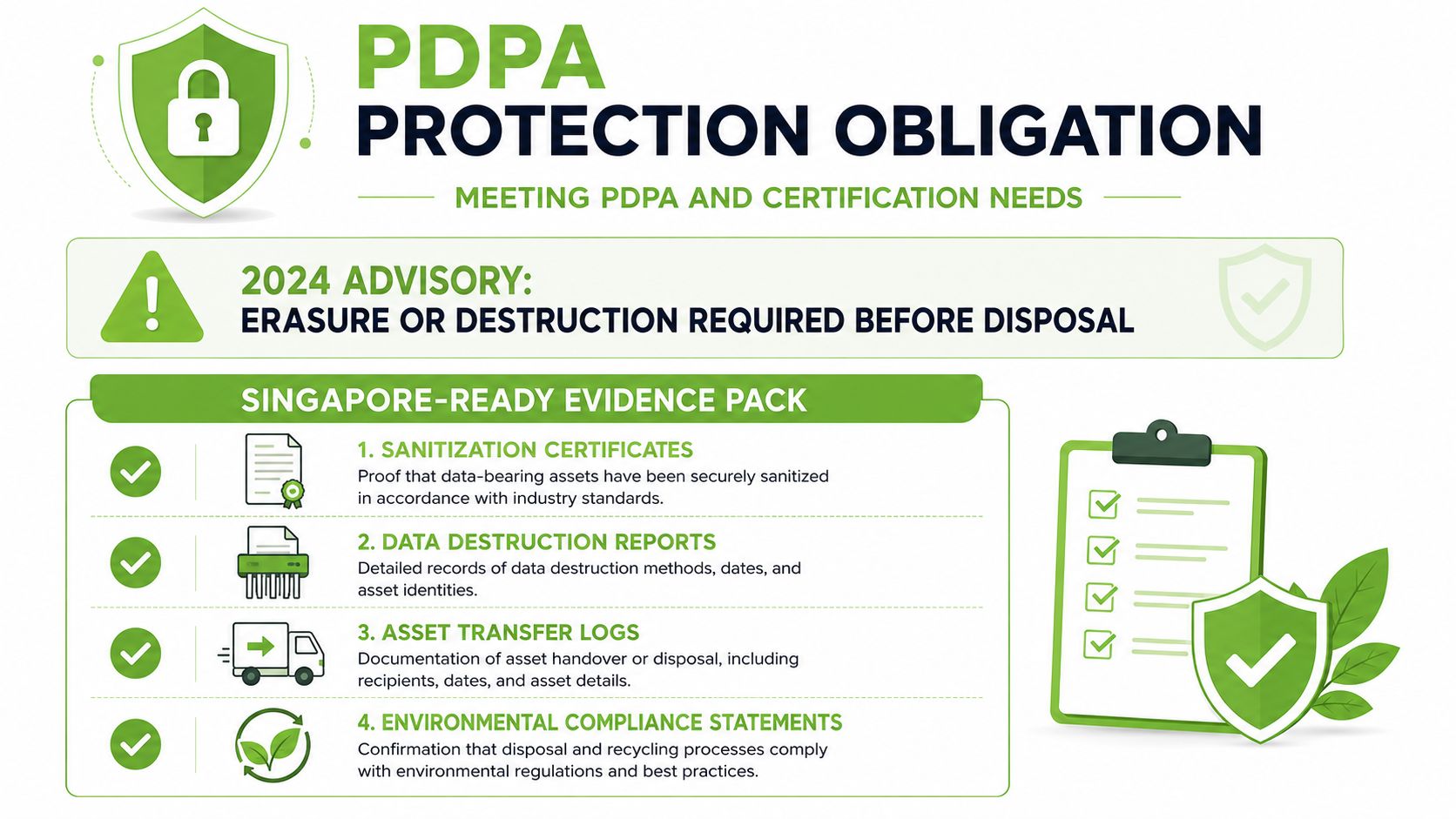
Under Singapore's PDPA protection obligation, organisations must make reasonable security arrangements to prevent unauthorised access, disclosure, or similar risks to personal data. For retired laptops, drives, and mobile devices, that turns disposal into a data-protection job, not just an environmental one. The Personal Data Protection Commission's 2024 advisory also warns organisations to ensure records are erased, degaussed, destroyed, or otherwise rendered unrecoverable before disposal, which makes proof part of the process rather than an afterthought. That requirement is discussed in the local secure disposal context in Shred It Singapore and secure disposal practices.
What a Singapore-ready evidence pack looks like
The best way to make this manageable is to build an evidence pack for every retirement batch. It should include sanitisation proof, transfer history, and vendor records, so your DPO and auditor can follow the story without chasing emails.
- Sanitisation Certificates: These show which device was cleared, purged, or destroyed, and they matter because they connect the media type to the chosen method.
- Data Destruction Reports: These give the practical record of what was wiped or physically destroyed, which helps when a device cannot be reused.
- Asset Transfer Logs: These show custody changes, pickup details, and handover points so the trail stays intact.
- Environmental Compliance Statements: These support the recycling or material recovery side of the process.
Which controls matter most
Vendor certification is part of that proof story. Guidance for ITAD compliance commonly points to R2v3, e-Stewards, and NAID AAA as useful indicators for recycling and secure destruction practices, and Singapore buyers should ask how those align with their own internal controls. The goal is not to collect logos. The goal is to show that the vendor's method, recordkeeping, and handling standards are compatible with your organisation's risk posture.
If your organisation handles mixed media types, separate the workflow early. Reusable media can be sanitised under recognised processes, while damaged or high-risk media should go through physical destruction with documented evidence. That separation makes the evidence pack cleaner and helps when procurement, security, and legal teams review the same disposal batch from different angles.
The practical question isn't “Did we use a vendor?” It's “Can we prove what happened after the device left the office?” In Singapore, that proof is what keeps secure disposal defensible.
How myhalo Delivers Hybrid ITAD
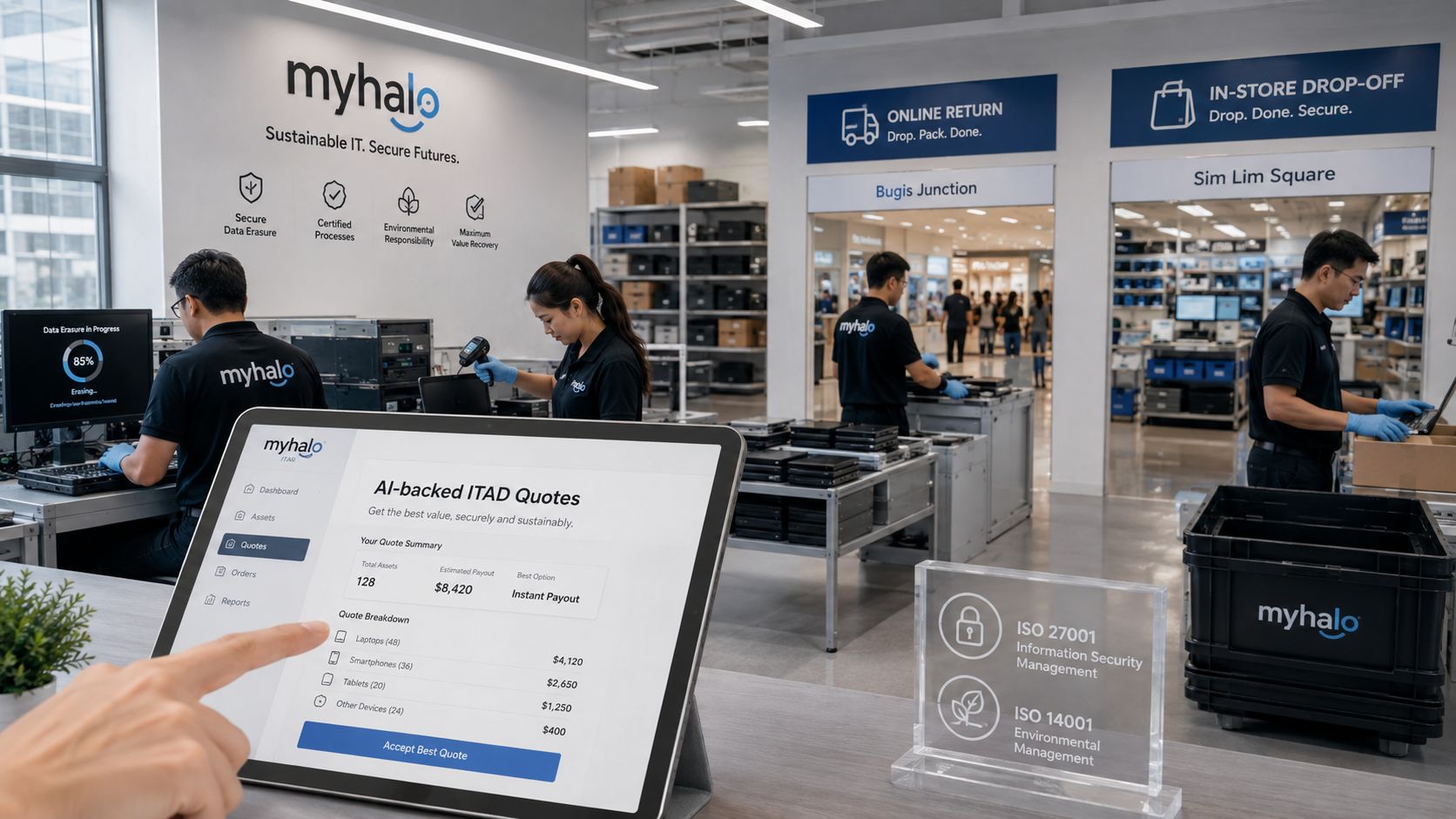
myhalo's model fits Singapore's reality because it combines physical convenience with documented handling. The service offers collection through central Singapore touchpoints at Bugis Junction and Sim Lim Square, plus online quote flows, so office teams and smaller organisations can move assets without building a complicated logistics process. It also uses an AI-backed pricing approach for valuation and supports secure data destruction with certificates, which matters when the same asset might be either resale-ready or destruction-only.
Why a hybrid model helps mixed fleets
A hybrid setup works well when some devices are reusable and others are not. myhalo's flow supports certified ReLoved resale, repair, and part harvesting, which makes it easier to route an asset to the right end-of-life path instead of forcing every item into the same bucket. That matters for local organisations with different device ages, brands, and conditions.
The corporate side is important too. myhalo provides Corporate IT Asset Disposition and lifecycle support, along with ISO-aligned data handling practices for devices processed by the business. It also publishes impact accounting, including about 2,020 MTCO2e avoided in 2024 across smartphones, laptops, tablets, and desktops, which gives sustainability teams a concrete way to talk about reuse outcomes without guessing at the numbers.
Practical benefit: when collection, sanitisation, resale, and recycling live under one workflow, the handover feels less fragmented for IT, procurement, and sustainability teams.
The cleanest way to understand the service is to see it as a bridge between convenience and compliance. myhalo's corporate ITAD page on what IT asset disposition means in practice sits in that middle ground, where value recovery and secure handling both matter. For Singapore organisations, that kind of hybrid model is useful because it helps turn end-of-life assets from storage liabilities into audited, traceable outcomes.
Choosing an ITAD Partner and SLA
A good ITAD partner should make your internal review easier, not harder. Start with the basics, then test how the vendor handles evidence, timing, and exceptions. If they can't explain those points clearly, they're not ready for a serious Singapore deployment.
What to ask before you sign
- Certifications and standards: Ask which recycling or destruction certifications they hold, and how those map to your own compliance needs.
- Asset-level tracking: Require device-by-device tracking, not just bulk weight reports.
- Sanitisation method by media type: Hard drives, SSDs, phones, and mixed storage should not all be treated the same.
- Collection windows: Fix pickup timing in the SLA so your office doesn't end up waiting indefinitely with cleared space but uncleared risk.
- Evidence pack format: Ask for the exact documents you'll receive, and confirm they match DPO, procurement, and audit needs.
- Reuse and recycling outcomes: Define how reused, resold, harvested, and recycled assets will be reported.
For contract language, it helps to read a service agreement before you lock in expectations. A clear example of the type of detail to look for is the Quikly service terms, which show how service scope and responsibility can be written in a way that leaves less room for confusion.
SLA details that prevent headaches
The strongest SLAs include who owns approval, who performs sanitisation, who issues certificates, and how long logs are retained. They also specify what happens if a device fails testing, arrives damaged, or can't be sanitised in the expected way. Those “what if” clauses matter because real IT fleets are messy, and the vendor's response to exceptions tells you more than a glossy brochure ever will.
Simple procurement rule: if the SLA doesn't say how proof is delivered, it doesn't really protect you.
A useful contract also names the KPIs you care about. That might include reuse rate, certificates issued, and the time between pickup and evidence delivery. Those are practical indicators of whether the partner is running a disciplined operation or just moving boxes around.
Common Singapore ITAD Questions
Cross-border handling matters because PDPA evidence shouldn't disappear when devices move out of sight. If assets or records leave Singapore, keep the sanitisation proof, chain-of-custody logs, and vendor responsibility clearly documented so your internal audit trail doesn't break. SMEs also benefit from ITAD, even with low volumes, because mixed devices still carry data risk and small batches still occupy expensive office space.
Vendor logs should be reconciled regularly, not left until year-end. A sensible rhythm is to match pickup records, sanitisation certificates, and asset register updates every time a batch closes, so exceptions surface early. That habit is what keeps ITAD useful as both a compliance control and a zero-waste practice.
Ready to feel lighter and do good? Let's clear out those old devices together. Visit myhalo to explore secure ITAD, data-safe device handling, and convenient options for giving retired tech a proper next step.