
You've just unboxed a shiny new smartphone, and your previous one is already sitting in a drawer. It still works, but you haven't decided whether to sell it, recycle it, pass it to someone else, or keep it “just in case”. The longer it stays there, the more you worry about forgotten photos, banking apps, account locks, and the effort involved in handing it over safely.
That hesitation is completely understandable. A good 2nd hand phone journey should feel convenient, safe, and responsible, not like a risky bargain hunt. In Singapore, the circular tech ecosystem makes it possible to upgrade without turning a perfectly useful device into e-waste. You can buy a tested phone, repair a damaged one, trade in an older model, or securely release a drawer orphan so it can serve someone else.
Table of Contents
- Welcome to the Second-Hand Phone Revolution
- Understanding the Used Phone Market in Singapore
- Choosing Between Certified Refurbished and Peer-to-Peer
- Getting the Best Value When Selling or Trading In
- Protecting Your Privacy with Secure Data Erasure
- Extending Device Life Through Repair and Upcycling
- Joining the Zero E-Waste Community
Welcome to the Second-Hand Phone Revolution
Meet Daniel. He upgraded his phone after noticing that his battery no longer lasted through a busy day. The new device was faster and brighter, but his old phone wasn't useless. It had a healthy display, a working camera, and enough performance for messaging, maps, and streaming. Still, Daniel left it in a drawer because he wasn't sure how to remove his data properly.
That story is common. People often hold on to old phones because they fear a privacy leak or don't want the hassle of negotiating with strangers. A phone can become a “drawer orphan”, not because it has no value, but because the handover process feels uncertain.
A phone can be finished with your routine without being finished altogether.
The second-hand market changes that relationship. Instead of treating an upgrade as a straight line from shop shelf to rubbish bin, think of your phone as part of a longer journey. One person's previous model can become another person's affordable daily driver. A damaged handset can provide a screen, camera module, charging port, or other usable parts. A phone that no longer suits your needs may still have plenty of life left for someone else.
That's the heart of a circular tech lifestyle. Buying pre-owned, repairing before replacing, and passing devices on securely all keep useful materials and products in circulation. You don't need to become a repair expert or understand every technical specification. You need a clear process and a trustworthy route for the device you no longer use.
The emotional payoff matters too. Clearing old electronics from your home gives you back space and removes the nagging feeling that you're wasting something useful. With the right support, upgrading can feel lighter rather than guilty. You get a newer phone, another person gets access to a working device, and the old handset gets a chance to avoid an unnecessary end.
Understanding the Used Phone Market in Singapore
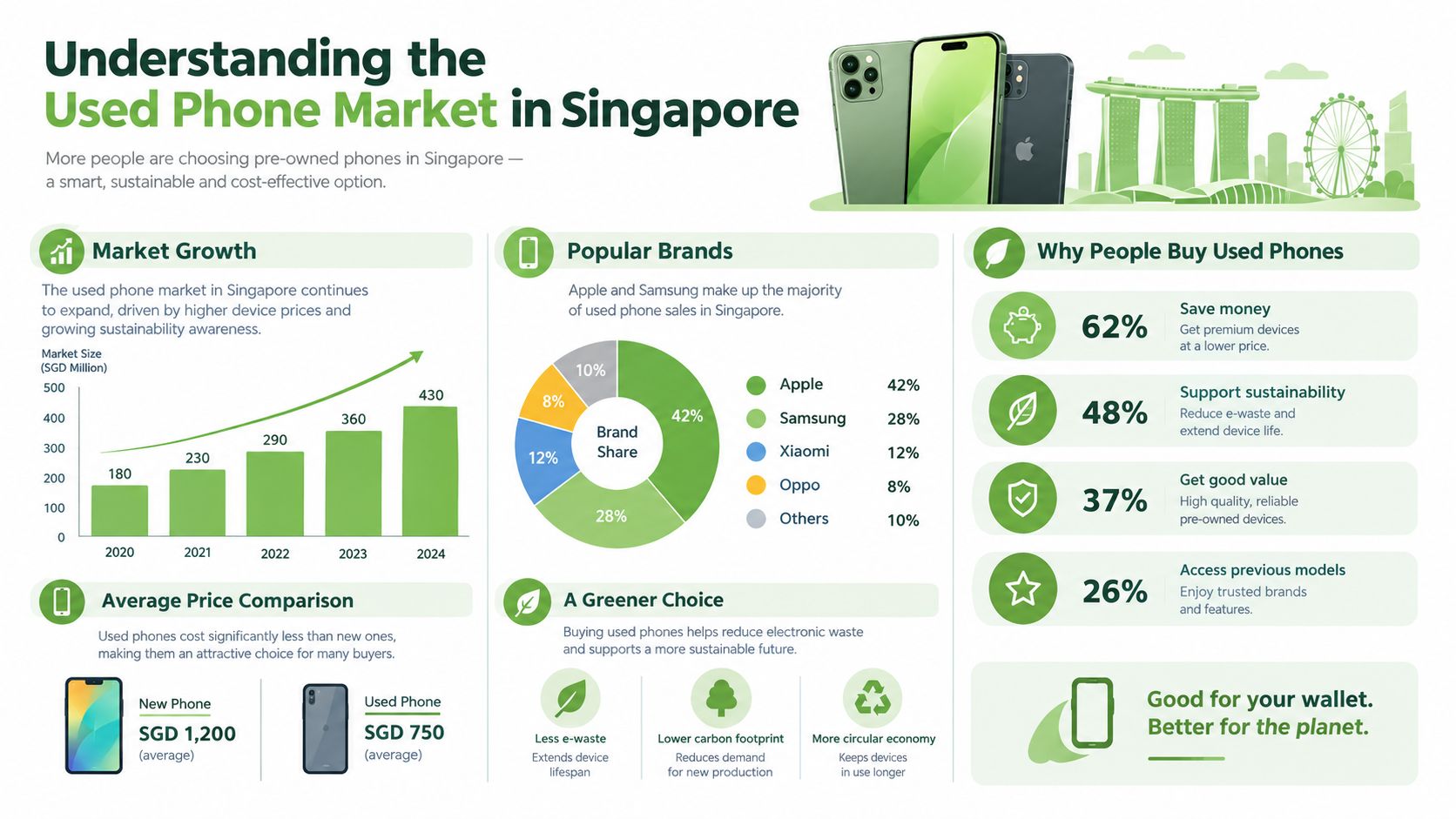
A phone upgraded this year may still have years of useful service ahead. In Singapore, that possibility has grown into an organised second-hand ecosystem, connecting trade-ins, refurbishment, repairs, resale, and cross-border circulation. Enterprise Singapore described the used and refurbished phone market as having major growth potential, alongside a global market that GSMA estimated could reach US$140 billion, or S$192 billion, by 2030. Carousell Mobile's Singapore device information provides additional market context.
The scale becomes clearer through the work of established distributors. Mercantile Pacific Asia, a Singapore-based distributor mentioned in the same Enterprise Singapore discussion, transacts over 1 million units a year. It has saved about 7 million phones from the e-waste stream and avoided more than 200,000 metric tonnes of CO2 emissions and 160 million litres of water, according to that discussion.
These figures do not mean reuse removes every impact from manufacturing, transport, or charging. They show why a longer device life matters. Keeping an existing phone in service can delay the environmental cost of producing and distributing another one. A handset's value therefore includes more than its resale price. It also includes the materials, energy, and working components that remain useful.
Why supply keeps coming back
Frequent upgrades create a steady stream of phones for trade-in and resale channels. A Singapore-focused report estimated that 2.9 million devices had been removed from circulation over five years and found that Singaporeans replace phones every 2.7 years on average, compared with a global average of 3.5 years, as reported in the Singapore used-device marketplace reference.
That replacement rhythm explains why many available phones are older than the newest release yet still practical. A recent flagship may appeal to someone who photographs often. A previous-generation iPhone or Samsung Galaxy could suit a student, family member, work role, or anyone who needs reliable essentials without a new-device price.
The same report found that 30% of Singaporeans had already purchased a second-hand or refurbished phone. It also found that 32% keep old phones indefinitely, 32% sell or trade them in, 20% recycle devices through proper e-waste channels, and 4% dispose of them improperly. Those patterns reveal the hidden lifecycle problem: a usable phone can remain inactive at home instead of reaching a person, repairer, or recycler who can handle it responsibly.
For Singapore households, releasing an old handset is a practical supply decision, not a niche sustainability gesture. A secure handover can move a working device back into local reuse, while damaged phones can enter repair or responsible recycling routes. That keeps the market supplied and gives each device a clearer next chapter.
Choosing Between Certified Refurbished and Peer-to-Peer
The cheapest listing isn't always the best value. A peer-to-peer phone may look attractive because you can message the owner directly and negotiate, but you'll usually need to perform the quality checks yourself. A certified refurbished phone costs more than an untested listing in some cases, yet the price can include inspection, grading, repairs, data handling, and a clearer route for support.
Battery health deserves special attention. A local certified-resale programme states that every ReLoved phone is sold with battery health of at least 80%, replacing the original battery if it falls below that standard, as described in the ReLoved device collection. Battery health refers to the battery's remaining maximum capacity compared with when it was new. Lower capacity generally means shorter use between charges and more frequent top-ups.
Ask for more than a cosmetic grade. A phone with a few marks may work beautifully, while a pristine-looking device may have a tired battery or an unreliable charging port.
What to compare before paying
| Feature | Certified Refurbished | Peer-to-Peer Classifieds |
|---|---|---|
| Functional testing | The seller can test core functions before listing. | You may need to test the phone yourself during a short handover. |
| Battery information | Battery health, replacement status, or a minimum standard may be provided. | Information may be incomplete or based only on the owner's experience. |
| Account locks | A professional process should require the phone to be ready for its next owner. | You must confirm that the previous owner has removed every account lock. |
| Returns or support | The programme may provide defined support terms. | After payment, support may depend entirely on the individual seller. |
| Cosmetic grading | Grades usually follow a stated condition system. | Descriptions such as “good condition” can mean different things to different people. |
| Price | You pay for the device and the checks behind it. | The upfront price may be lower, but hidden repairs can change the total cost. |
A short guide to refurbished phones in Singapore can help you understand the checks to ask about. For any route, test the display, cameras, microphones, speakers, buttons, charging, Wi-Fi, Bluetooth, mobile connectivity, and biometric features where applicable.
Practical rule: Ask for the battery's maximum capacity, cycle count, and replacement status. Cosmetic grade tells you how a phone looks. Battery diagnostics tell you more about how it may feel during a busy day.
Peer-to-peer buying can work for confident shoppers who know how to inspect devices and accept more uncertainty. Certified refurbishment is often easier for buyers who value a documented process and predictable condition. Neither choice needs to be treated as a moral test. The smart choice is the one that matches your tolerance for checking, risk, and follow-up.
Getting the Best Value When Selling or Trading In
Selling an old phone works best when you prepare it like a small handover project, not a last-minute clean-up. A buyer or trade-in programme needs to know the model, storage capacity, physical condition, battery state, and whether the device functions properly. Clear information makes valuation easier and reduces surprises.
Some modern buyback services use an AI-backed pricing algorithm to generate fair, transparent, real-time quotes. That approach can make the first step simpler than private selling because you get a structured estimate instead of starting with open-ended haggling. You can then decide whether an online quote, an in-store assessment, or a private listing suits you.
A calm handover checklist
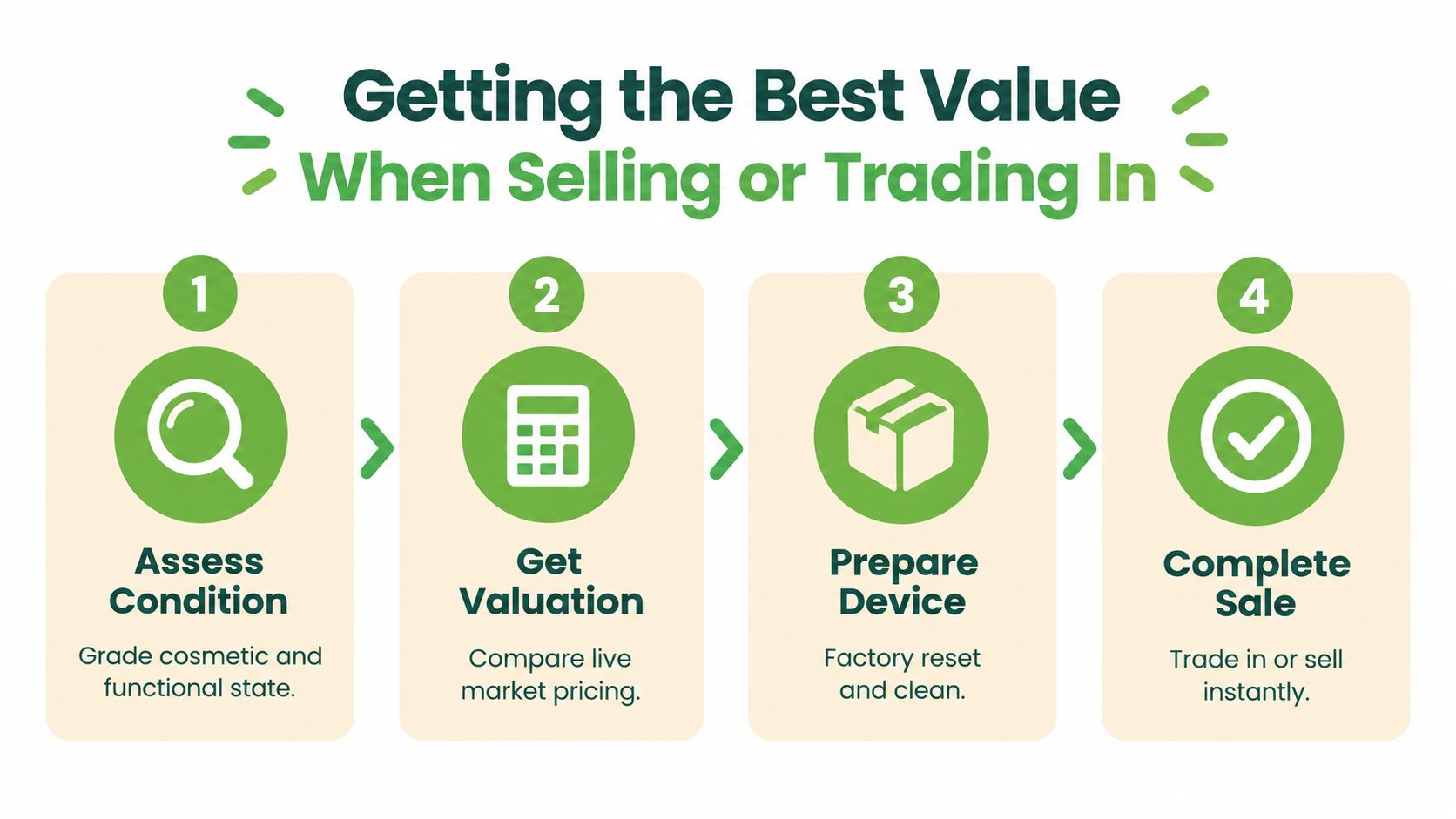
Assess the condition. Note cracks, dents, screen burn-in, camera problems, charging faults, water exposure, and battery behaviour. Be honest about defects. A realistic condition description usually creates a smoother assessment than an optimistic one.
Get a valuation. Enter the correct model and storage details, then compare the quote with what similar phones are selling for. A private sale may require more time and messages. A buyback route may offer less back-and-forth and a faster decision.
Prepare the device. Back up photos, contacts, authenticator access, and important files before you erase anything. Sign out of Apple ID or Google accounts, disable Find My or equivalent device locks, remove your SIM and microSD card, and clean the handset without forcing liquid into openings.
Complete the sale. Follow the service's instructions for an online shipment or physical drop-off. Keep any handover confirmation and make sure you understand when payment is issued and what happens if the physical inspection differs from the initial description.
The account-lock step is essential. A phone can be fully functional but unusable to its next owner if Activation Lock or another security feature remains connected to you. Singapore trade-in guidance from major device programmes also requires a full data wipe and account-lock removal. Samsung's Singapore trade-in FAQ specifically says that any SIM or microSD card left inside a collected device will be destroyed on receipt, as set out in Samsung's Singapore trade-in guidance.
You can review the phone trade-in process in Singapore before choosing between a quote and a private sale. The main value isn't only the cash or credit. Passing the phone into a reuse channel gives it a chance to become someone else's working device, or to contribute useful parts if repair makes more sense.
Protecting Your Privacy with Secure Data Erasure
A phone leaving your hand can carry much more than old photos. Messages, saved passwords, email accounts, contacts, location history, work documents, health information, payment apps, and authentication tools may remain connected to you. A forgotten phone in a drawer can become a privacy risk the moment someone else gains access to it.
A factory reset is a useful first step for personal handovers. It should not be the whole plan when a device enters a reuse, recycling, or corporate disposal process. You need confidence that personal information cannot be recovered after another party receives the phone. In simple terms, the phone should continue its journey, while your digital identity stops with you.
Singapore's nationwide e-waste rules require licensed recyclers to permanently erase or destroy all data stored on a data-bearing device before it is prepared for reuse, recycled, disposed of, or transferred to another recycler. Phones are included among these devices, as explained in Singapore's e-waste extended producer responsibility system-system-for-e-waste-management-system).
The Personal Data Protection Commission's guidance also requires organisations to securely delete, erase, or destroy personal data on retired storage media before redeployment, exchange, or disposal. This applies directly to businesses handling staff phones, and the same habit works at home. Once the device leaves your control, your information should leave with it. Secure data management for retired devices explains why a documented process matters, while secure data destruction guidance for retired devices describes the handling behind that process.
What to do before handover
- Create a backup: Move photos, contacts, files, and app data to a trusted destination before starting the reset.
- Protect your access: Confirm that you can sign in to your password manager, email, banking apps, and two-factor authentication after the old phone is gone.
- Remove accounts: Sign out of Apple, Google, Samsung, and other accounts. Then disable device tracking and activation locks.
- Remove physical storage: Take out the SIM and microSD card. A reset may not remove information stored on a removable card.
- Request evidence: For business or formal processing, ask whether secure-erasure documentation or a certificate is available.
A responsible lifecycle service makes privacy protection routine. The phone is assessed, data follows a defined process, and the device can then move to repair, resale, parts recovery, or recycling. You should not have to guess what happened to your information.
This short video offers another way to understand secure device handling:
Privacy should not leave a working phone forgotten in a drawer. Choose a service that treats data destruction as part of the device's full journey, alongside reuse and responsible recycling.
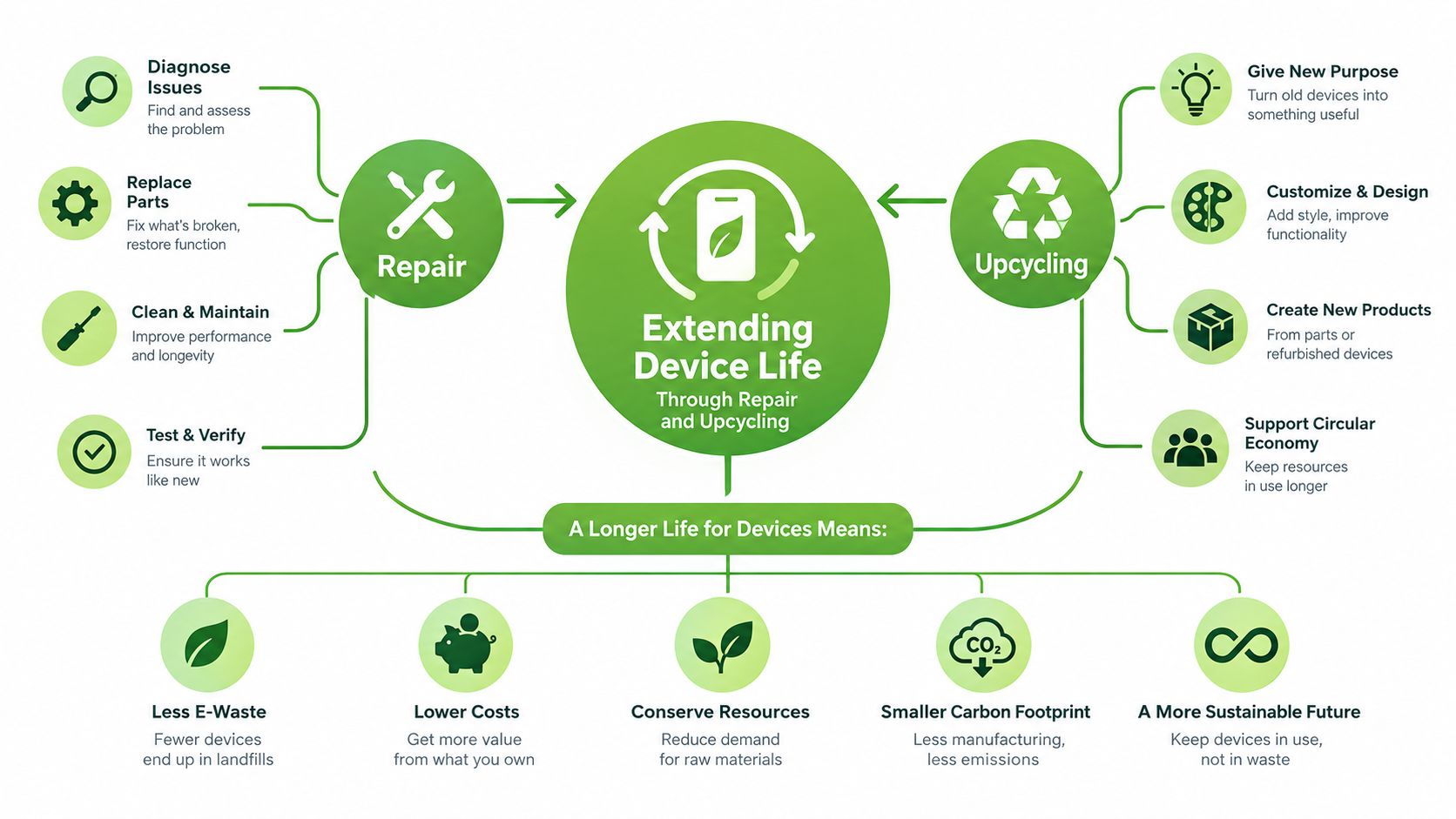
Extending Device Life Through Repair and Upcycling
A cracked screen doesn't automatically make a phone worthless. A dead battery doesn't mean every internal component has failed. In many cases, the device contains valuable parts that can be repaired, reused, or harvested for another handset.
Singapore's regulatory and service environment strongly favours repairable second-hand phones over disposal. The National Environment Agency's e-waste guidance explicitly recommends repair where feasible and reuse or donation for working electronics. Singapore also provides mobile-phone battery recycling pathways through its e-waste system.
Repair changes the value equation
Component-level repair means a technician replaces the failed part rather than treating the entire phone as disposable. Samsung Singapore has introduced component-level repairs for selected smartphones, showing how a faulty component can be addressed without scrapping the whole module. This can make restoration more practical when the logic board and other core assemblies remain healthy.
Consider three common situations:
- The battery has worn down: Replacing the battery can restore useful everyday performance while preserving the screen, cameras, speakers, and main board.
- The charging port has failed: A phone that can't charge may still contain a perfectly healthy display, camera system, and storage.
- The screen is cracked: A replacement display can return the handset to service, provided the internal frame and other components pass inspection.
Upcycling takes the next step when full repair no longer makes sense. A technician can test and recover healthy parts from one device to rescue another. This keeps components in circulation and changes the question from “Can this phone be sold as-is?” to “What useful value remains inside it?”
A broken phone is often a parts inventory waiting for a careful assessment.
That mindset helps households make better choices. A device that cannot be resold as a complete phone may still support another repair. Even a battery that has reached the end of its useful service belongs in an appropriate recycling pathway rather than a general rubbish bin.
Repair also supports more accessible second-hand choices. When technicians restore devices properly, buyers gain more options across different budgets and use cases. When sellers submit damaged phones for assessment instead of abandoning them, the refurbishment ecosystem gets more material to work with.
Joining the Zero E-Waste Community
A useful phone doesn't need to remain with its first owner forever. It can move from a personal upgrade to a certified resale device, from a repair bench to a new daily routine, or from a damaged handset to a carefully recovered set of parts.
Start with the action that feels easiest today:
- If you need a phone: Look for a certified refurbished device with clear testing information, a defined condition grade, and battery details.
- If you're upgrading: Back up your information, remove account locks, erase the phone, and request a trade-in or buyback assessment.
- If the phone is damaged: Ask whether repair is practical before replacing it. A battery, display, port, or other component may be the only problem.
- If it can't be repaired: Choose a responsible e-waste route that can handle data-bearing devices and mobile-phone batteries correctly.
- If your home or office has several old devices: Group them together and arrange a planned collection or drop-off instead of letting them disappear into separate drawers.
The Singapore consumer market shows why simple, secure collection matters. A 2025 survey found that 60% of people keep old devices after upgrading, and among those who keep them, 32% leave them unused indefinitely. The survey also found that 90% of Singaporeans would be open to reusing, recycling, or returning old devices if the process were simpler and more secure, as reported by IT Brief Asia's Singapore circular tech coverage.
Convenience can turn good intentions into action. An organised process for collection, data erasure, valuation, repair, and resale removes the awkward decisions that keep old electronics stuck at home. You don't need to solve the entire e-waste challenge alone. One phone, handled well, is already a meaningful step.
For practical disposal options, review where to recycle electronics in Singapore. Then choose your next move, whether that's buying a tested pre-owned phone, trading in an upgrade, repairing a tired handset, or clearing out a whole drawer of forgotten tech.
Ready to feel lighter and do good? Explore myhalo for certified pre-owned devices, repair and rescue support, trade-in options, secure data handling, and responsible upcycling. Clear out your old phones with a convenient process that protects your privacy and gives useful technology a longer life.