
Old batteries have a way of gathering in the same places, the kitchen drawer, the office desk, the gaming corner, the old laptop bag you keep meaning to clear out. If you've ever picked up a handful of AA cells, a swollen phone battery, and a charger cable you no longer use, it can feel oddly hard to know what goes where, especially when you're also worrying about leaks, short circuits, or private data on devices that still turn on.
Singapore has made this easier to handle, because battery recycling now sits inside a wider Extended Producer Responsibility system, and the country's battery recycling capacity has grown to more than 11,000 tonnes per year after the opening of a third local plant, a rise of more than 30% under the Resource Sustainability Act 2019 framework (Bird & Bird). That matters because the goal isn't just to “throw batteries away” correctly, it's to keep them moving through licensed channels where they can be handled safely and recovered properly.
If you want a broader view of why structured recycling systems matter in buildings and workplaces, a useful read is this guide on effective waste management programs. For Singapore households and businesses, the practical question is simpler, where should each battery go, and how do you prepare it without creating a hazard?
Table of Contents
- Introduction to Battery Recycling in Singapore
- Preparing Batteries for Safe Recycling
- Consumer Collection Options and Drop-Off Points
- Corporate Battery Recycling and ITAD Services
- What Happens to Recycled Batteries After Drop-Off
- Costs and Incentives for Recycling Batteries
- Conclusion and How myhalo Simplifies Recycling
Introduction to Battery Recycling in Singapore
A drawer full of old batteries, a swollen phone pack, or a box of mixed office spares can create the same question, where should these items go next? The answer depends on the battery type, because Singapore treats household cells, rechargeable packs, and larger commercial batteries differently under its e-waste rules. That distinction explains almost every rule that follows, from how the battery is set aside to where it is sent for treatment (The Environmentalist Lawyer).
The framework is built to do more than keep batteries out of general rubbish. It supports effective waste management programs by reducing fire risk, improving material recovery, and making it clearer who handles each step after collection. For households, that usually means separating small cells from normal trash and using approved collection channels. For businesses, it also means keeping track of what leaves the site, how sensitive equipment is cleared, and whether the downstream handler can document the process. That difference shows why a single disposal habit does not fit every battery.
Practical rule: if you are unsure, remove the battery from regular rubbish first, then sort it by size, chemistry, and source, for example, a loose household cell, a rechargeable pack, or a larger regulated load. A short pause at this stage prevents many of the mistakes that cause leakage, short circuits, or rejected drop-offs.
Battery recycling singapore therefore starts with classification, not with a bin. A small alkaline cell, a lithium-ion pack from a laptop, and a corporate batch of mixed devices all travel through different channels, even though they may look similar at a glance. For household users, convenience matters, so myhalo can fit into the process through drop-off and buyback options. For corporate users, the same pathway can extend into ITAD services, which help align collection with asset handling and data protection. When the battery type is matched to the right route, the rest of the process becomes much easier to follow.
Preparing Batteries for Safe Recycling
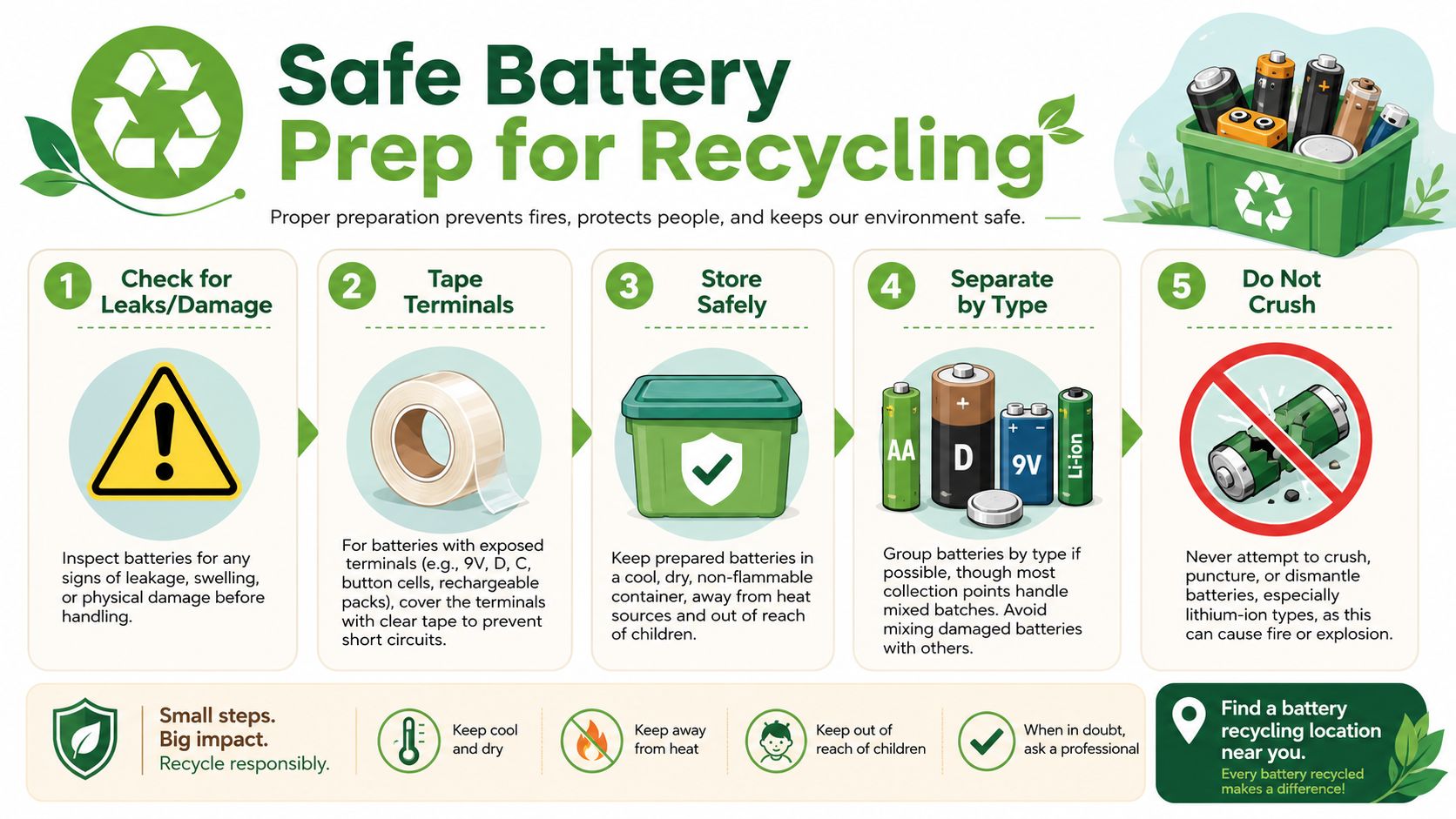
A battery that looks harmless in a drawer can become a problem once it is mixed with keys, coins, or other metal items. Safe preparation lowers the chance of short circuits, leakage, and rejected drop-offs, and it also makes the handover easier for both household and corporate recycling channels under Singapore's EPR framework.
Different battery types need different handling. A loose alkaline cell from a TV remote does not need the same care as a lithium-ion pack from a laptop, and a company batch of mixed devices calls for still more attention because the route after collection can involve asset controls as well as recycling. That is where myhalo fits naturally into the picture, with drop-off, buyback, and ITAD options that match the source of the battery rather than forcing every user into one path.
Handle household and rechargeable batteries differently
Household cells like AA and AAA are small, but they still should not be thrown loose into a bag with metal objects. Rechargeable batteries from phones, laptops, and power tools need extra care because exposed terminals can touch other conductors and create a short circuit. ALBA's public guidance also says damaged e-waste or leaking batteries should go into a properly secured container before drop-off, and ICT devices should have data wiped whenever possible before disposal (ALBA E-Waste Smart Recycling).
A simple prep routine keeps the process controlled, almost like sorting ingredients before cooking. Separate the battery first, then make sure it cannot touch anything that conducts electricity.
- Check for leaks or swelling: If a battery is damaged, keep it apart from the rest and avoid pressing on it.
- Tape exposed terminals: This is important for batteries with open contacts, including some rechargeable packs and button cells.
- Keep items dry and contained: A sealed bag or secure container is safer than a loose pile in a tote.
- Group like with like: Mixed chemistries create confusion at intake, so separate what you can.
- Never crush or puncture batteries: That matters especially for lithium-ion cells.
Batteries with exposed metal ends are safer when each terminal is covered before transport.
If you are sorting other household waste too, a UK pizza box recycling guide is a useful reminder that material-by-material sorting makes recycling easier to manage. Batteries follow the same principle, only with stricter handling because they can react if they are damaged or shorted.
For people who are still looking for a convenient handover point, a local recycle bin near me search can help you find the nearest approved option before you head out.
Consumer Collection Options and Drop-Off Points
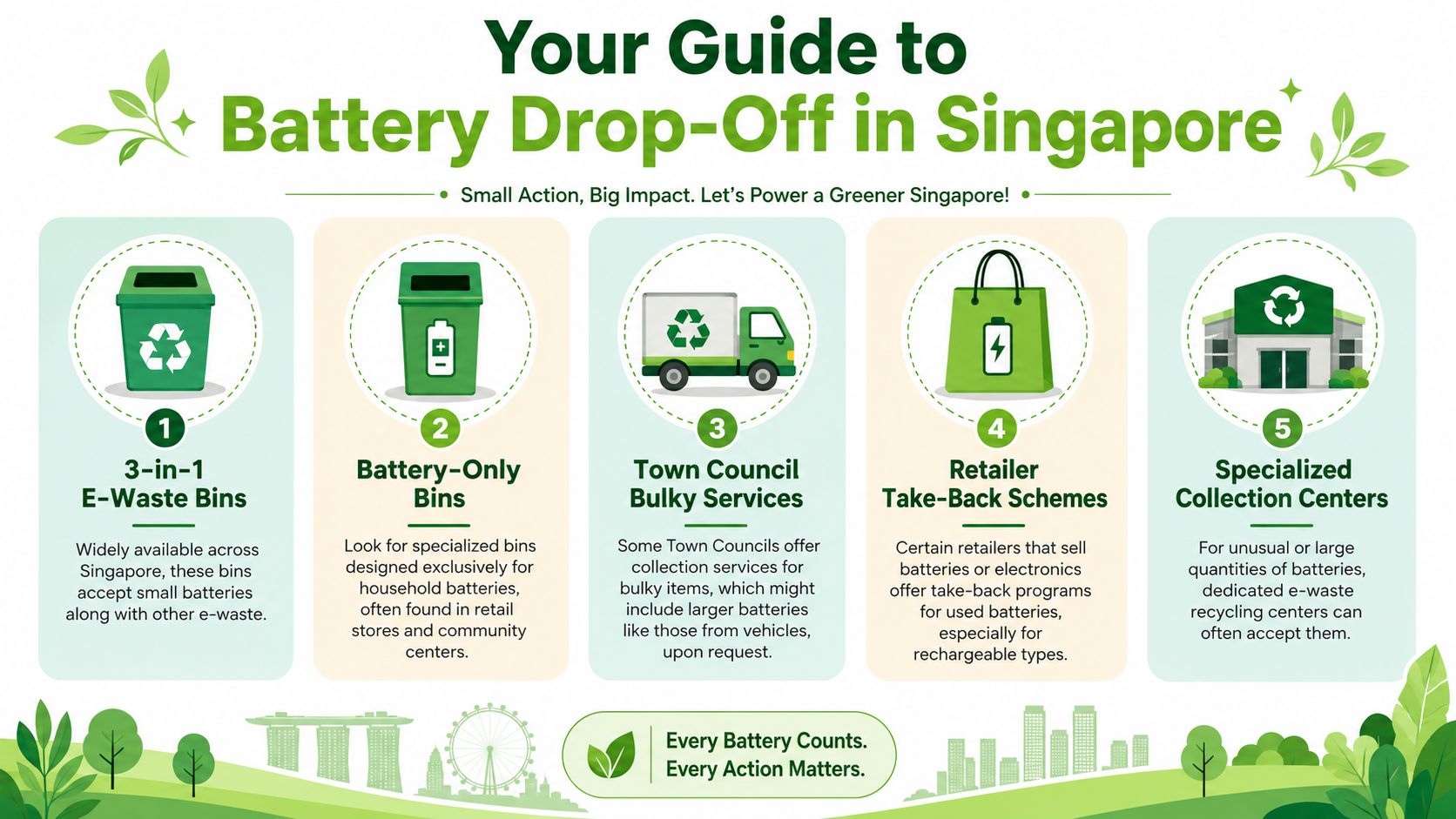
A used battery often sits in a drawer for weeks because people are unsure where it should go. In Singapore, the answer depends on the battery type and how much effort you want to spend getting it there, but the basic rule stays the same. Household batteries such as AA and AAA can go into the 3-in-1 e-waste bin, battery-only bin, or battery-and-bulb bin provided by ALBA E-Waste Smart Recycling, and the batteries are then sent to licensed e-waste recycling facilities for treatment (NEA e-waste management).
The main public routes
For small batteries, the nearest regulated bin is usually the simplest choice. For larger items, NEA's nationwide system includes manned over-the-counter collection, public bins, on-demand doorstep collection for a fee through ALBA's app or website, the Town Council bulky item removal service, and a free depot drop-off point at 20 Tuas Loop, Singapore 637350 (NEA nationwide system).
A practical way to choose is to match the battery to the handover point.
- 3-in-1 e-waste bins: Suitable for small household batteries and other small e-waste items.
- Battery-only bins: Useful when you have loose batteries and nothing else to drop off.
- Manned counters: Helpful if you want staff to check the item before you hand it over.
- Doorstep collection: Better for bulky regulated items that are awkward to carry.
- Depot drop-off: A convenient backup if you are already near that location.
If you are trying to find the nearest approved point, a local recycle bin near me search can help you check which option is closest before you leave home. The main thing is to bring batteries that are already prepared, rather than loose items with damaged packaging or leaking cells.
Simple habit: if a battery is damaged, secure it first, then use a route that accepts regulated e-waste instead of ordinary recycling.
Corporate Battery Recycling and ITAD Services
A warehouse clear-out can look simple on paper, then become messy the moment batteries sit beside laptops, phones, and other tracked equipment. Corporate recycling needs more than a bin. It also needs clear handover records, item sorting, and a decision on whether each device should be collected, resold, or sent for secure disposal.
Start by separating the loads before anyone arrives for pickup. Loose household cells, rechargeable packs, and larger regulated equipment should stay in different groups so staff can check them without confusion. Damaged items belong in secured containers, and any packaging that could tear or spill should be removed or stabilised first. If workers are unsure which devices carry data, mark them clearly before they leave the premises.
That is where a structured ITAD process helps. It usually covers chain of custody, secure data destruction, and documented disposal, so the organisation can show what left site and how it was handled. A practical reference is this guide on certified IT asset disposition in Singapore. myhalo also supports corporate IT lifecycle and ITAD handling with data management support, which fits teams that are clearing batteries from end-of-life devices and need the disposal trail to stay intact.
For teams planning a clean-out, begin with an inventory. Group the items by battery type, then decide whether each one goes into collection, resale, or secure disposal. That sequence helps staff avoid a mixed handover, which is a common source of delays and rechecking. It also gives facilities teams a clearer path when battery recycling sits alongside equipment recovery under Singapore's EPR framework.
What Happens to Recycled Batteries After Drop-Off
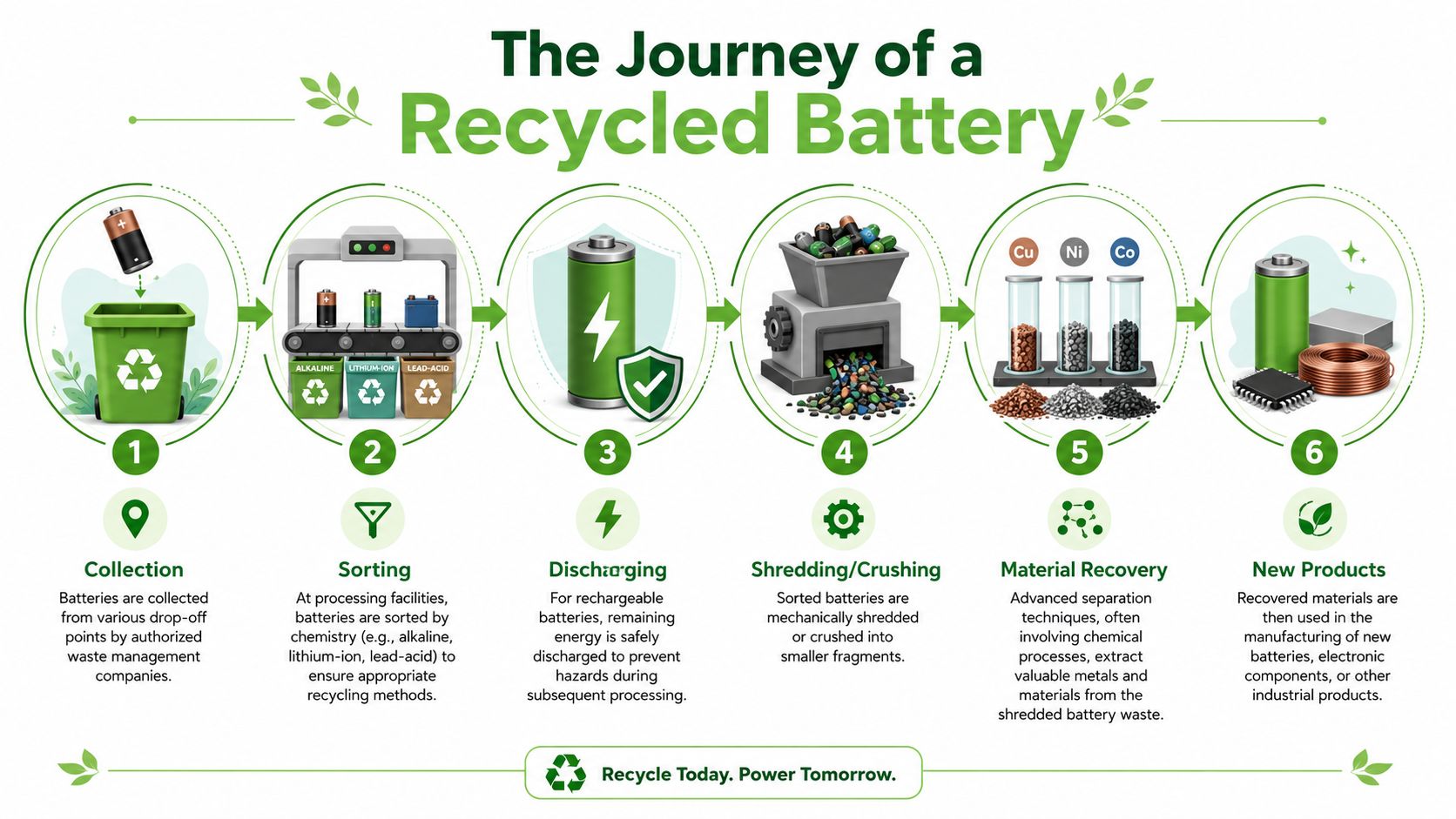
Once batteries leave a collection point, the sorting work becomes visible. A battery dropped into the right stream can move through Singapore's recycling chain with less fire risk, less contamination risk, and fewer delays at the plant. That early separation matters because the next steps depend on battery type, condition, and how carefully the load was prepared.
From collection to material recovery
At the plant, batteries are usually sorted by chemistry and format before any recovery work begins. The next steps can include controlled discharge, dismantling, shredding, mechanical separation, and then metal extraction and purification before the recovered material is used again. That sequence is straightforward to describe, but it only works well when batches are clean and consistent, because lithium-ion packs, alkaline cells, and damaged batteries do not behave the same way.
Singapore also has a strong technical benchmark for recovery yield. NTU reported a low-heat process that can extract up to 95% of a lithium-ion battery's critical elements, which lines up with the goals of EPR recovery pathways (NTU ERI@N). The figure matters because it shows what licensed recycling routes can support when the feedstock is properly prepared. Good pre-treatment helps recyclers recover more useful material, and that supports a more circular system.
The commercial side is already operating at scale. One Tuas facility was reported to recycle about 5,000 tonnes of lithium-ion batteries in a single year, and another Jurong plant was described as the region's first lithium battery recycling plant, backed by a S$30 million investment and designed to process 14 tonnes per day, or about 280,000 lithium-ion smartphone batteries daily (The Business Times). Those figures show why careful household sorting and licensed corporate channels matter from the start.
For a broader look at what belongs in each stream, this guide on how to recycle your e-waste helps connect battery drop-off with the rest of a device's recycling path, especially when the item carries both a battery and recoverable hardware. In practice, drop-off is the handover point, and the main work begins after that.
Costs and Incentives for Recycling Batteries
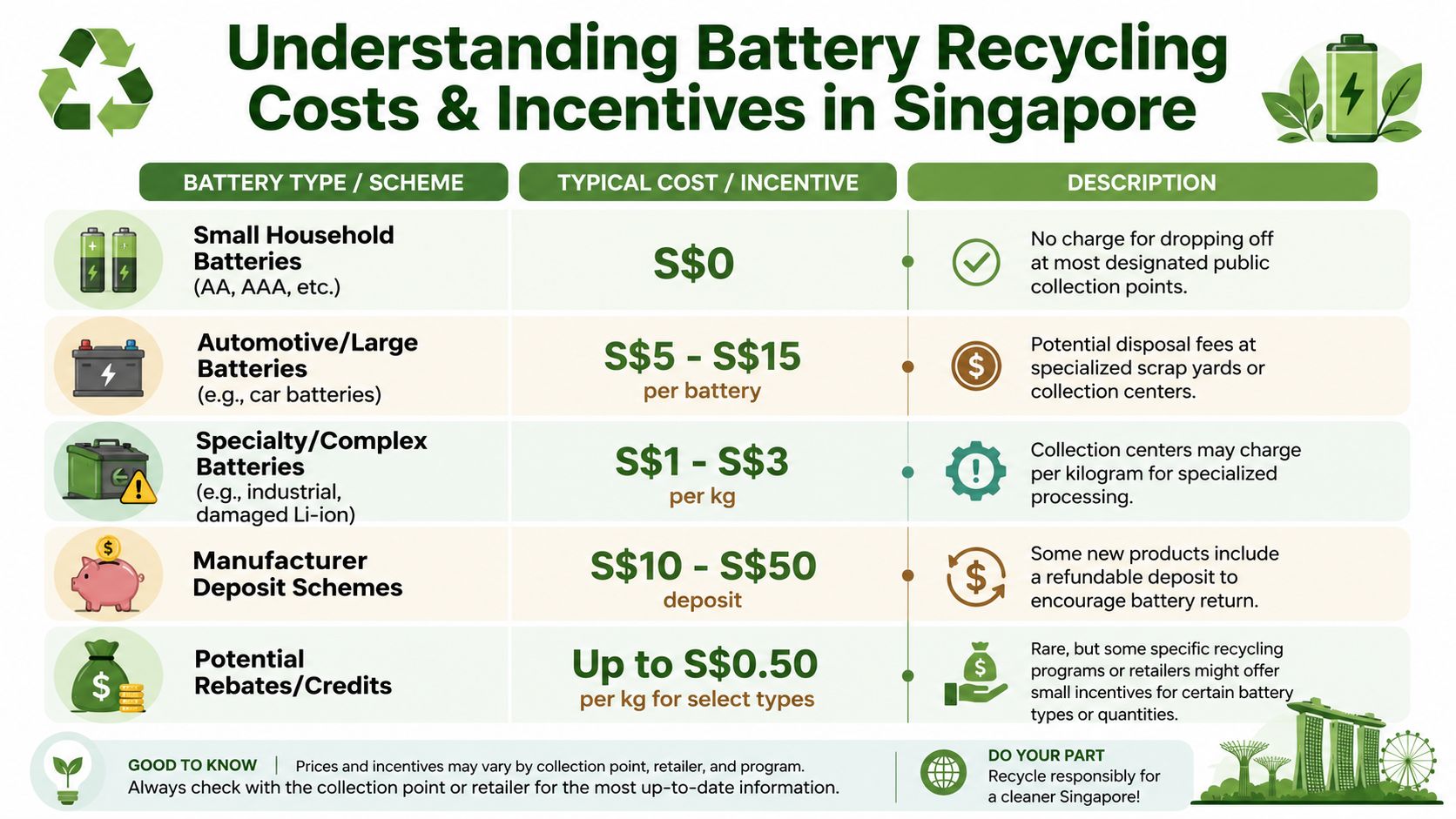
A battery dropped into the right collection route often costs little or nothing for households, but the details change once the battery gets larger, more specialised, or tied to business equipment. Small consumer batteries usually fit the simplest path because approved public collection points are already set up for everyday use. Larger packs, damaged units, and batteries from industrial or corporate devices may need a different collector because the handling steps depend on chemistry, size, and condition.
Typical fees and possible credits
| Option | Typical Fee (SGD) | Potential Credit (SGD) |
|---|---|---|
| Small household batteries | S$0 | None stated |
| Automotive or large batteries | S$5 to S$15 per battery | None stated |
| Specialty or complex batteries | S$1 to S$3 per kg | None stated |
| Manufacturer deposit schemes | S$10 to S$50 deposit | Refundable deposit may apply |
| Potential rebates or credits | Not stated | Up to S$0.50 per kg for select types |
That table is a practical guide, not a fixed price list. The route you choose matters as much as the battery itself. A household battery that goes into an approved bin is usually straightforward. A car battery, or a battery that is damaged, swollen, or attached to equipment, often needs a specialist collector, and that is where handling fees are more common.
For businesses, the value side is not only about disposal. Certified collection can support reporting, traceability, and compliance, especially for devices that still contain data. Some organisations also look at buyback or reuse first if the device still works, because that can preserve value before the item reaches recycling.
Worth remembering: recycling is not always the first-value option, repair, resale, or controlled reuse can make more sense when the battery or device still has usable life left.
If you are sorting a mixed inventory, start with the battery type, then decide whether it belongs in a free public drop-off route, a paid specialist route, or a resale or return programme. That sequence reduces surprises and helps households and companies choose the most practical path. If you need help finding partner locations for device returns and related services, use myhalo retail partners.
Conclusion and How myhalo Simplifies Recycling
Battery recycling in Singapore works best when you treat it like a simple checklist, identify the battery, prep it safely, choose the right collection route, and let licensed recyclers handle the rest. The system already has public bins, counters, doorstep options, and specialised plants behind it, so the hard part is usually just making the first sorted pile on your table.
If you're clearing devices as well as batteries, it helps to use one place that understands both disposal and recovery. myhalo's retail and service network can support drop-off, device resale decisions, and ITAD needs, and you can find partner locations through myhalo retail partners. That makes it easier to move from drawer clutter to an actual plan without juggling too many separate stops.
Ready to feel lighter and do good? Let's clear out those old devices together, and make your next battery drop-off simple, safe, and responsible.
A CTA for myhalo.