
Your drawer's full again. Old invoices, HR folders, a dead laptop, maybe a few phones that still hold photos, emails, and client files. It's a very Singapore problem, too, because space is tight, privacy matters, and “I'll deal with it later” can turn into a real data risk.
That's where secure shredding helps. Done properly, it's not just about getting rid of clutter, it's about making sure paper records, hard drives, SSDs, phones, and USB media can't be pieced back together by the wrong person. In Singapore, that matters for personal data, workplace records, and retired tech alike, because disposal is part of data protection, not an afterthought.
Table of Contents
- Introduction to Secure Shredding in Singapore
- Singapore Shredding Market Overview
- Comparing Paper Digital Media and Device Destruction
- Compliance and Certification Requirements in Singapore
- How to Choose the Right Shredding Provider
- Understanding Cost and Time Expectations
- Booking Process and Proof of Destruction
- How myhalo Supports Secure and Sustainable Shredding
Introduction to Secure Shredding in Singapore
A common concern starts the same way. The boxes are stacked, the phone has been replaced more than once, and the old laptop still feels too risky to toss out. That reaction is understandable, because documents and devices often contain personal details, financial records, and work files that should not be left where a simple mistake can expose them.
Secure shredding is the practical response. For paper, it means destroying records so they cannot be pieced back together with ease. For digital media, it means going beyond “delete” and making sure storage devices are sanitised or physically destroyed when needed. Singapore guidance treats that difference seriously, and the PDPC advises organisations to use disposal methods that make recovery difficult, including shredding for paper and secure erasure or physical destruction for electronic media.
A useful way to see it is this. A shredder in the office drawer is only one piece of the process. Real protection comes from collection, transport, destruction, and proof, so there is no guessing about what happened to the files or devices after they left the room.
Practical rule: if you are unsure whether a document or storage medium contains personal data, treat it as sensitive and destroy it properly rather than leaving it unattended.
That is why people in Singapore often look for services that can handle both paper and device destruction together. It matches the way offices work, because HR files, invoices, laptops, phones, and USB sticks rarely arrive in neat separate piles.
Singapore Shredding Market Overview
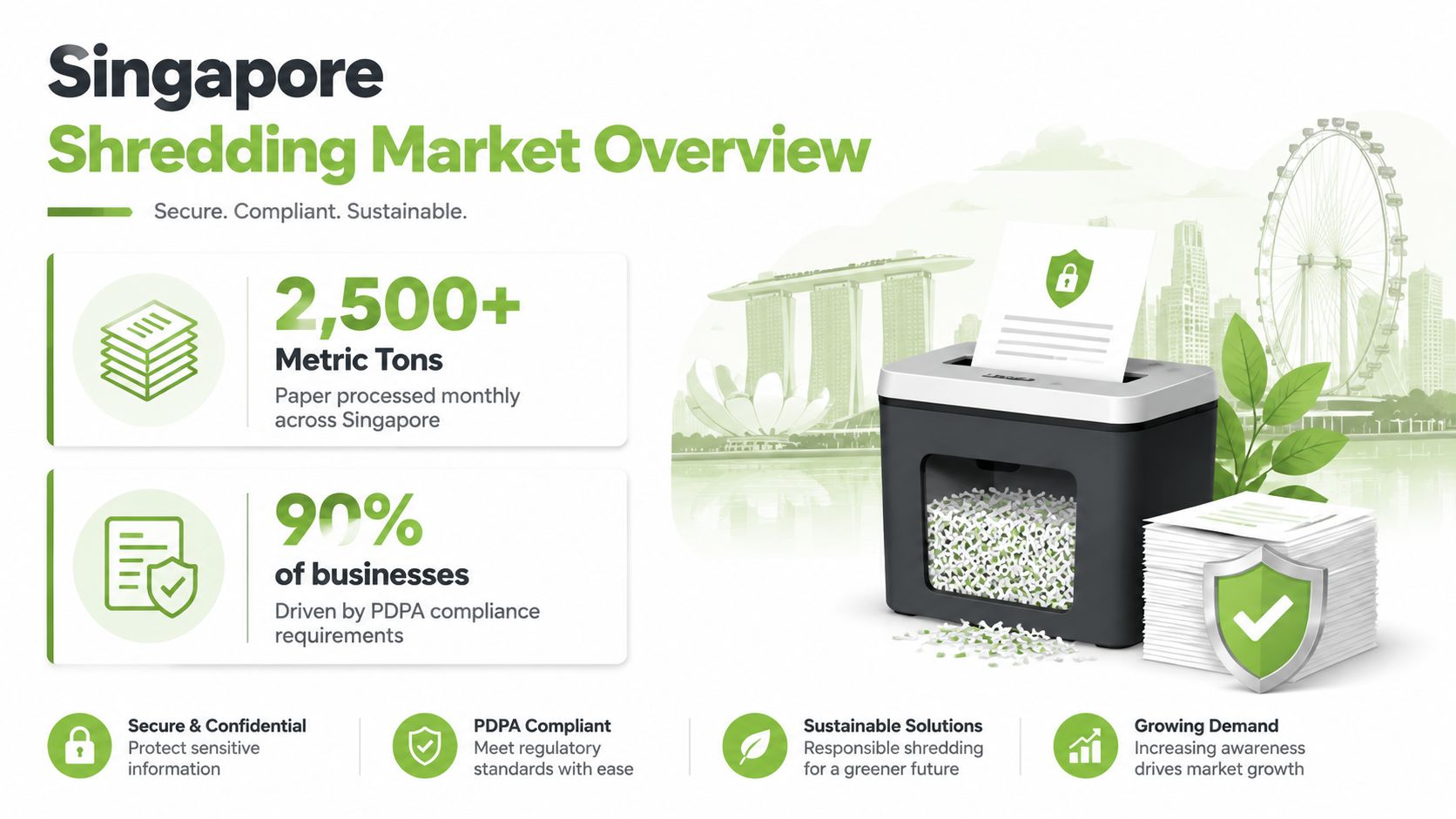
A Singapore press profile shows that shredding here is a business process, not a casual side task. Shred-it reportedly processes 170,000 kg of paper every month in Singapore, which points to an industrial level of destruction rather than a small office chore The Straits Times profile. Even without adding up every filing cabinet in the country, that figure makes the scale of secure disposal easier to grasp.
Why the market is built around compliance
Singapore's data protection rules give shredding a legal purpose, not just a convenience role. The PDPA has been in force since 2 July 2014, and official guidance says organisations should make recovery difficult when disposing of personal data PDPA disposal guidance summary. That is why demand comes from offices, schools, clinics, SMEs, and corporate teams that need disposal habits they can defend if questions arise later.
The market is also shaped by simple practical limits. Singapore is compact, office space is limited, and records do not disappear just because a filing cabinet is full. Certified destruction helps companies clear storage space while keeping disposal defensible, especially for customer records, HR files, invoices, and retired IT assets. It also links paper handling with digital and device disposal, because organisations rarely retire documents without also retiring storage media or office hardware.
Why outsourcing often makes sense
In-house shredding works for small, low-risk tasks, but it can fall short once volume, sensitivity, or device variety increases. A desktop unit can handle a handful of pages, yet it does not solve the wider problem of mixed media, chain of custody, or proof of destruction.
A service provider closes that gap by collecting items, transporting them securely, destroying them at the right level, and issuing proof afterward. That workflow matters for paper files, digital media, and devices alike, because each one carries information in a different form and needs a different end-of-life process.
Useful way to frame it: the question is not whether something can be torn up, it is whether it can be destroyed securely, consistently, and at the right security level.
That is why professional shredding services matter in Singapore. They turn disposal into a documented process, and that matters more than many organisations first expect.
Comparing Paper Digital Media and Device Destruction
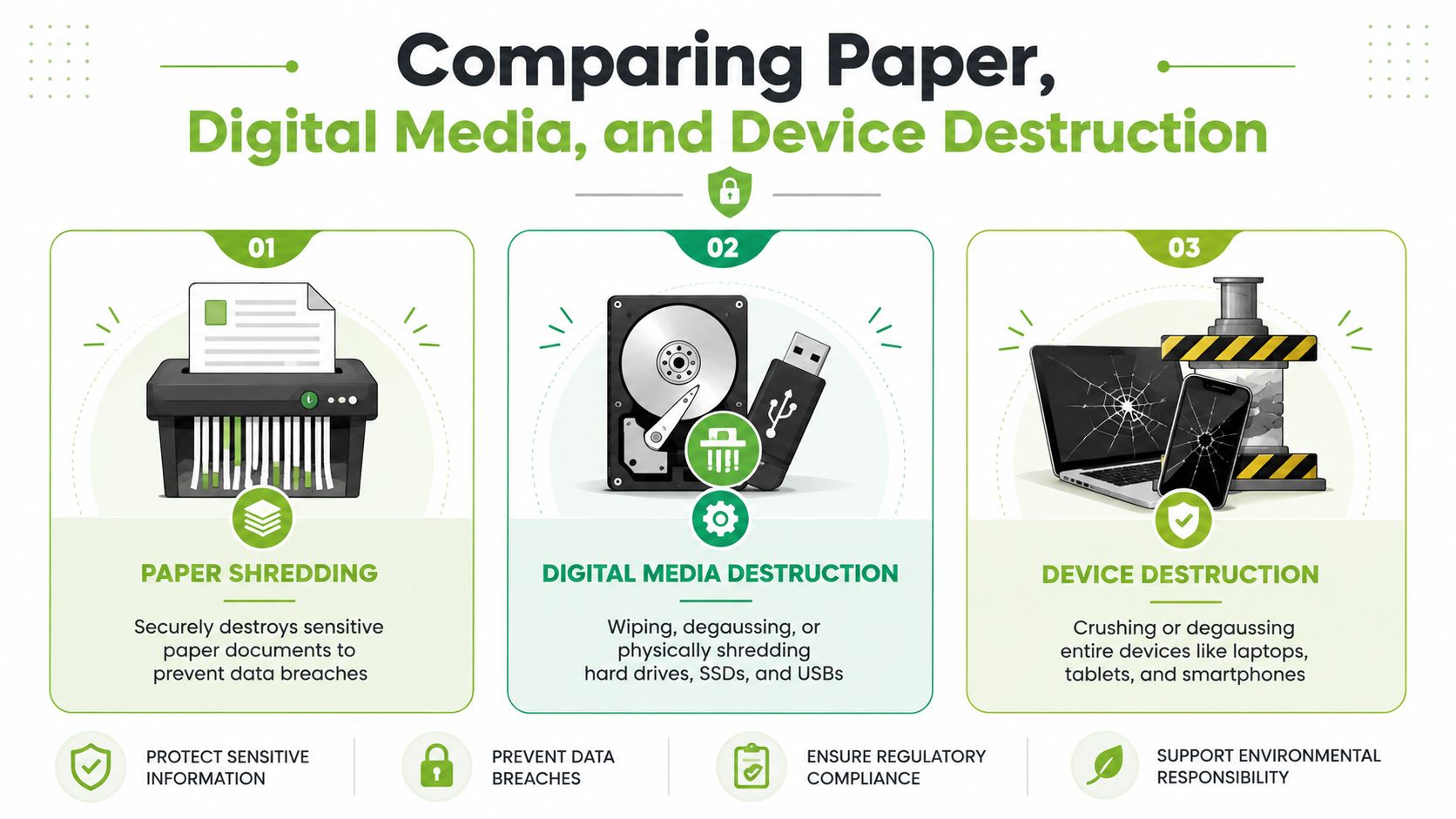
Paper, digital media, and whole devices each need a different destruction method. The mistake many people make is assuming one solution covers everything. It doesn't, because a paper file, a hard drive, and a smartphone store information in very different ways.
Paper shredding
For paper, the goal is simple. Cut documents so reconstruction becomes impractical. In Singapore, high-security paper destruction often uses P-5 micro-cut shredders that reduce sheets to particles as small as 2 x 10 mm, though the trade-off is lower throughput at around 7 to 8 sheets per pass P-5 shredder specification. That makes P-5 a strong fit for confidential files when reconstruction resistance matters more than speed.
Digital media destruction
Digital media is different. Hard drives, SSDs, and USB sticks can retain recoverable data even after files are deleted. For magnetic media, degaussing is one option, while other cases need secure erasure or physical destruction. You can read more about that process in this hard disk degaussing guide.
Device destruction
Phones, tablets, and laptops add another layer. They're not just storage devices, they're complete machines with batteries, boards, memory, and often multiple data-bearing components. Crushing or physically destroying the device is often the right answer when secure reuse is no longer possible.
| Method | Best for | Main benefit | Main limitation |
|---|---|---|---|
| Paper shredding | Office files and printed records | Fast destruction of physical documents | Doesn't address digital data |
| Digital media destruction | HDDs, SSDs, USBs, magnetic media | Protects data at the storage level | Needs the right method for the right media |
| Device destruction | Phones, laptops, tablets | Covers mixed hardware and hidden storage | Can reduce reuse potential |
The smart move is to match the method to the medium. That's how organisations avoid false confidence.
Compliance and Certification Requirements in Singapore
A stack of old files in a storeroom, a box of retired laptops, and a drawer of used access cards all raise the same question. How do you dispose of them in a way that protects people's information and leaves a record you can show later? In Singapore, data disposal is not treated as casual housekeeping. Organisations are expected to make reasonable security arrangements when personal data is discarded, and that includes using methods that make recovery difficult PDPC disposal guidance.
For paper records, the baseline guidance calls for at least level P-3 cross-cut shredders, which cut paper into pieces no larger than 320 mm² PDPA shredding guidance. That requirement turns disposal into something measurable instead of vague. A strip-cut page and a cross-cut page may both look “shredded” to the eye, but only one gives the kind of separation that aligns with the guidance.
What the minimum standard means
The P-3 floor matters because it gives teams a clear line to follow. If a document can still be pieced together, the job is incomplete. Singapore's guidance also makes clear that simple deletion does not solve every digital disposal problem. For electronic storage, secure physical destruction may be needed when erasure is not suitable PDPA shredding guidance.
That is where paper and device disposal need to be planned together. A filing cabinet, a USB drive, and a retired laptop all hold information in different forms, so the disposal method has to match the medium. Otherwise, one weak link can leave the whole process exposed.
Why certificates and chain of custody matter
A Certificate of Destruction helps, but it is only one part of the record. It should sit beside chain-of-custody logs, the destruction method used, and evidence that the provider handled the material properly from pickup to final processing. That matters even more when the disposal covers mixed assets like paper files, laptops, and phones.
A service may collect everything from one office, but the controls behind the scenes still need to hold up. Sealed transport, tracking, and clear handoffs reduce the chance of confusion about where the material went and who controlled it at each step. If the trail is unclear, the proof becomes weak even if the destruction itself was done correctly.
If you manage surveillance records or access-control footage, the same privacy logic applies there too. The linked overview of CCTV GDPR requirements for businesses shows how disposal and retention rules usually sit inside a wider privacy framework, not as a separate afterthought.
Why policy teams should care
Policy teams need two things from a disposal process. The first is a method that suits the material. The second is evidence they can show during a review or audit. That is why many organisations also align disposal records with internal controls such as those discussed in ISO 27001 data destruction guidance.
The same thinking helps teams handle both compliance and sustainability in one workflow. If paper, digital media, and devices are processed together with proper records, there is less duplication, less uncertainty, and fewer gaps between collection and final destruction.
Bottom line: if you cannot explain how the data was destroyed, you probably do not have enough evidence for a serious audit trail.
How to Choose the Right Shredding Provider
A good shredding provider should make the process easier, not more confusing. The easiest way to compare vendors is to check what they destroy, how they destroy it, and what proof they give you afterwards. That's especially important in Singapore, where many search results talk about bins and certificates but skip the end-to-end process across paper and devices end-to-end secure shredding.
Start with the destruction methods offered
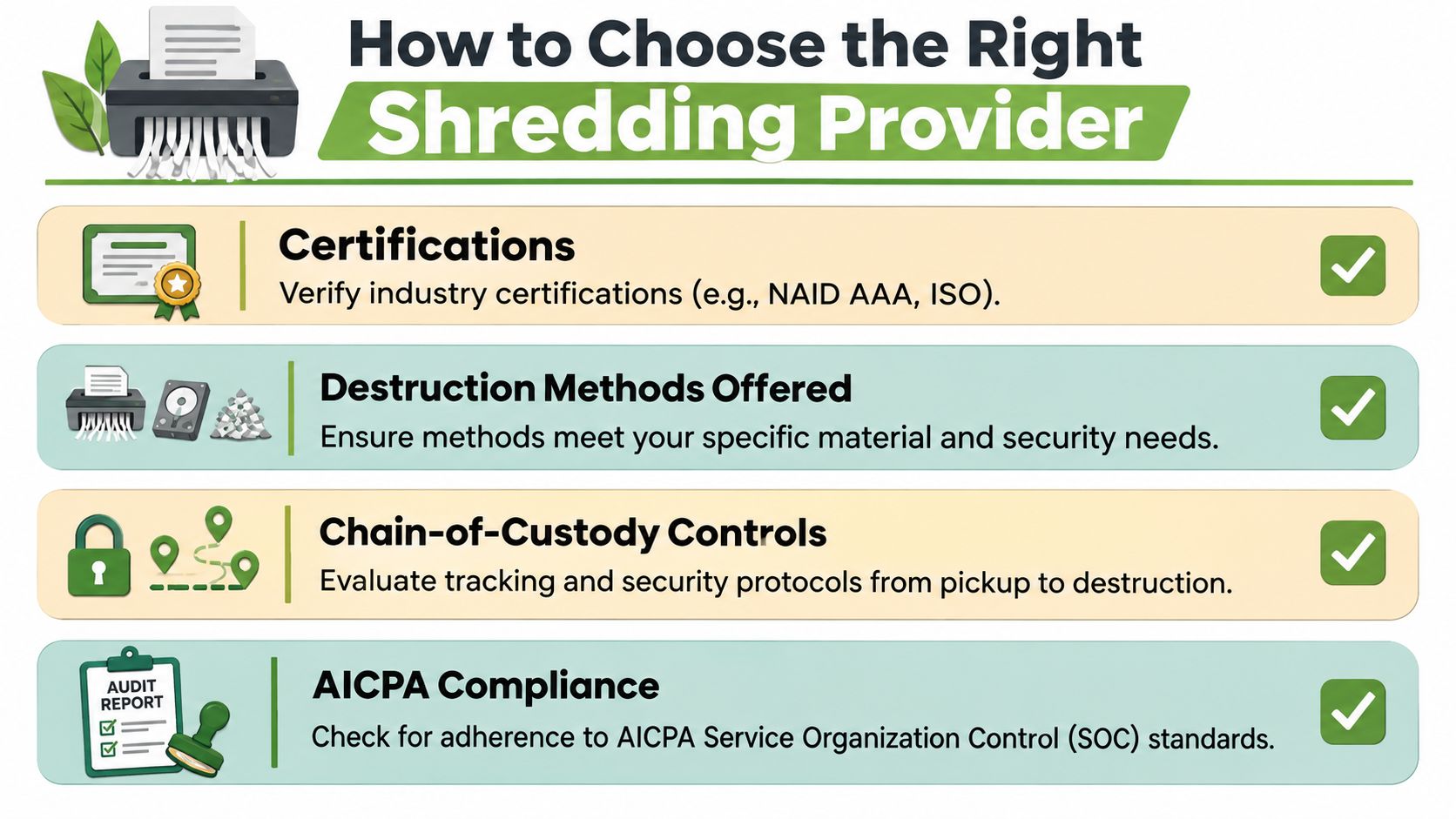
Ask whether the provider handles paper, digital media, and devices. A provider that only collects documents may be fine for archive cleanouts, but it won't solve laptop retirement or SSD disposal. If you've got mixed assets, the provider should be able to explain how each one is processed.
Check the chain of custody
Look for sealed transport, tracking, and a clear handoff trail. If materials move from your office to a van to a facility, each step should be documented. The reason is simple, once custody becomes vague, confidence drops.
Ask about certifications and reporting
A credible provider should be able to talk about its operating standards and give you a proper destruction record. The exact labels vary by service type, but the principle is the same, documented, auditable handling.
Match the service model to your workload
Use the service that fits your volume and risk level.
- Scheduled collection works for recurring office disposals.
- One-off bulk service suits cleanouts and relocation.
- On-site destruction is useful when materials shouldn't leave your premises.
- Off-site destruction can fit larger, well-controlled batches when transport security is strong.
The provider should also make the process visible. For a closer look at service formats, the internal overview at shredding services in Singapore is a helpful reference point.
Understanding Cost and Time Expectations
Shredding costs usually depend on what you're destroying, how much there is, and how quickly you need it done. Paper jobs are often priced differently from device destruction because the handling, security, and processing steps aren't the same. Mixed loads can also take longer to quote because the provider has to separate paper from drives, phones, and other hardware.
What drives the quote
A smaller office cleanout usually needs less planning than a server-room clearout or an archive purge. The quote tends to reflect pickup logistics, the number of containers, the destruction method, and whether the job happens on-site or at a facility. Urgent jobs can be harder to schedule because the provider has to fit them into secure transport and machine availability.
Why time estimates can vary
Paper-only work is generally easier to slot into a schedule than a mixed disposal project. Device work often needs more control because each item may need to be logged, sorted, and destroyed under a tighter process. Cooling cycles, security screening, and transport windows can all affect timing.
Here's the practical way to budget for it.
| Job type | Typical planning effort | Main timing pressure |
|---|---|---|
| Small office paper purge | Low | Pickup window and container count |
| Mixed paper and device disposal | Medium | Sorting and custody documentation |
| Large bulk clearance | Higher | Transport, processing, and verification |
Practical rule: if the job includes laptops, SSDs, or phones, don't budget it like a paper-only cleanup. The process is more deliberate for a reason.
The safest approach is to ask for a written scope before booking. That way, the service timeline and the handling method are clear before anything leaves the office.
Booking Process and Proof of Destruction
A booking should feel clear from the first enquiry. A good provider lays out each step, from the initial quote to the final records, so you can see how your documents or devices are handled before anything leaves your control. For Singapore users who want a documented process, the chain of custody should stay visible throughout.
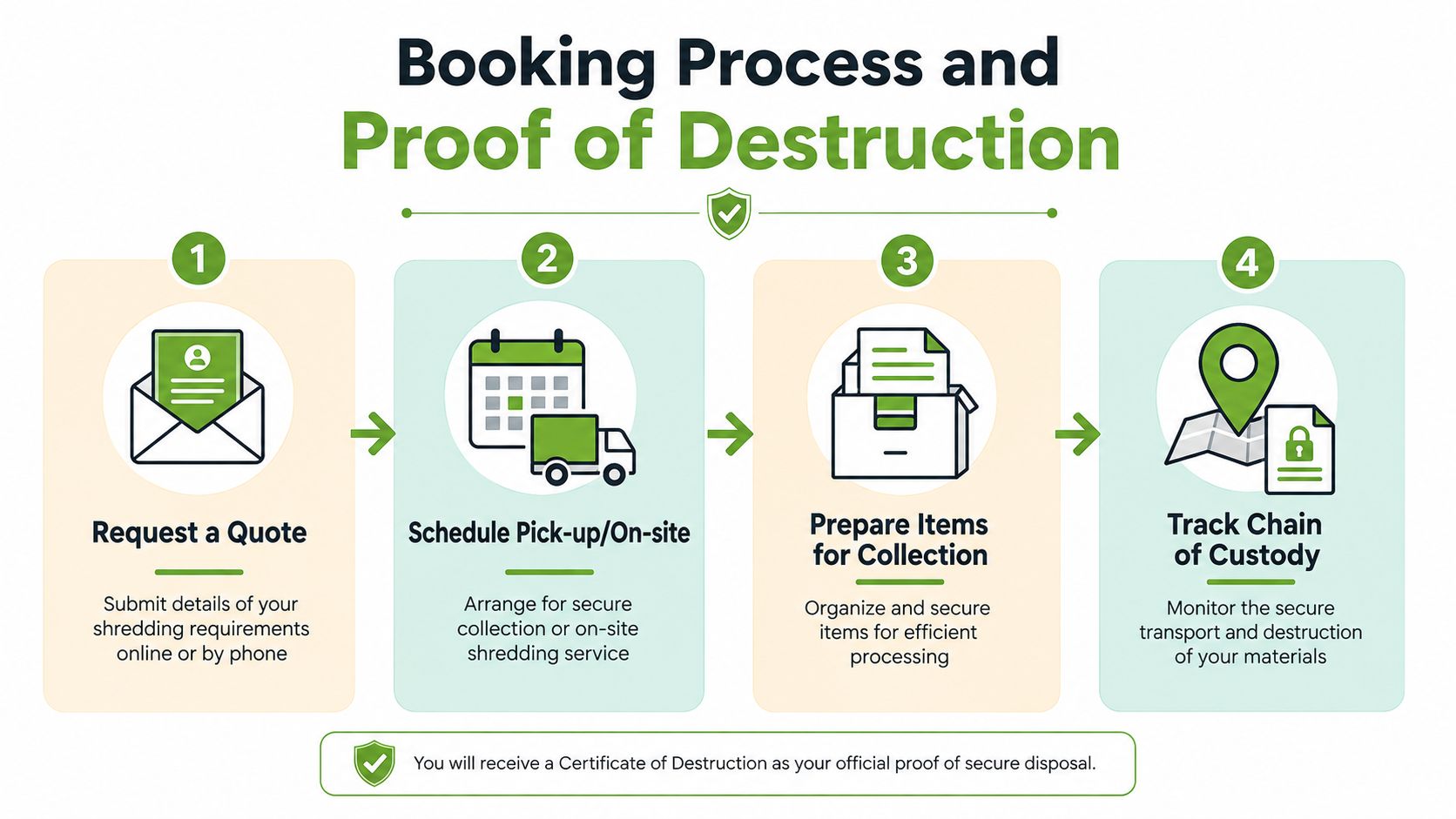
Step 1 Request a quote
Start with a clear list of what you have, paper files, hard drives, SSDs, phones, or a mix of media. A precise description helps the provider match the right destruction method to the items in front of you. If you are unsure whether something contains personal data, treat it as sensitive until the provider explains how it will be handled.
Step 2 Schedule pickup or on-site service
Choose a time that fits your internal handling needs. Some teams prefer on-site destruction because the items stay on the premises until they are destroyed, while others choose scheduled collection because it is easier to arrange. In either case, the provider should explain how the materials are controlled during transport or processing.
Step 3 Prepare items for collection
Keep documents, drives, and devices organised before handoff. Separating paper from electronics makes the transfer cleaner and helps staff track custody more easily, which is why guidance on document paper shredding often stresses tidy preparation. Do not leave sensitive items in shared areas while waiting, because personal-data documents should not be left unattended.
Step 4 Check proof of destruction
After the service, keep the certificate and any supporting logs with your compliance records. Paper destruction may come with a destruction certificate. Digital media may also require erasure logs or serial-number records, depending on the service and the items destroyed.
The image above is a reminder that proof matters as much as the shredding itself.
How myhalo Supports Secure and Sustainable Shredding
A lot of destruction services stop at “destroy it.” That solves the privacy issue, but it doesn't always solve the sustainability question. Singapore generated about 60,000 tonnes of e-waste in 2023 and is projected to reach about 74,000 tonnes annually by 2030, so the decision to destroy a device should sit beside the decision to reuse, repair, or recover parts whenever that's safe and practical Shred-it e-waste context.
Where the myhalo model fits
myhalo operates with a hybrid setup in Singapore, including physical drop-off and collection points at Bugis Junction (#03-25/26) and Sim Lim Square (#03-40), alongside online portals for quotes and purchases. In this kind of workflow, devices can be assessed for repair, reuse, or recovery before a final disposal decision is made. That matters because it avoids sending usable hardware straight to destruction when a safer second life is still possible.
Why this matters for mixed device estates
For businesses and individuals, the challenge is often not one old laptop. It's a mix of worn-out phones, slow notebooks, and retired office gear that all carry different privacy and sustainability concerns. A service that can handle secure data destruction while also considering reuse pathways keeps the process cleaner and closer to a zero e-waste mindset.
Simple standard: destroy what must be destroyed, recover what can still be used, and document the decision either way.
If you're clearing out old paper files or retired devices and want a process that respects both privacy and waste reduction, myhalo can help you take the next step with less guesswork. Reach out when you're ready to clear the clutter, protect your data, and move forward with a more responsible way to let go.