
You've got a shopping tab open, an older phone in your hand, and three Samsung Galaxy S24 Ultra prices staring back at you. One listing looks like a new retail deal, another is labelled refurbished, and a trade-in calculator promises a discount that may change after someone checks the device. That's why the Samsung S24 Ultra price in Singapore can feel less like one price and more like a moving target.
The number that matters depends on four things: storage, sales channel, condition, and what happens to your current phone. By the end, you'll be able to compare a new handset with a certified refurbished unit, a used listing, a Samsung trade-in quote, and the repair-versus-replace option without confusing launch RRP with today's real cost.
Table of Contents
- Why the Samsung S24 Ultra Price Still Confuses Singapore Shoppers
- Official Launch Pricing That Anchors Every Offer in Singapore
- New Retail Versus Certified Refurbished Versus Used in Singapore
- How Samsung Trade-In Discounts Actually Work
- What an AI-backed Pricing Algorithm Does to Your Quote
- Repair Versus Replace at Today's S24 Ultra Resale Value
- Choosing the Right Path for Your Upgrade
Why the Samsung S24 Ultra Price Still Confuses Singapore Shoppers
The Galaxy S24 Ultra remains a premium phone, but its original price is no longer the only useful benchmark. A sealed unit, a certified refurbished phone, a display set, and a used device may all carry the same model name while offering very different value. Treating them as interchangeable is how buyers overpay.
The label matters more than the headline number
A current listing substantially below Samsung's original recommended retail price may be a promotion, older stock, a refurbished unit, or a used phone. The listing should tell you which one. If it doesn't, ask before paying.
Condition also changes the calculation. A clean phone with strong battery health and a warranty deserves a different price from a device with visible marks, uncertain repair history, or no return protection. Storage creates another gap, especially because the 256GB, 512GB, and 1TB models share the same RAM baseline.
Practical rule: Compare the final amount in your wallet, not the large discount printed beside the listing.
The myhalo approach is useful here because it treats the S24 Ultra as part of a device lifecycle. A phone can be repaired, traded in, resold, refurbished, or responsibly routed for recycling. That gives you more choices than buying new and leaving your old handset in a drawer.
Before you compare offers, record the exact model, storage capacity, cosmetic condition, battery condition, warranty status, and whether the phone has been repaired. Then compare like with like. A 256GB certified refurbished phone shouldn't be judged against a sealed 1TB handset, and a trade-in estimate shouldn't be treated as cash until the device passes physical verification.
Official Launch Pricing That Anchors Every Offer in Singapore
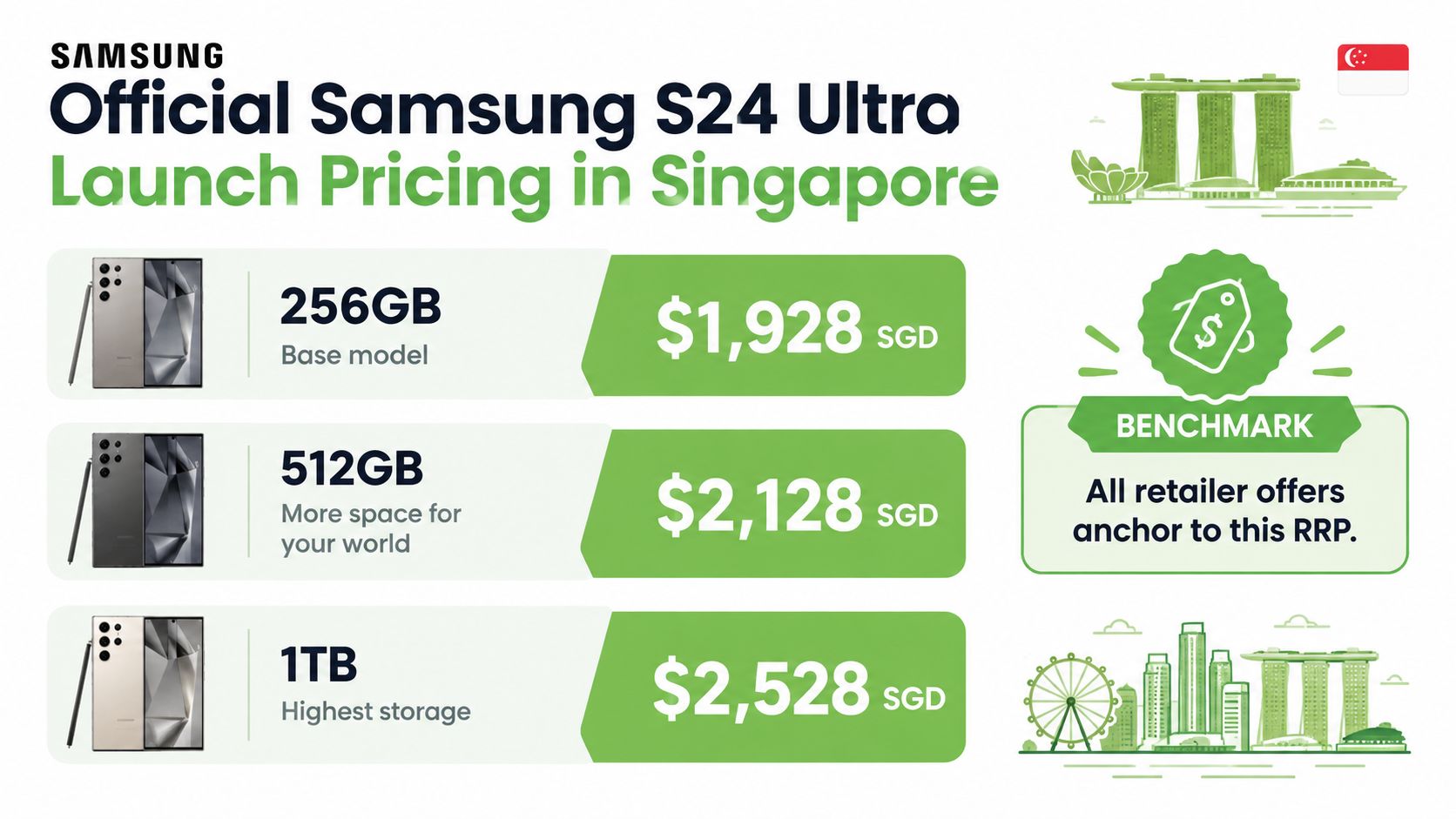
Samsung launched the Galaxy S24 Ultra in Singapore on 31 January 2024, after pre-orders opened on 18 January at 2:00 a.m. Singapore time. The official GST-inclusive recommended retail prices were S$1,928 for 256GB, S$2,128 for 512GB, and S$2,458 for 1TB, according to Samsung's Singapore launch announcement.
| Storage | Official launch RRP | RAM | Difference from previous tier |
|---|---|---|---|
| 256GB | S$1,928 | 12GB | Entry point |
| 512GB | S$2,128 | 12GB | S$200 more |
| 1TB | S$2,458 | 12GB | S$330 more |
The spread from the 256GB model to the 1TB model was S$530. The 1TB version therefore carried a 27.5% premium over the 256GB model, calculated from that S$530 difference against the S$1,928 entry price. The 512GB model cost S$200 more than 256GB, while the 1TB model cost S$330 more than 512GB.
Storage is the real value lever
All three launch versions included 12GB of RAM. The core platform also remained consistent, including the Snapdragon 8 Gen 3 for Galaxy processor and UFS 4.0 storage. The 512GB model doubled local storage without changing the memory baseline, which makes it the more sensible upgrade for people who record 4K or 8K video, keep large offline files, or install demanding games.
The phone also brought a 200MP primary camera, 5,000mAh battery, titanium frame, and a seven-year software and security support promise, all described in this Singapore Galaxy S24 Ultra review and specification guide. Those features help explain why a working S24 Ultra still has a strong reuse case.
For more context on how local handset pricing works, see this Singapore mobile price list. Use the launch RRP as an anchor, not as proof that a current listing is good value. A much lower price should prompt you to check whether you're looking at clearance stock, refurbishment, a display unit, or a second-hand phone.
New Retail Versus Certified Refurbished Versus Used in Singapore
You can compare Samsung S24 Ultra offers properly only when every route shows a realistic price, warranty, and level of risk. A sealed phone costs more, while certified refurbished and used units reduce the upfront bill in exchange for closer checks.
| Path | Typical SG price band, 256GB | Warranty profile | Best fit |
|---|---|---|---|
| New retail | Around S$1,500–S$1,900, depending on retailer promotions | Retailer or manufacturer terms vary | Buyers who want a sealed device and maximum certainty |
| Certified refurbished | Meaningfully below launch RRP when stock is available | Refurbisher warranty and grading should be checked | Buyers who want verified hardware at a lower price |
| Used | Around S$764 for a used 256GB example, depending on condition | Often limited or seller-dependent | Buyers who prioritise the lowest upfront price |
The S$764 used-market example for a 256GB unit comes from Singapore resale evidence in this repair-versus-replacement guide. Treat it as a reference point, not a guaranteed quote. Cosmetic grade, battery health, repair history, accessories, storage, and return protection can shift the final offer.
What you're really paying for
New retail buys certainty. The device is unused, support is clearer if something fails, and the purchase carries the highest premium. Pay this price when you want a sealed phone and do not want to investigate its history.
Certified refurbished is the sensible middle option for many buyers. A proper programme should test the handset, grade its condition, explain what has been checked, and include a warranty. Confirm the warranty length, battery policy, screen condition, included accessories, return window, and whether any components were replaced. This refurbished phones guide for Singapore buyers is useful for checking those details before you pay.
Used listings offer the lowest entry cost, but they demand the most work from you. Ask for the exact storage tier, inspect the display and frame, test every camera and the S Pen, check charging, confirm account removal, and match the seller's description against the physical device. A cheap S24 Ultra becomes poor value if it needs immediate repair or has no meaningful return protection.
My recommendation is clear. Choose new when certainty matters most. Choose certified refurbished when you want the strongest balance between price and protection. Choose used only when you can inspect the phone properly and accept limited warranty support.
How Samsung Trade-In Discounts Actually Work
Samsung's trade-in discount looks straightforward at checkout, but the first figure is only an estimate. The final value depends on whether the phone you hand over matches the answers you gave during the condition assessment.
The Singapore process
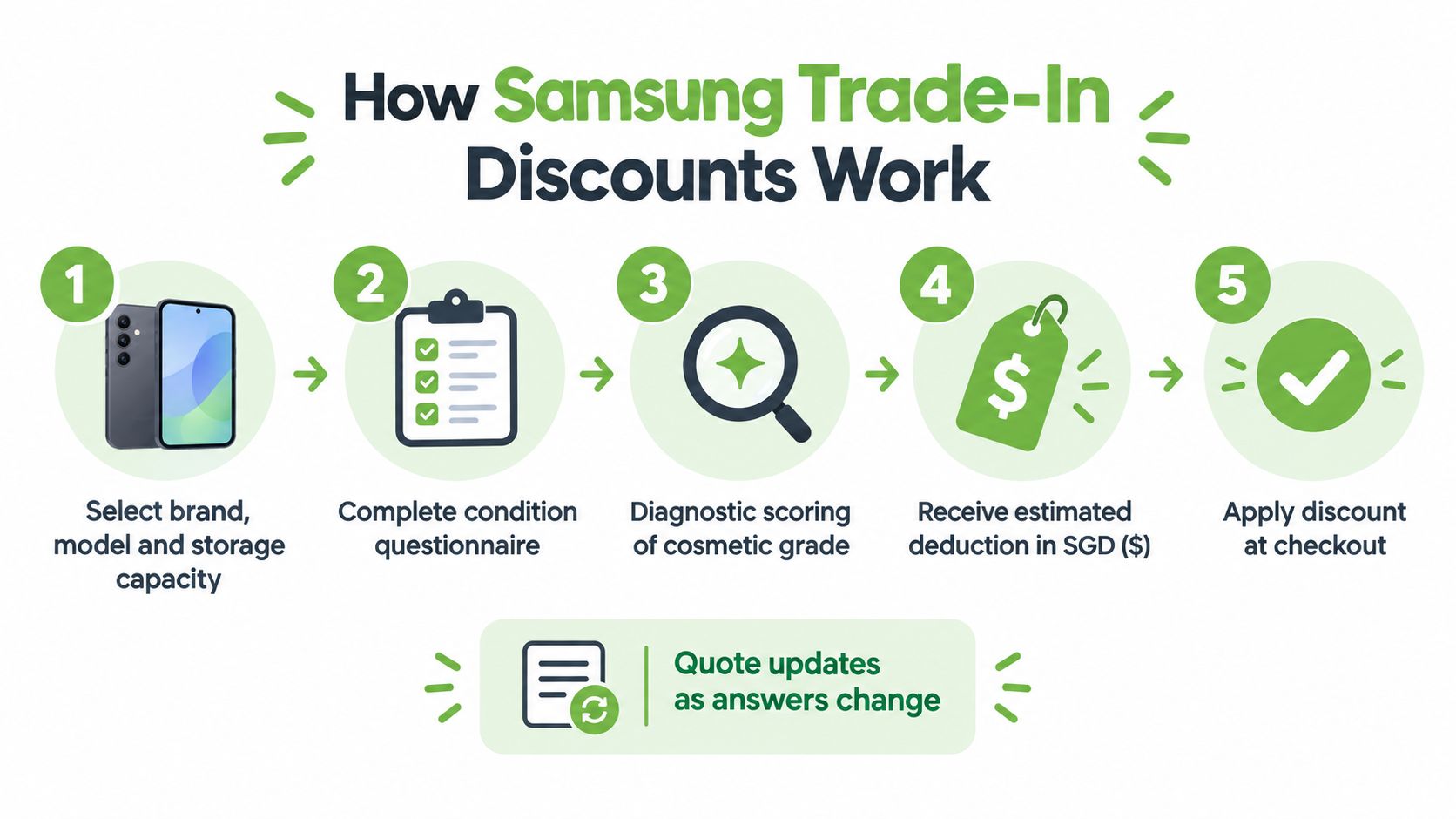
- Select the device. Choose the old phone's brand, model, and storage capacity.
- Answer the condition questions. Report screen damage, functional faults, cosmetic wear, and other relevant issues conservatively.
- Receive the estimated deduction. Samsung applies the estimated trade-in value against the new purchase price.
- Wait for contact. After delivery, the process schedules contact within one working day.
- Hand over the phone. The old device must be collected within three business days.
- Pass physical verification. A major mismatch can stop collection and trigger a chargeback of the trade-in and token values.
That timing and verification detail changes how you should read a Samsung S24 Ultra price with trade-in. The discount is a conditional ceiling, not guaranteed cash in your pocket. If you declare a phone as fully functional but the inspection finds a fault, the quoted deduction may not survive.
Answer like an inspector, not a salesperson
Use the strictest reasonable interpretation of every question. If the display has a faint line, describe it. If the frame has a dent, don't call it minor wear. If the battery behaves inconsistently, don't assume the inspection won't notice.
You should also photograph the phone before collection, back up your data, remove your accounts, and reset the device only after confirming that your files are safe. The safest comparison is between Samsung's final verified value and a direct buyback offer, not between a guaranteed offer and a preliminary estimate.
For a broader explanation of how device condition affects resale, read this Samsung phone trade-in value guide. The principle is the same across channels: honest condition details produce more useful comparisons.
What an AI-backed Pricing Algorithm Does to Your Quote
You enter “Galaxy S24 Ultra” and receive two very different offers. The gap usually comes from the inputs behind the quote, not an obvious mistake. An AI-backed quote engine weighs the model, storage capacity, cosmetic grade, battery health, and current demand before producing a real-time offer.

The inputs that shape your quote
Model and storage are fixed once you own the phone, yet they still separate one offer from another. A 1TB S24 Ultra provides more local capacity than a 256GB model, while both use the same 12GB RAM baseline. Check the storage tier before comparing prices, because a quote for one configuration cannot fairly represent another.
Condition and battery health belong to the individual device. A clean display, working cameras, responsive S Pen, and reliable charging support a stronger offer than visible damage or uncertain performance. Battery condition can also shift the result. A phone at 95% health should present more favourably than the same phone at 85%, even when the exterior looks identical.
Demand sits outside your control. Buyback platforms adjust offers according to what they can resell, refurbish, or route into another use. The principle resembles dynamic pricing for ecommerce brands, where prices respond to changing market inputs instead of staying fixed.
The quote therefore reflects both your phone and the buyer's next step. A device with clean hardware may attract stronger demand than one needing repair, while a less popular configuration can receive a weaker offer despite similar condition.
Treat the instant quote as a starting point
Enter the exact storage tier, describe every fault accurately, and save the quote details before comparing channels. Use the same day and the same condition description where possible. Do not improve the description to chase a higher figure. Physical inspection can reduce the offer after collection.
The same discipline applies beyond phones. This Singapore laptop trade-in guide shows why model and condition inputs matter before accepting a device quote. For the S24 Ultra, the practical conclusion is clear: the algorithm prices the differences you report and the market can verify. Check those inputs before judging whether the final Samsung S24 Ultra price is fair.
Repair Versus Replace at Today's S24 Ultra Resale Value
A cracked S24 Ultra needs a current-value test, not a launch-price comparison. Put the repair estimate beside the phone's resale value and the cost of a verified replacement. The right choice depends on how much working value the repair preserves.
Typical smartphone repairs in Singapore can range from S$80 to S$300. Battery replacements commonly fall between S$80 and S$130, while camera repairs may cost S$200 to S$350, according to repair-cost guidance. Use the S$764 resale benchmark above as the reference point, then compare the exact quote for your device.
A straightforward decision rule
- Battery issue: Repair usually wins when the screen, frame, cameras, and motherboard remain sound. The cost is far below the resale benchmark, and you keep a capable flagship in service.
- Camera fault: Get a written diagnosis before approving work. A camera repair can consume a large share of the phone's current value, so compare it with a verified buyback offer or certified refurbished replacement.
- Major display or combined damage: Sell, trade in, or send the phone for refurbishment when the estimate takes up a substantial part of its market value. Frame or motherboard damage makes replacement more attractive.
- Repairable cosmetic damage: Keep using the phone if it works properly and the fix is modest. Scratches and dents do not automatically justify replacing a fully functional device.
The sensible threshold: repair a contained fault when the post-repair phone remains worth keeping. Cash out when several costly faults appear together.
A repair provider should give you a diagnosis, parts estimate, and approval record before work starts. Repair businesses use cell phone repair shop software to organise diagnostics, parts, estimates, and customer approvals. You do not need that software yourself, but you should expect an itemised quote and clear data-handling process.
Sustainability also supports repair, reuse, trade-in, or refurbishment before disposal. Formal take-back arrangements can include one-for-one collection when a new product is delivered. If the S24 Ultra still works, protect your data, compare the repair bill with its resale value, and give the device a route back into use before sending it into the waste stream.
Choosing the Right Path for Your Upgrade
Choose based on your actual constraint, not the most dramatic discount.
If budget is the priority, start with a certified refurbished 256GB unit. It can sit meaningfully below the original launch RRP while giving you more confidence than an unverified marketplace listing. Check the warranty, grading, battery policy, and return terms before comparing the final price.
If storage is the priority, the 512GB model is the practical sweet spot for many users. It doubles local storage compared with 256GB while retaining 12GB of RAM and the same core platform. The 1TB version makes sense only if you'll genuinely use that capacity for media, large files, or heavy offline storage.
If sustainability is the priority, trade in or sell the old phone rather than leaving it idle. A verified quote can reduce the cost of the replacement, while repair or refurbishment keeps usable hardware in circulation. Back up your files and use a service with clear data-handling procedures before handing over the device.
If damage is the problem, diagnose first. A contained battery or minor fault can justify repair, while a high repair bill combined with display, camera, or frame damage points towards resale, trade-in, or responsible parts recovery.
myhalo offers a route that combines instant-quote trade-in with certified ReLoved devices, alongside repair, data recovery, secure data handling, and responsible reuse. That makes it relevant when you want to compare the value of your current phone with the cost of a verified replacement, rather than treating the S24 Ultra as a one-off purchase.
My recommendation: Start with the exact storage and condition of the phone you own, then compare a verified refurbished offer, a final trade-in value, and a repair quote. The cheapest headline price is rarely the cheapest complete decision.
Ready to feel lighter and do good? Visit myhalo to compare a trade-in or buyback route with certified ReLoved devices, while keeping your data secure and usable technology in circulation. If your S24 Ultra is damaged, ask about repair or data support before you replace it.