
A typical iPhone phone screen repair in Singapore costs S$80 to S$450+, depending on the model and the damage. Most repairs are completed on the same day, often within 30 to 60 minutes.
That cracked glass can appear at the worst possible moment, perhaps after a short drop onto a tiled floor or a slip from your hand at a hawker centre. You may still be able to read messages, but touch response, Face ID, brightness, or your peace of mind may already be affected. The good news is that you don't always need to replace the entire phone, and you can make a sensible choice by checking the damage, price, warranty, privacy safeguards, and the device's wider condition.
Table of Contents
- Understanding Your iPhone Screen Repair Options
- DIY Repair Versus Professional Service in Singapore
- What to Expect at a Service Centre
- Protecting Your Data During Repair
- Making Repair a Sustainable Choice
- Taking the Next Step with Confidence
Understanding Your iPhone Screen Repair Options
A cracked iPhone screen doesn't automatically mean your phone has reached the end of its useful life. If the picture remains clear and your finger movements register normally, the damage may be limited mainly to the front glass. If you see lines, dark patches, unusual colours, or areas that don't respond to touch, the display underneath may also be damaged.
Singapore repair reporting for 2026 shows why this problem is so common locally. Screen-related faults account for 41% of phone repairs, while Apple represented 47.22% of the mobile vendor market in April 2026, according to Singapore iPhone repair market reporting. In simple terms, Singapore has a large population of iPhones in daily use, and screens are one of the most frequent reasons those devices visit a repair counter.
Start with the type of damage
Consider two common situations. Mei drops her older iPhone, notices a web of cracks, but can still see the image and use every part of the touchscreen. Daniel drops his newer model and finds that the screen now flickers, shows a black section, and misses taps near the edge. Mei may have more repair choices. Daniel likely needs a full display-module replacement.
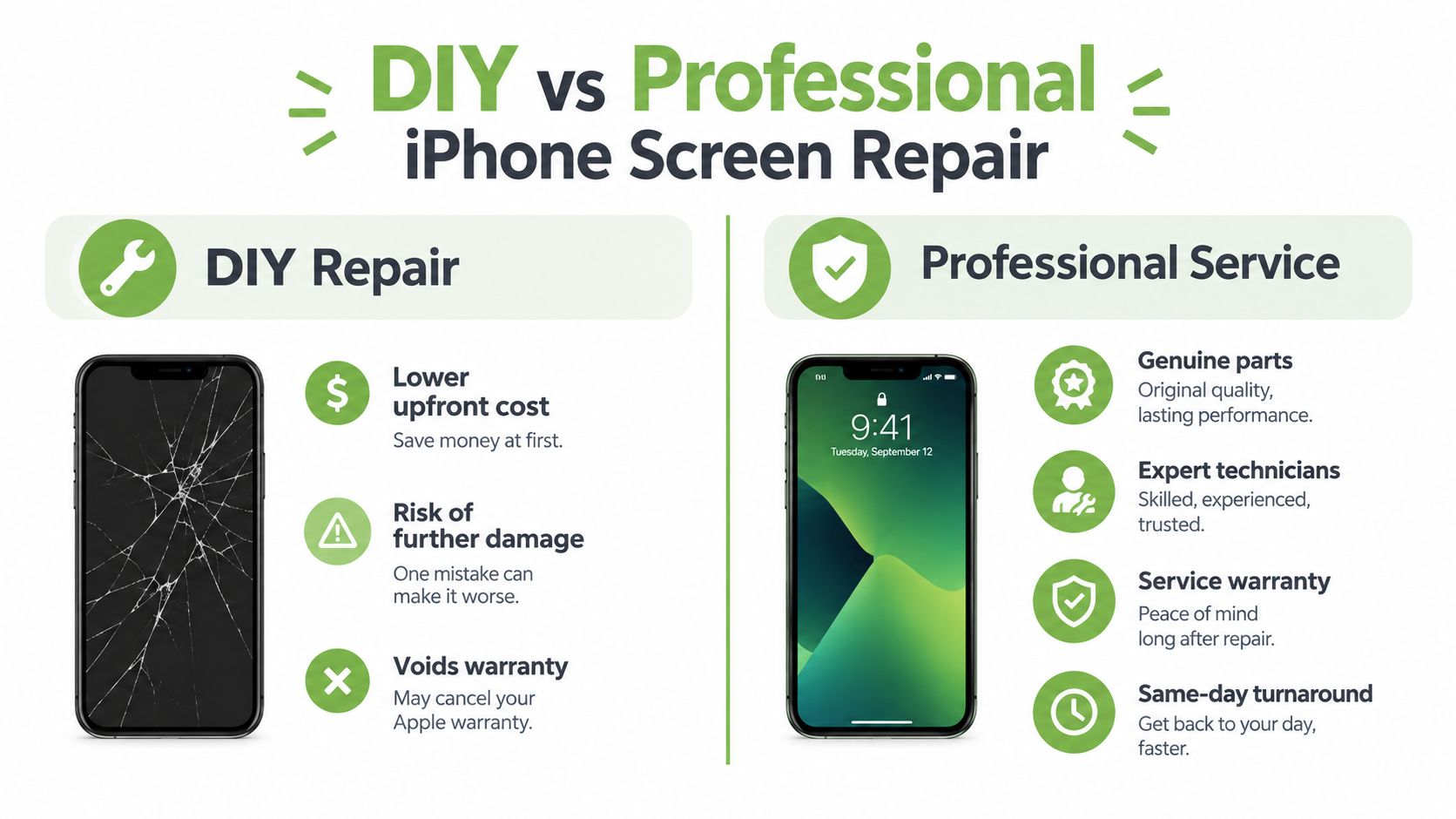
DIY repair kits can look attractive because the upfront price may appear lower. They also require careful disassembly, suitable tools, patience, and confidence with delicate internal connectors. A small mistake can create a second problem, such as damaged cables, a poorly seated display, or a phone that no longer functions as expected.
Professional service costs more than doing the work yourself, but it gives you a clearer process. You can ask which part will be fitted, how the shop tests the device, what the written warranty covers, and whether your data will remain private. For a practical comparison before requesting a quote, read this guide to phone screen repair prices in Singapore.
Practical rule: If the display has lines, dead zones, or colour changes, don't choose a glass-only fix simply because it sounds cheaper. Ask for a diagnosis first.
DIY Repair Versus Professional Service in Singapore
DIY repair makes sense only when you understand the trade-off. You may save on labour, but you take responsibility for identifying the correct screen, opening the phone safely, transferring small components, and checking every function afterwards. A repair that looks straightforward from a video can become stressful when adhesive, fragile connectors, or a damaged frame complicate the job.
Professional repair is usually the more convenient option for someone who relies on an iPhone for work, banking, transport, and family communication. Singapore pricing references for 2026 place older iPhone repairs around S$80 to S$180, XR through 13 models around S$150 to S$300, and newer 14 through 17 models around S$250 to S$450. These ranges are summarised in Singapore's iPhone screen repair pricing guide.
| iPhone model range | Typical cost range | Estimated turnaround |
|---|---|---|
| Older iPhones | S$80 to S$180 | Same day, often 30 to 60 minutes |
| iPhone XR to iPhone 13 | S$150 to S$300 | Same day, often 30 to 60 minutes |
| iPhone 14 to iPhone 17 | S$250 to S$450 | Same day, often 30 to 60 minutes |
The price difference between models reflects more than the size of the glass. Newer assemblies can involve more expensive OLED components, different part availability, and model-specific repair requirements. Before approving any work, confirm the exact model rather than relying on a phrase such as “iPhone 13 series”. The screen supplied for one model may not suit another variant.
What you are really comparing
A DIY kit gives you control over the timing and the chosen part. It doesn't give you a shop's diagnostic process, written post-repair support, or an experienced person to identify hidden frame or display damage. If the phone contains irreplaceable photos or work files, the risk of an unsuccessful repair deserves serious consideration.
A professional shop should explain whether it offers original-grade, aftermarket, or other replacement options in language you can understand. Part quality can affect brightness, colour, touch feel, and the way the screen fits the frame. You can also ask whether the repair may affect remaining manufacturer coverage, and whether the service warranty excludes future drops, liquid exposure, or unrelated faults.
For an overview of what replacement components can involve, see this guide to phone repair parts. The useful question isn't “What is the cheapest screen?” Ask instead, “Which option gives me an acceptable balance of price, reliability, features, and support for this phone?”
Apple's Singapore repair information directs customers to a Genius Bar or Apple Authorised Service Provider. Under AppleCare+, Apple lists S$42 for screen or back-glass damage, while out-of-warranty accidental damage ranges from S$455 to S$575, depending on the model tier, as shown on Apple's Singapore iPhone screen service page. That makes coverage status an important first check before comparing independent quotes.
What to Expect at a Service Centre
A good service visit should feel like a conversation, not a guessing game. Start by showing the technician the visible damage and describing what changed after the drop. Tell them if the phone has experienced liquid exposure, earlier repairs, intermittent touch problems, or a damaged frame.

The checks that matter
A typical assessment should establish whether the phone needs glass-only work or a complete display module. Singapore repair listings distinguish between lower-priced glass or original-grade replacement work and substantially higher-cost full display replacements. One local repair guide describes screen work around S$30 to S$170 for selected Grade AAA or original-grade options, while another lists modern repairs around S$345 to S$575 and full replacements reaching S$789 to S$1,339, depending on model and scope, as outlined by Singapore iPhone LCD repair pricing information.
These figures aren't interchangeable quotes. They describe different levels of work. If the image remains stable and only the outer glass is cracked, a technician may discuss a less extensive option. Lines, discolouration, flickering, or dead zones generally point to a failing LCD or OLED panel, which calls for the complete module rather than a cosmetic glass fix.
Ask these questions before you authorise the job:
- Part choice: Is the replacement original, original-grade, or aftermarket, and what differences should I expect?
- Feature testing: Will you test touch response, brightness, cameras, speakers, Face ID, and proximity functions?
- Warranty scope: How long does the warranty last, and does it cover touch faults, display defects, or only the replaced part?
- Data access: Do you need my passcode, and if so, what specific tests require the phone to be fully functional without security barriers?
- Final price: Does the quote include labour, adhesive, calibration, and any applicable taxes or fees?
Singapore repair providers commonly offer limited cover after screen work. Examples range from 30 days to 90 days for standard iPhone repairs, while one provider states that water-damage repairs receive only 7 days, as described in Singapore screen repair warranty information. Read the terms rather than relying on a verbal promise.
A short final test at the counter can prevent an awkward return visit. Type across the whole screen, swipe from each edge, adjust brightness, try Face ID, make a quick call, and check the front camera and speaker. For help choosing a suitable shop, you can also review this guide to shops that repair phones in Singapore.
Protecting Your Data During Repair
Your screen is replaceable. Your private photos, messages, authentication details, and work files may not be. Back up the iPhone before handing it over, especially if the display still works well enough to use iCloud or a computer.
Some Singapore repair providers state that they don't erase data during ordinary repairs, but also warn that they can't guarantee zero data loss. One local FAQ says data remains intact in 99% of cases, while its privacy information explains that a passcode may be requested for functional testing and that access is restricted to authorised personnel, as detailed in Singapore phone repair data and privacy guidance. Treat that figure as a provider-specific statement, not a universal promise.
A safer handover routine
- Back up first. Use iCloud or a computer and check that your latest photos, contacts, notes, and important files are available.
- Record the condition. Photograph the front, back, sides, and any existing cracks or dents while the display still works.
- Ask about the passcode. A shop may need a device with no passcode for certain tests, but it should explain why. If possible, stay nearby while testing takes place.
- Remove sensitive access. Consider signing out of financial or highly confidential apps if the repair process doesn't require them.
- Request a clear privacy explanation. Ask who can access the phone, whether data is copied, and how any temporary notes or test files are removed.
If the damage has already caused lost files or the phone won't boot, don't repeatedly experiment with repairs. A specialist such as trusted data recovery specialists may be a better starting point when recovering information is more important than immediate screen replacement.
Singapore media coverage has highlighted that repair shops don't follow one universal data-handling standard. Unauthorised access to computer material can lead to up to two years' jail and/or a fine of up to S$5,000 for a first-time offender, according to Singapore reporting on privacy in phone and laptop repair. You can also consult the Singapore consumer-protection guidance if a business misrepresents its repair result, price, or warranty terms.
For a practical preparation checklist, use this guide to backing up an iPhone before you visit a service centre.
Making Repair a Sustainable Choice
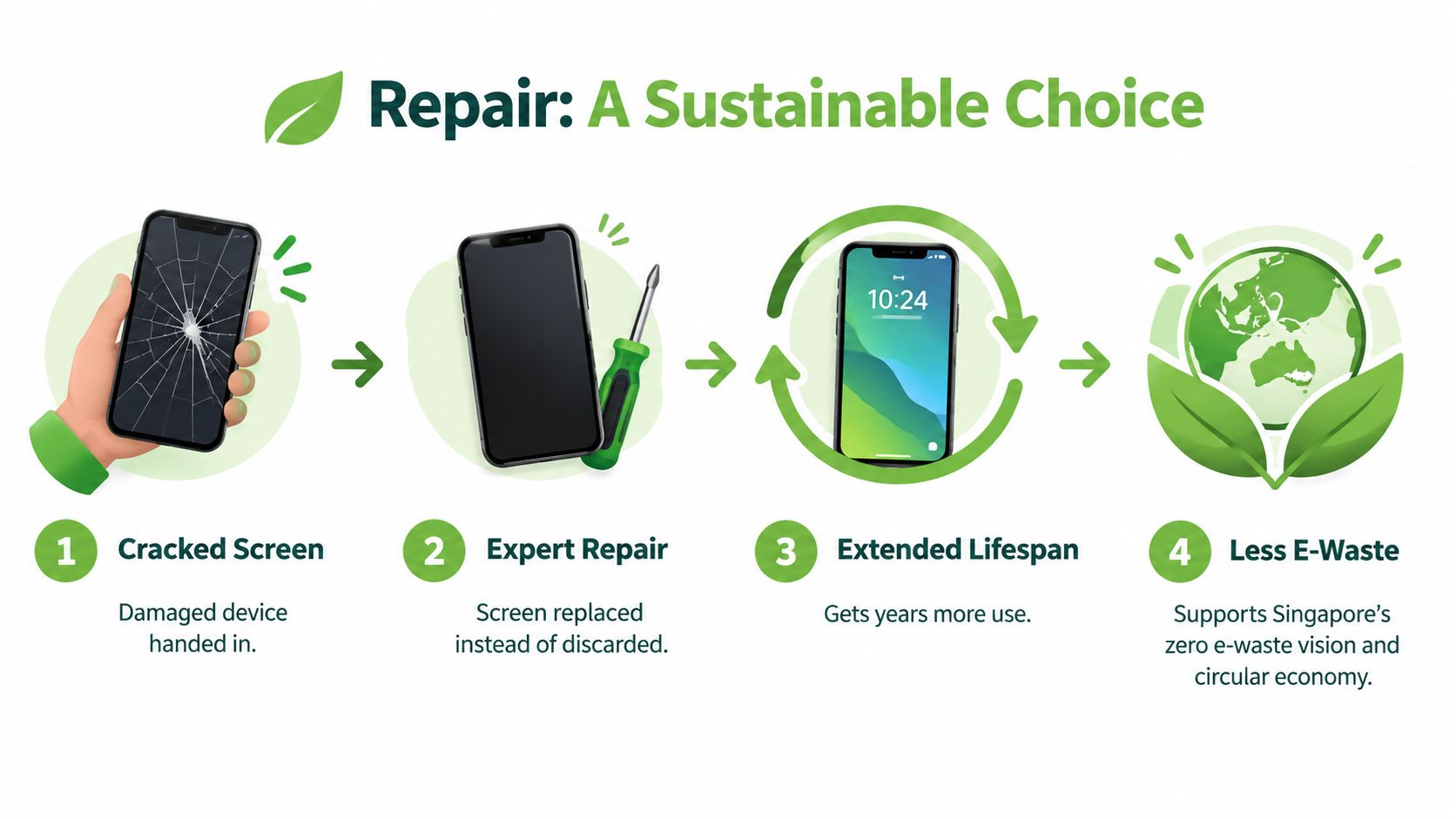
Repairing a cracked iPhone can be a practical way to keep a useful device in service instead of sending it into a drawer or replacing it immediately. That matters because every phone contains materials, components, packaging, and energy that went into making and distributing it. Extending the life of a device helps you get more value from what you already own.
Sustainability doesn't require a perfect decision. It can begin with a simple question: Is the rest of this phone still working well? If the cameras, battery performance, charging, software, and frame remain suitable for your needs, a screen repair may preserve a dependable device while avoiding unnecessary disposal.
Repair, reuse, and responsible exit routes
A responsible repair service can help you consider more than the immediate fix. A damaged phone may be suitable for repair, resale, trade-in, parts harvesting, or recycling, depending on its condition. Parts from one device may also help keep another device working, while unusable components should go through an appropriate e-waste pathway rather than ordinary household disposal.
The decision becomes less straightforward when the screen is only one of several serious faults. If the phone also has charging problems, a failing battery, liquid damage, or a bent frame, ask for a complete assessment before spending money on the display. A repair-plus-buyback comparison may be more sensible than treating the screen in isolation.
A sustainable repair decision is also a financial decision. Keep the device when a dependable fix restores useful life, and consider reuse or responsible recycling when repair no longer makes practical sense.
A calmer way to reduce e-waste
Repair can fit naturally into everyday life. You don't need to keep a device forever, and you don't need to buy a new one whenever the glass cracks. You can repair a suitable phone, use it for longer, pass it to someone else, or choose a certified resale route when you're ready to upgrade.
That approach supports a circular economy, where products and components stay useful for as long as possible. It also makes decluttering feel less wasteful. Instead of leaving old phones in a drawer because you're unsure what to do with them, ask a reputable provider to explain the repair, resale, data-erasure, and recycling options available.
Taking the Next Step with Confidence
You can make an informed iPhone screen repair decision by checking four things in order: the damage, the total cost, the warranty, and your data. A fifth question completes the picture: will repairing this device give it useful life, or are several other faults pointing towards trade-in, resale, or responsible recycling?
Start by identifying the exact iPhone model and testing what still works. Request a written quote that explains the part type and whether the repair is glass-only or a complete display replacement. Ask about the warranty in plain language, including exclusions for drops, liquid, and unrelated faults.
Before handover, create a backup and agree on how the shop will protect your information. After the repair, test touch response, brightness, cameras, Face ID, speakers, and charging before leaving. These small checks take little time and give you a much clearer record of the phone's condition.
A repair isn't just a way to make a cracked screen look better. It can restore a device you already know, save the disruption of moving to another phone, and keep useful technology in circulation. When the repair no longer makes sense, a responsible trade-in, resale, parts recovery, or recycling route can still prevent a working device from becoming forgotten e-clutter.
myhalo can help with phone repair, data recovery, secure data handling, trade-in, and responsible device reuse across Singapore. Your precious files and memories matter to us, whether you need to protect your privacy with Safe data or rescue lost files with Save data, reach out to the caring team today.