
You've just set up a new phone, transferred your photos, and put the old one in a drawer "just in case". Weeks pass. The battery slowly drains, a new model launches, and that phone you meant to trade in is worth a little less than it was. You're not alone in hesitating, and it usually isn't laziness. You might worry about private photos, banking apps and work files, you might not know what a fair price looks like, or you might be unsure whether a shop, a marketplace buyer or a recycler is the right place to go.
That's why a GW Mobile trade in is best judged the same way you'd judge every other route, on pricing transparency, data handling, convenience and environmental outcome. No single route suits every phone or every person. This guide lays the options side by side, explains how quotes are built, and shows you the checks to make before you hand anything over, so you can choose the route that fits your priorities and feel good doing it.
Table of Contents
- Trade-In Routes Compared at a Glance
- What Sets Your Trade-In Price and How to Check It
- Protecting Your Data Before You Hand Over a Phone
- How a GW Mobile Trade-In Works, Step by Step
- Keep, Trade In or Recycle Depending on Your Phone
- Where Old Phones End Up and Why It Matters
- Confirm Your Route and Request a Quote
Trade-In Routes Compared at a Glance
| Route | Pricing transparency | Data handling | Convenience | Environmental outcome |
|---|---|---|---|---|
| Retailer trade-in (e.g. GW Mobile) | Quote shown before handover, final price after inspection | Ask for the wipe method in writing | Walk-in or mail-in, set by the outlet | Device reused, resold or repaired if accepted |
| Specialist buyback or refurbisher (e.g. myhalo) | Instant online quote, final price after inspection | Ask for the erasure process and any certificate | Online quote, drop-off or collection | Reuse, repair or parts recovery where the device qualifies |
| Private sale on a marketplace | Set by buyer and seller | Seller is responsible for wiping and account removal | Slow, with photos, meetups and haggling | Reused if sold, with no processing standard |
| Keep at home | No cash value | Data stays on the device | No effort | Idle device adds to the e-waste stock |
| General household bin | No value | Data at risk if not wiped | Easiest | Lowest recovery, hazardous parts not handled properly |
Reading the table is simple. Transparent means the quote states its basis and any inspection adjustment in writing, so you can see why a number changed. Where a cell tells you to ask, the outlet's own policy decides, and you shouldn't assume the answer. The same device can also land in different rows depending on its condition, storage and whether it still powers on.
What Each Route Means in Practice
A retailer trade-in suits a working phone you want valued against another purchase or for cash, with the inspection done at the counter. A specialist buyback or refurbisher focuses on grading, erasure and putting devices back into use, and customers can sell their existing phone to myhalo and get an instant quote, which makes same day comparison with a retailer quote easy.
A private sale can fetch a strong price if you have time, but you handle listing, meetups and the full data wipe yourself. Keeping the phone costs nothing today, yet its value and battery health keep slipping. The general household bin is the weakest option on every criterion except effort, because recoverable parts and hazardous materials aren't handled properly.
The key difference: A trade-in quote is a starting point, the final price follows inspection, and the data handover is the step people most often rush.
No route wins on all four criteria. Pick the two that match what you care about most, whether that's price, proof of erasure, speed or reuse, and compare those closely before you commit.
What Sets Your Trade-In Price and How to Check It
A fair quote isn't based on age alone. Singapore trade-ins are usually built from four valuation variables, and you can check each one at home in a few minutes before you visit any outlet. Doing that homework means you won't be surprised at the counter, and you can spot a quote that doesn't explain itself.
| Factor | What it changes | How to check it first |
|---|---|---|
| Exact model | Base value of the device | Model number on the box or in Settings, About |
| Storage capacity | Higher storage usually lists at a higher value | Storage shown under Settings |
| Cosmetic condition | Grade based on scratches, dents and cracks | Look at the screen and frame in good light before you visit |
| Battery and software health | Repair cost and resale appeal | On iPhone, Settings, Battery, Battery Health and Charging, on Android, check the brand's battery menu |
Why a Flat Model Price Misleads
Resale listings are useful benchmarks, not payouts, because a shop still has to allow for refurbishment, warranty and margin before it can resell your phone. Even so, the ranges show how much model tier and storage matter. On GW Mobile's iPhone 12 series listings, pre-owned iPhone 12 units are listed at approximately S$279 to S$389, iPhone 12 mini at S$249 to S$319, iPhone 12 Pro at S$339 to S$419 and iPhone 12 Pro Max at S$419 to S$599.
Storage widens the gap further. The same listings show iPhone 14 Pro at about S$659 for 128GB to S$1,129 for 512GB, while iPhone 14 Pro Max reaches approximately S$1,359 for 1TB. That's a several hundred dollar difference within one model family, which is why a single headline price for "an iPhone 14 Pro" tells you very little.
How to Read a Quote Before You Agree
Get at least two estimates on the same day, because valuations vary across buyers and markets move after each new launch. If you're weighing a Samsung as well, this guide to checking a Samsung phone trade-in value walks through the same checks for that range. Ask three plain questions each time.
- Cash or credit: Is the offer cash, store credit or purchase-linked credit, and does a promotional bonus change the effective value?
- Written basis: Does the quote name the exact model, capacity, condition grade and battery status it assumes?
- Inspection rule: What happens to the price if staff find a fault you didn't declare, and can you decline and take the phone back?
A quote without a condition grade is hard to check, because you can't tell whether a lower final price reflects real damage or a vague estimate you accepted too quickly.
A structured quote should contain device identity, capacity, condition grade, battery status and payment type, all in one place. Keep a screenshot or a printed copy. If one outlet gives you that detail and another gives you only a number, you already know which offer is easier to trust and compare.
Protecting Your Data Before You Hand Over a Phone
A factory reset is a sensible baseline. It is not the same thing as certified data destruction, and the gap between the two is where most handover worry sits. Consider a trade-in at a busy counter: a queue behind you, staff reaching for the phone, a reset you half-ran in the car. Your device may still hold Singpass access, banking tokens, work email, customer contacts and years of photos, and nobody has yet answered who wipes what, when, or how you will know it is finished.
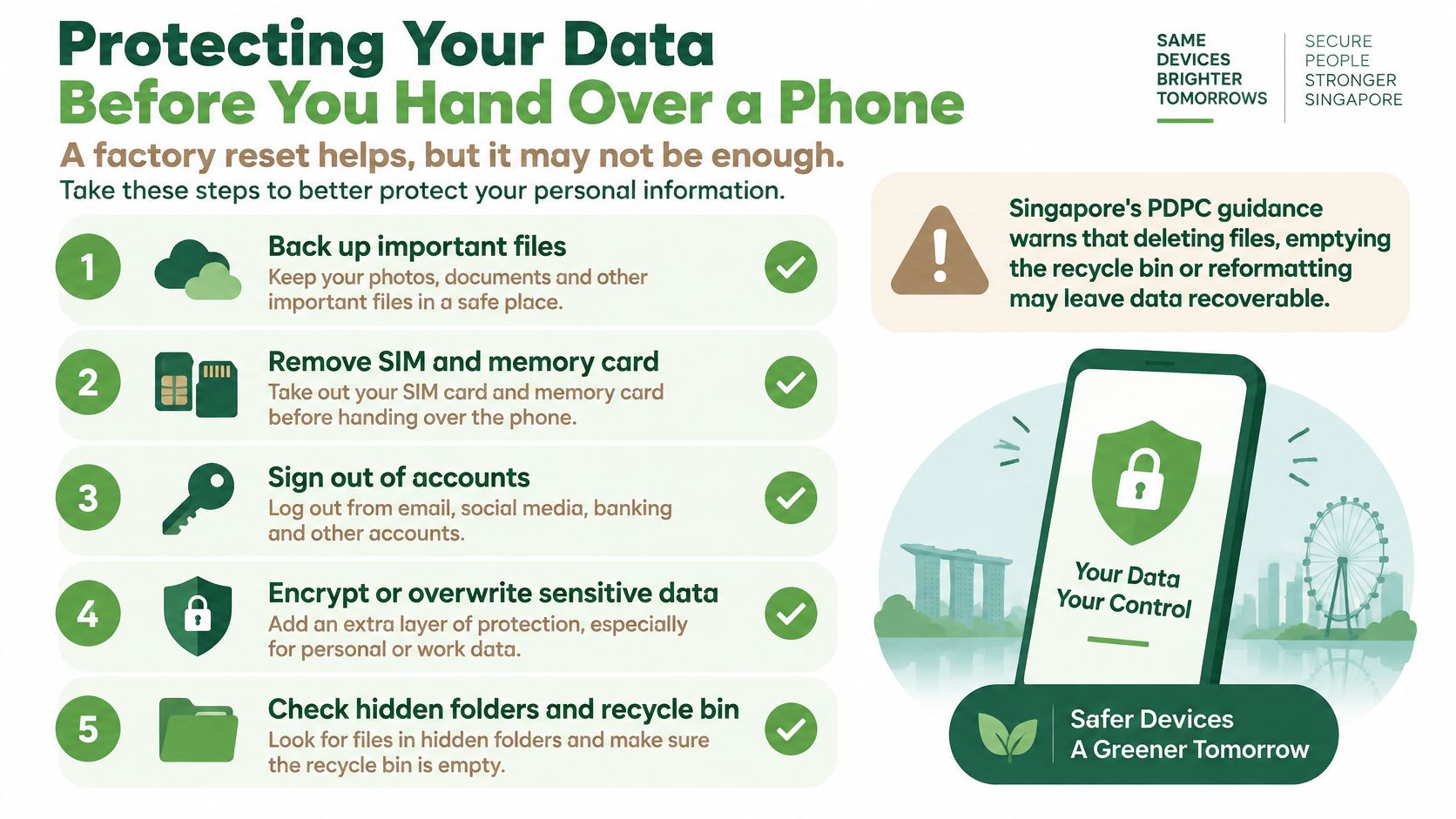
PDPC guidance, summarised in myhalo's guide to trading in a phone for a new phone, warns that deleting files, emptying the recycle bin or reformatting may leave data recoverable, and that secure overwriting or physical destruction may be required depending on the storage technology. That warning covers a mid-range phone you are selling for a few hundred dollars just as much as a laptop full of client records.
Reset Versus Documented Sanitisation
A consumer reset clears the device for the next user and removes your accounts when it is done properly. Documented professional sanitisation goes further, with a defined erasure method, the device identifier recorded, and ideally a certificate or chain of custody record you can keep. For a personal phone with low-risk content, a careful reset plus account removal may be enough. For a work phone, a freelancer's device or a small business handset, documented erasure is the safer standard, and this overview of secure data destruction explains the methods in plain terms.
Set against the four tests this guide keeps returning to, data handling is the one that almost never appears in the quote. Two buyers can offer the same figure and differ entirely on what happens to your files afterwards.
Account locks matter for resale too. An iPhone still signed in to an Apple ID, or an Android phone still tied to a Google account, can block activation for the next owner and will usually be rejected or repriced by the buyer. Clearing them before you arrive also protects the price you were quoted, which links preparation straight back to pricing transparency.
Your Handover Checklist
- Back up first: Save photos, files and messages to cloud storage or a computer, then open a few items to confirm the backup works.
- Sign out fully: Sign out of your Apple ID or Google account and turn off Find My or the Google device lock, so the phone can be activated again.
- Remove cards: Take out the SIM and any microSD card, and delete the eSIM profile if you use one.
- Unpair accessories: Disconnect watches, earbuds and other linked accessories so they don't stay tied to the old handset.
- Reset as a baseline: Run a factory reset once the steps above are done, not before.
- Ask at the counter: Confirm when the wipe happens, how the device identifier is recorded, what happens to any card left inside, and whether you will receive proof of erasure.
If the phone holds company data, follow your employer's policy first and don't rely on a shop's routine alone. A certificate or chain of custody record may be worth more than a marginally higher quote, because it is the proof you will want if questions arise later. myhalo, for one, describes its service as secure data management and destruction, with certificates on request, which is the kind of arrangement that covers this step where a general trade-in counter stops. Environmental outcome is the other half of the same decision: a device wiped to a documented standard is easier to resell or harvest for parts than one that ends up as scrap.
How a GW Mobile Trade-In Works, Step by Step
If you are weighing a trade-in, the key moments are the price check and the handover. GW Mobile is a repair and resale business that trades in used devices. Check its own pages for current services, location and process details before making a trip.
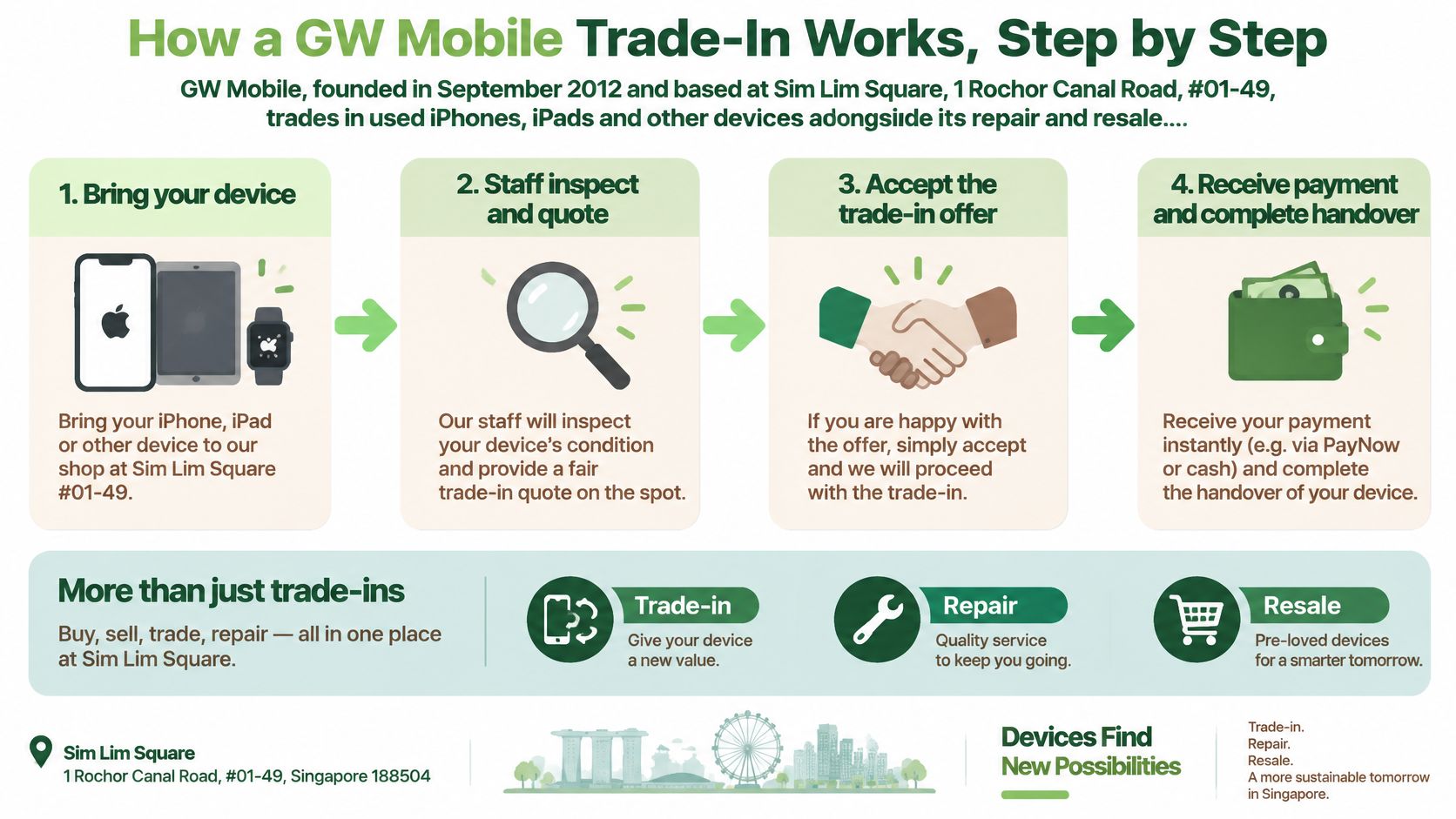
A repair and resale business may assess a phone partly by what it would take to prepare it for another owner. The exact process and offer can vary, so compare the quoted amount with the final offer and ask what explains any change.
The Likely Sequence From Quote to Handover
- Share the model and storage: Give the exact details, since an estimate for one version may not apply to another.
- Get an indicative quote: Treat it as provisional until the device has been inspected. Keep a copy of any terms provided with the estimate.
- Present the phone for inspection: Ask what condition checks are included and whether faults could change the valuation.
- Review the final offer: If the amount differs from the estimate, request a clear explanation of the adjustment.
- Complete the handover: Confirm when the device changes hands and what record you will receive.
- Confirm payment terms: Check the payment method and any conditions before accepting.
- Keep your records: Save the quote, final offer and proof of handover.
Three Questions Before You Leave the Counter
Ask how the final price was reached, what happens if you decline, and what record confirms the handover. These answers help you compare routes on pricing transparency and convenience, while clarifying what happens to the device after you leave it.
Take time to consider the offer. A second quote can provide a useful comparison, and clear handover terms help you make an informed choice.
Keep, Trade In or Recycle Depending on Your Phone
The biggest barrier isn't finding a buyer. It's the drawer. Recent Singapore reporting covered by TelcoNews Asia on circular tech and e-waste cites an estimated 2.9 million smartphones sitting idle in homes, with replacement occurring every 2.7 years on average versus 3.5 years globally.
The same reporting identifies data privacy and inconvenient return options as major obstacles, while 90% of surveyed Singaporeans were open to reuse, recycling, or return if the process became simpler and more secure. In other words, many individuals are not refusing to act. They just want a process that feels safe and doesn't take all afternoon.
The Cost of Waiting
Resale value falls with each year and each new launch, and batteries degrade even in a drawer. That means the gap between two quotes today is often smaller than the value you'll lose by waiting six months to decide. Timing your decision well matters too, and this guide on when to get a new phone can help you judge whether to upgrade now or hold on.
| Your situation | Likely route | Why it fits |
|---|---|---|
| Working, recent model | Trade in or sell for cash or credit | It still holds resale value, which falls each year |
| Cracked screen or failing battery | Repair first, then compare quotes | A repair may lift the quote by more than it costs |
| Dead or water-damaged | Licensed e-waste recycling | Little resale value, but data must still be wiped |
| Work phone with company data | Trade in only with documented erasure | Company policy and data rules come first |
| Rarely used backup | Keep, with a set review date | A phone left idle loses value and battery health |
A working recent model is the clearest trade-in candidate, so compare two quotes and act while demand is strong. A cracked screen or weak battery doesn't always end the conversation, since a repair may lift the final quote by more than it costs, but ask for both prices, repaired and as-is, before you spend anything. Accessories such as cables and boxes are rarely essential, so ask rather than hunting for them for a week.
A dead or water-damaged phone has little resale appeal, yet it still holds data and recoverable parts, so licensed recycling beats the bin. A work phone should only move with documented erasure and your employer's approval, whatever the quote. Keeping a backup can be sensible for travel or emergencies, as long as you set a review date and charge it now and then. Small habits help at home too, from clearing one drawer of cables to exploring greener choices for everyday savings that cut waste without adding chores.
A useful test: The best route is the one you actually complete this month, not the one with the highest estimate on paper.
Where Old Phones End Up and Why It Matters
A phone handed in for trade-in or sale may be reused by another owner, repaired, or stripped for parts. A device that cannot be recovered may instead need recycling. The route matters: reuse keeps a working phone in service, while parts from upcycled devices can help rescue others.
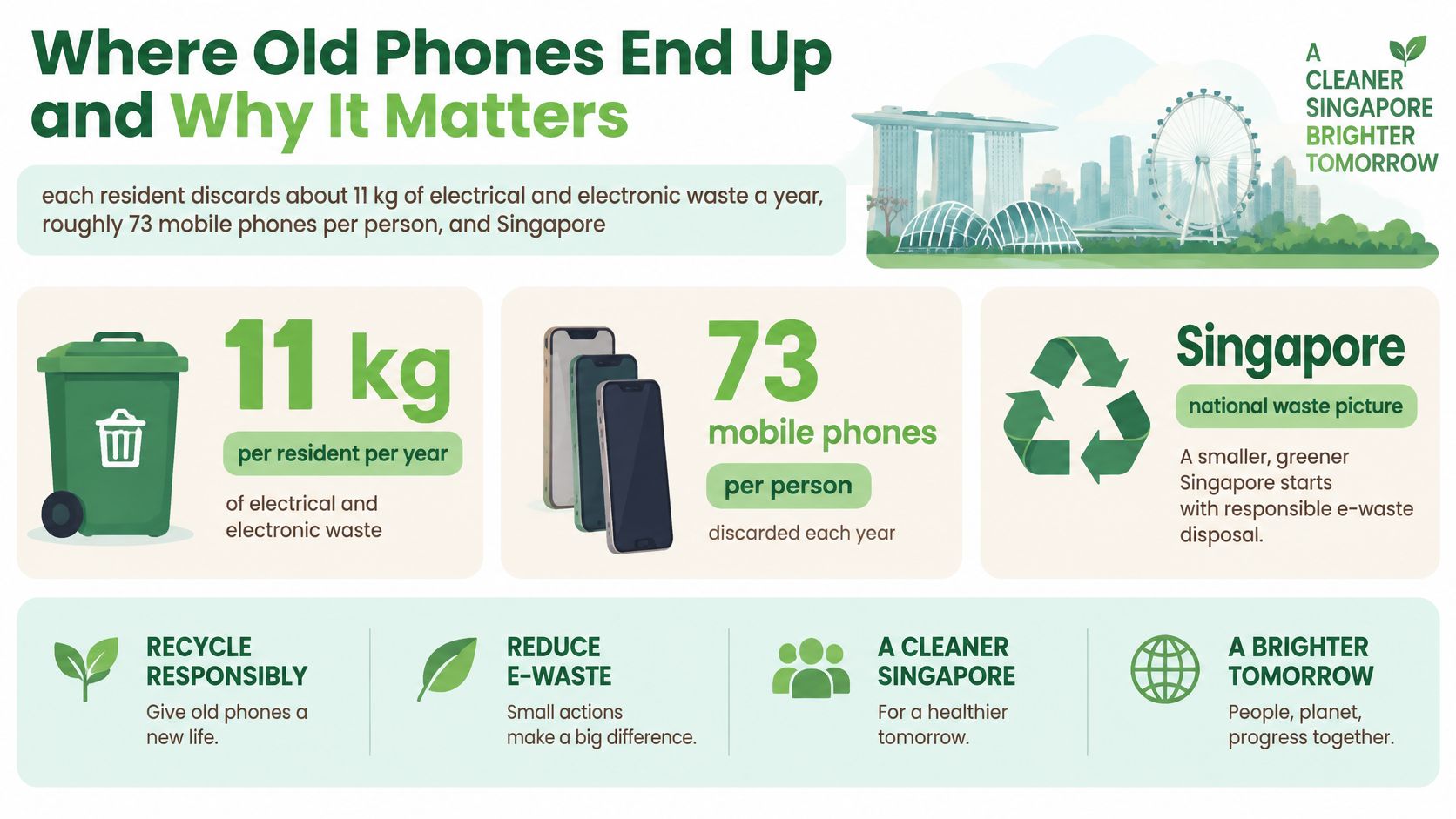
For a phone that cannot be resold, where to recycle electronics in Singapore offers guidance on finding appropriate drop-off options. A specialist service can also help assess whether repair, resale or parts recovery is possible before recycling.
When the Environmental Gain Is Real
The environmental benefit depends on what happens to the device after handover. Repair and resale extend its useful life; parts recovery can keep another device working. Recycling is the route for what cannot be reused. Ask the provider what happens to devices it cannot resell, and how it handles parts and recycling.
myhalo reports that its 2024 upcycling, rescuing and reloving activity avoided 2,020 MTCO2e of carbon emissions: 960 MTCO2e from smartphones, 890 from laptops, 90 from tablets and 80 from desktops. These are myhalo's reported figures, not a measure of the wider market.
Choose the route that fits the phone's condition and gives it a clear next use. A completed handover to repair, resale, parts recovery or recycling is more useful than leaving a device idle.
Confirm Your Route and Request a Quote
Before choosing a GW Mobile trade-in or another route, ask for the quote, final price and data-wipe method in writing. A clear record makes it easier to compare offers and understand what will happen to your phone and its data.
A Simple Way to Compare Today
myhalo offers instant trade-in quotes for Apple devices, Samsung devices and gaming laptops. Compare the estimate with other offers, and check how the final price may change after the device is assessed. For questions before visiting, contact myhalo CircularXchange on WhatsApp at +65 8068 0100.
Ask each provider how it grades the phone, how payment is made and how data is handled. myhalo offers secure data management and destruction, with certificates on request. You can ask for proof of erasure before handing over your device.
If unused devices are the issue, myhalo's Upcycle service gives a $30 voucher for de-cluttering e-clutter. Its upcycling pathway can also extend device lifespans and use parts to rescue other devices.
Check your phone against the price factors and handover checklist, then request a quote for the route that suits your needs. Compare pricing transparency, data handling, convenience and environmental outcome before deciding.
Visit myhalo to request an instant quote or ask about secure data management and destruction on WhatsApp.