
Apple's official out-of-warranty iPhone battery service in Singapore ranges from about S$105 to S$175, depending on the model, while independent repair shops advertise replacements starting from roughly S$48 to S$88. The right choice depends on your iPhone's age, battery health, warranty coverage, resale value, and how much confidence you need in the replacement part.
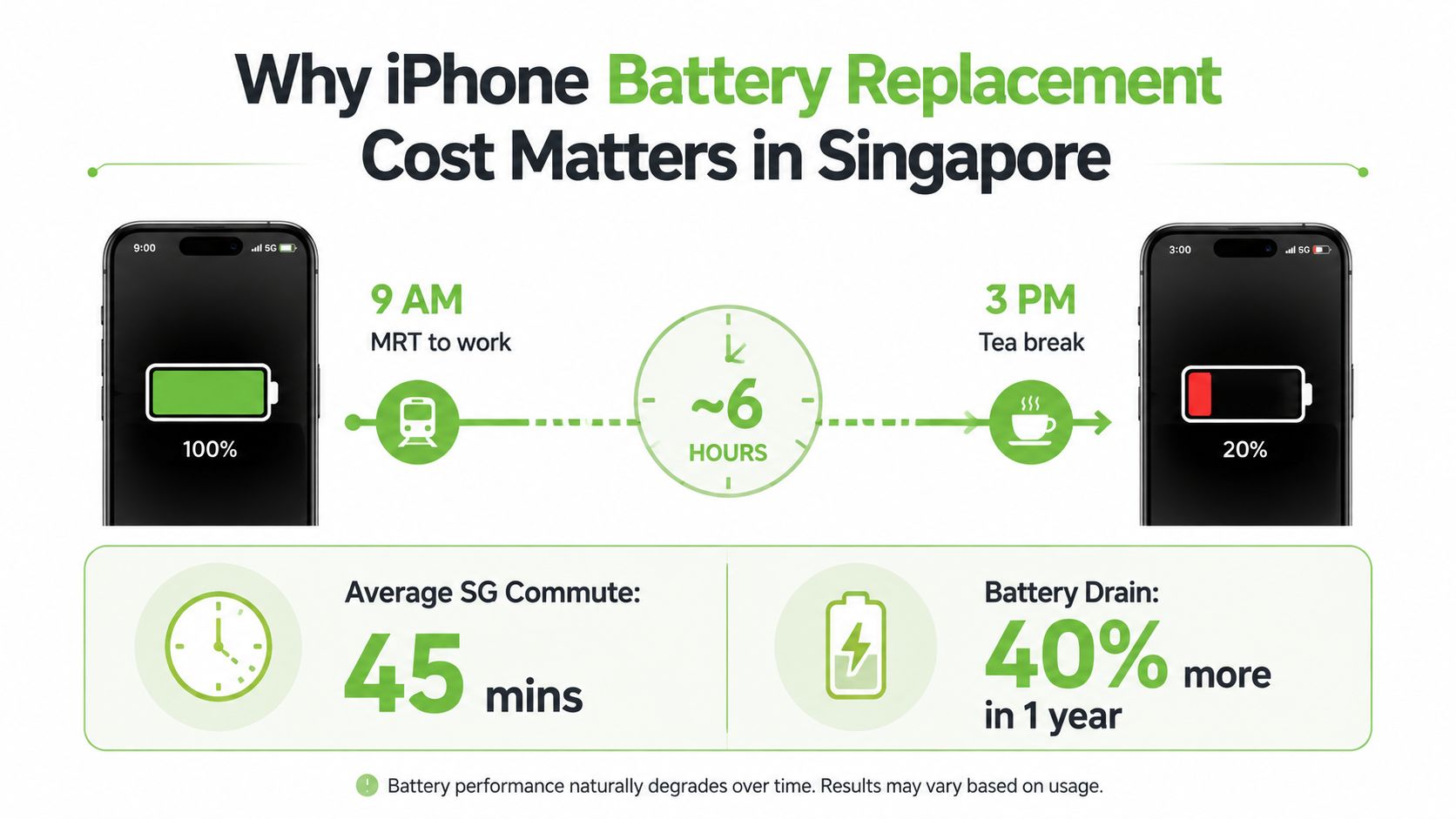
Your iPhone used to survive the MRT ride, a full workday, and dinner without drama. Now it's gasping by tea break, showing a worrying percentage drop during light use, or shutting down just when you need PayNow. That's a frustrating problem, but it doesn't automatically mean you need a new phone.
For Singapore owners, iPhone battery replacement cost is a lifecycle decision. You're choosing between restoring the device, selling it while it still has value, buying a certified refurbished phone, or sending an older handset into an upcycle pathway instead of leaving it forgotten in a drawer.
Table of Contents
- Why iPhone Battery Replacement Cost Matters in Singapore
- The 80% Battery Health Threshold Explained
- Comparing Apple Official Independent and DIY Options
- Model-by-Model Price Tiers in 2026
- When Cheapest Repair Becomes the Most Expensive Mistake
- AppleCare+ and the 90-Day Service Warranty
- Repair Trade-In or Upcycle Making the Smart Lifecycle Call
- Your iPhone Battery Action Checklist
Why iPhone Battery Replacement Cost Matters in Singapore
At 78% maximum capacity, an iPhone may need a charger by mid-afternoon even though the screen, camera, and processor still work well. That is the core repair question in Singapore: which battery option restores useful life without wasting money on a phone that is already nearing replacement?
Apple's Singapore battery service sets the official benchmark. Out-of-warranty pricing is about S$105 to S$175, depending on the model, according to Apple's Singapore battery service page and the Singapore iPhone battery price list. Independent providers advertise many replacements at S$48 to S$88, while some lower-cost services begin around S$25 to S$60, depending on the part and provider (Singapore independent battery replacement guide, local iPhone battery repair pricing).
The cheapest quote is not automatically the best value. A lower-priced third-party cell can suit an older iPhone used as a backup or passed to a family member, but ask about battery quality, repair workmanship, and post-service support. Apple or an Apple Independent Repair Provider is the stronger choice when you plan to sell or trade in the phone, or when dependable battery reporting matters.
The price is only one part of the calculation
A battery replacement preserves the value of a working display, camera, storage capacity, and familiar setup. It also keeps a usable device in service instead of replacing the entire phone for one worn component.
I would not approve every repair. Compare the quote with the phone's condition and likely trade-in value. If the battery is the only serious fault, repair can buy practical extra life. If the phone also has display, charging-port, and performance problems, check trade-in, certified ReLoved, or upcycle options before spending.
My practical rule: Repair when the battery is the main problem and the phone still suits your needs. Choose trade-in or another lifecycle option when several costly faults are appearing together.
The 80% Battery Health Threshold Explained
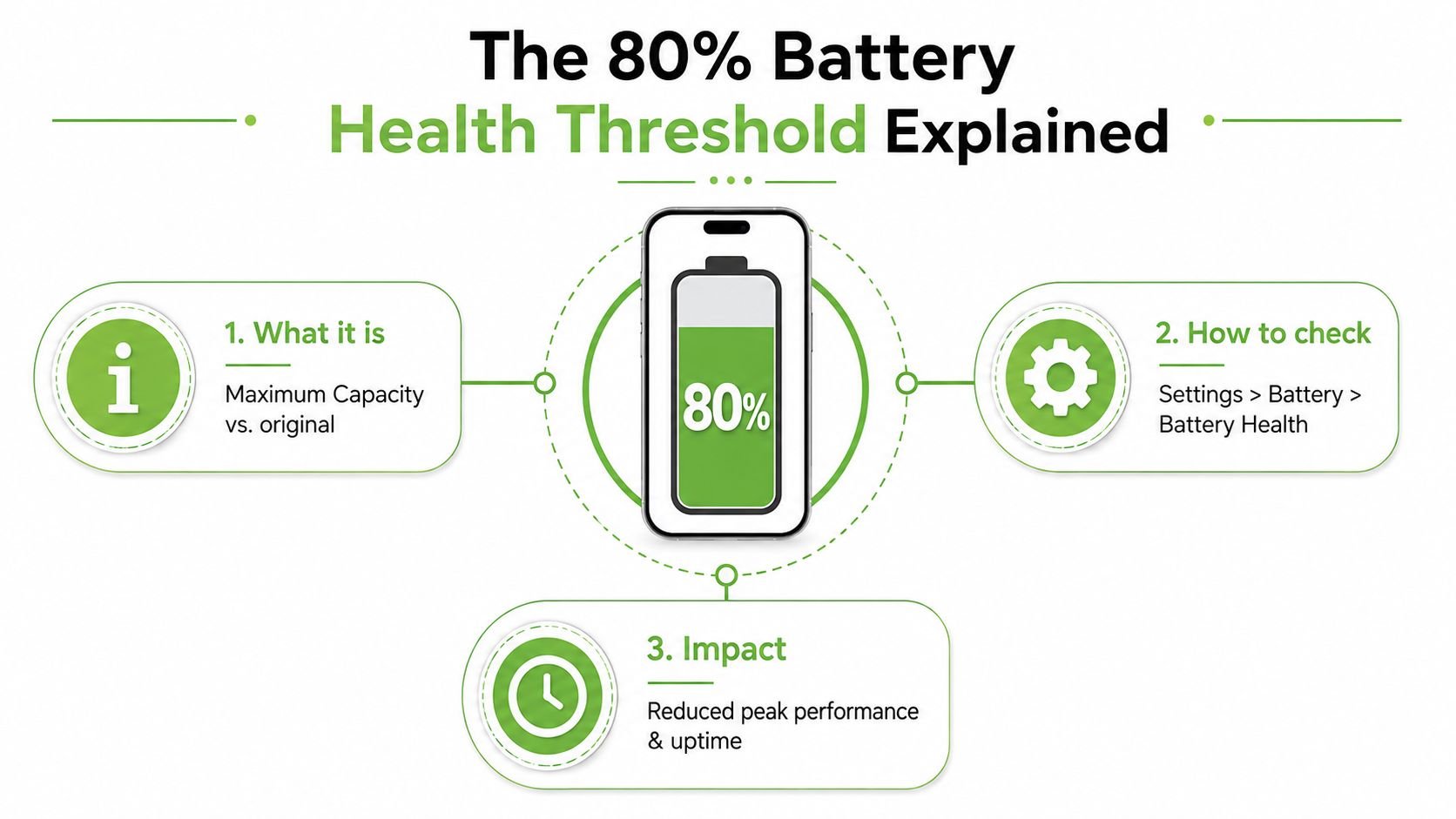
The number that matters most is Maximum Capacity. It compares your battery's current capacity with its capacity when new. It isn't a complete health report, but it gives you a clear reference point for deciding whether reduced runtime is normal wear or a repair priority.
Apple uses a threshold of less than 80% for no-extra-cost battery replacement under AppleCare+, provided the iPhone is covered by that plan. Apple states this condition repeatedly on its Singapore support pages, so battery health is more than a technical reading. It can directly change your out-of-pocket repair cost (Apple Singapore battery replacement terms).
Check your number in under a minute
Open:
- Settings
- Battery
- Battery Health & Charging
- Maximum Capacity
Read the percentage alongside the phone's performance messages. A lower capacity usually means less runtime between charges. Unexpected shutdowns, noticeably weaker peak performance, or a degraded-battery warning deserve more attention than the percentage alone.
An iPhone at 90% may be comfortable to keep using if it meets your routine. At 82%, replacement may already be worth budgeting for if you rely on navigation, mobile payments, hotspot access, or a long day away from a charger. Below 80%, the decision becomes more urgent, especially when the phone is covered by AppleCare+.
The threshold doesn't mean every iPhone at 79% is unsafe or unusable. It means the battery has crossed Apple's service benchmark, and your daily experience should now guide the timing. If the phone still works well and you can charge conveniently, you may wait. If it dies during work or travel, waiting only makes the device harder to rely on.
Here's a visual walkthrough for checking battery information and understanding the replacement decision:
Comparing Apple Official Independent and DIY Options
Singapore owners have four realistic routes. They aren't interchangeable, and the cheapest quote doesn't buy the same outcome as official service.
| Channel | Typical SG price | Parts authenticity | Warranty | Best for |
|---|---|---|---|---|
| Apple official service | About S$105 to S$175 | Apple service part | Apple service terms apply | Newer iPhones, resale confidence, predictable support |
| Apple Independent Repair Provider | Often around S$110 to S$130 for iPhone 11 and newer genuine-battery service | Genuine Apple battery where offered | Provider terms and applicable service coverage | Owners who want Apple-aligned parts through an independent shop |
| Independent repairer | About S$48 to S$88 for many listed replacements, with some options around S$25 to S$60 | Third-party, OEM-style, or original-grade depending on quote | Varies by shop and part | Extending an older phone at lower cost |
| DIY kit | Kit price varies | Depends on the seller | Usually limited compared with professional service | Confident repair hobbyists with proper tools and patience |
Apple's official S$175 charge for the highest tier is roughly 2 times to 3.6 times the lowest advertised independent starting prices in Singapore (local independent replacement listings). That premium pays for a more controlled service pathway, Apple-genuine parts where applicable, and stronger predictability around system behaviour.
What each option really means
Apple official service is my default recommendation for a newer iPhone that you may sell later. It's the cleanest choice when documentation, parts provenance, and buyer confidence matter more than the lowest upfront cost.
IRP service can sit between Apple and a typical repair shop. Ask directly whether the quote uses an Apple-genuine battery, what warranty applies, and how the phone will report battery information after service. Don't accept “original quality” as a complete answer. Request the exact part description.
For independent repair, the shop's process matters as much as the price. Ask whether it backs up diagnostics, protects your data, tests charging and battery reporting, and provides written warranty terms. You can also read our guide to iPhone repair parts and what their labels mean before approving work.
DIY is the option I'd reserve for people who already understand adhesive removal, tiny connectors, battery handling, and reassembly. Opening an iPhone can introduce problems with internal components and sealing. A cheap kit can become expensive if the phone needs a second repair.
Decision rule: Choose Apple or IRP when resale and predictability matter. Choose a reputable independent repairer when extending an older phone is the goal. Choose DIY only if you're comfortable owning the risk.
Model-by-Model Price Tiers in 2026
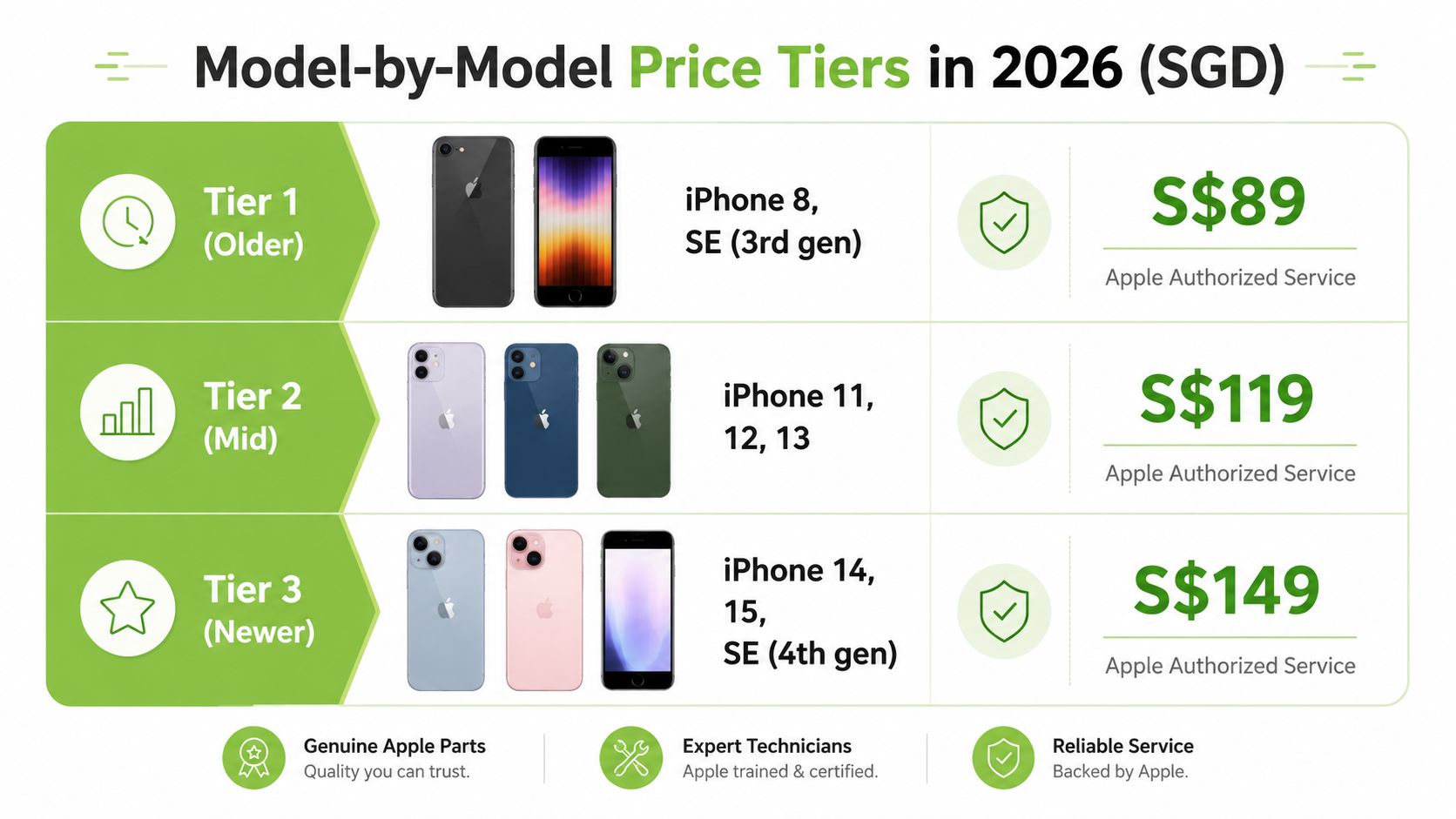
A model number and a battery-health reading give you a more useful starting point than age alone. Check Settings > General > About, then compare the official fee with what the phone could still return through resale, trade-in, or a certified ReLoved route. Singapore's official battery service is model-tiered, with older models around S$105 and the newest tier reaching about S$175 (Singapore model-tier battery pricing).
The iPhone SE (3rd generation) and iPhone 8 sit near the lower official band. Repair makes sense when the display, cameras, charging port, and frame remain in good condition. If those parts are already worn, put the battery fee toward a trade-in or upcycle option instead.
The iPhone 11 through iPhone 13 deserve a value check rather than an automatic repair. Their performance remains suitable for everyday use, but your decision should reflect storage, camera needs, and the trade-in offer. A battery replacement is easier to justify when the phone has useful resale value and you plan to keep it.
Newer models, including the iPhone 15 and iPhone 16 Pro, can reach the official ceiling of S$175. A higher fee can still protect more recoverable value, especially if trade-in or certified ReLoved assessment is available. For a phone with strong cosmetic condition, replacing the battery before handover may preserve its practical value. For a damaged phone, upcycle it rather than paying solely to improve a resale listing.
Independent quotes commonly begin around S$48 to S$88 for selected older and mid-range models. A genuine-part option can rise to about S$145 to S$175 for newer devices. Use the model, health reading, part type, and expected trade-in value together. A headline quote alone is not a proper comparison.
When Cheapest Repair Becomes the Most Expensive Mistake
A low quote looks attractive because battery replacement seems like a simple component swap. The result depends on the cell, calibration, adhesive work, testing, and support after repair.
Lower-cost options usually use non-Apple batteries or labour outside the Independent Repair Provider network. They can suit an older iPhone you plan to keep, but expect more variation in battery-health reporting, calibration, longevity, and post-repair behaviour. The cheapest quote becomes poor value if the phone still drains quickly or needs another replacement soon.
Apple-genuine or IRP-backed work costs more, often around 2 times to 4 times the entry-market price in Singapore. It offers more predictable parts and service processes, as shown by this Singapore repair-market comparison. The premium makes more sense when the phone retains meaningful value, has good cosmetic condition, or may be traded in later.
Match the part to the phone's future
For an older iPhone with a scratched frame, modest resale value, and a plan for continued use, an original-grade third-party cell from a trusted shop is often sensible. You are restoring daily usability, not preparing the phone for resale.
For a newer iPhone, choose Apple or an IRP-backed genuine battery. Buyers and trade-in assessors value confidence, while system messages or uncertain battery provenance can complicate handover. A cheaper repair may reduce the amount someone is willing to pay later.
The 80% battery-health threshold should guide the timing. Below it, performance and endurance concerns become easier to explain to a buyer or trade-in assessor. Before paying for a replacement, compare the repair quote with the phone's trade-in value, a certified ReLoved assessment, and any upcycle route. A degrading battery can still lead to recoverable value.
Ask these questions before accepting a low quote:
- Part description: Is the battery Apple-genuine, original-grade, OEM-style, or another third-party type?
- Battery reporting: Will Maximum Capacity and service messages behave as expected?
- Warranty: What happens if the battery drains unusually fast after installation?
- Data handling: Can the technician repair it without your passcode?
- Testing: Will charging, cameras, Face ID, speakers, and mobile connectivity be checked?
The question is whether the lowest quote delivers predictable usable life over time.
AppleCare+ and the 90-Day Service Warranty
AppleCare+ can change your iPhone battery replacement cost completely. Apple's Singapore repair information states that battery service costs S$0 when AppleCare+ covers the iPhone and its battery retains less than 80% of its original capacity (Apple Singapore repair service details).
Both requirements apply. AppleCare+ does not make every battery replacement free, and a reading below the threshold does not qualify without the relevant coverage. Check your plan before comparing third-party quotes, especially if the phone is still worth keeping or trading in.
Run this coverage check first
- Confirm AppleCare+: Check whether the plan remains active.
- Record Maximum Capacity: Open Battery Health & Charging and note the percentage.
- Check the model: Find the exact iPhone model under General > About.
- Ask about prior work: Keep any receipt or service record from an earlier replacement.
- Request the final quote: Confirm whether diagnostics, parts, labour, and applicable service coverage are included.
Out of warranty, Apple's fee generally follows the model tier, not how inconvenient the battery feels. An iPhone at 79% and one with a lower reading do not automatically receive different out-of-warranty prices. Compare the known service fee with trade-in value, a certified ReLoved assessment, and an upcycle route before paying.
Apple's repair terms state that service parts and products carry a 90-day warranty from the service date (Apple Singapore repair terms). Keep the invoice. Ask exactly which symptoms qualify, how quickly you must report them, and where the phone must return for inspection.
For a local comparison of battery checks and replacement options, review iPhone battery replacement service details before choosing between repair, trade-in, or upcycle.
Repair Trade-In or Upcycle Making the Smart Lifecycle Call
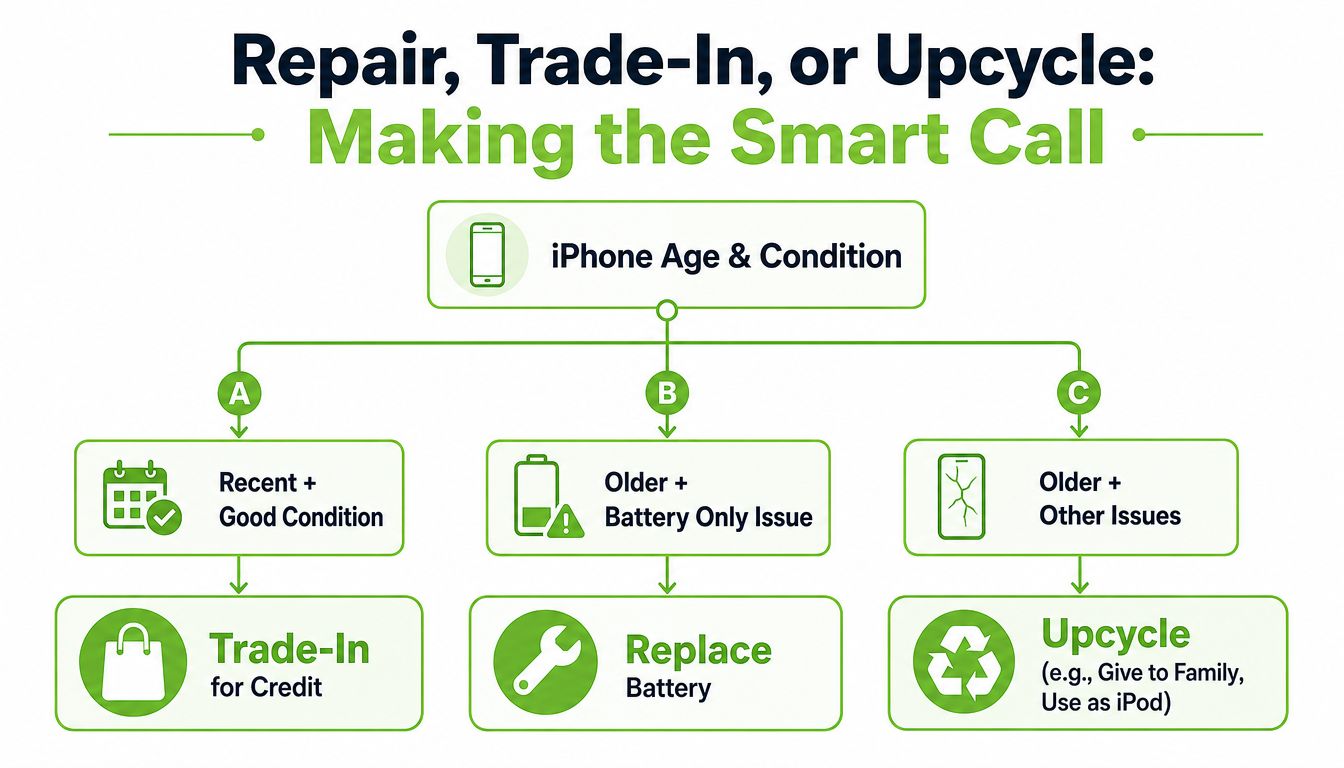
Battery replacement is only one of three sensible paths. Repair the phone when the battery is the main fault, trade it in when the device still carries useful resale value, and upcycle it when repair no longer makes economic sense.
A recent iPhone with AppleCare+ and capacity below the service threshold is straightforward. Use the covered replacement route, keep the phone, and avoid replacing an otherwise capable device.
A mid-life iPhone needs a closer comparison. Get a repair quote for the exact model, then request an instant-quote trade-in assessment. If the repair fee consumes a meaningful share of what the phone could return, selling or trading in may be cleaner. A trade-in can convert a device with a degraded battery into cash or credit towards another phone, depending on the offer and condition.
Three outcomes, one responsible goal
Repair: Choose this when the display, cameras, charging port, frame, and storage remain satisfactory. A battery-only fault is often the easiest problem to solve.
Trade-in or certified ReLoved: Choose this when you want a different device without sending the current one straight to disposal. A tested, graded ReLoved phone can also provide a more controlled route to upgrading than buying an unknown used handset.
Upcycle: Choose this when the iPhone has several faults or little residual value. Usable components can help rescue other devices, and eligible items may qualify for vouchers through an upcycle pathway.
The broader aim is to keep devices circulating. myhalo's Singapore trade-in service is one example of a lifecycle route that sits alongside repair, buyback, certified resale, and parts recovery.
Before handing over any device, protect your information. Back it up, sign out where appropriate, and ask how the provider handles personal data. A battery decision should improve your phone's usefulness without creating a privacy problem.
Your iPhone Battery Action Checklist
Use this checklist today:
- Check Maximum Capacity: Open Settings > Battery > Battery Health & Charging.
- Confirm AppleCare+: If coverage is active and capacity is below 80%, check the covered service route.
- Compare like with like: Request Apple, IRP, and independent quotes for the exact model and part type.
- Compare repair with value: If the quote takes too much of the phone's likely resale value, request an instant-quote trade-in.
- Choose reuse or upcycle: For an older, heavily worn device, consider parts recovery instead of storage or disposal.
Back up your photos, messages, and documents before service. This iPhone backup guide can help you prepare safely.
Your precious files and memories matter to us. Whether you need to protect your privacy with Safe data, rescue lost files with Save data, or choose repair, trade-in, certified ReLoved resale, or upcycle for an ageing iPhone, myhalo is ready to help. Visit myhalo online or drop by the counters at Bugis Junction or Sim Lim Square to take the next responsible step.