
You've got a drawer, cupboard, or storeroom filled with old phones, laptops, tablets, and chargers. The devices may still contain private files, while your recycling receipt says little about what happened after collection. For a corporate IT manager, that uncertainty can become an audit problem. For a homeowner, it can make letting go feel risky.
A sustainability certificate turns a vague disposal claim into documented evidence. It can connect each device to its collection record, data-erasure outcome, processing route, and environmental result. That's the practical difference between saying “we recycled it” and showing how the device moved through a safe, responsible lifecycle.
Table of Contents
- The Real Value of Proving Your Tech Disposal
- What a Sustainability Certificate Actually Covers
- Singapore Regulations Driving the Need for Certification
- Comparing Data Destruction and Carbon Avoidance Certificates
- How myhalo Issues Your Sustainability Certificate
- Business and Personal Benefits of Holding a Certificate
- Common Questions and Starting Your Zero E-Waste Journey
The Real Value of Proving Your Tech Disposal
A finance team asks where retired laptops went. Procurement wants evidence for a supplier review. Your sustainability team needs support for an ESG disclosure. At home, you want to clear out old phones without exposing family photos, banking details, or work documents. In each situation, a basic recycling receipt may confirm handover, but it often doesn't answer the questions that matter most.
Which asset was processed? Was its data permanently destroyed? Who handled it? What materials were recovered? Can the record be reviewed later?
That's why a sustainability certificate matters. It acts as a bridge between a responsible action and an auditable outcome. A strong record should help a buyer trace the device journey from collection to final treatment, rather than relying on a broad green claim.
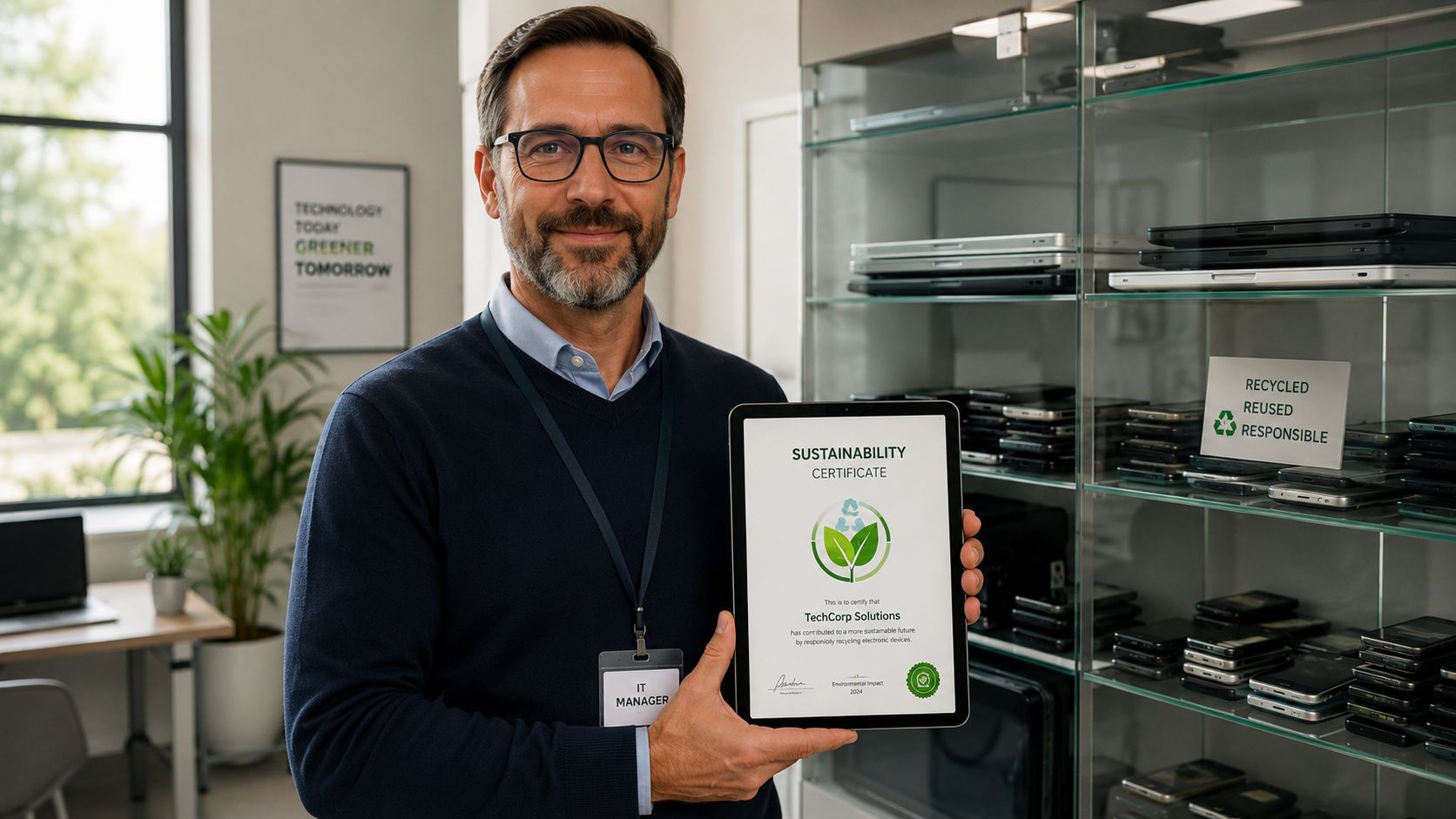
From good intentions to usable evidence
Singapore's e-waste framework already expects licensed recyclers to permanently erase or destroy data stored on data-bearing devices before those devices are reused, recycled, disposed of, or transferred to another recycler. Compliance records must be kept for five years, and violations can lead to fines of up to S$10,000, as set out in Singapore's e-waste regulatory requirements.
That changes the role of a certificate. It isn't just a feel-good badge. It can provide a structured record for internal governance, vendor reviews, privacy controls, and sustainability reporting.
For a company, the certificate can sit alongside an asset register and disposal approval. For a household, it offers reassurance that the old device didn't disappear into an unknown channel. The same principle applies to the benefits of responsible tech waste recycling: convenience matters, but confidence matters too.
Practical rule: If a certificate doesn't identify what happened to the device, it can't do much to support a serious sustainability claim.
What a Sustainability Certificate Actually Covers
A useful sustainability certificate should read more like a device passport than a decorative piece of paper. It records the important stops in a device's end-of-life journey, allowing someone else to understand what was collected, what was secured, and what was recovered.
The core record
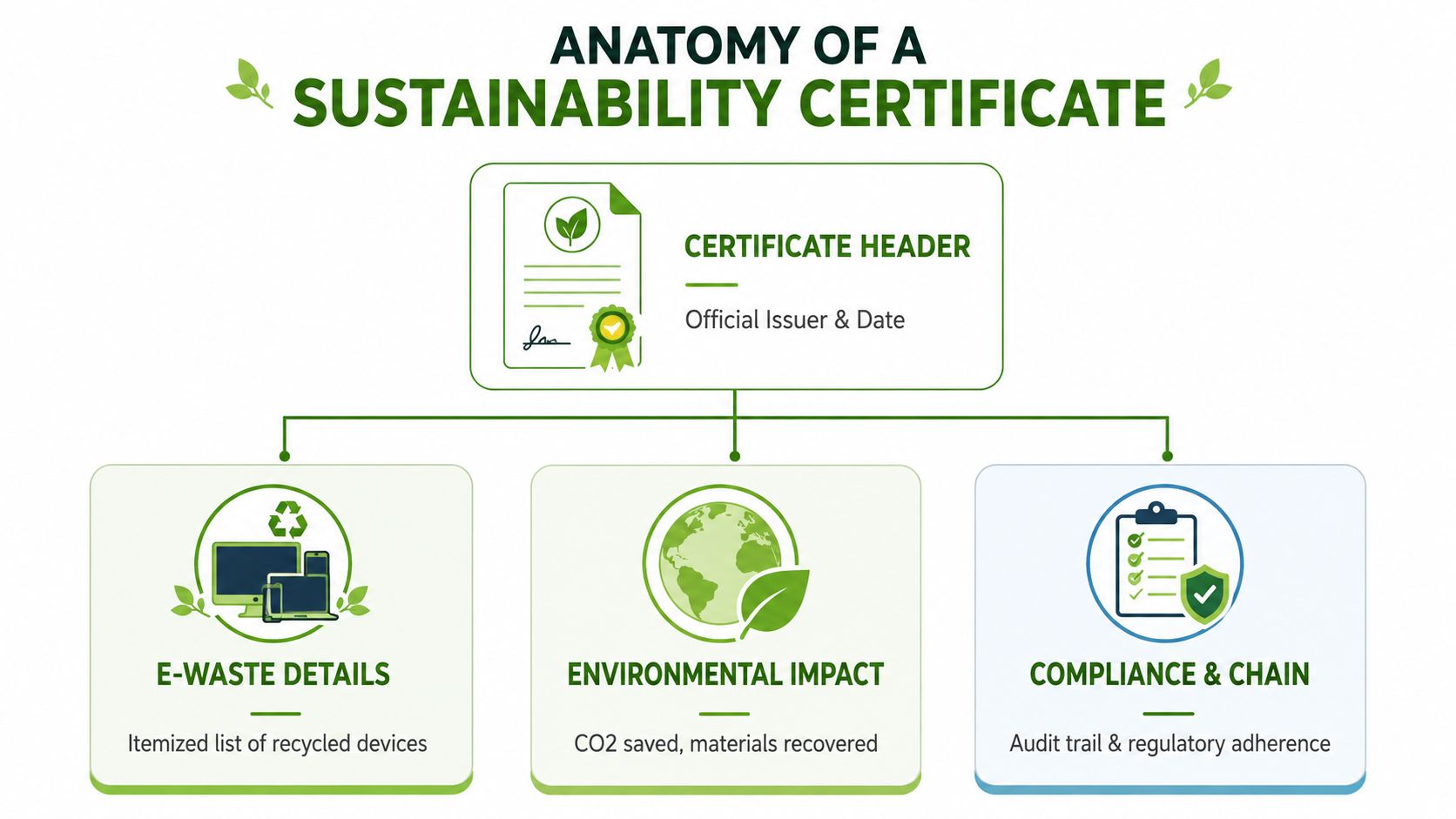
A robust certificate commonly brings together several layers of evidence:
Asset identification: Serial numbers, device types, quantities, and collection details connect the certificate to the actual equipment. “Ten laptops” is less useful than an itemised record that identifies the laptops processed.
Chain of custody: The record should show the movement of devices from collection through sorting, reuse, recycling, or final treatment. This helps procurement and compliance teams understand who handled the assets and when.
Data destruction: A data-bearing device needs a documented sanitisation method. That might involve secure erasure or physical destruction, depending on the device condition and the organisation's policy. A separate guide to secure data destruction can help teams understand why this evidence deserves its own review.
Environmental outcome: The certificate may record recovery information, such as materials diverted into processing or an estimated avoided-emissions result. Any environmental calculation should explain its basis, rather than presenting an unexplained number.
Issuer and date: The issuing organisation, processing date, and certificate reference help a reviewer verify the record and identify the relevant service event.
A basic recycling receipt may show only that equipment was handed over. A sustainability certificate should connect the handover to the outcome. That distinction matters when a company wants evidence for an audit or when an individual wants confidence that reuse and recycling were handled responsibly.
What it shouldn't claim
A certificate doesn't automatically prove that every environmental impact has disappeared. It also shouldn't be treated as a universal replacement for an environmental management certification, product ecolabel, or climate-reporting assurance statement. The document is valuable when its scope is clear and its claims match the records behind it.
Singapore Regulations Driving the Need for Certification
Singapore's sustainability sector is becoming more formal. Enterprise Singapore reports that uptake of certification for SS ISO 50001 and SS ISO 14001 has surged by 40 to 50% annually since 2021, reflecting sustained demand for recognised sustainability standards in the local market. ISO 14001 focuses on environmental management systems, while ISO 50001 focuses on energy management, and both are positioned as globally relevant standards for companies competing across markets in Enterprise Singapore's overview of green standards.
That wider movement affects IT asset disposition. A device-lifecycle provider may be asked to support environmental governance, data security, and reporting evidence at the same time. A certificate helps create that connection, but it must be backed by detailed records.
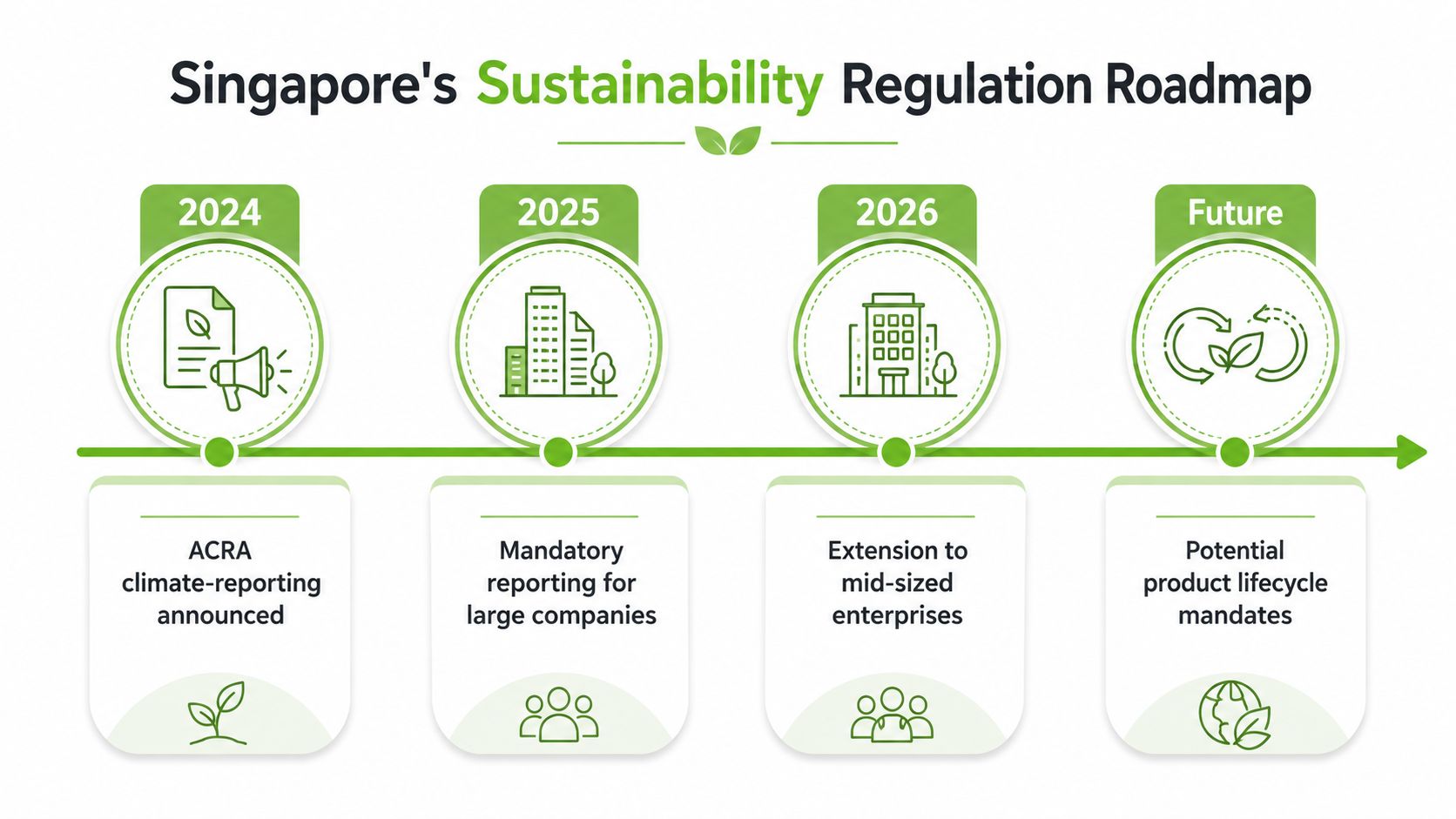
ACRA's reporting timeline
ACRA states that all listed companies in Singapore must report Scope 1 and Scope 2 greenhouse-gas emissions from FY2025. STI constituents must also report other ISSB-based climate-related disclosures from FY2025 and Scope 3 emissions from FY2026. Non-STI listed companies with market capitalisation of S$1 billion and above begin other ISSB-based climate-related disclosures from FY2028, while the remaining non-STI listed companies follow from FY2030. The complete schedule appears in ACRA's sustainability-reporting requirements timeline.
External limited assurance for Scope 1 and Scope 2 emissions becomes mandatory from FY2029 for listed companies and FY2032 for Large NLCos. ACRA says the assurance provider must be an audit firm registered with ACRA or a testing, inspection, and certification firm accredited by the Singapore Accreditation Council.
E-waste compliance is part of the picture
Singapore generates about 60,000 tonnes of e-waste a year, according to the national e-waste framework. The framework uses Extended Producer Responsibility, which places greater emphasis on organised collection and proper treatment.
The data-erasure requirement is especially important for ITAD. Licensed recyclers must permanently erase or destroy data before further handling and maintain complete records. A certificate that includes asset-level identity, sanitisation evidence, and processing details therefore supports both environmental accountability and information-security governance. It helps a company show that disposal wasn't an untracked final step.
For teams reviewing Singapore IT compliance requirements, the practical lesson is simple: request documentation that can be checked, retained, and matched to the organisation's own asset records.
Comparing Data Destruction and Carbon Avoidance Certificates
These documents answer different questions. A Data Destruction Certificate answers, “What happened to the information stored on this device?” A Sustainability Certificate answers, “What happened to the device as a resource, and what environmental outcome can we document?”
One doesn't automatically replace the other. A procurement reviewer may focus on privacy controls, while a sustainability manager may need recovery and carbon-avoidance information. For a complete corporate disposal file, both records may be relevant.
| Feature | Data Destruction Certificate | Sustainability Certificate |
|---|---|---|
| Primary purpose | Evidence that stored data was securely erased or destroyed | Evidence of responsible device processing and environmental outcomes |
| Main risk addressed | Data exposure, privacy breaches, and security-policy failures | Unverified recycling claims and weak ESG evidence |
| Useful details | Asset identity, sanitisation method, processing date, and completion record | Asset identity, chain of custody, material recovery, and environmental calculations |
| Typical reviewer | IT security, privacy, risk, or audit teams | Sustainability, procurement, ESG, finance, or corporate affairs teams |
| Best question to ask | Can we prove the information is no longer recoverable? | Can we prove what happened to the equipment and support the environmental claim? |
Choosing the evidence you need
Ask for a data-destruction certificate when devices contain customer records, employee information, business documents, or regulated data. Ask for sustainability documentation when your organisation needs to demonstrate reuse, recycling, recovery, or environmental impact.
The strongest workflow links both certificates to the same asset list. That way, the security team can review sanitisation while the sustainability team reviews the device outcome, without relying on separate, disconnected records.
For practical guidance on reducing a computer's environmental footprint before disposal, this PC carbon-footprint guide can help teams think about repair, reuse, replacement, and end-of-life decisions together.
How myhalo Issues Your Sustainability Certificate
A certificate becomes more useful when you understand how the underlying record is created. The journey should begin before a device reaches a processing centre, because every missing handover or unidentified asset weakens the final evidence.
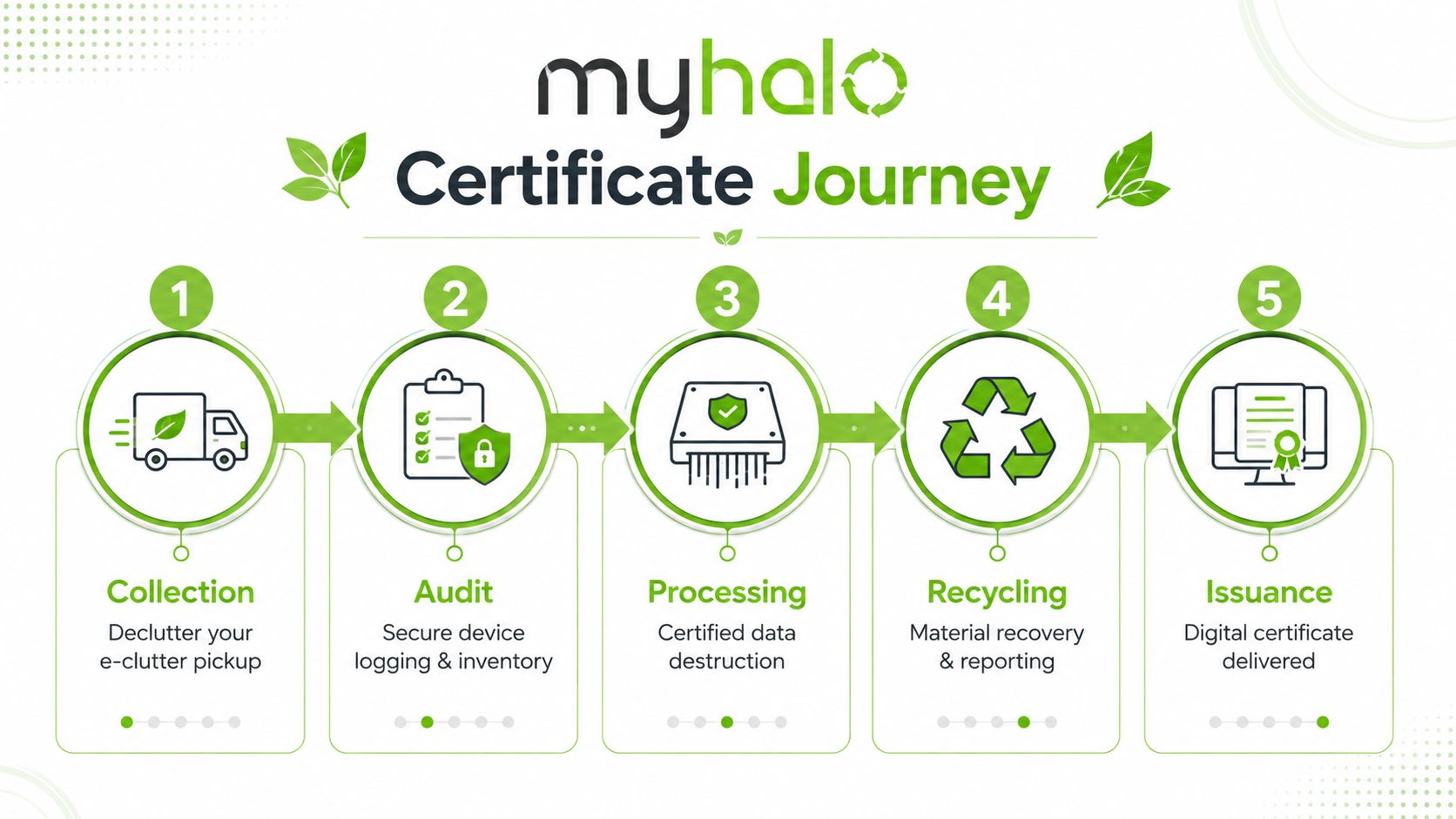
Five practical stages
1. Collection starts the chain. Through its Declutter your e-clutter service, myhalo receives devices from homes and organisations. Corporate collections can begin with an agreed inventory, while individuals can bring eligible devices to the Bugis Junction or Sim Lim Square counters.
2. Audit creates an asset record. Devices are logged and assessed, with identifying information captured where available. This step separates a traceable ITAD workflow from an anonymous pile of electronics.
3. Processing protects information. Data-bearing devices go through secure data handling and destruction procedures aligned with the required compliance process. The appropriate method depends on the device and its condition. The result should be recorded against the relevant asset.
4. Reuse and recovery determine the outcome. Repairable equipment may be directed towards life extension, while other devices can move towards parts harvesting or material recovery. The certificate should distinguish these outcomes rather than treating every device as generic waste.
5. Issuance packages the evidence. The final digital certificate brings together the service record, processed assets, data-destruction information where applicable, and environmental reporting details. This gives the customer a document that can be stored with disposal approvals, ESG files, or personal records.
Why the calculation needs context
Environmental figures are useful only when the methodology is understandable. A reported avoided-emissions value should relate to the device categories processed and the lifecycle assumption used, rather than appearing as an unexplained headline figure.
For a corporate IT manager, that transparency makes the document easier to share with procurement, sustainability, and audit colleagues. For a homeowner, it means the certificate tells a more complete story than “dropped off for recycling”. It shows that convenience, safety, and responsibility can exist in one process.
Business and Personal Benefits of Holding a Certificate
A certificate reduces the distance between an action and the person who needs to verify it. That's valuable in business, where a supplier may need to answer questions from procurement, internal audit, information security, and sustainability teams. It's also reassuring for individuals who want a clear record that their old device was handled responsibly.
For corporate teams
A well-organised certificate can support:
- Procurement reviews: Share evidence that a disposal partner tracks devices and documents the outcome.
- Tender responses: Provide a credible record when buyers ask about data security, reuse, recycling, or environmental governance.
- ESG reporting: Give sustainability teams source documentation for lifecycle and recovery claims.
- Internal controls: Match the certificate against the asset register, disposal approval, and data-security record.
- Supplier management: Compare providers based on the quality of their evidence, not only their collection promise.
Singapore's e-waste system already requires licensed recyclers to retain compliance records for five years, so corporate buyers should ask how their own certificates and supporting documents will be stored and retrieved. A certificate isn't a substitute for an audit, but it can make an audit trail far easier to follow.
For households and SMEs
The personal benefit is simpler. You can clear unused technology without wondering whether private information remains on it. You also gain a tangible record of taking part in a more circular approach, whether the device is repaired, resold, harvested for parts, or sent for material recovery.
For businesses communicating their environmental work, a certificate can support a factual sustainability update or a sustainability-focused press release resource, provided the published claims match the evidence available. Responsible communication means avoiding broad promises and stating exactly what the certificate covers.
For people and companies alike, proof makes responsible disposal easier to trust.
Common Questions and Starting Your Zero E-Waste Journey
Do I get a certificate for one laptop? That depends on the service and the requested documentation, so confirm the certificate scope before handing over the device. A single device can still deserve an identifiable record, especially when it contains sensitive information.
Is a data-destruction certificate the same as a sustainability certificate? No. The first focuses on information security. The second focuses on the device's environmental and lifecycle outcome. Ask for both when your policy requires secure erasure and sustainability evidence.
Can individuals use the same type of service as companies? myhalo supports corporate ITAD and lifecycle programmes, as well as individual drop-offs at its Bugis Junction and Sim Lim Square locations. That makes it possible to start with one unused phone at home or a larger organised office collection.
What if the device still works? Repair, resale, or trade-in may extend its useful life before recycling becomes necessary. A certified refurbished device can also be a practical alternative to buying new, while a repair decision may be better for a device that only needs a battery or component replacement.
What if I've lost important files? Don't erase or dismantle the device first. myhalo's Save data service supports recovery attempts, while Safe data focuses on privacy and secure destruction when recovery isn't required.
A zero e-waste lifestyle doesn't begin with a perfect setup. It begins with one honest decision about what your device needs next, followed by a process you can trust.
Ready to feel lighter and do good? myhalo helps households and organisations declutter unused devices, protect private information through Safe data, and support recovery through Save data. Visit myhalo to choose a convenient, safe, and responsible next step for your old tech.