
You're standing in a Singapore electronics shop, trying to decide whether the Samsung 25W charger in your hand is the right match for your Galaxy phone. The box says “25W”, but your phone still charges slowly, or the replacement adapter you found online looks almost identical to the original. The practical questions are more useful than the headline wattage: does it support the right charging protocol, is it safe for Singapore sale or reuse, and what should happen to it when it reaches the end of its useful life?
A Samsung 25W charger can be a compact, practical accessory for everyday charging, but responsible ownership involves more than plugging it in. You'll get better results by checking USB-C Power Delivery 3.0 with PPS, verifying the adapter's safety credentials, inspecting its physical condition, and choosing reuse or approved recycling instead of treating a small charger as disposable.
Table of Contents
- Understanding the Samsung 25W Power Adapter
- Samsung 25W Charger Specs and Charging Performance
- How to Verify Authenticity and Safety in Singapore
- Choosing Between Third-Party and Genuine Samsung Adapters
- Samsung 25W Charger Lifecycle and E-Waste Impact
- What to Do with an Unwanted or Failed Samsung Charger
- Closing Thoughts on Safer, Smarter Charging
Understanding the Samsung 25W Power Adapter
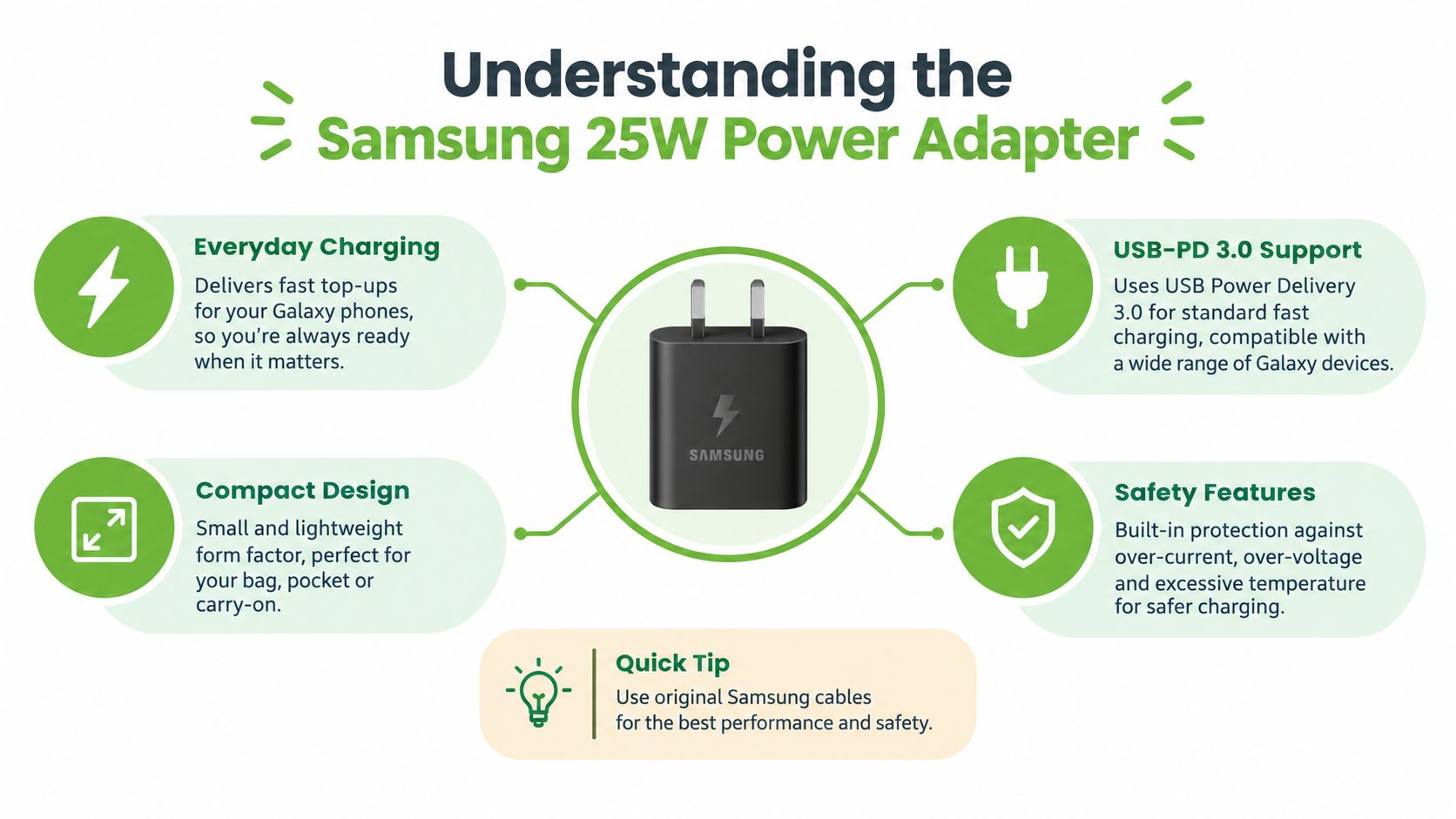
The Samsung 25W power adapter is a USB-C wall charger designed to work with compatible Galaxy devices and other suitable USB-C products. Its important feature isn't just the number printed on the casing. It uses USB Power Delivery 3.0 with Programmable Power Supply, or PPS, a standard that lets the connected phone and charger negotiate an appropriate voltage and current instead of relying only on a fixed output.
That negotiation explains why two chargers with the same wattage label can behave differently. A phone must support the relevant USB PD and PPS functions before it can use the adapter's intended charging behaviour. Samsung Singapore lists compatibility with Galaxy models including the Galaxy S10 5G, Galaxy A80 and Galaxy A70, while also describing the adapter as suitable for future compatible devices. See Samsung's official Singapore 25W power adapter specifications for the model details.
What the 25W label really tells you
The 25W rating is a maximum capability, not a promise that every connected device will charge at that speed. The phone controls the charging session and may request less power because of its own limits, battery condition, temperature, cable, or charging protocol.
For Singapore users, the USB-C design also matters beyond one phone. An interoperable standard makes the adapter more useful across compatible Galaxy phones and other USB-C devices, although older or non-PPS products may charge more slowly. If you're comparing cables and adapters, this USB-C charging guide can help you understand why the complete charging setup matters.
Practical rule: Treat “25W” as the adapter's ceiling. Treat your phone's specifications, PPS support and cable as the factors that determine what you'll actually receive.
Samsung 25W Charger Specs and Charging Performance
A charger's wattage label is only the headline. What matters is the voltage, current, and charging protocol, because those determine whether your phone can use that 25W ceiling efficiently or fall back to a slower mode.
Samsung lists this adapter with a fixed PDO output of 9V at up to 2.77A. PDO, short for Power Data Object, is one of the charger's fixed power profiles. It also supports two PPS ranges: 3.3–5.9V at up to 3.0A, and 3.3–11.0V at up to 2.25A. In plain terms, PPS gives the charger more room to adjust power in smaller steps, instead of serving only one fixed level.
That matters during real charging, not just on a spec sheet. A compatible Galaxy phone can request power more precisely as battery level and temperature change, which helps explain why one adapter and cable combination may feel noticeably different from another even when both are labelled 25W.
Super Fast Charging needs more than wattage
Samsung's Super Fast Charging depends on USB PD 3.0 plus PPS support. A charger that offers USB-C and a similar wattage may still charge your device, but it may not reproduce the same charging behaviour if PPS is missing or implemented differently. The adapter, the cable, and the phone all have to work as a set.
As noted earlier in Samsung's Singapore specifications, the newer adapter design also has standby consumption below 5mW, while the earlier design is listed at 20mW. That difference is easy to overlook, but it shows why a charger should be judged as a long-use device, not just a speed accessory. Power use, compatibility, and safety all matter across the charger's full life.
If you want a practical way to check the whole setup, this guide to certified power banks and cables for fast charging in Singapore helps you compare the adapter, cable, and device together.
How to Verify Authenticity and Safety in Singapore
You find a Samsung 25W charger in a marketplace listing, the photos look convincing, and the price seems fair. That is the moment to slow down. A charger is not just a fast-charging accessory. It is a mains-powered device that has to be genuine, suitable for local sale, and still physically safe after months or years of use. Imported and second-hand adapters deserve the same checks as sealed retail stock.
A simple Singapore safety check
Find the SAFETY Mark. In Singapore, AC adaptors are listed as Controlled Goods under the Consumer Protection (Safety Requirements) Registration Scheme. That means the adapter should carry a valid SAFETY Mark before it is supplied locally. Start with the Controlled Goods information from Singapore's Consumer Product Safety Office so you know what category applies and what approval to look for.
Match the exact product identity. Check the model number printed on the charger body against the box, receipt, or online listing. Then check the model number and SAFETY Mark registration directly against the CPSO registry. A Samsung logo only identifies branding. It does not confirm that the exact unit in your hand is approved for Singapore distribution.
Look closely at condition. The casing should feel intact and properly aligned. Stop if you see cracks, exposed parts, scorching, melted plastic, bent pins, looseness at the plug, or smell unusual heat damage. A charger can still deliver power and still be unsafe.
Check whether the mark details make sense. Missing, expired, or inconsistent registration details are a warning sign. Counterfeit goods often copy surface details well enough to pass a quick glance, so the better habit is to compare the printed information, not just the finish.
Understand why classification matters. Different electrical products are assessed under different safety frameworks. The same principle of verified product classification applies across regulated electronics, including chargers. Reading broader material on home battery safety standards can help you see why product category and protective requirements need to match before a device is treated as safe.
If a charger fails these checks, do not pass it on or keep using it. A worn or uncertified adapter can put your phone, socket, and surrounding space at unnecessary risk.
Choosing Between Third-Party and Genuine Samsung Adapters
A third-party charger isn't automatically a poor choice, and a Samsung-branded charger isn't automatically suitable if it's damaged or counterfeit. The useful comparison is more specific: does the adapter support USB PD 3.0 with PPS, carry the required Singapore safety marking, match your device, and come from a trustworthy seller?
A generic 25W unit may advertise the same maximum output while lacking PPS. In that situation, a compatible Galaxy phone could charge, but it may fall back to a slower mode. A genuine Samsung adapter gives you a clearer match between the manufacturer's stated protocol and the product you're buying, while a reputable third-party model can be reasonable if its specifications and compliance details are transparent.
| Feature | Genuine Samsung 25W Adapter | Generic Third-Party 25W Adapter |
|---|---|---|
| Charging protocol | USB PD 3.0 with PPS, as specified by Samsung | May support PD, PPS, both, or neither |
| Output information | Defined fixed and programmable ranges | Quality and detail vary by model |
| Singapore compliance | Check the SAFETY Mark and exact model | Check the SAFETY Mark and exact model |
| Charging behaviour | Designed for compatible Samsung devices | May charge more slowly if PPS is absent |
| Counterfeit concern | Still possible when bought from an unverified seller | Quality varies widely between sellers |
| Best use | Predictable compatibility and documented specifications | Acceptable only after careful verification |
Look beyond the adapter
A slow phone doesn't always mean the wall charger has failed. The USB-C cable may have worn internal conductors, the phone may not support the same charging mode, or a power bank may offer a different output profile. Test the charger with a known-good compatible cable and, where possible, another suitable device before replacing anything.
Supply-chain uncertainty also matters for online purchases. GoSafe's guide to supply chain risks for MSPs offers useful background on why provenance and vendor controls matter for technology products, even though individual consumers may be buying only one accessory.
If the problem points to the phone rather than the adapter, professional phone repair parts and repair support may be more sensible than replacing a working charger.
Samsung 25W Charger Lifecycle and E-Waste Impact
A phone charger often reaches the end of its life without much notice. It may still power on, but charge less reliably, run hotter than before, or get replaced just because a newer device arrives. That makes the charger more than a speed accessory. It is part of a device lifecycle, with safety, reuse, and disposal choices that matter after the first unboxing.
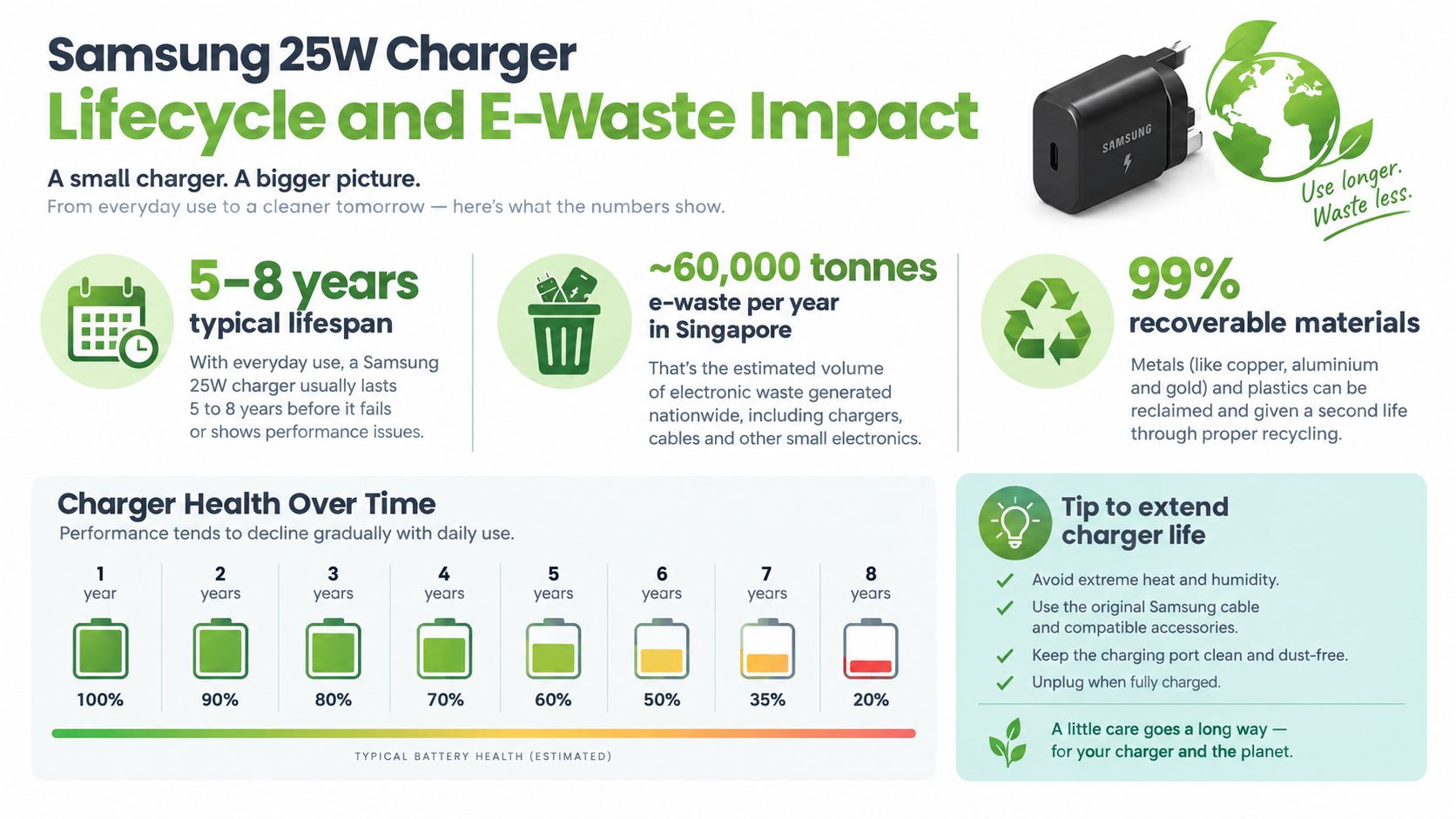
Singapore's e-waste figures show why small accessories should not be overlooked. The National Environment Agency estimates that Singapore generates about 60,000 tonnes of e-waste annually, equivalent to roughly 11kg per person, or the weight of approximately 73 mobile phones, according to the NEA's e-waste study and stakeholder update. The same source reports that 60% of Singapore residents either didn't know or were unsure how to recycle e-waste.
That uncertainty affects chargers directly. A working Samsung 25W adapter may be tossed out with household rubbish, even though it still has useful service life. A failed one may sit in a drawer for years because the owner is unsure what counts as proper disposal.
Why reuse deserves first place
A charger works like any other small electronic product. The longer it stays safely in use, the more value you get from the materials, manufacturing, packaging, and transport that already went into it. Reuse usually makes more sense than replacement when the adapter remains electrically compatible, physically intact, and safe to operate.
That leads to a simple order of action:
- Keep it in service: If the adapter still works safely with compatible devices, continue using it rather than replacing it for appearance or convenience.
- Pass it on carefully: A working, verified charger can be resold or given to someone who needs that exact type of adapter.
- Collect it responsibly: If it has failed or is no longer wanted, send it through an approved e-waste route, not general rubbish.
Singapore's formal e-waste system now covers small items such as chargers and cables. More than 550 collection bins had been deployed nationwide, and 4,300 tonnes of consumer e-waste had been collected since the scheme began, equal to about 10.5% of consumer electrical and electronic equipment supplied in 2020 (as reported by NEA, see full stakeholder update linked earlier).
This short video from NEA explains how Singapore collects small e-waste items like chargers and cables at public bins.
What to Do with an Unwanted or Failed Samsung Charger
A charger can fail without warning. One day your phone charges slowly, the next day the adapter feels hotter than usual or shows a crack near the USB-C port. Before you throw it into a drawer or the rubbish bin, check what is truly wrong. Slow charging can come from the cable, the phone's charging port, or the adapter itself.
Follow this safe decision path
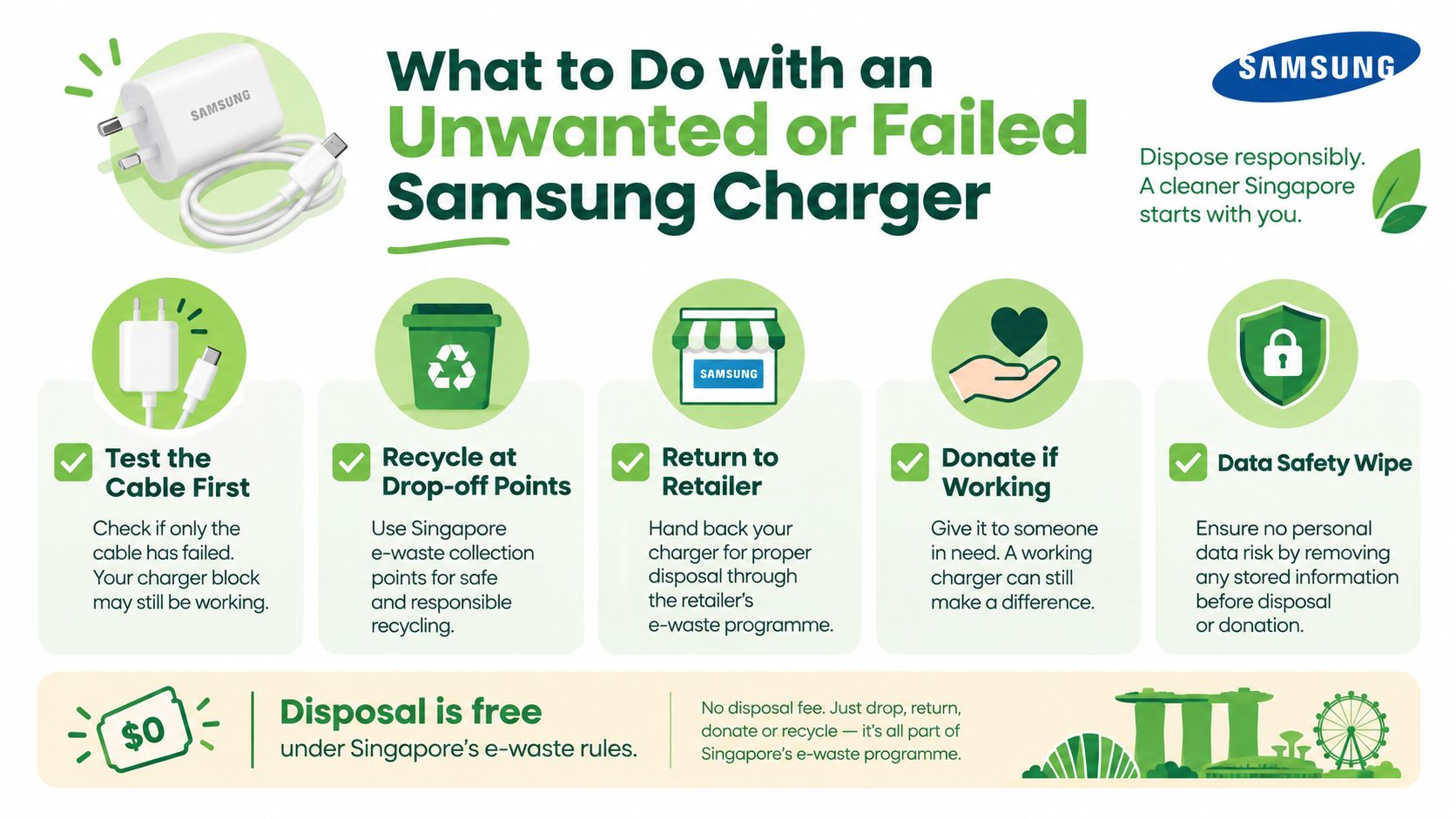
Test the cable first. Swap in a known-good USB-C cable and try the same phone again. If charging returns to normal, the cable is the likely fault, not the adapter.
Stop using damaged equipment. Unplug the charger if you notice cracks, exposed parts, scorch marks, liquid contact, a burnt smell, or unusual heat. Surface wear is one thing. Structural damage is different, and taping over it does not make the charger safe.
Separate working from failed units. A charger that is still safe, authentic, and compatible can stay in use, or be passed on to someone who needs that exact type of adapter. A failed unit should be kept away from everyday electronics until you can send it for proper collection.
Use a recognised e-waste route. Chargers are small, but they are still electronic waste. If you need a local drop-off option, use this guide to where to recycle electronics.
Protect data when devices are involved. The charger itself does not hold personal files. A phone, tablet, or laptop being cleared out at the same time might. Back up what you need first, then arrange secure erasure or data destruction for the device.
Batteries need extra care. Singapore's e-waste authorities warn that lithium-ion batteries placed in general waste can create fire risks, so do not put battery packs in household rubbish or the blue recycling bin. Do not dismantle a charger or battery pack at home to recover parts either. Approved collection and recycling channels are better equipped to handle them safely.
A failed accessory can still have value. It may contain recoverable materials, or it may point to a cable or device problem elsewhere in your charging setup.
Closing Thoughts on Safer, Smarter Charging
The best Samsung 25W charger decision combines three checks. First, confirm that your phone and cable can use USB PD 3.0 with PPS, rather than assuming every 25W label delivers the same result. Next, verify the Singapore SAFETY Mark, model information and physical condition before using a new, imported or second-hand adapter.
Finally, think beyond the day you buy it. Keep a safe charger in service, pass on a working one responsibly, and send a failed unit through an approved e-waste pathway. That small habit supports Singapore's wider move towards a zero e-waste future without making everyday charging complicated.
myhalo helps Singapore households and organisations extend device life through repair, certified reuse, buyback, upcycling and secure data handling. Ready to feel lighter and do good? Visit myhalo to explore convenient ways to declutter your e-clutter safely and responsibly.