
Old statements, expired contracts, school forms, and staff records have a way of gathering in one drawer until nobody wants to touch them. The worry is usually simple, if these papers contain names, account details, or other personal information, what's the safe way to get rid of them without creating a privacy problem?
In Singapore, that worry is reasonable. Document paper shredding sits inside a wider duty to handle personal data carefully, and the PDPA expects reasonable security arrangements during disposal and destruction, not just tidy desk habits. If you've ever kept a stack of papers because “I'll deal with it later”, this guide will help you sort out what shredding really does, how to choose the right cut level, and how to think about the paper after it's destroyed. For people who are also clearing homes or offices, this practical 2026 decluttering guide for Sydney moves is a useful example of how to approach a big clear-out in a calm, organised way.
Table of Contents
- When the Paper Piles Up and the Worry Creeps In
- What Document Paper Shredding Does
- Strip-Cut, Cross-Cut, and Micro-Cut Compared
- PDPA, Chain of Custody, and Singapore Compliance
- Preparing Documents for Secure Shredding
- Choosing a Shredding Service for Homes and Organisations
- How myhalo Fits and a Gentle Way to Start
When the Paper Piles Up and the Worry Creeps In
A home study can look harmless right up until the bottom shelf fills with old bank letters, medical bills, and school notices. In a small office, the same thing happens with invoices, contracts, and staff files, except the pile keeps moving from one corner to another because nobody wants to be the person who throws away the wrong document. That quiet hesitation is normal, especially when the papers contain personal data.
The instinct is often to keep everything “just in case”. The problem is that loose storage creates its own risk, and eventually someone has to decide whether the papers belong in a file cabinet, a locked bin, or a shredder. In Singapore, that decision is not just about cleanliness, because the PDPA has already made disposal part of a serious data-handling duty.
Practical rule: if a document would make you uneasy if a stranger read it, don't treat it like ordinary waste.
For many readers, the hardest part is not the shredding itself. It's the uncertainty about what level of destruction is enough, whether the papers need to be kept, and whether a home shredder really counts as secure. A sensible way to think about it is to start with the document's sensitivity, then match the destruction method to that level, rather than starting with whatever machine happens to be nearby.
A simple way to reduce the stress is to build the decision around one question, “Can this paper still reveal something useful if someone tries to piece it back together?” That question is more useful than asking whether it just looks torn up. For readers who are clearing out a household or office archive, the safest path is usually to sort first, shred second, and keep the process tight and deliberate instead of spread across several weekends.
What Document Paper Shredding Does
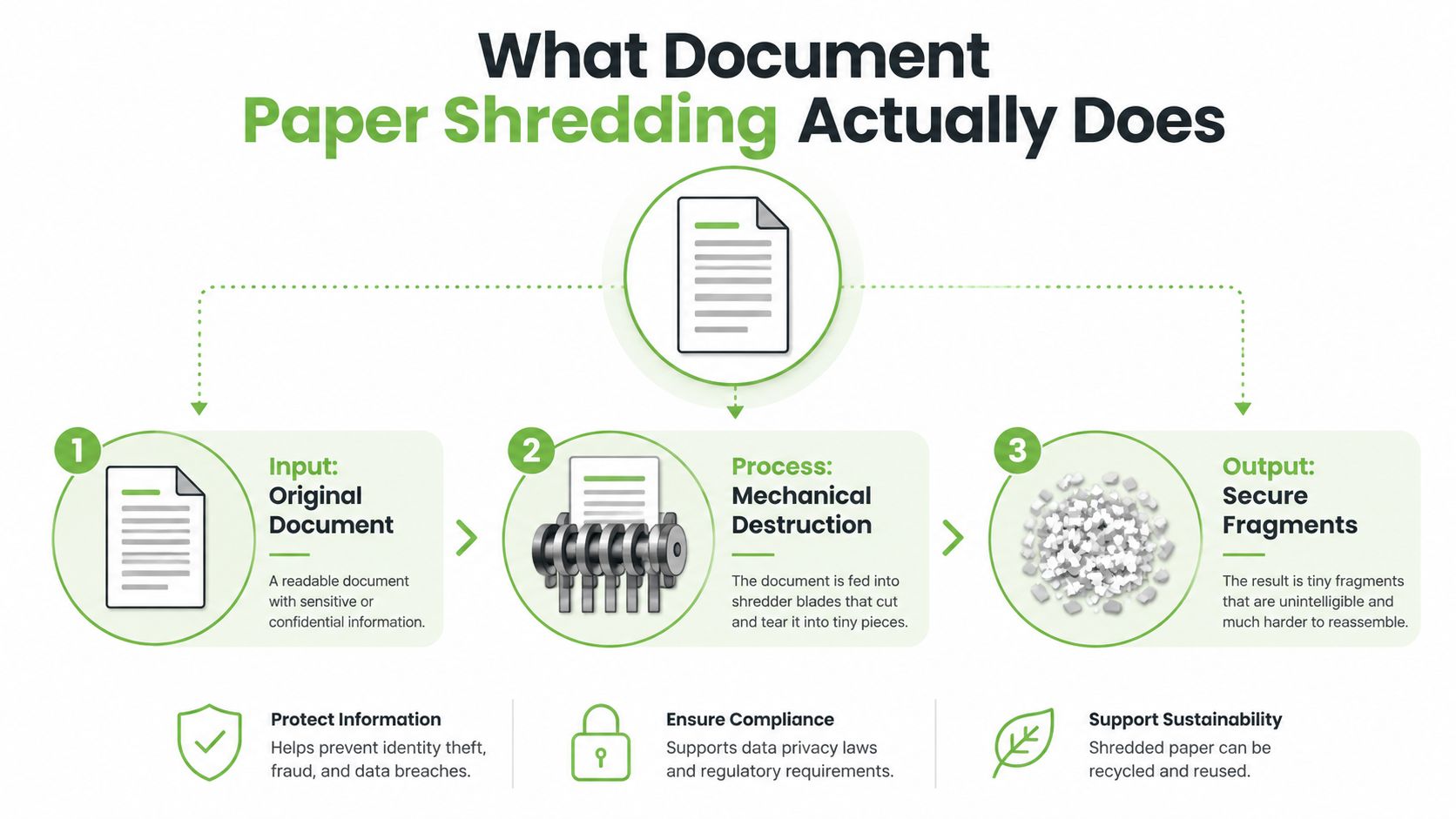
A readable sheet becomes fragments, and the key question is whether the information can still be recovered. A page can look destroyed and still leave names, account numbers, or layout clues behind if the pieces are large enough or handled carelessly.
The basic mental model
Shredding is mechanical destruction. A shredder cuts, tears, or crushes paper into fragments, and the security of that result depends on the shape and size of the fragments. A stack of old statements, a folder with staples, and a single receipt can all pass through the same machine, but they do not all end up equally hard to reconstruct.
That is why shredding is different from throwing intact paper into recycling. Recycling still leaves the document structure visible for too long if the paper is being handled casually, while shredding changes the geometry of the page. It is also different from pulping or incineration, which remove the paper's readable form more completely.
What counts as “paper” in real life
In practice, document paper shredding often covers more than a clean single sheet. Office folders, receipts, old ID copies, and paper attached to small fasteners are often treated as part of the same destruction job, because the concern is the information on the page, not whether the sheet had a staple in the corner. That is also why people sometimes use “shredding” to describe a broader disposal process, even when the actual task is more accurately called secure destruction.
Shredded does not automatically mean secure. The question is whether the output is merely hard to read, or genuinely beyond reconstruction.
A short glossary helps here. Strip-cut means long narrow strips. Cross-cut means the paper is cut across two directions. Micro-cut means much smaller fragments. Chain of custody means there is a tracked path from the desk or storage point to the final destruction point, so the paper is not just “gone”, it is accounted for. If you want a clearer feel for how different machines shape those fragments, this guide to paper shredding machines shows the main differences without turning it into a sales pitch.
Strip-Cut, Cross-Cut, and Micro-Cut Compared
A lot of people choose a shredder by looking at sheet capacity or price first, then assume the cut style is just a design detail. It isn't. The cut geometry is what changes how easy it is to reconstruct the document, and the ISO/IEC 21964 benchmark gives a clearer way to think about security than marketing labels do. For Singapore-facing decisions, that matters because the right answer depends on document sensitivity, not just the machine sitting under the desk.
The three common styles
Strip-cut is the most basic option. It turns a page into long ribbons, which is fine for low-risk paper but not ideal for documents you'd rather keep out of sight for good. Cross-cut chops the page into small pieces and is the everyday office standard for confidential business records. Micro-cut goes further, making much smaller fragments that are harder to piece back together.
Here's a practical snapshot.
| Cut style | Security level | Particle size | Typical use |
|---|---|---|---|
| Strip-cut | Lower security levels | Long strips | Low-risk household paper, casual clean-outs |
| Cross-cut | Common office threshold, often around P-4 for confidential business records | Small pieces, with P-4 limited to particles up to 160 mm² and width up to 6 mm | Routine office records, ordinary confidential files |
| Micro-cut | Higher security levels, including P-6 and P-7 for stronger reconstruction resistance | Much smaller fragments, with P-7 at 5 mm² and width up to 1 mm | Highly sensitive records, material needing stronger protection |
The useful takeaway is simple. If the paper contains ordinary confidential business information, P-4 is often the common threshold, but highly sensitive material belongs in P-6 or P-7 equipment rather than a standard office shredder, because the cut geometry directly affects recoverability risk. That's the point where the machine choice starts to matter more than the convenience of a quick feed slot.
A second thing people miss is sustained performance. NSA/CSS testing doesn't just look at whether a shredder can destroy office paper, it also checks whether it can keep going for an hour and tolerate a limited number of jams that are cleared quickly. A shredder that sounds strong on paper but jams repeatedly can interrupt workflow and weaken consistency, which is why procurement should cover both security level and feed reliability. For readers comparing machine categories, this guide to paper shredding machines is a helpful internal reference.
PDPA, Chain of Custody, and Singapore Compliance
A stack of old staff forms, customer printouts, or tax records can feel harmless once it leaves the desk. In Singapore, that paper still matters until it is destroyed properly. The Personal Data Protection Act has been in force since 2 July 2014, and it requires organisations to make reasonable security arrangements for personal data, including disposal and destruction, so shredding is part of compliance, not a separate housekeeping task. The Singapore PDPC's 2024/2025 guidance also shows that disposal failures can still surface as reportable incidents, which is why destruction has to be treated as part of the full storage-and-destruction lifecycle. Singapore's document destruction and PDPA context captures this compliance framing clearly.
What chain of custody looks like in practice
Chain of custody sounds formal, but the everyday version is simple. It is the record that shows who handled the papers, where they sat, and when they were destroyed. In an office, that usually means sealed consoles, scheduled pickups, witnessed destruction, a certificate of destruction, and a retention policy that says when documents move from active use to final disposal.
For a homeowner or small operator, the same logic can be lighter but still disciplined. Sort the papers, bag them, label them if needed, and destroy them in one session so they are not left in a loose recycling bin for days. If someone else can reach the papers before shredding happens, the control point has already slipped. Secure data destruction practices also help keep that path clear, and how secure data destruction works in Singapore is a useful reference if you want to see how the process is usually set up.
Keep the paper path short. The fewer places a sensitive document sits, the easier it is to explain what happened to it later.
A useful way to think about this is that shredding supports auditability. It does not replace a retention policy, and it does not excuse poor storage, but it does close the loop when the document has reached the end of its useful life. That is why the compliance question is not only “Was it shredded?” but also “Can we show how it moved from storage to destruction?”
For teams handling staff files, customer records, or old contracts, a documented process matters almost as much as the shredder itself. For individuals, the benefit is simpler. You get rid of paper in a way that feels deliberate, not rushed, and you avoid the uncomfortable middle ground where important records are sitting in a half-cleared pile beside the rubbish bin.
Preparing Documents for Secure Shredding
The easiest mistakes happen before the shredder is even switched on. Papers get mixed together, old tax files get tossed with junk mail, and someone tries to feed a bulky stack into a machine that was clearly meant for lighter use. A better habit is to prepare the documents first, then shred them in one controlled pass.
Sort before you destroy
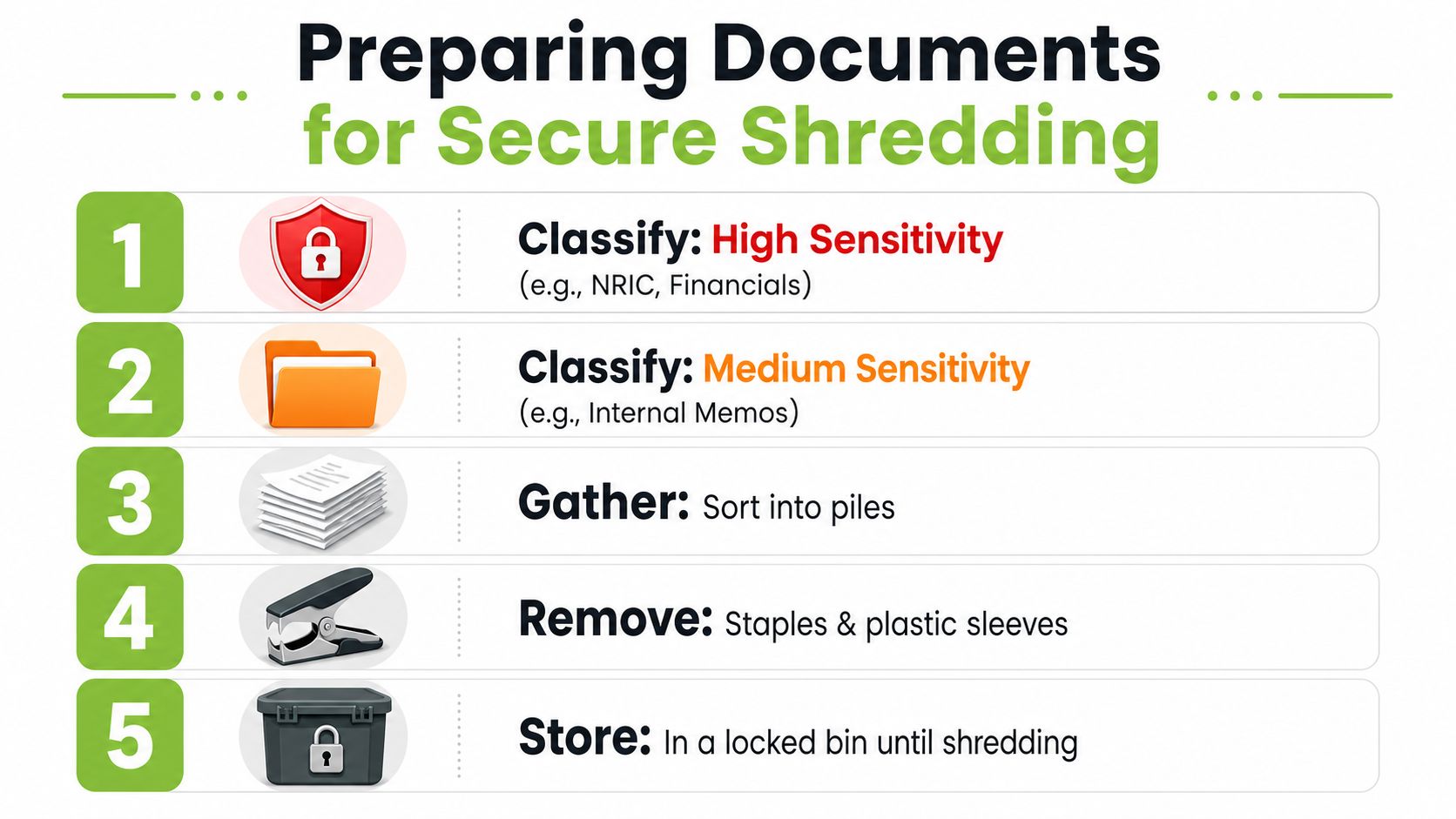
Start by separating documents into broad sensitivity bands. Personal papers are things like utility notices or low-risk correspondence. Confidential papers cover items such as internal memos, invoices, and routine business records. Highly sensitive papers include identity documents, financial records, and anything that would cause real harm if someone reconstructed it later.
That rough sorting makes the rest easier. It tells you what should be kept, what can be digitised, and what should go straight to destruction. It also helps you decide whether the document needs a standard office shred or a higher-security route.
Handle fasteners and storage properly
Staples, clips, binders, and plastic sleeves are a practical issue, not just an office nuisance. Some shredders handle them, some don't, and forcing the wrong material through the machine can cause jams or damage. If the machine manual says remove them, do it before the batch goes in.
A clean preparation routine can look like this:
- Classify the paper. Separate personal, confidential, and highly sensitive files before you start.
- Keep what you must retain. Legal, tax, and medical records should follow your retention rules, not your desk clutter.
- Digitise useful records first. Scan what you still need for reference, then destroy the paper copy if your process allows it.
- Remove incompatible fasteners. Take out staples, clips, and sleeves if your shredder can't handle them.
- Bag and store securely. Keep ready-to-shred paper in a locked bin or sealed bag until destruction happens.
The question “Is one pass enough?” depends on the sensitivity of the file and the cut type you've chosen. If the paper is low-risk, one controlled destruction step may be enough. If the contents are highly sensitive, the better answer is usually to use a higher security level rather than relying on repeated passes through a weaker machine.
Choosing a Shredding Service for Homes and Organisations
The right setup depends on volume, sensitivity, and how much proof you need after destruction. A home user with a small stack of statements doesn't need the same arrangement as a school admin office or an SME holding employee files. The decision is usually between owning a small shredder, using a shared office setup, or bringing in a certified service that handles destruction with a stronger paper trail.
Three common paths
A personal desktop shredder gives you control and instant disposal. It works well for low-volume household use, especially if you choose a cross-cut or micro-cut model and empty it regularly. The trade-off is capacity and maintenance, because you're the one clearing jams and looking after the machine.
An in-office shared shredder spreads the load across a team. It can make sense where several people need a common disposal point, but it still needs management, access control, and a process for emptying the bin. If no one owns the routine, the shredder area can become a holding point for unsorted paper.
A third-party certified provider is usually the cleaner choice when you need scheduled collection, sealed containers, and a record of destruction. For higher-volume or more sensitive environments, that paper trail matters. You can also read more about shredding services in Singapore if you're comparing service models.
| Option | Strengths | Limits |
|---|---|---|
| Personal desktop shredder | Control, instant disposal | Limited capacity, maintenance is on you |
| In-office shared shredder | Can be cost-effective for volume | Needs management and good housekeeping |
| Third-party certified provider | Certified handling, audit trail | Pickup has to be scheduled |
If the document's value is mostly in privacy and traceability, the service model matters as much as the machine.
A helpful rule is to match the method to the mess you're trying to avoid later. For a few envelopes at home, DIY can be fine. For recurring staff records or mixed confidential batches, a service with locked collection and destruction records is easier to defend if anyone ever asks what happened to the papers.
The nearby video gives a useful visual comparison of service styles, especially for readers trying to decide between self-managed shredding and professional pickup.
How myhalo Fits and a Gentle Way to Start
Not every paper disposal problem needs a big project. Sometimes the win is just clearing one bag of old statements, one box of expired HR forms, or one drawer that's been too awkward to open for months. A calm start makes the whole thing feel manageable, and it's usually enough to get the process moving.
For Singapore users who want a single place to think about lifecycle decisions, myhalo's public-facing services sit around secure handling, device recovery, and responsible end-of-life support. That matters because paper destruction is really part of the same bigger habit, deciding what stays, what gets digitised, what gets destroyed, and what should be handled with a proper trail. If your disposal routine is already mixed up with old devices, this guide to where to recycle electronics can help you organise the broader clean-out.
A practical way to think about the choice
If the paper is low-risk and the volume is small, a home shredder may be enough. If the papers are sensitive, mixed, or tied to records governance, a controlled service is easier to manage. If you're already dealing with other retired assets, a provider that can align destruction with broader lifecycle handling can reduce the number of separate decisions you need to make.
myhalo's own service model sits within that wider zero e-waste mindset, where repair, reuse, and part harvesting are prioritised before disposal. That approach pairs neatly with the idea that destruction should be intentional, not casual. It also makes it easier for people who care about both privacy and responsible material handling to move one step at a time.
The myhalo Promise is simple, secure destruction should feel straightforward, not stressful. If you're clearing out old paperwork or retired devices, start with the easiest pile first and let the process build from there.
Ready to feel lighter and do good? Let's clear out those old documents and devices together. Visit myhalo to explore secure data handling, responsible lifecycle support, and a simple way to take the next step.