
You know the feeling. The phone battery drops to 8% before you even reach the MRT platform, the laptop gets warm under your desk, or an old power bank has started swelling in a drawer you've been avoiding. In Singapore, that isn't just annoying, it can turn into a safety worry, a data worry, and a “what do I do with this now?” worry all at once.
If you've been trying to make sense of a lithium ion battery Singapore search because you're not sure whether a battery is still usable, needs repair, or should be handed over safely, you're in the right place. This guide keeps things practical, local, and calm, with simple steps for spotting trouble, storing batteries properly, and passing devices on without the usual stress. For a wider look at why keeping old tech out of the bin matters, you can also see myhalo's e-waste impact page.
Table of Contents
- Why Lithium-Ion Batteries Matter to You in Singapore
- How Lithium-Ion Batteries Work and the Types You Use Every Day
- Everyday Safety and Storage Habits That Prevent Battery Fires
- Singapore Rules for Transporting, Carrying, and Disposing of Batteries
- Choosing Between New, Refurbished, and Trade-In Devices
- Repair, Trade-In, and Certified Replacement in Real Life
- Responsible Recycling and Zero E-Waste Pathways in Singapore
- Practical FAQs and Your Next Step with myhalo
Why Lithium-Ion Batteries Matter to You in Singapore
A phone that dies on the ride home, a laptop that stops holding charge, or a battery that starts to look a little swollen can feel like a small nuisance. In Singapore, those moments sit inside a bigger decision, because lithium-ion batteries power phones, laptops, portable devices, backup systems, and many connected devices people rely on every day.
The local market reflects that reality. One Singapore battery market outlook reports that lithium-ion was the largest revenue-generating product segment in 2024, at 61.47% of market revenue (Data Bridge Market Research). The same study projects the wider lithium-ion battery market at US$92.20 billion in 2024 and US$386.74 billion by 2032, with a 26.29% CAGR from 2025 to 2032 (Data Bridge Market Research).
Why the local context feels different
Singapore is dense, digital, and short on space. Batteries matter here not only because people use them, but because they sit inside homes, offices, data centres, logistics chains, and mobility tools that all need to keep moving. A healthy battery saves time and avoids disruption. A failing battery can interrupt work, raise disposal questions, and create privacy worries if the device still holds personal files.
Practical rule: if a battery changes shape, heat, or behaviour, treat it as a device issue first, not just a charging issue.
That simple rule helps with the first triage question many people face. Is the battery a repair candidate, a reuse candidate, or a safety hazard. In some cases, a device can be repaired and kept in service. In others, the battery is still useful enough for trade-in or reuse. If it is swollen, leaking, or overheating, it belongs in the safety category and should be handled carefully instead of being kept in a drawer.
The zero e-waste approach fits that decision-making. The right next step is not always to throw the item away. Sometimes it is repair, sometimes it is trade-in, and sometimes it is safe collection for recycling. If you want a broader view of why discarded batteries and devices need careful handling, the guide on the e-waste impact of discarded devices is a useful place to start.
For households that are comparing small-device batteries with larger storage setups, the article how vpps maximise your solar investment is also useful reading. It shows how battery storage thinking changes once you move from a phone or laptop to a home energy system.
How Lithium-Ion Batteries Work and the Types You Use Every Day
A lithium-ion battery works like a small reversible shuttle for energy. During charging, lithium ions move through the cell in one direction. During use, they move back again and release energy to power the device. That back-and-forth movement is what lets the same battery store and deliver electricity many times.
The common chemistries you'll hear about
In Singapore, battery chemistry shows up in many places, even if the label is hidden inside the casing. Phones, laptops, tools, e-bikes, and home storage systems may all use different versions of lithium-ion, and each version is chosen for a different balance of size, runtime, heat tolerance, and lifespan.
Li-NMC, short for Lithium-Nickel Manganese Cobalt, is one of the chemistries often discussed in market studies and product planning. It is commonly used where energy density matters, so the battery can store a lot in a compact space. LFP, or Lithium Iron Phosphate, is another chemistry you will hear about more often in newer EV and stationary-storage conversations. It is usually chosen for steadier thermal behaviour and a different lifespan profile, which is why it comes up in safety-minded repurposing and recycling discussions in Singapore.
For phones and laptops, lithium-cobalt blends are still common enough that many users never see the chemistry name at all. That is normal. What matters in daily life is how the battery behaves, whether it charges normally, holds power for a reasonable time, and stays physically stable. If a device stays light and compact while still giving useful runtime, that usually reflects a design choice built around energy density and form factor.
What to look for on the label
A battery label can tell you more than you might expect. Look for the chemistry name, voltage, and safety markings if they are visible. If the label is faded or hard to read, that does not automatically mean the battery is unsafe. It does mean you should pay closer attention to the device itself, especially if it has become warm too quickly, loses charge unusually fast, or shows any change in shape.
For readers who want a practical phone-focused guide, phone battery care tips and replacement options in Singapore gives a useful next step. It helps you separate a battery that still has useful life from one that should be replaced or checked more carefully.
If you are comparing how battery design changes storage decisions in larger systems, how vpps maximise your solar investment helps explain why chemistry choice matters once you move beyond a phone or laptop. In a home energy setup, the questions are different. You are no longer only asking whether the battery still works, you are also asking whether it is a repair candidate, a reuse candidate, or a safety hazard, and where it should be handed off in Singapore.
Everyday Safety and Storage Habits That Prevent Battery Fires
The safest battery habits are usually the least dramatic ones. You charge in sensible places, you notice changes early, and you stop using a device the moment it starts acting oddly. That calm approach matters because battery problems rarely begin with a bang, they usually begin with a small change in shape, heat, smell, or runtime.
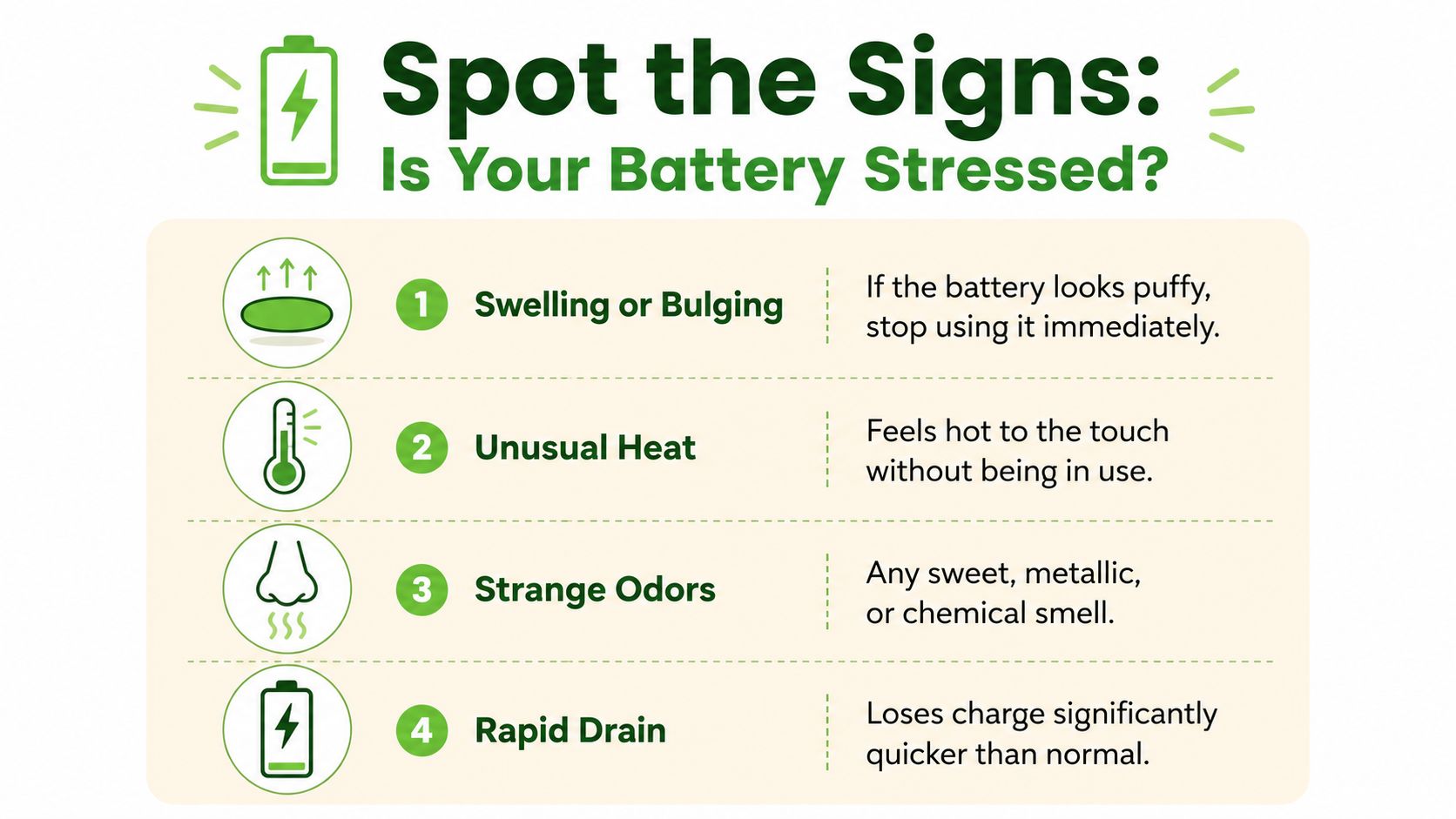
The warning signs to watch for
A battery that is swollen, unusually hot, giving off a strange smell, or draining much faster than usual is telling you something. Don't keep testing it over and over. If it feels hot when it's not in use, or if the device surface is lifting, back away and switch to a safer plan.
Practical rule: a swollen battery is not a “maybe later” problem. It's a stop-using-now problem.
At home, the habit changes are simple:
- Charge on hard, open surfaces. Beds, sofas, and pillows trap heat.
- Unplug once full where practical. Leaving a battery hot for long stretches isn't ideal.
- Use the original charger where possible. It keeps the charging profile consistent.
- Keep devices out of direct sun. That includes windowsills and parked car boots.
- Store unused devices at around 50% charge. A cool, dry place is better than a fully drained drawer.
The link between storage and long-term health
Unused devices need care too. A tablet you only bring out for travel, or a spare laptop kept for backup, won't stay healthy forever if it's left empty or baked in heat. A battery that sits for months at full charge or zero charge is more likely to age badly than one kept in a moderate state.
For phone-specific care, including replacement warning signs and handling ideas, you can also read myhalo's phone battery care tips and replacement guide. That's useful if the issue is small now but you want to avoid a bigger battery headache later.
Singapore Rules for Transporting, Carrying, and Disposing of Batteries
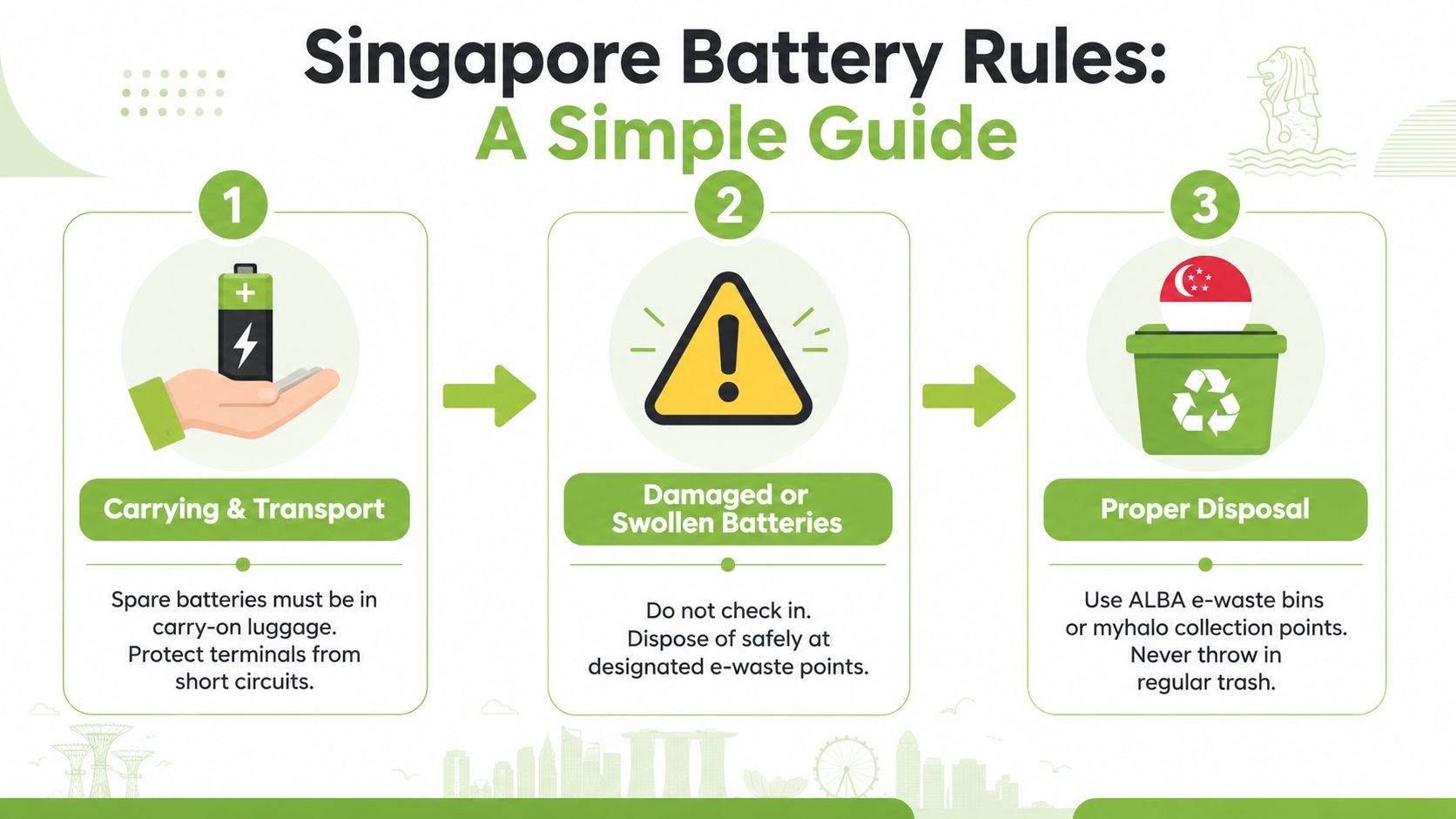
Batteries are easy to carry until they aren't. The moment you need to fly, move damaged stock, or clear out old devices from a home office, the rules matter. Spare lithium-ion batteries should be protected against short circuits when transported, and damaged or swollen units should never be treated like ordinary throwaway items.
What travellers and office teams should remember
For anyone flying with spare batteries, the key idea is simple. Keep them in a safe carry setup, protect the terminals, and do not put damaged batteries where they can be forgotten in checked luggage. That is especially important if a battery is already swollen or overheated.
The national disposal picture is just as important. Singapore's e-waste system is built around proper collection, not casual binning. Batteries should go to designated e-waste points, not into regular household trash. The same logic applies in offices, schools, and shared storage rooms, where one badly handled battery can create a bigger safety problem for everyone nearby.
Where the rules meet real action
If a battery is damaged, treat transport and disposal as separate decisions. First, make it safe to handle. Then send it to the right point. If you need a public-facing overview of battery recycling pathways in Singapore, myhalo's battery recycling guide is a useful place to start.
Official guidance should still be your final check before travel or bulk disposal. Singapore's rules can change depending on the transport mode and the condition of the battery, so it's smart to verify the latest advice with government resources before moving a large batch of devices. That's especially true for companies clearing laptop fleets or homes clearing a drawer full of mixed chargers and power banks.
Practical rule: if you're unsure whether a battery is safe to move, isolate it first and ask before you carry it farther.
The main thing to remember is that batteries are not just waste. They're handled items, and sometimes hazardous ones. Treating them that way protects the people around you and makes the handoff to proper recycling smoother.
Choosing Between New, Refurbished, and Trade-In Devices
A battery decision often turns into a device decision. If your phone or laptop is slowing down, you may be weighing whether to buy new, buy refurbished, or trade in the old device first. In Singapore, where people upgrade often and desk space is precious, the smartest choice isn't always the newest one.
The three common paths
| Pathway | Typical Price | Warranty | Environmental Impact | Data Handling |
|---|---|---|---|---|
| New | Highest upfront cost | Usually manufacturer-backed | Highest new-material demand | Data transfer and wipe are your responsibility |
| Certified refurbished | Lower than new | Depends on seller and grade | Lower embodied impact because the device is reused | Should include secure wipe and testing |
| Trade-in | Reduces replacement cost | Not a product purchase, so varies | Keeps devices in circulation longer | Should include secure data handling before handoff |
Certified refurbished devices make a lot of sense when the hardware is still strong and the battery or casing is the main reason for replacement. That's the logic behind refurbished phones in Singapore, especially for people who want a dependable device without paying full new-device pricing.
How to think about the choice
A new device gives you the latest model and a fresh battery, but it also creates the biggest material footprint. A refurbished device can give you a tested, graded handset or laptop at lower cost, as long as the seller is transparent about condition and data handling. Trade-in works best when your old device still has value and you'd rather turn it into credit or cash than leave it in a drawer.
For people who worry about privacy, the question isn't just price. It's whether the handoff includes proper data wiping, secure storage, and a clear next step for the device. That's where the process matters as much as the product.
Repair, Trade-In, and Certified Replacement in Real Life
A common Singapore scenario looks like this. Someone brings in a phone that doesn't hold charge well, or a laptop that shuts down too quickly, and the first question is not “What's the battery chemistry?” It's “Can this be fixed, and is my data safe?”
What the counter journey usually feels like
At a repair and trade-in counter, the device is checked first. A technician looks at whether the issue is battery-related, part-related, or something broader. If the device can be repaired, that saves time and keeps the machine in use. If it's better suited for trade-in, the quote is usually generated through a transparent pricing process rather than a vague guess.
That's also where secure handling makes a huge difference. People hesitate to let go of old devices because photos, work files, and messages still feel personal. A documented wipe and secure data process turns that uncertainty into a clear handoff.
Where drop-off and processing become concrete
For Singapore users, the convenience is real because drop-off isn't hidden away in a vague warehouse. There are physical points at Bugis Junction (#03-25/26) and Sim Lim Square (#03-40), which makes it much easier to act on a device problem the same day. Repair, resale, and component harvesting can all happen within a managed workflow rather than a one-off disposal step.
Practical rule: if a device still powers on and still has value, ask about repair or trade-in before calling it waste.
In some cases, the battery issue is only one part of the picture. The device might be a repair candidate, or it might be better suited for certified resale after testing. In other cases, parts can be recovered and put back into useful circulation. That's how the local device lifecycle starts to make sense as a chain, not a single decision.
Responsible Recycling and Zero E-Waste Pathways in Singapore
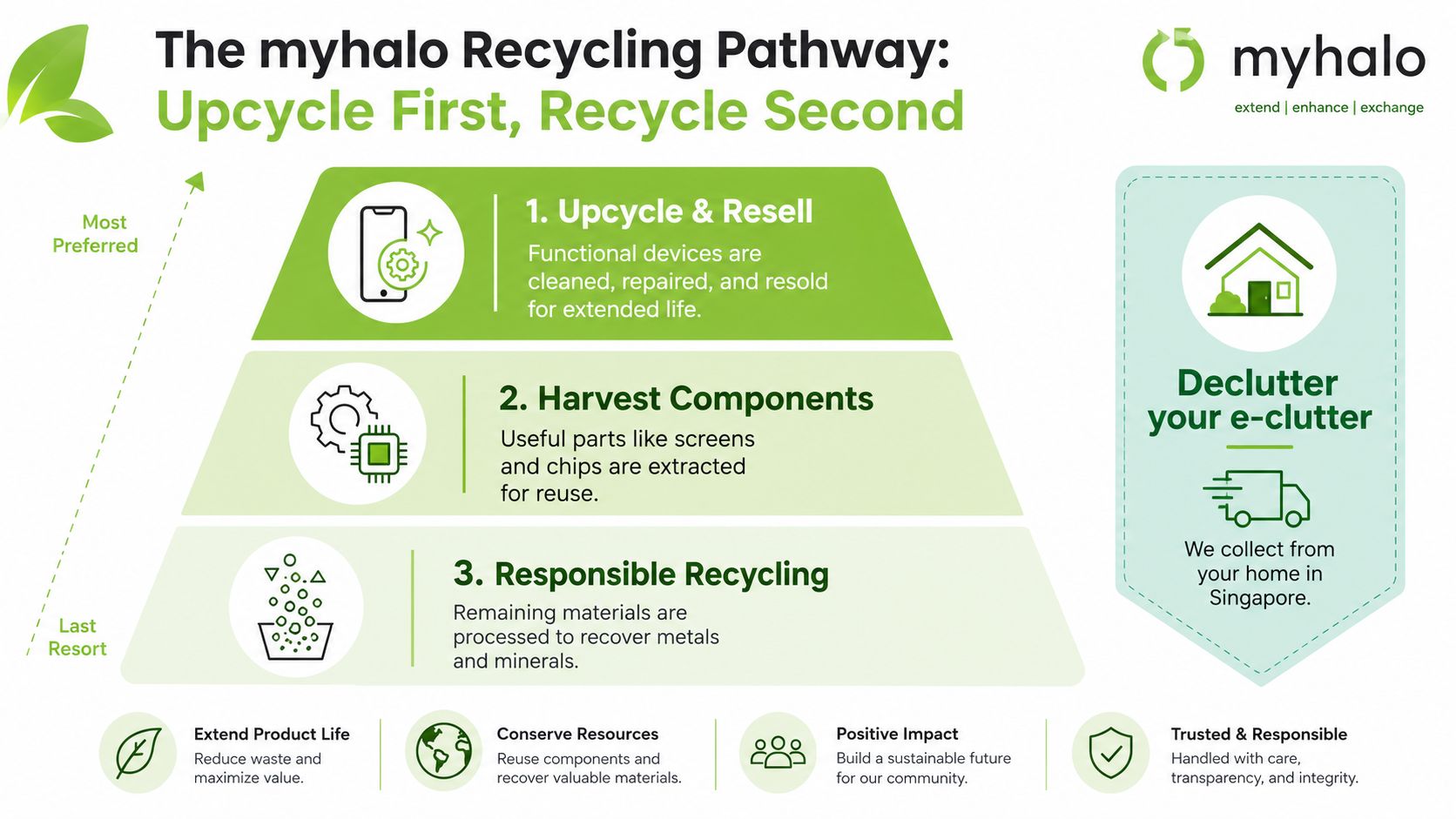
Recycling is important, but it works best when it comes after repair and reuse. That's the hierarchy that keeps good devices in circulation for as long as possible, while still making sure broken ones are handled properly at the end.
What happens after drop-off
A responsible device handoff usually starts with sorting. Working devices can be cleaned, checked, and prepared for resale. Non-working units may still offer usable components, so parts harvesting can extend the life of other devices. Only after those options are exhausted should full material recycling take over.
That approach fits Singapore's broader circular battery ecosystem. The country already has industrial-scale lithium-ion recycling capability, including a facility that can process 14 tonnes per day and claims recovery from roughly 280,000 smartphone batteries daily (The Straits Times). Another Singapore recycling developer, NEU Battery Materials, says its process uses electricity as the only consumable, avoids toxic waste and harsh acids, and is designed to process LFP batteries while producing battery-grade lithium (SG Innovate).
Why the order matters
If a device can be repaired, that is usually the most useful outcome. If it can be resold, that extends its life even further. If it can't do either, then component recovery and materials recycling keep valuable resources in motion instead of sending them to landfill or mixed waste.
Practical rule: the last stop should be recycling, not the first thought.
That's also where a structured collection programme helps households and offices. myhalo's Declutter your e-clutter approach collects devices from homes and offices, supports secure processing, and routes units through repair, resale, parts recovery, and recycling as appropriate. In a city like Singapore, where storage space is tight and device turnover is constant, that kind of pathway turns a clutter problem into a responsible one.
Practical FAQs and Your Next Step with myhalo
A swollen phone battery is the easiest question to answer. Don't keep using it if it's puffed, hot, or lifting the screen. If the device is still working, that doesn't automatically make it safe, and it doesn't mean you should keep charging it while you decide what to do.
A laptop battery is harder to judge from the outside, because the casing can look fine while performance has already dropped. If the machine is shutting down too quickly, running hot, or failing to hold charge, it's worth getting it checked instead of guessing. A power bank that looks swollen or smells odd should also be treated as unsafe, even if it still lights up.
Quick answers to common questions
- Can an old tablet that still works be useful? Yes, if it still runs well enough for second-life use, it may be better suited to resale or repurposing than disposal.
- Should I keep a low-performing battery “just in case”? Not if it shows stress signs. Safety comes first.
- Is a dead battery always e-waste? Not always. Some devices can be repaired, and some can feed parts recovery before any recycling happens.
- What about devices from offices or school fleets? Those often need documented handoff and secure data handling, especially when the storage contains work files or student records.
If you're looking for a straightforward next move, the simplest one is to bring the device to a proper collection or repair point instead of leaving it in a drawer. That keeps the battery safer, the data safer, and the device in a better position for reuse if it still has life left.
Ready to feel lighter and do good? Let's clear out those old devices together. Visit myhalo to explore repair, trade-in, and responsible drop-off options that make battery care, data security, and zero e-waste feel easy.