
That drawer of old phones. The stack of bank statements in the cupboard. The dead laptop you meant to deal with months ago. This is a familiar feeling for many in Singapore. You want the clutter gone, but you also don't want your personal details, work files, or family photos ending up in the wrong hands.
That hesitation is reasonable. Old paper records can expose addresses, account details, and signatures. Old devices can hold far more than people realise, even after you've “deleted” files. Secure shredding solves that anxiety by turning a vague worry into a clear process. Items are collected, tracked, destroyed, and documented properly.
It matters at home and at work. According to myhalo's consumer survey reference, working adults in Singapore hold an average of 3.3 inactive small electronic devices at home, and many are partially functional or still store important data. That means clutter is often also a privacy issue.
Shredding is also bigger than disposal. In a responsible device lifecycle, secure destruction is the point where sensitive data is handled safely so that materials can move into recycling, repair support, or other circular pathways without unnecessary risk.
Table of Contents
- Feeling Weighed Down by Old Tech and Paperwork
- What Gets Shredded Paper Hard Drives and Beyond
- On-Site vs Off-Site Shredding Which Is Right for You
- The Secure Shredding Process from Start to Finish
- Staying Compliant with PDPA and Certifications
- Your Checklist for Choosing the Right Shredding Service
- Beyond Shredding myhalo's Zero E-Waste Approach
Feeling Weighed Down by Old Tech and Paperwork
A common scene looks like this. One drawer holds an old iPhone, a retired office access card, two thumb drives, and a portable hard drive that no longer powers on. Another shelf has insurance letters, printed payslips, expired contracts, and envelopes with your name and address still visible.
People often keep these things because throwing them away feels risky. If you tear up a bank letter by hand, is that enough? If you factory reset a phone, is the data really gone? If you pass an old laptop to recycling, who's checking the drive inside? Those questions are exactly why shredding services in Singapore matter.
For paper, shredding removes the chance that confidential information can be pieced together from intact documents. For electronics, secure destruction prevents storage media from being reused or accessed without authorisation. The emotional benefit is just as real as the security benefit. Once the job is done properly, the lingering “I should deal with that” feeling disappears.
Practical rule: If an item contains identity details, account information, client records, or stored files you wouldn't hand to a stranger, it deserves secure disposal.
Many people also want a simple way to build better habits around managing sensitive information privately. That starts before destruction. Keep sensitive files separated, label what's safe to discard, and avoid mixing confidential materials with everyday recycling.
A tidy home office or storeroom isn't just about neatness. It's about reducing risk, clearing mental space, and making room for devices and documents that still have a purpose.
What Gets Shredded Paper Hard Drives and Beyond
When people hear “shredding,” they usually think of paper first. That's still part of the picture, but modern shredding covers much more than printed documents.
Paper is only the starting point
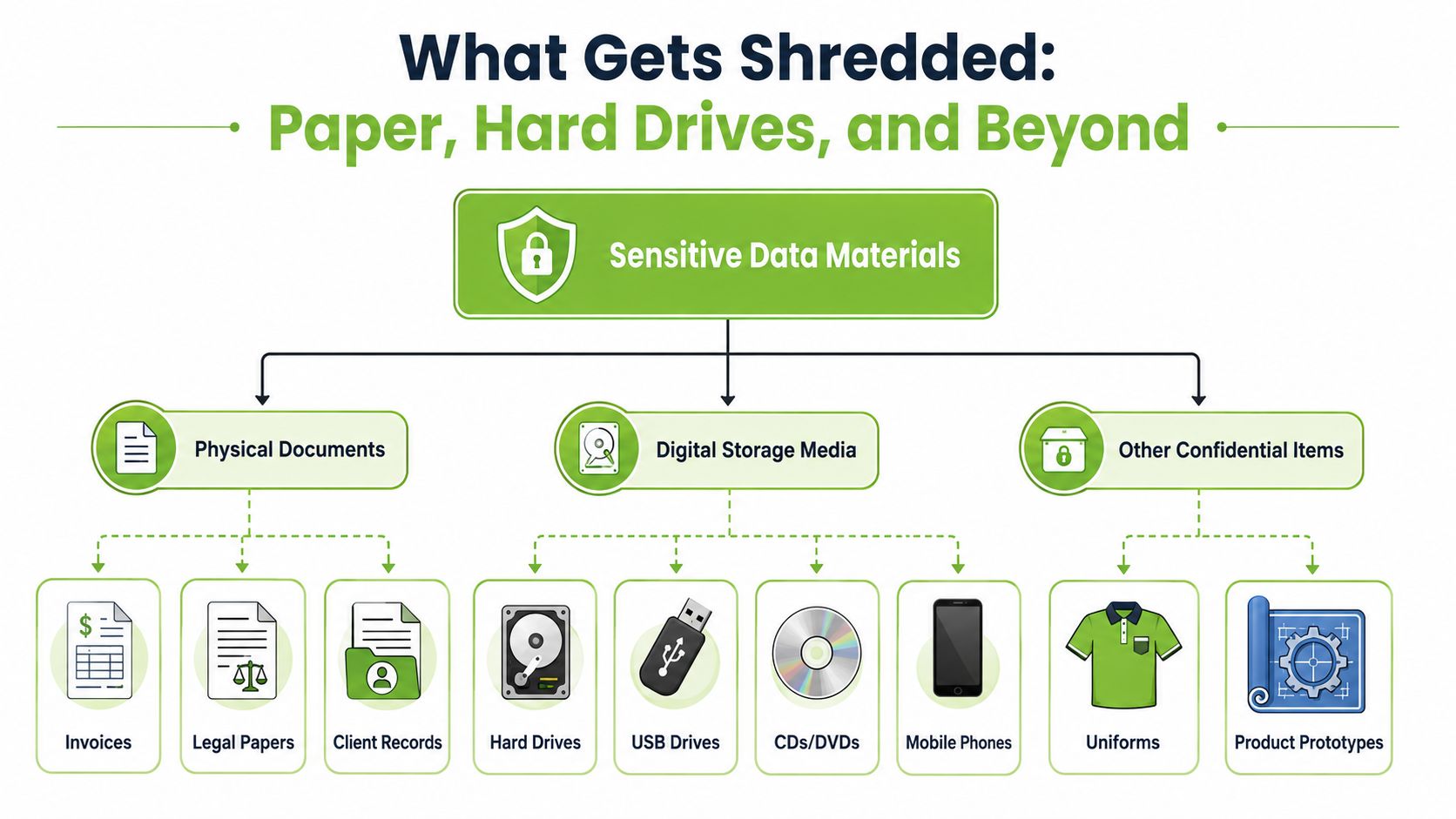
Traditional paper shredding usually includes:
- Personal records like bank statements, medical paperwork, utility bills, and tax documents
- Business records such as invoices, HR files, contracts, and client paperwork
- Printed materials with identifiers including mailing labels, forms, and internal reports
Digital storage needs a different approach. A paper shredder can't solve the problem of data sitting on a hard disk or flash chip. Professional destruction services may handle:
- Hard disk drives (HDDs) from desktops, laptops, and servers
- Solid state drives (SSDs) used in modern laptops and compact devices
- USB drives and memory cards
- CDs and DVDs
- Old mobile phones and tablets, depending on the provider's setup
Deleting files isn't the same as physically destroying the storage media. A device can look empty and still retain recoverable data. That's why secure destruction is often the safer option when equipment has reached the end of its useful life.
Why hybrid destruction matters
Many homes and offices don't have only one type of confidential waste. They have boxes of paper and a pile of retired electronics at the same time. That's where hybrid data destruction becomes useful.
According to this Singapore shredding industry write-up, a 2025 NEA report found that 65% of businesses now dispose of mixed confidential data (paper + electronic), yet 70% of shredding guides omit this hybrid requirement. That gap matters because real clean-outs rarely happen in neat categories.
One clear-out can include staff records, old backup drives, branded uniforms, archived invoices, and a few forgotten USB sticks from years ago.
If you're choosing among shredding services in Singapore, ask whether they can process mixed materials in one organised workflow. It saves time, reduces confusion, and helps avoid the very common mistake of securely destroying paper while overlooking the devices sitting beside it.
On-Site vs Off-Site Shredding Which Is Right for You
The biggest practical choice is where the destruction happens. On-site shredding means the provider comes to your location. Off-site shredding means materials are collected securely and destroyed at the provider's facility.
The difference isn't only about logistics. It affects cost, visibility, and how much direct control you want during the process.
When on-site makes more sense
On-site shredding suits jobs where visibility matters most. You can usually witness the destruction, confirm what's being processed, and close the loop immediately. That's attractive when the materials are highly sensitive or when internal policy requires direct observation.
In Singapore, community pricing discussion on industrial shredding indicates that on-site truck-based shredding can cost approximately SG$600, while off-site shredding starts around SG$200+. That price gap reflects the extra work involved in bringing mobile equipment to your premises.
When off-site is the better fit
Off-site shredding often suits bulk jobs, archive clear-outs, and organisations that want a more budget-friendly option. The provider collects materials, transports them under controlled procedures, and completes the destruction at a central facility.
For many businesses, the deciding factor is scale. If you're retiring a large batch of devices or paperwork as part of an IT refresh, off-site processing may be easier to coordinate alongside broader asset handling such as corporate IT asset disposition.
Here's a simple side-by-side view.
| Feature | On-Site Shredding | Off-Site Shredding |
|---|---|---|
| Visibility | You can usually watch destruction happen at your location | You rely on documented handling and facility processes |
| Cost | Approximately SG$600 based on the cited Singapore discussion | Starts around SG$200+ based on the same cited discussion |
| Best fit | Sensitive materials, witnessed destruction, immediate assurance | Bulk volumes, centralised processing, tighter budgets |
| Movement of materials | Materials are destroyed before leaving your premises | Materials are transported securely to the provider's facility |
| Peace of mind style | Real-time observation | Process control and documentation |
Choose based on the sensitivity of the material, the amount you need destroyed, and whether witnessing the process matters more to you than price.
Neither option is automatically “better” for everyone. The right choice is the one that fits your risk level, workflow, and budget without creating unnecessary friction.
The Secure Shredding Process from Start to Finish
A first booking often sounds more intimidating than it really is. In practice, the process is usually structured, repeatable, and designed to protect both convenience and accountability.
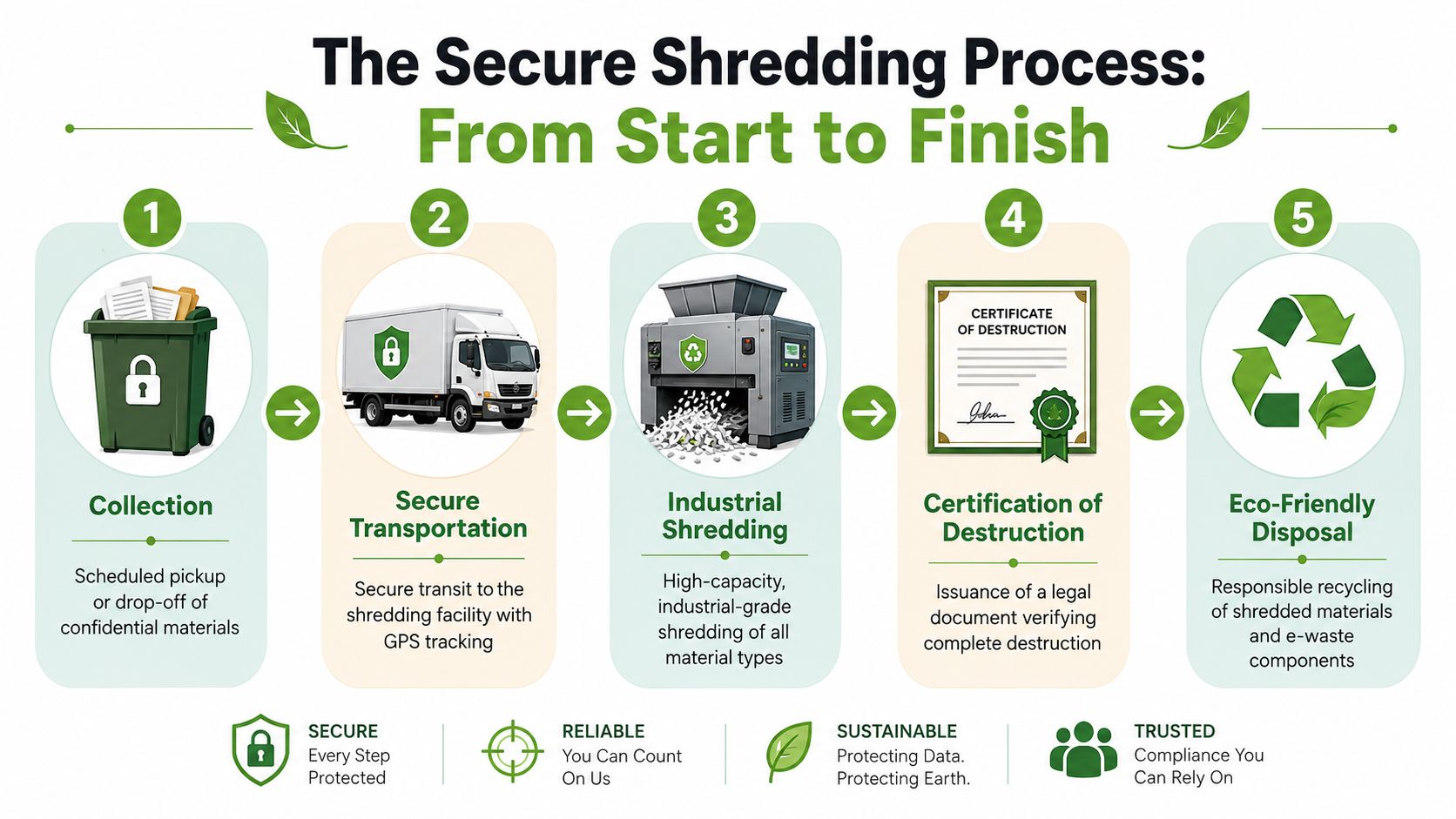
A useful visual guide helps make that flow easier to picture.
What you'll usually experience
Most professional jobs follow a sequence like this:
Booking and scope confirmation
You describe what needs destruction. That may include paper files, hard drives, USBs, or mixed materials.Collection or on-site setup
For off-site jobs, materials are packed for secure transport. For on-site jobs, the mobile unit or team arrives at your premises.Controlled destruction
Industrial equipment destroys the materials so they can't be reconstructed or reused as functioning data storage.Documentation
You receive records showing the work was completed.
For hard drives, certified on-site destruction can be especially direct. According to this Singapore hard drive shredding guide, mobile industrial units pulverise media into minuscule particles, typically under 2mm, at your premises, giving clients visual confirmation and an immediate Certificate of Destruction for PDPA compliance.
If you want a simple explainer on careful pre-disposal handling, this guide on wiping out your data before recycling your device is a helpful companion read.
Later in the process, seeing the workflow in action can make the service feel far less abstract.
What the certificate should confirm
The Certificate of Destruction is the part many people remember best, because it turns trust into a record. It's the proof that the provider did not only collect your materials. They completed the destruction.
Look for confirmation of:
- The date of destruction
- The destruction method
- The relevant asset or serial details, where applicable
- The provider's identity and process trail
A good shredding process doesn't end when the machine stops. It ends when you have clear evidence of what was destroyed and how it was handled.
That documentation matters for businesses, and it's reassuring for households too. When the paperwork is complete, you're no longer guessing whether the job was done properly.
Staying Compliant with PDPA and Certifications
Secure disposal in Singapore isn't just a matter of preference. If documents or devices contain personal data, disposal has to be handled responsibly. That's where PDPA awareness becomes practical rather than abstract.
What compliance looks like in practice
A compliant shredding provider should be able to show that your confidential materials are protected from collection to destruction. That journey is often called the chain of custody. It means there's a documented process for who handled the items, when they were moved, and how they were destroyed.
According to Crown Records Management's Singapore guidance, professional shredding services in Singapore follow strict chain-of-custody protocols and may hold certifications such as NAID AAA and ISO to validate their security processes under PDPA-related requirements.
That matters because disposal failures usually happen in the gaps. A box left unattended in a loading area. A retired drive that wasn't logged. A vendor that collects materials but can't clearly document the final destruction step.
For readers who want a broader view of security controls used by service providers, these IT Experts Canada solutions give a useful outside example of how organisations think about layered protection across physical and digital environments.
Which certifications are worth checking
Certifications can sound technical, but they serve a simple purpose. They show that the provider's systems and procedures have been evaluated against recognised standards.
Look out for references to:
- NAID AAA for document security practices
- ISO certifications covering areas such as quality, environmental management, and safety
- R2v3 where e-waste and responsible recycling are part of the workflow
- BizSAFE Star where operational safety is relevant
For businesses handling retired electronics, this article on secure ITAD and certified asset disposition in Singapore is a practical read because it connects disposal, documentation, and environmental responsibility in one framework.
Compliance isn't a logo on a website. It's a process trail you can verify.
That's the standard worth aiming for when evaluating shredding services in Singapore.
Your Checklist for Choosing the Right Shredding Service
Choosing a provider gets easier when you stop thinking in marketing terms and start asking operational questions. A trustworthy company should be able to answer them clearly.
Questions worth asking before you book
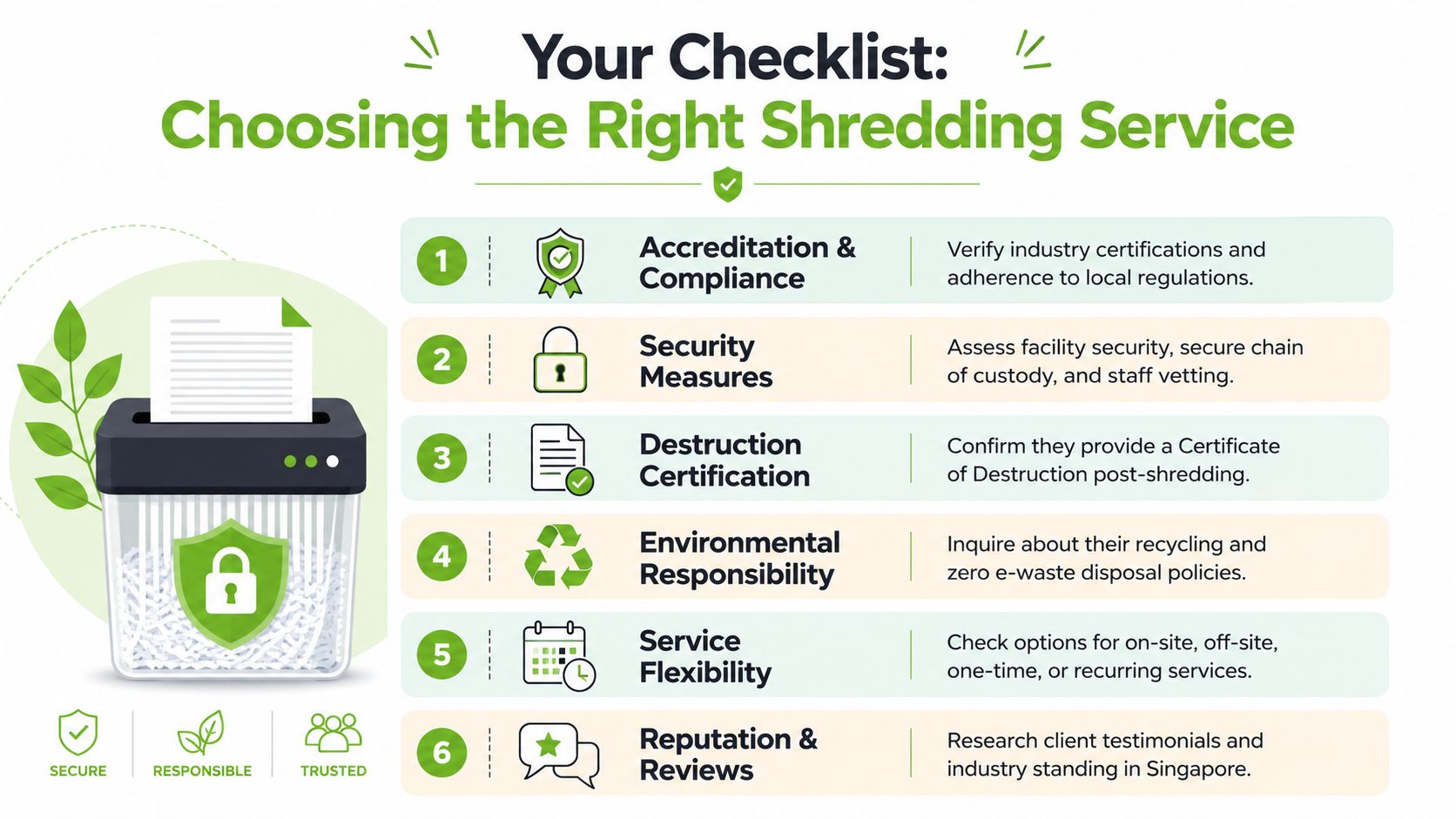
Start with this shortlist:
- Can you verify your licensing and certifications? Ask for specifics, not vague reassurance.
- How do you maintain chain of custody? You want to know how materials are tracked from pickup to destruction.
- Do you issue a Certificate of Destruction? This should be standard, not an awkward extra.
- Can you handle both paper and electronic media? Mixed clear-outs are common.
- What happens to the shredded residue afterward? Responsible recycling matters.
- Do you offer on-site and off-site options? Flexibility helps you match the service to the job.
This matters more than many people realise. According to this Singapore guide on document shredding verification, a 2025 survey found that 78% of Singaporean consumers cannot verify a shredding company's regulatory compliance, and 60% of providers do not publicly disclose their NEA licence number.
That's a serious transparency gap. If a provider makes it hard to confirm basic compliance details, treat that as a warning sign.
A good provider doesn't just promise security. They make it easy for you to check.
Beyond Shredding myhalo's Zero E-Waste Approach
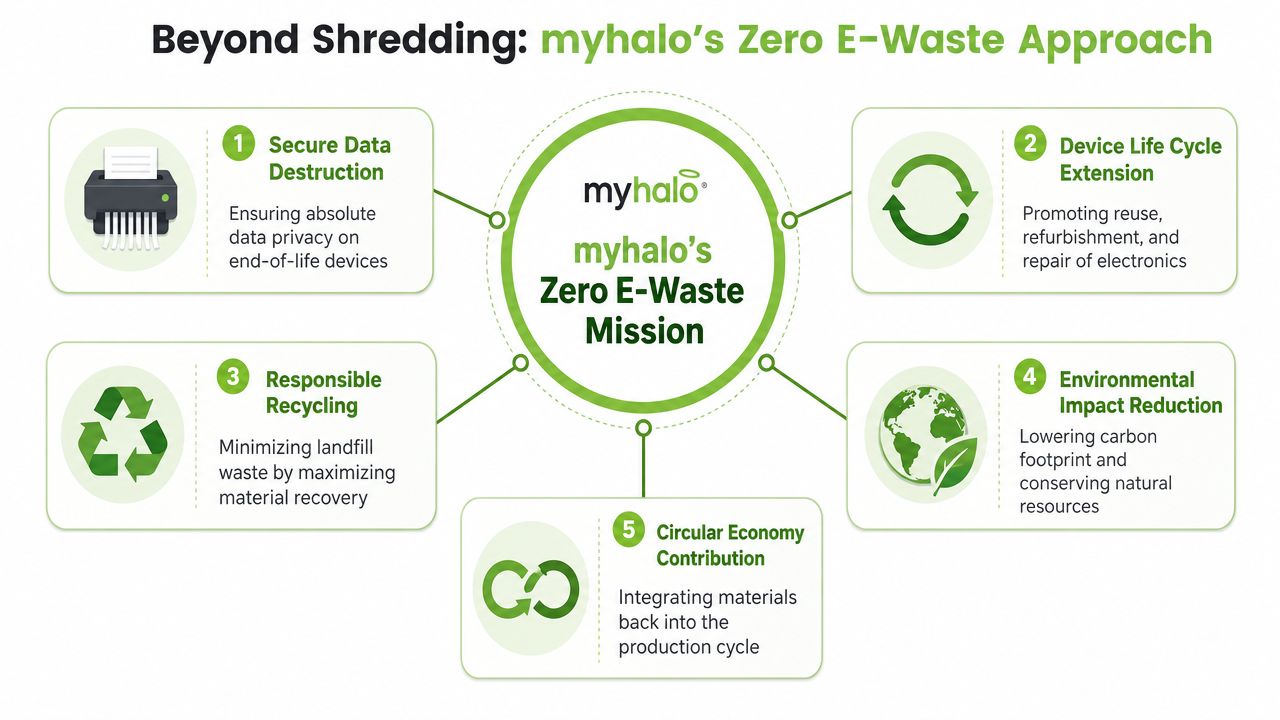
Shredding is important, but it isn't the whole story of responsible tech handling. In a circular device lifecycle, secure destruction is the point where privacy protection meets environmental responsibility.
Destruction is one part of a longer journey
Some devices still have life left in them. Those may be repaired, refurbished, or harvested for usable parts before final recycling becomes necessary. Others are at end of life, and secure data destruction clears the way for safe material recovery.
That's why shredding should be seen as the first secure step in a responsible circular process, not just the last step in getting rid of something. Once data risk is handled properly, organisations and households can make better decisions about reuse, resale, upcycling, or recycling.
One encouraging sign of this wider mindset is quality control around refurbished devices. According to myhalo's ReLoved device FAQ, myhalo implements a 30-point quality check for all ReLoved and upcycled devices, covering screens, buttons, cameras, and battery performance before sale.
If you're exploring broader disposal and recovery pathways, this guide on choosing a recycling company in Singapore adds useful context on what responsible downstream handling should look like.
A zero e-waste future depends on better decisions at every stage. Repair what can be saved. Reuse what still works. Upcycle what can support another device. Shred and recycle what has reached the end, with care and proof.
Ready to feel lighter and do good? Let's clear out those old devices together. Visit myhalo to explore safe, responsible options for secure data handling, device reuse, and a more convenient zero e-waste lifestyle.