
You've spotted a refurbished iPhone 14 that looks like a bargain, and the sticker is the number that sticks. That price is only a small part of the total cost. Battery health and proof that the last owner's data was wiped decide whether the phone is a sensible buy or a cheap headache. A low figure can hide a battery close to replacement, or a handover that only deleted the photos you can see.
This is a calm walk through grades, Singapore prices, warranty, the checks to run before you pay, and the data proof a careful buyer asks for. You'll see when the cheaper unit is the smarter one, and when it isn't.
Table of Contents
- What a Refurbished iPhone 14 Really Means
- Grades and Testing Standards Explained
- What a Fair Price Looks Like in Singapore
- Warranty and Battery Health Benchmarks
- How to Check a Unit Before You Pay
- Data Safety Checks Every Buyer Should Expect
- Pros, Cons and Carbon Savings
- Choosing Your Certified ReLoved iPhone 14
What a Refurbished iPhone 14 Really Means
A refurbished iPhone 14 is a phone someone returned or traded in. A workshop then inspected it, repaired what needed fixing, cleaned it, tested the main functions, and put it back on sale. It is not a sealed box from Apple, and it is not a handset passed along with no one looking inside.
Picture a bicycle. A refurbished phone is a pre-loved bike a workshop has tuned, tested, and fitted with new brakes. An unchecked used phone is that same bike sold exactly as it was found, flat tyre and all. The workshop is what you're paying for, not a new frame.
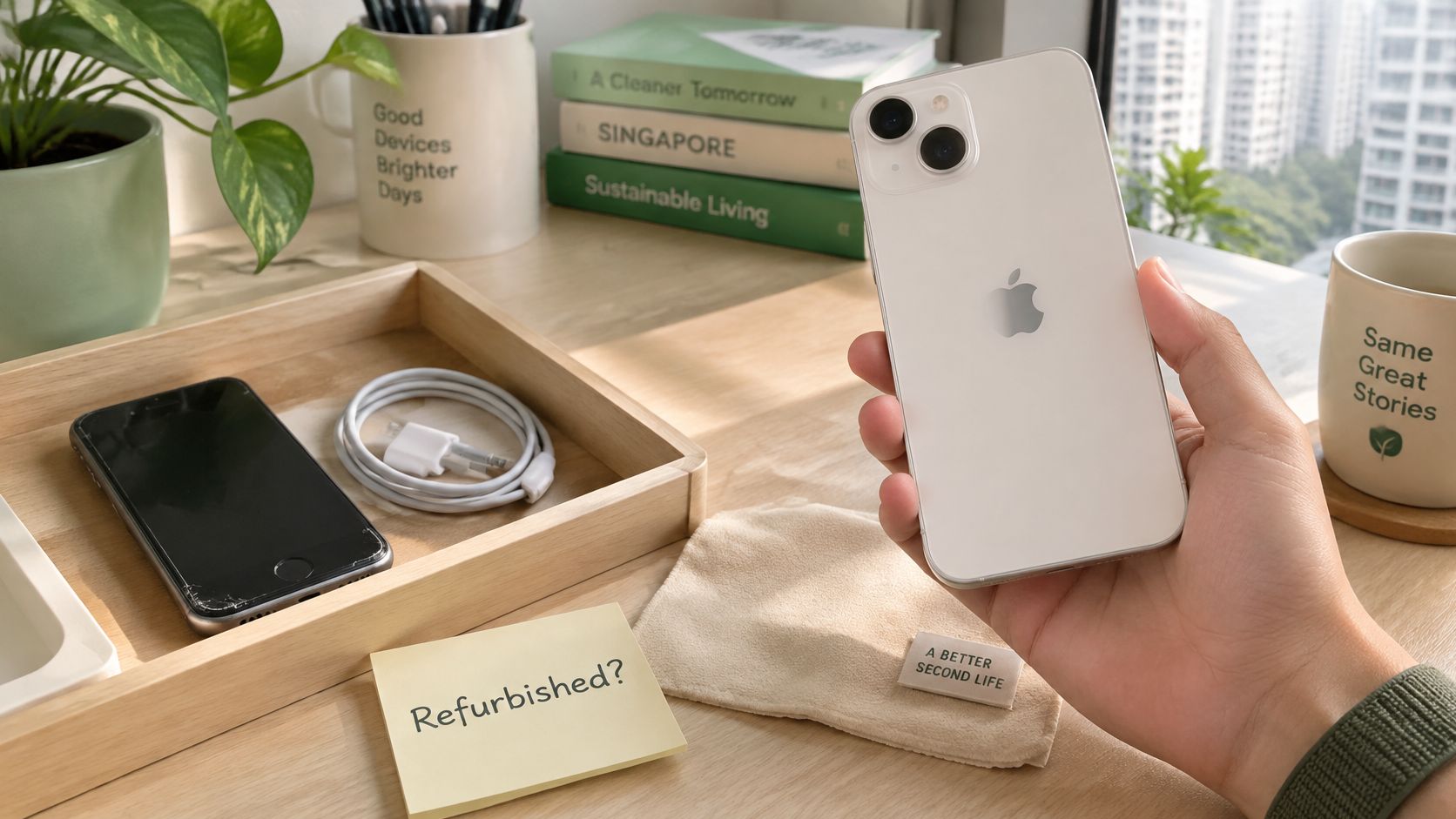
Three tiers keep the listings straight.
- Sealed new. It comes straight from the box, with a full manufacturer warranty and a fresh battery.
- Certified refurbished. Someone tested it, gave it a grade, and usually attached a warranty. This is the tier worth your time.
- Unchecked used. There is no inspection record and no promise about what still works. The price is often lowest because the risk sits with you.
The standard iPhone 14 reached Singapore shelves on 16 September 2022, after pre-orders opened on 9 September, as Apple's launch announcement records. A unit in your hand now has several years of life behind it. Judge that unit on its own condition, battery, storage, and accessories. The model name alone doesn't tell you any of those.
A pretty listing photo is a start. The grade, the battery percentage, and a written erasure record are what turn a listing into a purchase you can trust.
Grades, fair prices, warranty length, hands-on checks, data safety, and the honest trade-offs come next. Start with the grade, because a clean shell can still hide a tired battery.
Grades and Testing Standards Explained
A grade is shorthand a seller uses for looks and function. Scales differ between shops, so ask each seller what its words mean before you compare two prices. A "Good" phone at one counter can match an "Excellent" phone at another.
Common refurbished grades and what they mean
| Grade | What the body looks like | What works | What to ask |
|---|---|---|---|
| Like new | No visible scratches or dents | Fully tested, no functional faults | Battery health percentage and whether the part is genuine |
| Excellent | Light marks visible only up close | Fully tested, no functional faults | Battery health and any replaced parts |
| Good | Visible scratches or minor frame dents | Fully tested, only cosmetic wear | Battery health and the warranty length |
| Fair or below | Deep scratches, scuffs or cracks | Working, but some features may be limited | Exactly which features are affected and the return policy |
Treat the table as a translation aid, not a universal standard. If a seller won't define its grade in writing, you're guessing.
Why a clean shell can hide work
Appearance misleads because the battery sits deep inside. Apple's iPhone 14 battery repair guide tells technicians to remove the back glass and camera-related parts before battery removal, then to lift the adhesive tab with ESD-safe tweezers. Those steps mean a phone can look pristine while its back and cameras have already been opened. Electrostatic-safe tools matter because a static zap can damage the board you can't see.
A useful repair record names three things: which parts were replaced, whether those parts were genuine Apple parts, and what the tests showed afterwards. "Serviced" on its own is a vague word. Ask for the list.
A grade works a bit like a hotel star rating. It helps you shortlist, and it is only as good as the inspection behind it. Shops that publish a test routine, the way a clear quality assurance testing write-up does, give you something to hold the listing against.
For daily use, three results matter more than a flawless frame.
- Battery: the Maximum Capacity percentage, plus whether the cell is genuine.
- Screen: no dead pixels, and touch that responds across the whole surface, including the corners.
- Face ID: it enrols your face and opens the phone without a second try.
Cameras, speakers, microphones, Wi-Fi, Bluetooth, and the charging port belong in the same pass. If those three headline items are sound and the rest is documented, a light scratch is a fair trade for a lower price.
What a Fair Price Looks Like in Singapore
Listed refurbished iPhone 14 prices in Singapore run from about S$378 to S$570, using the seller pages below as reference points. Read them as listings from named shops, not as a single market rate, and match storage before you call one a deal.
iPhone 14 launch prices and current refurbished listings in Singapore
| Source | Price (S$) | Year | What it tells you |
|---|---|---|---|
| Apple launch, 128GB | 1,299 | 2022 | Original new price for the entry model |
| Apple launch, 256GB | 1,469 | 2022 | Original new price, S$170 above 128GB |
| Apple launch, 512GB | 1,799 | 2022 | Original new price, S$330 above 256GB |
| Mister Mobile, from | 378 | 2025 | Lowest listed refurbished price found, may be dated |
| Mobile Life, from | 458 | 2026 | Listed refurbished iPhone 14 |
| Allo Allo, displayed | 430 | 2026 | Shown against a displayed S$1,050, a retailer comparison |
| Allo Allo, 256GB blue | 570 | 2026 | Listed with a 24-month warranty |
HardwareZone's Singapore launch guide records the new prices at S$1,299, S$1,469, and S$1,799. Moving from 128GB to 256GB cost another S$170, and moving from 256GB to 512GB cost another S$330. The gap from the entry model to 512GB was S$500, about 38.5% of that entry price. Storage was a large slice of what people paid, so a 128GB listing and a 512GB listing are different products.
Mister Mobile listed refurbished iPhone 14 models from S$378 in 2025. That page is a year old, so treat it as a floor you might not still find. Mobile Life listed the refurbished iPhone 14 from S$458 in 2026. Allo Allo showed a refurbished iPhone 14 at S$430 in 2026, with a displayed saving of S$620 against S$1,050. That saving is the retailer's own comparison, not an independent market price.
Compare like with like: same storage, same colour, same grade. A 2025 listing is a clue, not today's till price.
A figure far under this band often signals a short warranty, a worn battery, or an origin the seller won't explain. The Singapore mobile price list is a handy cross-check when a quote feels oddly low.
Run this before you pay.
- Write down storage, colour, and grade for the unit in front of you.
- Place its price next to another listing with those same three details, not next to a cheaper 128GB phone.
- If it sits well below the band, ask what is missing: warranty months, battery percentage, or a clear source.
Warranty and Battery Health Benchmarks
After the sticker, two things determine the true value: how long the seller will stand behind the phone, and how much charge the battery still holds. A short returns window on a tired cell can wipe out a S$100 saving within a few months.
Maximum Capacity, under Settings, then Battery, then Battery Health & Charging, is the plain-language number. It shows how much of the original capacity is left. A phone at 85% still runs your day, but it holds less than it did when new, so you charge more often. A phone under 80% is nearer to a replacement bill.
Apple's Singapore repair support sets 80% of original capacity as the threshold for battery replacement coverage under applicable AppleCare terms. The same guidance says Apple service and replacement parts are guaranteed for 90 days or the remaining warranty term, whichever is longer. Batteries worn through normal use sit outside the standard warranty, so the seller's own cover is the promise you can actually use.
Allo Allo listed a refurbished 256GB iPhone 14 in blue at S$570 in 2026 with a 24-month warranty. That is a different promise from a seven-day exchange. Months of cover matter more than a small gap in the sticker when the battery is the part most likely to need work. If you want the mechanics of cycle wear in everyday language, the notes on phone and tablet battery replacement spell out what the percentage is really measuring.
What to add to the sticker
Think in total cost: purchase price plus a likely battery replacement if the percentage is already close to 80%. The cheapest unit can cost the most once that job is booked. A slightly dearer phone at 90% with a long warranty often wins.
Ask for three answers in writing.
- The percentage, taken from Battery Health, not a verbal "battery is fine".
- Whether the cell is a genuine Apple part or a third-party replacement.
- The remedy if the stated condition turns out wrong once you open Settings at home.
Practical rule: if the seller won't show Maximum Capacity, price the phone as if a battery job is already due.
How to Check a Unit Before You Pay
Give the phone ten quiet minutes at the counter or as soon as the parcel arrives, while the return window is still open. The six checks below each catch a different kind of disappointment.
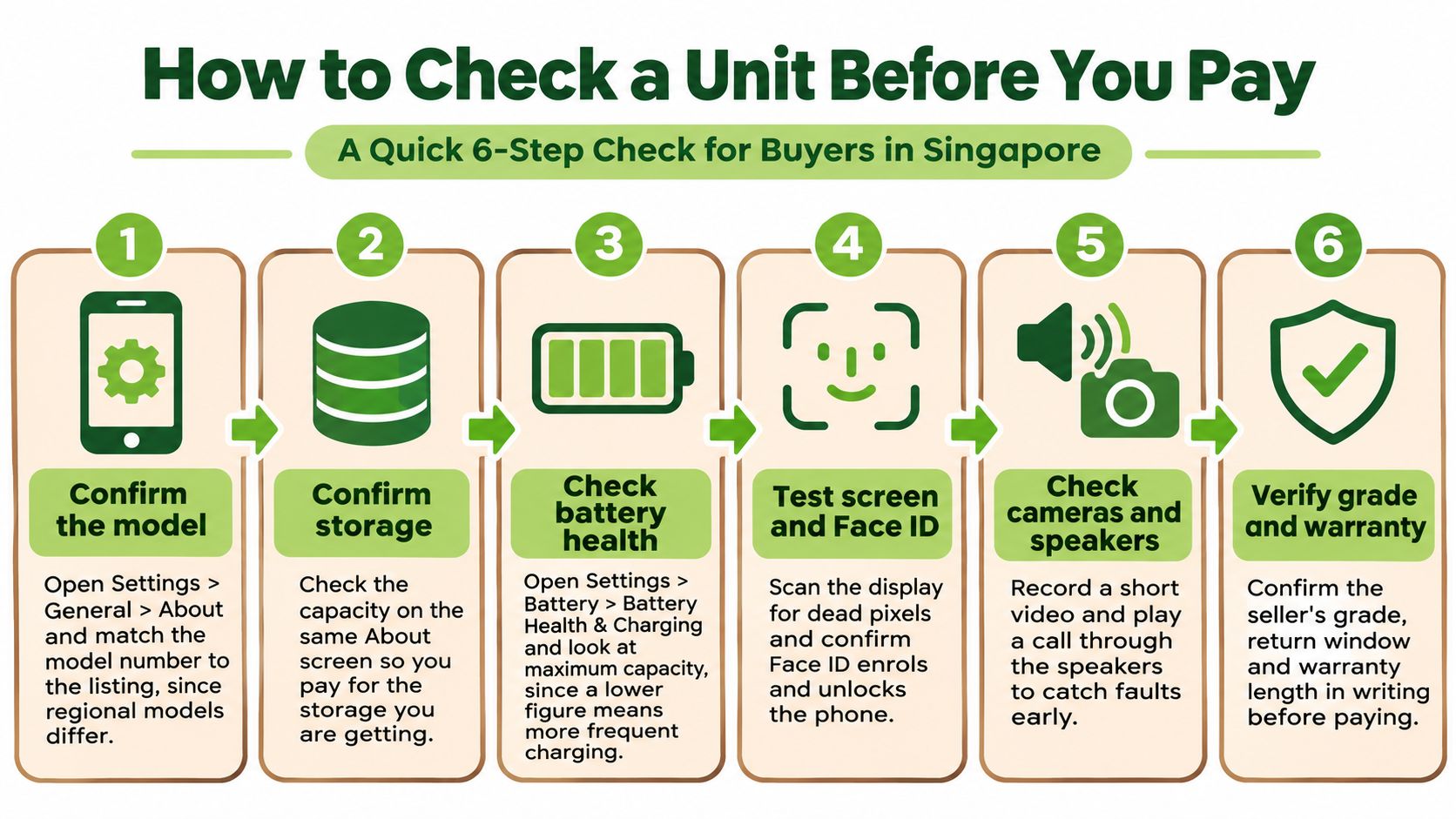
- Confirm the model. Open Settings, then General, then About, and match the model number to the listing. Regional models differ, and a phone built for another market can miss bands your carrier uses. The About screen takes five seconds and saves a week of weak signal.
- Confirm storage on that same screen. The iPhone 14 has no memory-card slot, so 128GB, 256GB, or 512GB is permanent. If the listing said 256GB and About shows 128GB, stop there.
- Test a local SIM or eSIM and watch for 5G registration. Apple's iPhone 14 tech specs list 5G Sub-6 bands including n1, n3, n8, n28, n40, n41, n77 and n78, which matter for Singapore, and Apple notes that 5G availability depends on the market and the carrier. A "SIM-free" label is not the same as a successful 5G registration on your line.
- Open Battery Health & Charging. Screenshot Maximum Capacity and note any peak-performance message. A warning there means the phone may slow itself to avoid unexpected shutdowns.
- Run the daily functions. Set up Face ID, open both cameras, play audio through the speakers, record with the microphone, charge from the port, join Wi-Fi, pair Bluetooth, and drag a finger across the whole screen. Corners are where touch faults hide.
- Make sure it isn't tied to the last owner. The phone should be signed out of the previous Apple ID, with Find My off, so Activation Lock is not waiting for a password you don't have. A locked phone is a paperweight until that account releases it.
A clean result is simple. The model and storage match the listing, 5G registers on your SIM, Maximum Capacity is the figure you were promised, every function in step 5 responds, and Find My is off. If one item fails, don't negotiate a small discount on the spot. Use the return window, or walk away, and buy a unit that passes the full set.
A short video walk-through of the same idea helps if you'd rather watch the menus than read them.
Data Safety Checks Every Buyer Should Expect
An iPhone holds messages, photos, contacts, payment details, and sign-in tokens. A careless handover is a privacy risk for the last owner and a mess for you if their account is still attached. Deleting the camera roll and signing out of iCloud is not the same as a proper wipe.
Singapore's Personal Data Protection Commission guide on securing personal data in electronic media says organisations must securely delete, erase, or destroy personal data before storage media is redeployed, exchanged, sold, recycled, or disposed of. That duty sits under Section 24 of the Personal Data Protection Act, which requires reasonable security arrangements against unauthorised access, disclosure, modification, loss, or disposal. For a refurbished iPhone 14, the practical reading is a verifiable erasure process, not a tidy home screen.
Erasure and destruction are different jobs. Overwriting suits flash storage, which is how an iPhone keeps data. Crushing, drilling, or shredding is for media that cannot be overwritten, such as some read-only discs. A phone headed for resale should be erased and released from the old Apple ID. It should not be smashed.
The Commission's notes on disposing of personal data also say organisations should keep control of devices that still hold personal data, and keep a record of how they were handled. That is why a shop's paperwork matters as much as the wipe itself.
Ask for three pieces of proof.
- A written erasure record for this unit, not a generic policy on the website.
- Confirmation that the previous Apple ID is gone and Find My is off, which you can see yourself on the phone.
- An intake and transfer note showing when the phone arrived and when it was cleared for sale.
myhalo's Safe data programme is built around this kind of verifiable erasure, and the same idea is spelled out in this guide to secure data management. Asking for proof is a normal question. A seller who has done the work will be glad you asked.
Pros, Cons and Carbon Savings
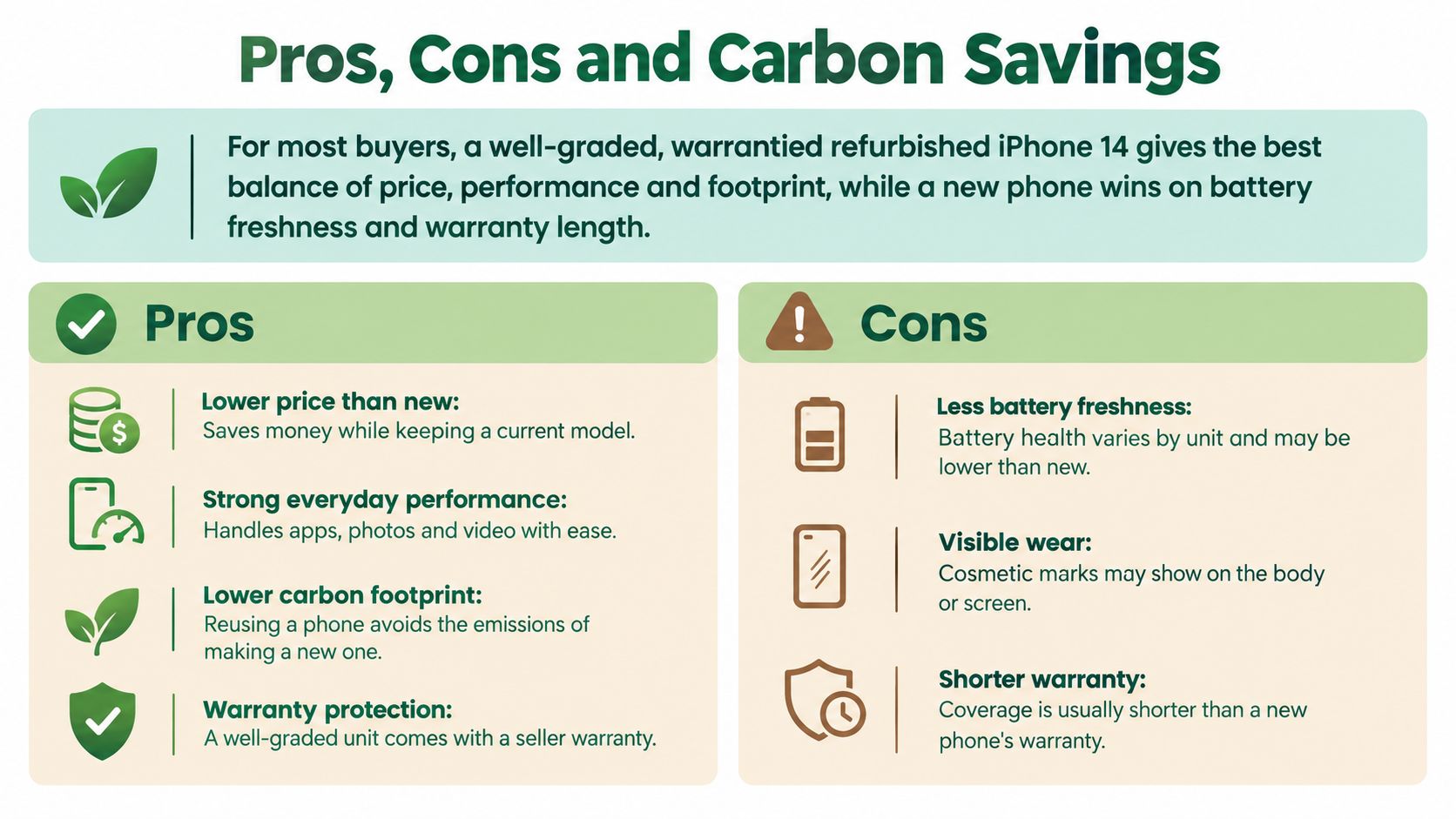
The cheapest refurbished iPhone 14 can cost more in the long run if its battery needs attention or its history is unclear. Compare the whole offer, not just the sticker price: a well-graded, warrantied unit can balance cost, performance and reuse, while a new phone offers a fresh battery and Apple's warranty. Choose new if you want the newest chip or a sealed box. Choose refurbished if you're comfortable with an earlier model and can check its condition.
Refurbished iPhone 14 compared with a new iPhone
| Factor | Refurbished iPhone 14 | New iPhone |
|---|---|---|
| Price | Often hundreds of dollars lower | Full retail price |
| Warranty | Seller sets the length, for example 24 months | Standard Apple warranty |
| Battery | May be worn; check the percentage | Fresh battery |
| Newest features | Limited to iPhone 14 hardware | Current model features |
| Accessories | Often missing or third-party | Complete box |
| Footprint | Lower, because an existing device is reused | Higher, due to manufacturing |
| Data risk | Depends on verified erasure | Clean from the factory |
The savings come with trade-offs: the warranty depends on the seller, the battery may have wear, and accessories may be missing or third-party. The iPhone 14 also cannot gain features reserved for later models. A new phone gives you a fresh battery and current-model features, but costs more and requires another handset to be made.
Reusing a phone can avoid making a replacement, while keeping its display, cameras, board and enclosure in service. Recycling has a different role: it handles a device that can no longer be used. Singapore's National Environment Agency reported an overall recycling rate of about 50% in 2024, down from 60% in 2014. That national figure is not a carbon score for one iPhone, but it underlines why extending a working phone's life matters.
The greener choice depends on what happens next. Keep the refurbished phone in use for longer, then choose a responsible route when it fails. A repair or trade-in does not automatically mean a device will be reused, so look for a seller that documents where traded-in phones go. Reuse is the preferred outcome when a device can be sold safely; recycling is the fallback when it cannot. A low sticker price is only part of the value. Battery condition and a responsible end-of-life route matter too.
Choosing Your Certified ReLoved iPhone 14
Choose a unit that meets the checks above, whether you buy from myhalo or another seller. myhalo's Certified ReLoved phones are tested and graded, and its online and in-store options are listed on the myhalo website. Compare the details each seller provides before deciding. The sticker price is only part of the value: battery health and proof of erasure matter too.
Your old phone can find a next use through trade-in or buyback, rather than sitting unused in a drawer. myhalo offers these services for eligible devices. For data handling, myhalo provides secure data destruction, with certificates available on request. Ask what documentation applies to your device before handing it over.
A different seller can still be a good choice. Before paying, get four details in writing: the grade and what it means, the battery percentage, the warranty length, and proof that the specific unit's data has been erased. If one is missing, keep looking. A low price is less attractive when the battery is worn or erasure cannot be confirmed.
Ready to choose a refurbished iPhone 14 or pass on an old device? Compare myhalo's ReLoved phones, then explore its trade-in or buyback options for a phone you no longer use. That way, you can weigh the handset's condition and data handling alongside its price.