

Third-party phone screen repairs in Singapore typically run from about S$60 for budget LCD screens to over S$400 for OLED Pro Max devices, while Apple-authorised repairs can reach roughly S$575 without AppleCare+. The right phone screen repair price depends on your model, panel technology, part grade, repair channel, and coverage.
You've probably been there. The phone slips from your hand onto an MRT tile, catches the edge of an MRT staircase, or lands face-first on a hawker centre floor. The display still lights up, but a web of cracks spreads across the glass. Your next move is almost automatic: search phone screen repair price Singapore and wonder why one result says S$60 while another seems close to S$600.
That confusion is understandable. A cracked budget LCD and a damaged flagship OLED aren't the same job. An authorised centre and an independent technician aren't using the same parts, process, or pricing model either. The useful question isn't “What does a screen repair cost?” It's “What does this specific phone need, and is repair still the sensible choice?”
This guide gives you that decision model, with Singapore price bands, the mechanics behind each quote, and a practical comparison between repair, trade-in, replacement, and responsible reuse.
Table of Contents
- That Sinking Moment Your Screen Cracks
- What Actually Drives Your Repair Quote
- Real 2026 Price Ranges by Popular Model
- Authorised Centres vs Third-Party Shops
- DIY Repair vs Hiring a Professional
- Getting an Accurate Real-Time Quote
- When Repair Is Not the Smart Move
- Your Next Steps and the myhalo Promise
That Sinking Moment Your Screen Cracks
The sound is small, but your stomach drops. Your phone hits the floor, you pick it up, and the first checks are simple: does the display light up, and does touch still respond? Only after that do you start thinking about the repair bill.
A cracked screen can still let you receive messages, pay for lunch, and open your banking app. That does not make it safe to ignore. A crack over the selfie camera, a dark patch near the edge, or missed taps can turn normal use into a daily risk. Keep moisture away, avoid pressing the damaged area, and protect your fingers from sharp glass.
Then the price search starts. Third-party iPhone repairs may sit around S$150 to S$400, while older phones and budget Android models can show much lower quotes. Apple-authorised fees can range from roughly S$209 for some iPhone SE models to about S$575 for top-end Pro Max models in 2026, as outlined in this Singapore phone screen repair cost guide. Those figures cover different phones, display assemblies, parts, and repair channels, so comparing them without checking the model will mislead you.
The practical truth: a headline range becomes useful only after you identify the phone model and the display fitted inside it.
Before accepting any “starting from” price, find the exact model and check whether touch works across the screen. Inspect the frame for dents, then ask whether the quote includes the part, labour, GST, testing, and warranty. Broken glass with a working display may need a different assembly from a panel showing black spots, lines, or ghost touches.
If the damage is cosmetic, you may manage briefly with care. A screen protector can reduce new scratches and make handling more comfortable, but it cannot repair a cracked panel. This screen protector guide explains the difference clearly.
Use the quote to compare three choices: repair the current phone, trade it in, or replace it and give the old device a responsible second life. The sensible option depends on the actual panel, model tier, warranty status, and part grade, not the cheapest number in a search result.
What Actually Drives Your Repair Quote
You bring in a phone with cracked glass, expecting one simple price. The shop still needs to identify the panel, model tier, part grade, damage scope, and service terms before quoting accurately. Two reputable shops can charge different amounts for what sounds like the same repair because they may be fitting different assemblies or covering different work.
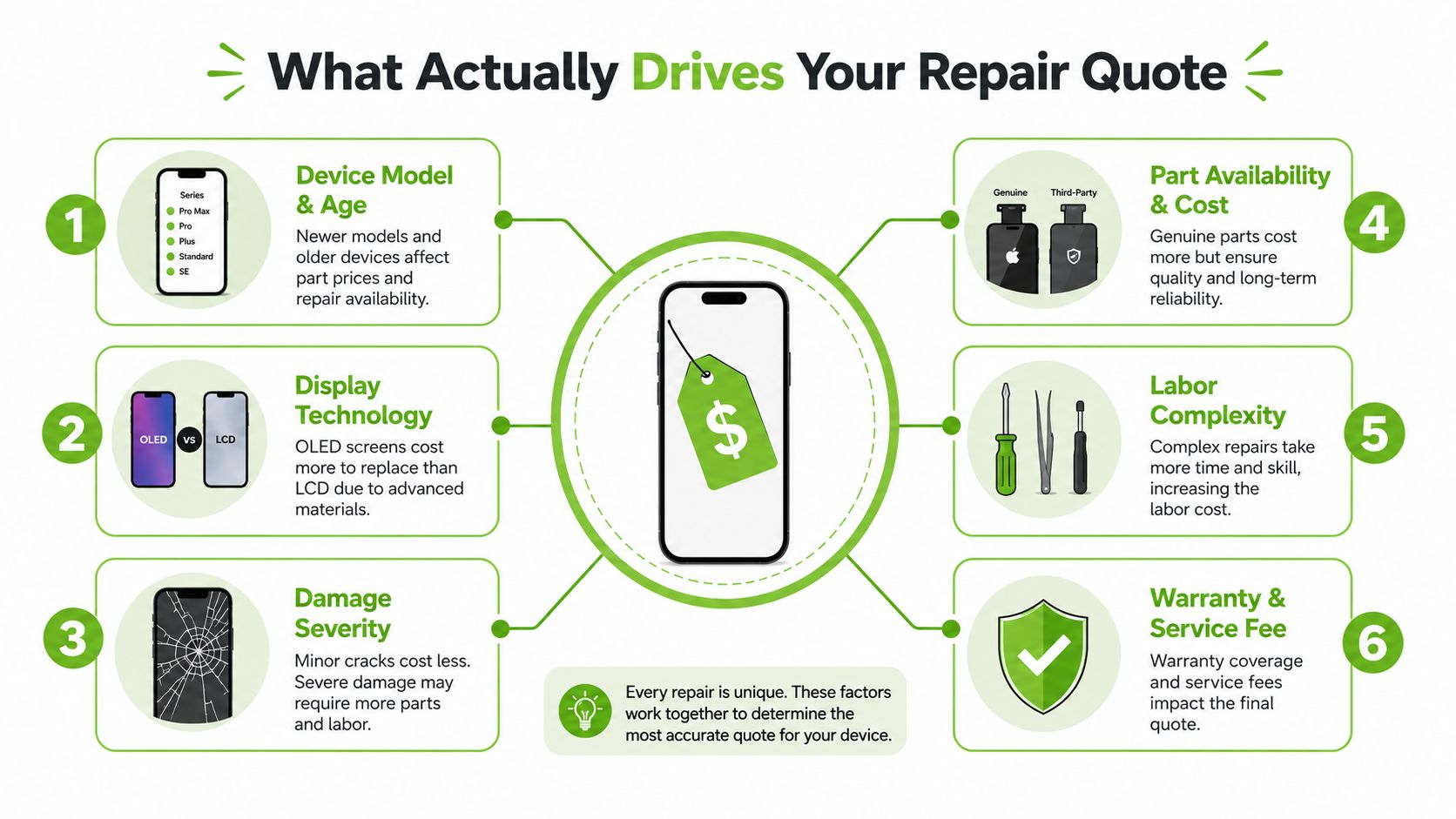
Device model and display generation
Model tier sets the starting point. Older iPhones often use less costly replacement screens. Newer Pro Max devices combine larger dimensions with premium OLED assemblies, so the parts bill rises. Third-party repair settings commonly place older iPhones around S$80 to S$150, newer iPhone 15 and 16 Pro Max models around S$200 to S$400 or more, Samsung AMOLED S-series panels around S$220 to S$350, and budget Android screens around S$60 to S$160, according to this Singapore repair-market comparison.
Display technology changes the quote further. LCD panels are generally simpler and cheaper to source. OLED and AMOLED panels are thinner, brighter, and more complex. Larger screens and higher-refresh-rate displays usually cost more, while foldable phones require specialised internal displays and hinge-linked assemblies. Treat foldables as their own pricing category.
Part grade and availability
Ask exactly what “OEM” means. A shop may offer a genuine manufacturer part, a refurbished original panel, or an aftermarket screen made to similar specifications. These choices can differ in brightness, colour, touch response, calibration, and long-term reliability.
Availability affects the price as well. Older models with many repairs behind them usually have more compatible parts in circulation. Newer flagships and foldables may have fewer viable options, giving suppliers less room to compete.
Damage, labour, and service conditions
The technician must check whether the crack affects only the glass or the full display assembly, touch digitiser, frame, sensors, or related components. Black spots, lines, ghost touches, or a bent frame usually mean more than a cosmetic glass problem.
Labour includes opening the device safely, transferring components where required, sealing the assembly, testing touch and brightness, and checking cameras and sensors. Same-day work can carry a different price from mail-in service because the shop allocates staff, tools, parts, and counter space immediately.
Warranty and turnaround
AppleCare+ changes the calculation. In Singapore, covered screen repair costs S$42, while other repairs cost S$148, according to this AppleCare+ cost explanation. Without coverage, Apple's out-of-warranty screen fees range from S$199 to S$575.
Before comparing quotes, ask these six questions:
- Exact model: Is it an iPhone SE, iPhone 15 Pro Max, Galaxy A-series, Galaxy S-series, or a foldable?
- Panel technology: Is the replacement LCD, OLED, or AMOLED?
- Part grade: Is it genuine, refurbished original, aftermarket, or a hybrid solution?
- Damage scope: Are the frame, sensors, touch layer, or display also affected?
- Warranty coverage: Does AppleCare+ or another service plan apply?
- Turnaround: Is the job same-day, appointment-based, or mail-in?
Use the answers to compare repair, trade-in, and replacement. A low quote may use a lower-cost panel or cover a simpler device. A high quote may include a premium assembly, authorised parts, or more involved labour. For a live number instead of a broad band, myhalo's AI-backed instant quote can place the model and repair details into a real-time comparison. Compare what is included, not just the final price.
Real 2026 Price Ranges by Popular Model
A cracked Galaxy Z Fold is not priced like a cracked budget Android. Panel type, model tier, part grade, and repair route can shift the bill by hundreds of dollars. Use the table below to screen the market, then ask the shop for a model-specific quote.
Singapore Phone Screen Repair Price Bands 2026
| Model Tier | Panel Type | Third-Party Range (SGD) | Authorised Range (SGD) |
|---|---|---|---|
| Older iPhone models | LCD or OLED, model dependent | S$80 to S$150 | Model-specific |
| iPhone SE, 2nd or 3rd generation | LCD | Around S$150 to S$400 in broad third-party listings | From roughly S$209 |
| iPhone 15 and 16 Pro Max | OLED | Around S$200 to S$400+ | Up to roughly S$575 |
| Samsung Galaxy A-series | LCD or lower-tier display, model dependent | Around S$65 to S$145 | Model-specific |
| Samsung Galaxy S-series | AMOLED | Around S$220 to S$350 | Model-specific |
| Samsung Galaxy Z Fold and Z Flip internal screens | Foldable internal display | Around S$225 to S$695 | Model-specific |
| Budget Android phones | Usually LCD | Around S$60 to S$160 | Often limited or model-specific |
Older iPhones and budget Android phones usually sit in the lower bands because their LCD assemblies are simpler and replacement parts are easier to source. Samsung AMOLED models and newer Pro Max phones cost more because the display assembly combines a higher-grade panel with touch, brightness, and calibration requirements. These broad market ranges are reflected in this independent Singapore screen repair pricing guide.
The table also explains why “cracked screen” is not enough information for a useful quote. An iPhone SE and an iPhone 15 Pro Max have different panels, assemblies, and service economics. Samsung A-series estimates of S$65 to S$145, along with foldable internal screen estimates of S$225 to S$695, are listed in this Singapore phone repair price overview.
Foldables need a separate decision. A Galaxy Z Fold internal screen can reach S$695, according to this Samsung repair cost guide for Singapore. The flexible display, hinge, dual-screen design, and limited parts supply make the job more complex. A cheaper quote may also mean a different part grade, so confirm whether the replacement is genuine, refurbished original, or aftermarket.
My recommendation: repair a standard phone when the quote stays in the lower bands and its battery and core functions remain healthy. If a foldable repair approaches the phone's current value, compare the repair bill with trade-in value and replacement cost before approving the work.
Apple pricing remains model-specific. Its Singapore repair page displays fees in Singapore dollars with GST included, while the exact amount appears through Apple's estimate tool. Treat online ranges as a starting point, not a promise. For a live comparison, myhalo's AI-backed instant quote can turn your model and repair details into a real-time number, which is more useful than choosing from a vague band alone.
Authorised Centres vs Third-Party Shops
Choose the repair channel by the phone's age, coverage, value, and role in your daily life. The lowest quote is not automatically the sensible choice.
Apple-authorised service is the stronger option for a covered iPhone, a new premium OLED model, or a phone you plan to resell with a clear service history. Apple's Singapore out-of-warranty screen fees range from S$199 to S$575. AppleCare+ reduces screen repair to S$42 and lists other repairs at S$148, according to this Singapore Apple repair cost guide.
Apple's official service page shows estimates by model, in Singapore dollars with GST included. There is no single Apple price because an iPhone SE and a top-end Pro Max use different display assemblies and have different service economics.
When an authorised centre is the better call
- Covered devices: AppleCare+ can make official repair much cheaper than an uncovered job.
- New flagship phones: Choose the strongest available parts and the manufacturer's calibration process.
- Biometric features: Face ID, display calibration, and sensor integration need careful handling.
- Warranty-sensitive owners: An independent opening may affect manufacturer service options.
When a third-party shop is practical
A reputable third-party shop often suits older iPhones, budget Android phones, and devices where official pricing approaches replacement cost. You may get faster counter service, more part-grade choices, and support for models with limited manufacturer service.
The trade-off is that you must check the details. Ask whether the replacement is genuine, refurbished, aftermarket, or a hybrid. Confirm the repair warranty, whether water resistance can be guaranteed after opening, and how the shop will handle your passcode and personal data. If the technician cannot answer clearly, the quote is incomplete.
Use this guide to choosing an iPhone repair service before handing over an iPhone. It helps you compare the technician, parts, warranty, and service process instead of judging by the shop sign.
Decision rule: choose an authorised centre for covered devices and valuable flagship OLED phones. Choose a reputable third-party technician for an older phone or tighter budget, after confirming the part grade and repair warranty.
The right comparison is repair versus trade-in versus replacement. If the repair quote is close to the phone's current value, check all three before approving work. myhalo's AI-backed instant quote gives a real-time figure for that comparison, rather than leaving you with a vague price band.
“Third-party” does not mean poor quality, and “authorised” does not always mean economical. Transparency, testing, parts choice, and accountability matter more than the sign above the counter.
DIY Repair vs Hiring a Professional
A YouTube repair video can make a screen replacement look like a tidy afternoon project. The phone opens, the screen lifts, a few connectors move, and everything goes back together. In real life, adhesive, tiny cables, calibration, and fragile components make the job much less forgiving.
DIY can reduce the upfront parts bill, but the saving disappears quickly if you damage the battery, tear a flex cable, break Face ID-related hardware, introduce dust, or create touch and brightness problems. You'll also need more than a screwdriver. A heat pad, suction tool, spudger, calibration frame, and suitable adhesives may all be necessary, depending on the device.
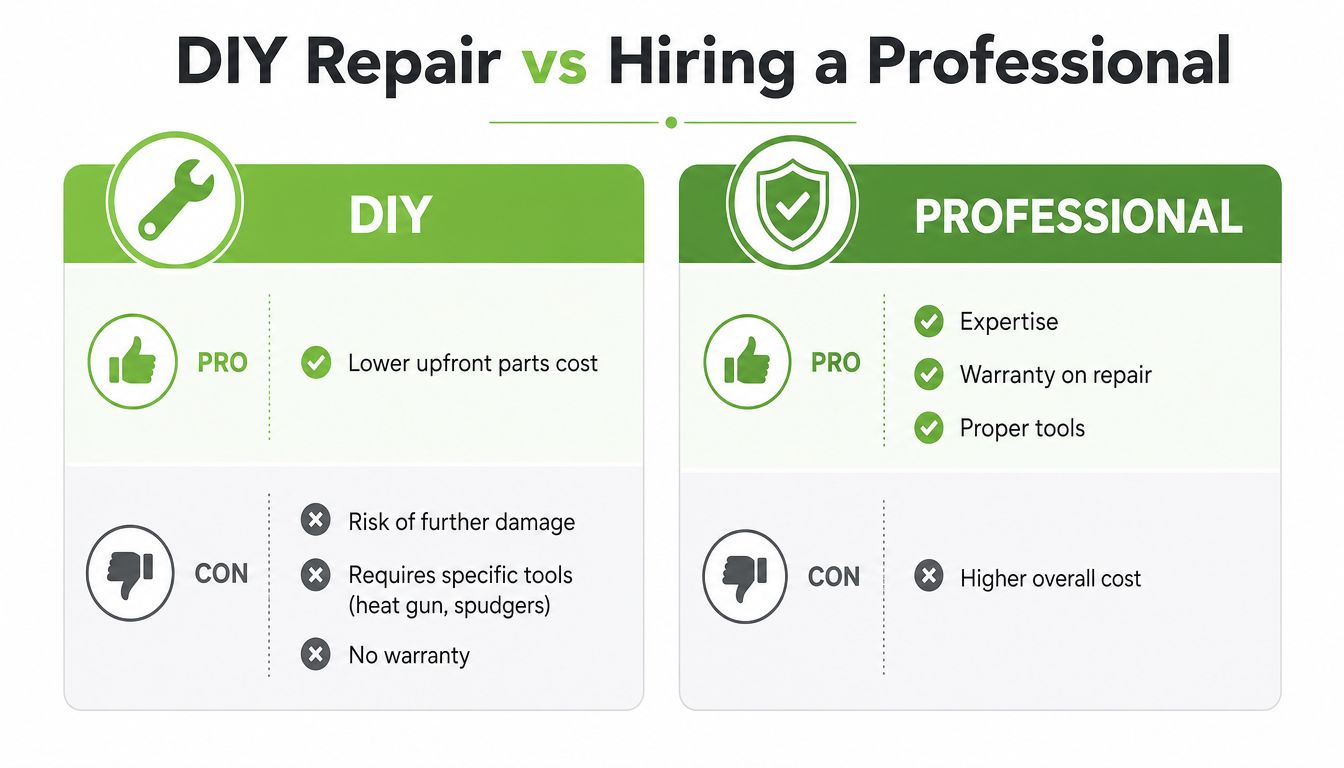
DIY makes sense when
You're working on an older, lower-value phone, you're comfortable with delicate electronics, and you accept that the device may not return to factory condition. It's also more reasonable when you have a spare device and can tolerate a failed attempt.
Before buying a kit, understand the part grade. This phone repair parts guide helps explain why two screens sold for the same model can behave differently.
Professional repair is safer when
A technician is the better choice for a current iPhone Pro model, Samsung AMOLED phone, or any foldable. It's also the right call when the phone contains work files, banking access, family photos, or authentication apps that you can't afford to lose.
A professional repair should include diagnosis, proper tools, post-repair testing, and a written service warranty. Ask the technician to test touch response across the whole panel, display brightness, front camera, proximity sensor, charging, speakers, and biometric functions before you leave.
| Choice | Main advantage | Main risk |
|---|---|---|
| DIY | Lower upfront parts cost | Further damage, no meaningful accountability |
| Professional | Expertise, tools, testing, repair warranty | Higher overall price |
My counter-side advice is simple. Don't practise your first delicate screen repair on the phone you rely on for work, payments, travel, and family contact. The cheapest part is not always the cheapest outcome.
Getting an Accurate Real-Time Quote
Generic price lists are useful for orientation, but they're poor at answering the question that matters: “How much will my phone cost to repair today?”
A proper quote needs the exact model and a clear view of the damage. The technician or quoting system should account for the display assembly, frame condition, touch response, part grade, service route, and any related faults. Apple follows the same model-specific logic. Its Singapore service page says the fee includes GST and that customers use an estimate tool to find the amount for a particular iPhone.
What to prepare before requesting a quote
Have the model name, storage variant if known, and a short damage description ready. Note whether the screen displays normally, whether touch works at the corners, and whether the frame is bent or separated.
A useful quote should show line items rather than one mysterious total:
- Device identification: The exact iPhone or Samsung model.
- Damage assessment: Glass, display, touch layer, frame, or additional components.
- Part option: Genuine, refurbished original, aftermarket, or another clearly named grade.
- Labour and service: Installation, testing, and any applicable service charge.
- Warranty: What the repair warranty covers and how long it applies.
- Collection method: Counter drop-off, appointment, or online arrangement.
myhalo uses an AI-backed pricing algorithm to provide transparent, real-time quotes for device services. You can select the device, answer condition questions, review the itemised result, and choose an online process or counter drop-off at Bugis Junction or Sim Lim Square through the repair quote engine.
The quote should remove “starting from” anxiety, but still read the conditions carefully. Confirm whether the price is locked once accepted, what happens if the frame has hidden damage, and whether you need to back up the phone before service.
Here's a visual walkthrough to help you understand the quoting process:
Don't hand over a device until you understand the price, part type, turnaround, warranty, and data-handling process. A fast answer is useful only when it's specific.
When Repair Is Not the Smart Move
Repair is usually better than replacing a usable phone, but not every repair deserves approval. A phone with a premium screen, weak battery, damaged frame, and ageing software may need more money than its current market value can justify.
Start with three questions:
- What's the complete repair quote? Include the screen and any related work.
- What is the phone worth today? Use a realistic trade-in or resale figure, not the original purchase price.
- What would a suitable replacement cost? Compare with a certified used device, not only a brand-new flagship.
A useful rule is to consider replacement when the repair cost exceeds 50% of the device's current value, as illustrated in this repair-versus-replace decision guide. That isn't a law, but it's a sensible warning line. Foldables reach that point quickly because internal screen replacements are commonly quoted around S$225 to S$695. Standard third-party iPhone repairs cluster around S$150 to S$400, while authorised Pro Max repairs can reach roughly S$575.
If repair doesn't make financial sense, don't throw the phone in a drawer or general rubbish. A trade-in can turn the broken device into an instant offer. A certified ReLoved route can give it a second life after testing and refurbishment. Upcycling can harvest working parts for other repairs and provide a voucher where eligible.
That's the responsible order of operations: repair first, reuse next, part harvesting after that, and disposal only as a last resort. You protect your data, recover some value, and keep useful materials in circulation.
Your Next Steps and the myhalo Promise
A cracked screen calls for a clear process, not a rushed replacement.
- Assess the phone: Confirm the model, panel behaviour, frame condition, and warranty status.
- Get a real quote: Ask for an itemised figure covering the display, labour, and related work. A generic price band is only a starting point.
- Compare the outcomes: Weigh repair against trade-in, certified reuse, or upcycling. The right choice depends on the phone's current value and the replacement cost.
Privacy matters during every option. Repair and Rescue services can restore usable devices, while secure data handling supports safer trade-ins and responsible reuse. ISO-aligned data management helps protect personal information during the process.
myhalo can provide a real-time quote and support repair, trade-in, upcycling, and secure data handling. Its team assists customers at Bugis Junction and Sim Lim Square. Request a quote before approving work, then keep the phone in use where the numbers make sense.