

Your drawer is full of paper you don't quite trust anymore. Bank letters, HR printouts, old school forms, customer records, maybe a few signed contracts, all sitting there because throwing them out feels reckless and storing them feels messy. In Singapore, that hesitation is rational, because paper still moves through homes and offices, and once it contains personal data, it needs to be handled with care under the PDPA, which came into force in 2014 and created a legal basis for secure disposal of records that contain personal data.
A buy document shredder decision isn't really about buying a gadget. It's about deciding how your household, SME, clinic, school office, or IT team will reduce exposure, keep destruction accountable, and avoid turning a paper pile into a data problem. The right machine can help, but the wrong one wastes money, jams constantly, and still leaves you with weak output that's easy to recover.
Table of Contents
- Why Singapore Homes and Offices Are Shopping for Shredders Again
- Shredder Cut Types and DIN P-Levels Explained
- Capacity, Duty Cycle, and Jam Prevention That Actually Matter
- Matching the Right Shredder Tier to Your Use Case
- Singapore Compliance, PDPA, and Audit-Friendly Destruction
- Total Cost of Ownership, Maintenance, and Eco-Disposal
- When Buying a Shredder Is the Wrong Move
- Your Shredder Decision Checklist for 2026
Why Singapore Homes and Offices Are Shopping for Shredders Again
A home office in Singapore can look tidy and still be risky. One drawer holds bank statements, another has staff forms, a third has old invoices and printed emails, and nobody wants to be the person who tossed confidential paper into a regular bin. That's why the question has returned with force, not because shredders are trendy, but because paper never fully left the workflow.
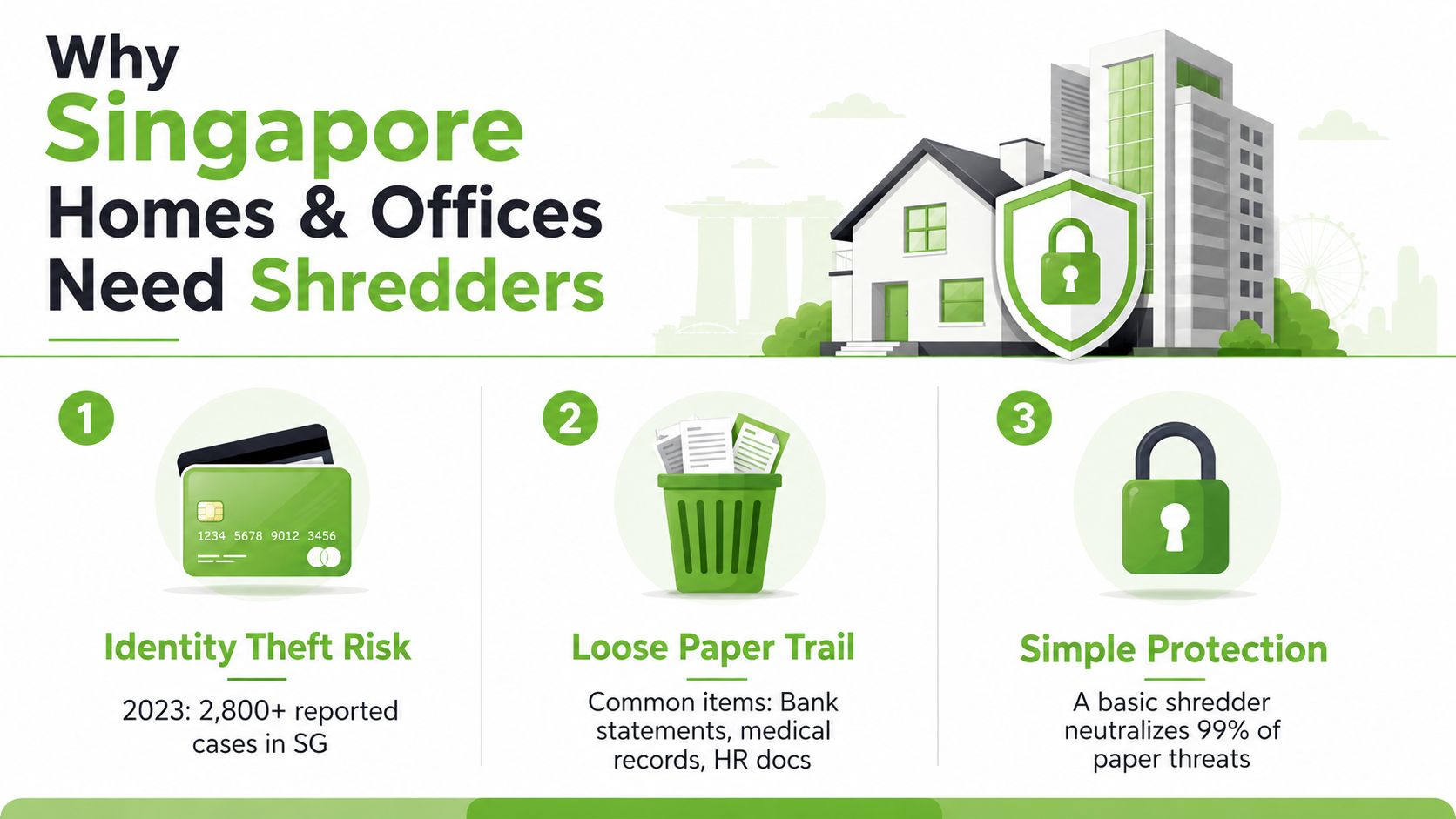
Singapore buyers should read the shredder decision through a compliance lens first. The PDPA came into force in 2014, and the point is straightforward, if a document contains personal data, secure disposal matters because physical paperwork still circulates in many businesses even in a digital-first market. That makes the shredder more than a convenience appliance, it becomes part of the organisation's data-handling routine, especially for finance, healthcare, education, and SMEs that still print, sign, file, and archive.
What the real problem looks like
The danger usually isn't a dramatic breach. It's a slow accumulation of risk, old payslips left in a tray, customer lists in a filing cabinet, or board papers printed for a meeting and forgotten afterwards. Once those papers are no longer needed, keeping them around is just exposure without value.
Practical rule: if you wouldn't leave the page on a shared desk, don't leave it in a regular bin either.
The market backdrop also explains why buyers are thinking harder before they spend. Independent industry research places the global document shredder market at USD 997.42 million in 2025, with a projected decline to USD 791.17 million by 2035 at a -2.29% CAGR Global Growth Insights market report. That points to a market shaped less by novelty and more by replacement cycles, compliance, and service-based destruction workflows.
Why the decision is about governance
For Singapore buyers, that means the question isn't “Do I want a shredder?” It's “How do I dispose of paper in a way that supports lawful data handling?” If your records include names, contact details, payroll items, medical notes, or client paperwork, a shredder can help create a defensible process. If your volume is low, outsourcing may still make more sense, but the risk itself is what drives the decision.
The sharp move is to treat shredding as part of document governance, not office décor. That mindset saves you from overbuying, underbuying, or assuming that a neat drawer equals safe disposal.
Shredder Cut Types and DIN P-Levels Explained
Most shopping pages reduce the category to “cross-cut vs micro-cut” and stop there. That's too vague for Singapore buyers, because the real decision is about how much recoverability you're willing to allow for the documents you handle. A shredder should map to the paper you actually destroy, not to a marketing label.
Start with the cut style
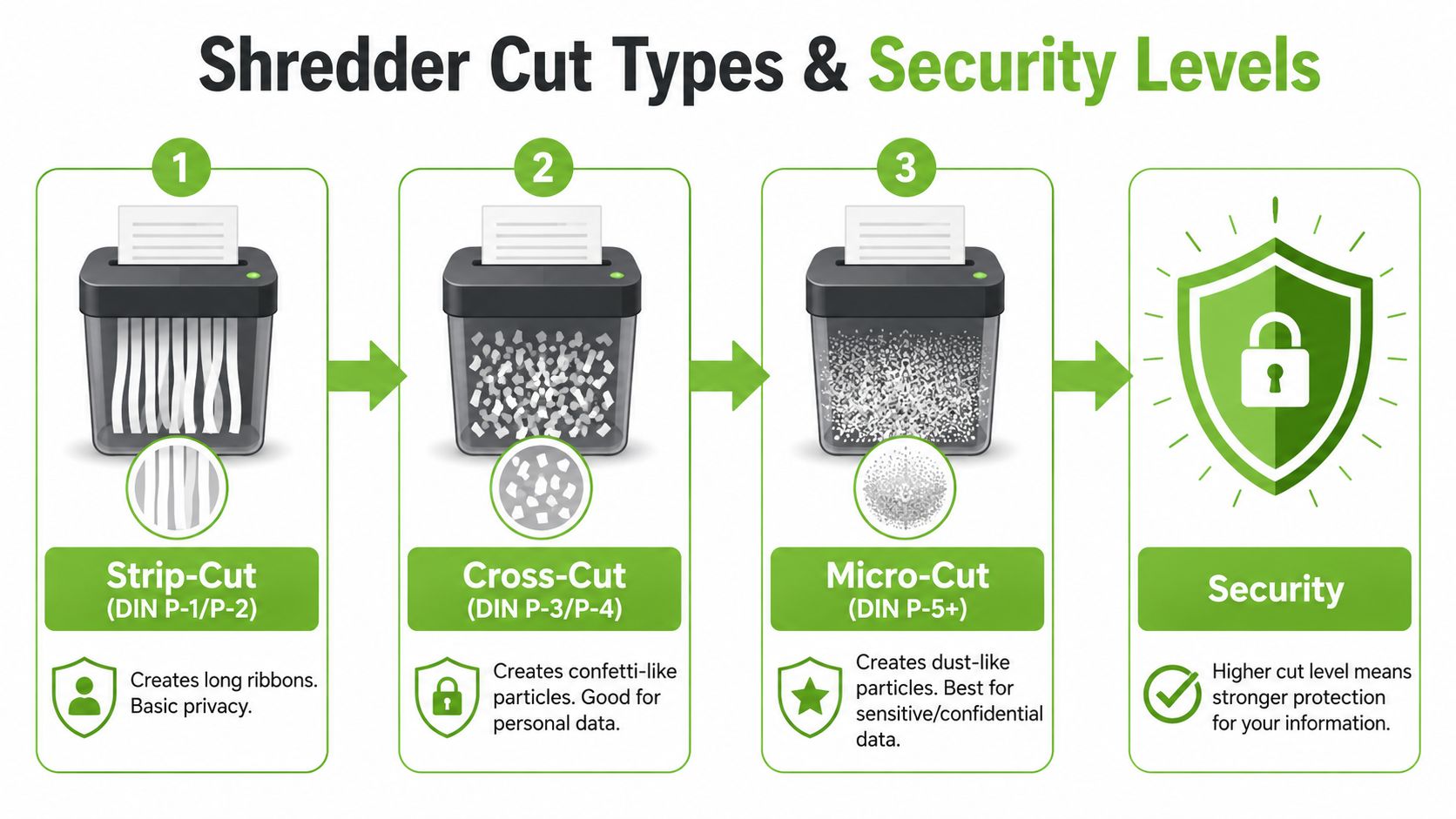
A strip-cut machine tears paper into long ribbons. It's the weakest practical choice and is classed as P-2, with about 40 shreds per page GBC cut-style guide. A cross-cut machine turns the sheet into confetti-like particles, and that's generally P-3, at about 200 shreds per page. A super cross-cut unit sits at P-4, around 400 shreds per page, while micro-cut reaches P-5, with around 2,000 shreds per page. The more pieces you create, the harder the paper is to reconstruct.
Useful shortcut: strip-cut is for low-risk paperwork, cross-cut is the normal business floor, and micro-cut is for much more sensitive records.
Then map the paper to the P-level
For document security, one of the clearest thresholds in the provided sources is the DIN 66399 / P-level system. A P-3 shredder is generally advised for confidential records, while P-4 and above is recommended for more sensitive regulated financial, legal, or medical material Choice Australia buying guide. The same source defines P-3 as pieces under 320 mm², roughly 6 mm x 50 mm.
That matters because it gives you a real mechanical benchmark. A receipt is not the same as an HR file. A printed agenda is not the same as a board paper pack. If the document has personal data or regulated content, you should default upward, not downward.
Know the top-end benchmark
The most demanding benchmark in the source set is the NSA/CSS requirement for paper shredders, which calls for shredded output no larger than 1 mm by 5 mm NSA/CSS requirements PDF. That's the level you're thinking about when records are exceptionally sensitive.
For Singapore buyers, the practical move is simple. If you're handling ordinary office paperwork, P-3 to P-4 is the serious conversation. If your documents carry higher sensitivity, move toward P-5 or a certified destruction workflow rather than pretending a cheap strip-cut unit can carry the load.
Capacity, Duty Cycle, and Jam Prevention That Actually Matter
Sheet count gets all the attention because it's easy to compare. It's also the spec most likely to mislead you. A machine that accepts a fat stack once but needs constant cool-downs, clears jams badly, or overheats in a shared office is worse than a smaller unit that keeps moving reliably.
Capacity is only useful when the machine can keep going
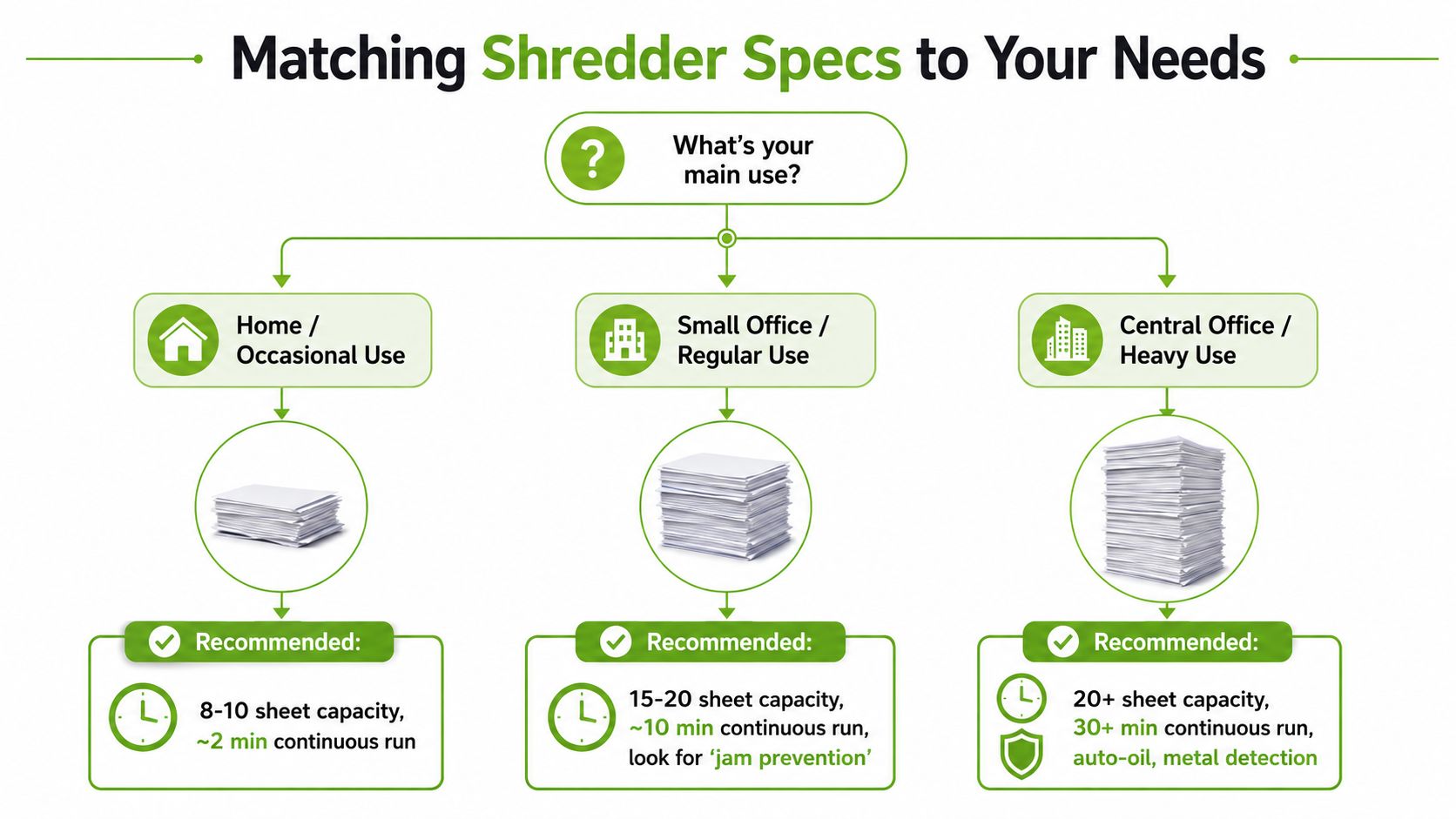
The NSA guidance says office-duty shredders typically run only 5 to 10 minutes before cool-down, while commercial machines may run 30 minutes or more. It also notes that basic home models handle 6 to 8 pages at a time, mid-range units up to 30 pages, and high-end machines stacks of up to 150 pages per pass NSA/CSS requirements PDF. The trade-off here is that more pages per pass does not automatically mean better performance.
A separate buying guide points to the same basic pattern, where home units handle lighter loads, medium models handle more, and high-end machines are built for heavy throughput Hiroyoung buying guide PDF. In practice, sheet-per-pass tells you how quickly you can start. Duty cycle tells you how long you can stay productive.
Match the machine to the way people actually work
A home user who shreds once a week can live with a small bin and a shorter run time. A clinic front desk, HR team, or school admin office can't. Shared equipment in a small Singapore office creates its own friction, because one person's jam becomes everyone's delay.
Here's the operational logic I use when speccing units:
- Light home use: buy a compact unit if the paper load is small and occasional, and skip the heavy commercial frame.
- Regular small-office use: choose a machine with a real duty cycle, not just a high capacity number.
- Bulk cleanout use: don't buy a desktop shredder and expect it to behave like a service machine.
Rule of thumb: if the bin fills faster than the machine can cool down, you're buying frustration.
Jam prevention isn't a luxury
The sample government spec for a high-security shredder includes overheat and overload protection, and that's not cosmetic. It also calls for up to 50 sheets of 70 GSM A4 per pass with 220 W single-phase power, which shows how secure destruction is still limited by heat and mechanical stress Government tender spec PDF. A good shredder needs jam sensors, overload protection, and bin sensors because those features keep output consistent and reduce motor damage.
If you work in a compact Singapore office, skip any machine that sounds impressive on the box but has no clear jam recovery, heat protection, or duty-cycle data. The spec sheet is only useful if the machine survives real daily use.
Matching the Right Shredder Tier to Your Use Case
A buyer can choose the right tier in under a minute if they stop thinking about “best shredder” and start thinking about workflow. Home use, small-office use, and shared corporate use need different machines, different bins, and different expectations. The wrong tier costs more because it either fails early or gets ignored.
Home and remote workers
If you're shredding personal mail, old bills, return forms, and the occasional document with your address or account details, a compact cross-cut unit is usually enough. You don't need a loud heavy-duty machine sitting beside your desk, and you definitely don't need to pay for industrial throughput you'll never use. A personal unit makes sense when the load is light, the drawer space is limited, and the machine can live out of the way.
Skip strip-cut unless the paper is low-risk and you're comfortable with weaker recovery resistance. Skip oversized commercial units because they're a bad fit for flats, study rooms, and shared home offices.
Small offices, clinics, and schools
People make the most expensive mistake. They buy a cheap personal shredder, hand it to three or four staff, and then act surprised when it overheats, jams, or dies early. That setup is wrong from day one.
For regular office use, look for P-3 or P-4, a stable duty cycle, and a bin that doesn't need constant emptying. Office teams often also need to shred staple-heavy documents, envelopes, and the occasional card, so the machine should handle mixed paper without constant intervention. If the work is recurring, the box should behave like a tool, not a toy.
Corporate desks and shared workspaces
For larger teams, the question changes again. At that point, the machine is part of a process, not a convenience item. You need clear destruction flow, a larger bin, stronger jam protection, and enough throughput to keep people from stockpiling paper near desks.
Buy this if: your team shreds weekly and the machine needs to be used by multiple people without babysitting.
Skip this if: the real use case is a one-off archive purge or mixed-device retirement.
If you want a Singapore-specific refresher on related disposal workflows, this document shredding guide from myhalo is worth reading because it sits closer to real office handling than most generic product pages.
The cleanest decision is often this. Buy a shredder for recurring paper flow. Outsource the rest.
Singapore Compliance, PDPA, and Audit-Friendly Destruction
The PDPA doesn't ask Singapore businesses to destroy every piece of paper forever. It asks them to protect personal data with reasonable security arrangements, and that's where shredder choice becomes operational rather than theoretical. If a document contains names, ID details, contact data, payroll information, medical notes, or client records, disposal has to be sensible, repeatable, and defensible.
Turn legal language into a working checklist
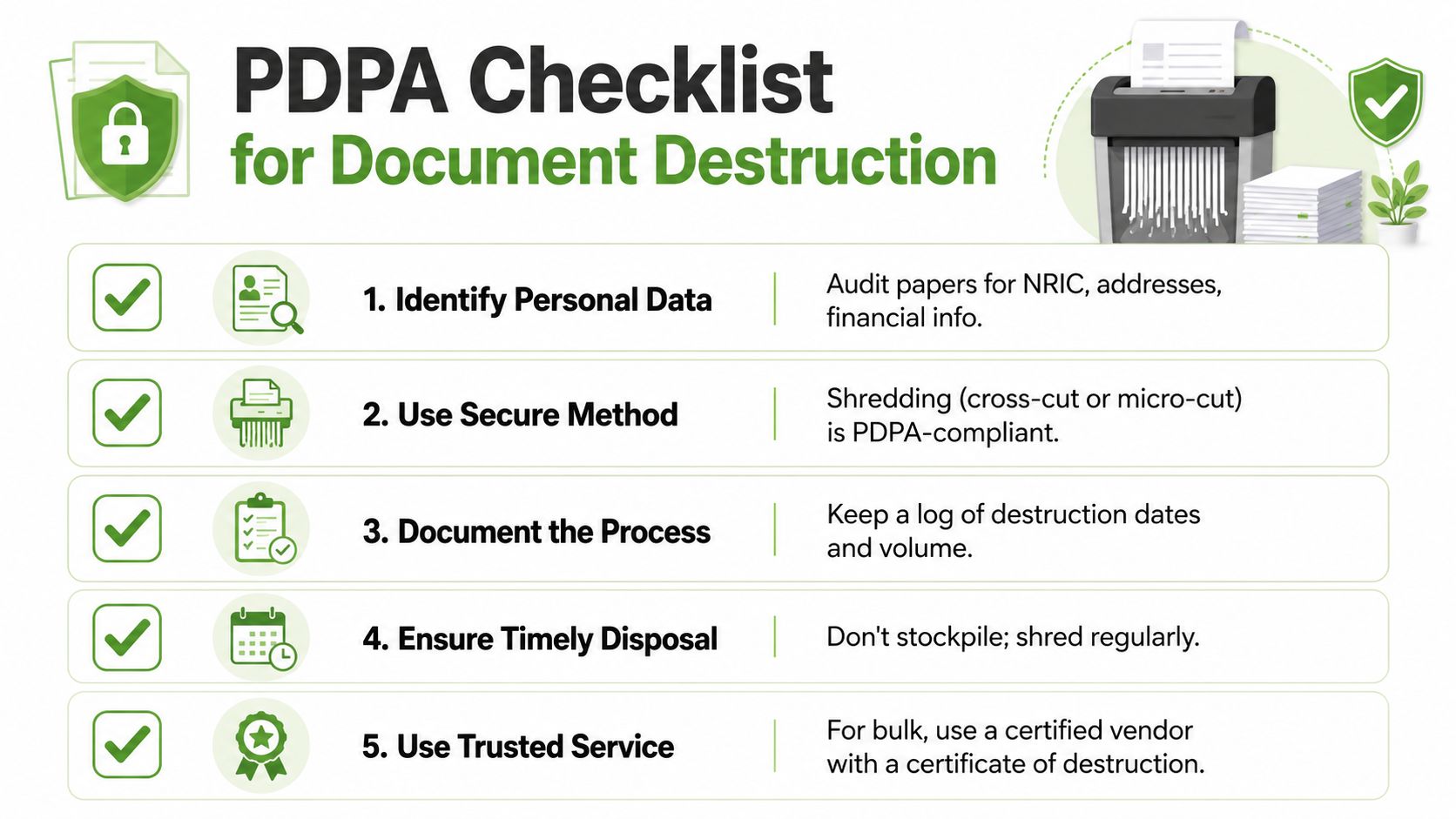
The practical move is to map each document type to a security level and a recordkeeping habit. Customer-facing files, HR paperwork, and financial records need more care than marketing printouts or drafts. That's where P-3, P-4, or higher starts to make sense, because the choice reflects the sensitivity of the data, not just the page count.
A useful habit is to log destruction date, document type, and rough volume. That simple record supports internal governance and helps prove the organisation followed a consistent disposal process. If destruction is outsourced, ask for a certificate of destruction and keep it with the rest of the compliance file.
Don't miss the paper that hides in plain sight
Many teams shred the obvious stuff and miss the less obvious forms of personal data. Printed email archives, scanned paper copies kept in folders, and old working sets from meetings can all linger after their purpose is gone. A machine is only one part of the system, the rest is making sure people use it on schedule.
The same discipline shows up in broader data-handling frameworks too, including myhalo's ISO 27001 data destruction guidance, which is useful for teams trying to align physical disposal with documented process.
Use the right workflow for the right volume
For a small office, shredding on a regular cadence is usually enough. For larger cleanouts, offsite destruction is cleaner and easier to audit. The moment paper starts stacking up for weeks because nobody wants to deal with the machine, the process has already failed.
The PDPA angle is simple. If the organisation can explain what was destroyed, how it was destroyed, and when it was destroyed, the process is far stronger than a pile of paper left for “later.”
Total Cost of Ownership, Maintenance, and Eco-Disposal
The cheapest shredder on the shelf is often the most expensive one after six months. The price tag doesn't show oiling sheets, blade wear, jam recovery time, bin liners, or the staff minutes wasted standing over a machine that keeps stopping. Once multiple people use it, the hidden costs become obvious.
Buy for lifespan, not for the sticker
A low-end model used by several staff will usually age badly because the machine was never built for that pace. A properly rated office unit costs more up front, but it gives you a steadier service life, fewer interruptions, and less labour spent clearing faults. That's the part buyers miss when they compare only the first invoice.
Maintenance matters too. Oiling keeps cutters working smoothly, and skipping it tends to turn small problems into jams and dull blades. The better unit is the one people can maintain without making the office hate the process.
Practical rule: if nobody in the office wants to empty, oil, or unjam it, the machine is too fragile for your environment.
Think beyond the machine itself
A shredder is part of a bigger disposal habit. If you're clearing out old paperwork, the machine should fit into a broader zero-waste mindset, not just a privacy mindset. When the shredder finally reaches end of life, don't dump it into general waste. Route it through e-waste or metal-recycling collection where possible.
For broader device disposal habits, myhalo's electronics recycling guide is a practical reminder that secure disposal and responsible end-of-life handling should sit together, not in separate silos.
The real economic test
If a compact shredder works for one person but becomes a bottleneck for three, it's already losing the cost equation. If the machine sits unused because it's noisy, awkward, or too slow, it's dead weight. The right choice isn't the cheapest one, it's the one that keeps working with the least drama.
That's the zero e-waste logic in plain terms. Buy less, use longer, and dispose properly when the time comes.
When Buying a Shredder Is the Wrong Move
Buying a machine makes sense only when the paper flow is steady enough to justify ownership. For one-off archive purges, staff offboarding, office moves, and mixed-device retirement, ownership is usually the slower path. A certified destruction service or ITAD provider removes the burden of storage, operation, and disposal in one go.
Choose outsourcing when the load is spiky
If the job is a bulk cleanout, don't turn a temporary workload into a permanent purchase. A shredder can handle recurring desktop paper, but a one-time mountain of paper demands time, labour, and patience that most offices don't have. That's especially true when the documents aren't just paper, but part of a wider retirement project involving laptops, drives, phones, or other assets.
Hybrid records are a strong reason to outsource. Paper plus devices means one chain of custody, not three separate disposal habits. If your team wants a single certificate trail for the handover, destruction, and final sign-off, a certified provider is the cleaner answer.
Keep the decision tied to accountability
A shredder gives you in-house control. Outsourcing gives you external proof. For many Singapore teams, the second option is easier to defend because the vendor process is documented and the destruction outcome is easier to file.
If you're already thinking about hard-drive retirement as part of the same project, myhalo's hard disk degaussing guide sits in the same decision space. That matters because the core problem is usually not the paper alone, it's the whole retired-information pile.
Use this simple split
- Buy a shredder if paper destruction is frequent, local, and predictable.
- Outsource destruction if the job is bulky, irregular, or tied to audit evidence.
- Use both if you need daily paper control plus occasional certified cleanouts.
myhalo is one option in that outsourced path, because it handles secure data destruction as part of corporate IT asset disposition and can issue certificates on request. That's a sensible fit when the job is broader than paper and the office wants the disposal record to be tidy.
Your Shredder Decision Checklist for 2026
Before you spend, answer four questions. What am I destroying, how often, in what space, and can I prove it? If you can't answer those clearly, you don't have a shredder problem yet, you have a workflow problem.
Use the answers to decide fast
- If the documents are sensitive and recurring, buy a machine with the right P-level and a duty cycle that matches your volume.
- If the shredder will sit in a shared office, prioritise jam prevention, bin capacity, and heat protection over flashy capacity claims.
- If the cleanout is bulky or mixed with devices, book a certified shredding or ITAD run instead of forcing the job into an office unit.
A monthly oiling routine is worth setting up if you buy. That tiny habit protects the cutters and keeps the machine behaving like a tool instead of a headache.
If the backlog is already growing, don't wait for a perfect in-house setup. Start with a certified destruction run, then decide whether recurring paper volume justifies ownership after the dust clears.
Ready to clear the paper pile and handle it properly? If you need secure disposal for retired devices, confidential records, or a larger office cleanout, myhalo can help with Safe data and responsible end-of-life handling. Visit myhalo to see how their secure destruction and ITAD services can fit your next cleanup.