
Saturday afternoon. You open a drawer looking for one cable and find three old phones, a tired laptop, mystery chargers, and a tablet you forgot you owned. Now questions emerge. Is anything still usable? Where does your data go? Which recycling companies in Singapore can safely handle this?
A zero e-waste mindset makes that mess much easier to sort. Start with the highest-value option first. Repair what still has life left. Trade in devices that others can refurbish and use. Upcycle accessories or parts where that makes sense. Recycle only what can no longer serve a purpose. It works like a smart decluttering ladder. The higher you stay on it, the more value you keep and the less waste you create.
That order matters because recycling is only one part of responsible tech clearing. A working phone is more useful in someone's hand than broken down into raw materials. A wiped laptop that gets a second life through resale or donation usually does more good than heading straight into a bin. If you want a practical local roadmap, this zero e-waste guide for decluttering tech in Singapore lays out the process step by step.
Convenience matters too. So does data safety. So does knowing your items are handled by people who treat old tech as a community resource, not just junk. That is the spirit behind myhalo's approach, and it is a useful lens for this list.
The companies below help with different parts of the journey, from collection and secure handling to proper material recovery. The goal is simple. Help you clear space at home or work in a way that feels safe, easy, and good for the planet.
Table of Contents
- 1. myhalo
- 2. ALBA E-Waste Smart Recycling Pte Ltd
- 3. SK tes formerly TES-AMM
- 4. Virogreen Singapore Pte Ltd
- 5. Metalo International Pte Ltd
- 6. KGS Pte Ltd
- 7. Veolia Singapore
- Top 7 Recycling Companies in Singapore, Comparison
- Beyond Recycling Join the Zero E-Waste Movement
1. myhalo
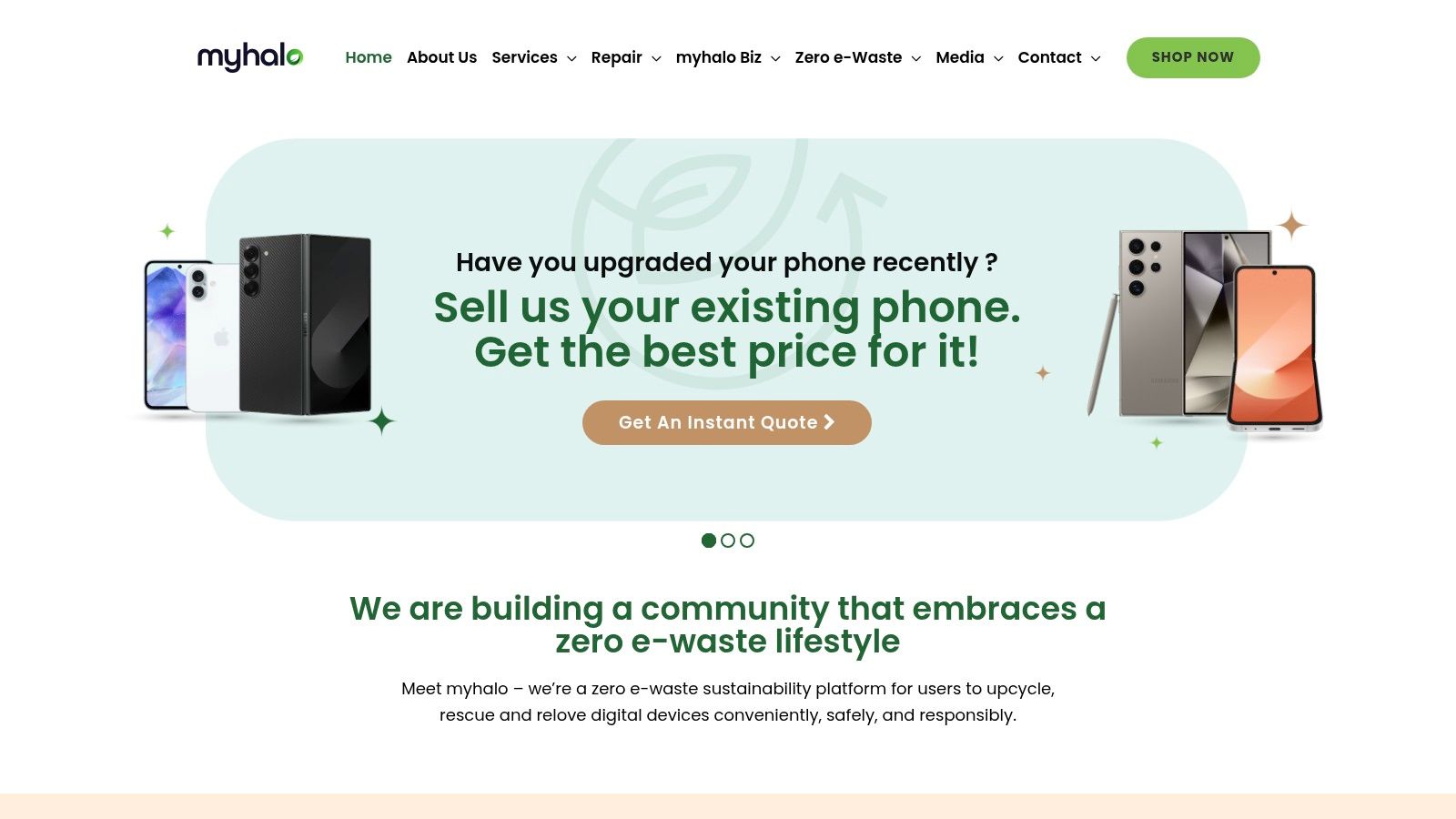
Your old phone is sitting in a drawer. The screen is cracked, the battery fades by lunchtime, and you are not fully sure what to do with the photos, accounts, and personal data still inside. That moment is exactly why a zero e-waste mindset helps. The goal is not to throw tech out quickly. The goal is to move it to the next best use.
myhalo stands out because it starts with the full hierarchy. Repair comes first. Then trade-in or resale if the device still has value. Upcycling comes next, so working parts can support another device. Recycling is the final step, used only after the higher-value options are exhausted. It is a practical way to declutter without wasting materials or shortening a device's life too soon.
Why myhalo stands out
myhalo brings several services into one place: repair, certified resale, buyback, trade-in, upcycling, data recovery, and end-of-life handling. That setup is helpful for households that want a simple path, and for businesses that need clearer control over the full device lifecycle.
The convenience piece matters more than it may seem at first. If you have to visit one provider for repairs, another for data recovery, and a third for disposal, old gadgets tend to stay forgotten in drawers. myhalo reduces that friction with online and in-store trade-in options, certified ReLoved devices, and physical counters at Bugis Junction and Sim Lim Square.
Its sustainability approach is also tied to published outcomes. myhalo shared its 2024 avoided emissions impact, linking carbon savings to repair, reuse, and upcycling across common devices such as phones, laptops, tablets, and desktops.
A simple rule helps here. If a device can be fixed, reused, resold, or harvested for working parts, sending it straight to recycling skips better options. If you want a clearer picture of why proper disposal still matters at the final stage, this guide on the negative effects of e-waste on the environment adds useful context.
Best for
myhalo fits people and organisations that want more than a bin.
- Broken but still worth saving: Repair and Rescue services support component-level repair for smartphones, tablets, laptops, and desktops.
- Still usable and valuable: Trade-in and buyback options can turn idle devices into a cash offer or store value.
- Looking for a safer second device: Certified ReLoved phones, laptops, and tablets are tested and graded before resale.
- Concerned about privacy: Secure data handling and certified destruction are available on request.
- Trying to recover important files: Save data services support recovery from failed drives and damaged devices.
There are a couple of practical limits. myhalo is focused on Singapore, and some services are quote-based instead of listed with fixed prices. For many people, that is a fair trade if the priority is convenience, data safety, and a responsible path that keeps usable tech in the community for longer.
🌿 The myhalo Promise
Joining the zero e-waste movement should feel good and easy. Safe data practices help protect your privacy. Declutter your e-clutter gives old devices a clearer path into repair, reuse, upcycling, or responsible recycling, with less stress and less waste.
2. ALBA E-Waste Smart Recycling Pte Ltd
ALBA is the public-facing name many residents will come across first, because it operates Singapore's Producer Responsibility Scheme route for regulated consumer e-waste. If you've seen e-bins around estates or in-store take-back points, this is the kind of convenience ALBA is built around.
For small household items, that matters a lot. You don't need to negotiate a custom service just to dispose of old cables, lamps, or small electronics responsibly.
What makes ALBA useful
ALBA runs a nationwide network that includes public e-bins, retailer take-back points, scheduled collection drives, a depot drop-off option, and doorstep collection for residents. You can explore their services at ALBA E-Waste Smart Recycling.
This kind of regulated collection matters because Singapore's e-waste stream keeps growing. The country generates an estimated 60,000 tonnes of e-waste annually, and the recycling sector has reported a sharp rise in the volume of e-waste being processed in recent years.
If you're deciding between simple disposal and a more circular path, it helps to understand the difference between recycling and reuse. This explainer on sustainable e-waste upcycling and recycling service in Singapore gives a useful zero e-waste perspective.
A few quick strengths and limits stand out:
- Best public access: ALBA is one of the easiest options for residents with regulated consumer e-waste.
- Clear accepted-item flow: It's designed for standard public disposal routes, not complicated evaluations.
- Good for compliance: Brands and retailers can also use this framework for EPR-related obligations.
- Less suited to ITAD: If you need detailed asset tracking, resale recovery, or advanced data services, this isn't the main focus.
If your gadget still works, check whether it can be repaired or traded in before dropping it into a bin. That's often the more zero e-waste move.
The main downside is that doorstep collection for residents is chargeable, and ALBA isn't built as a full IT asset disposition provider. For homes, though, it's one of the simplest compliant routes in Singapore.
3. SK tes formerly TES-AMM
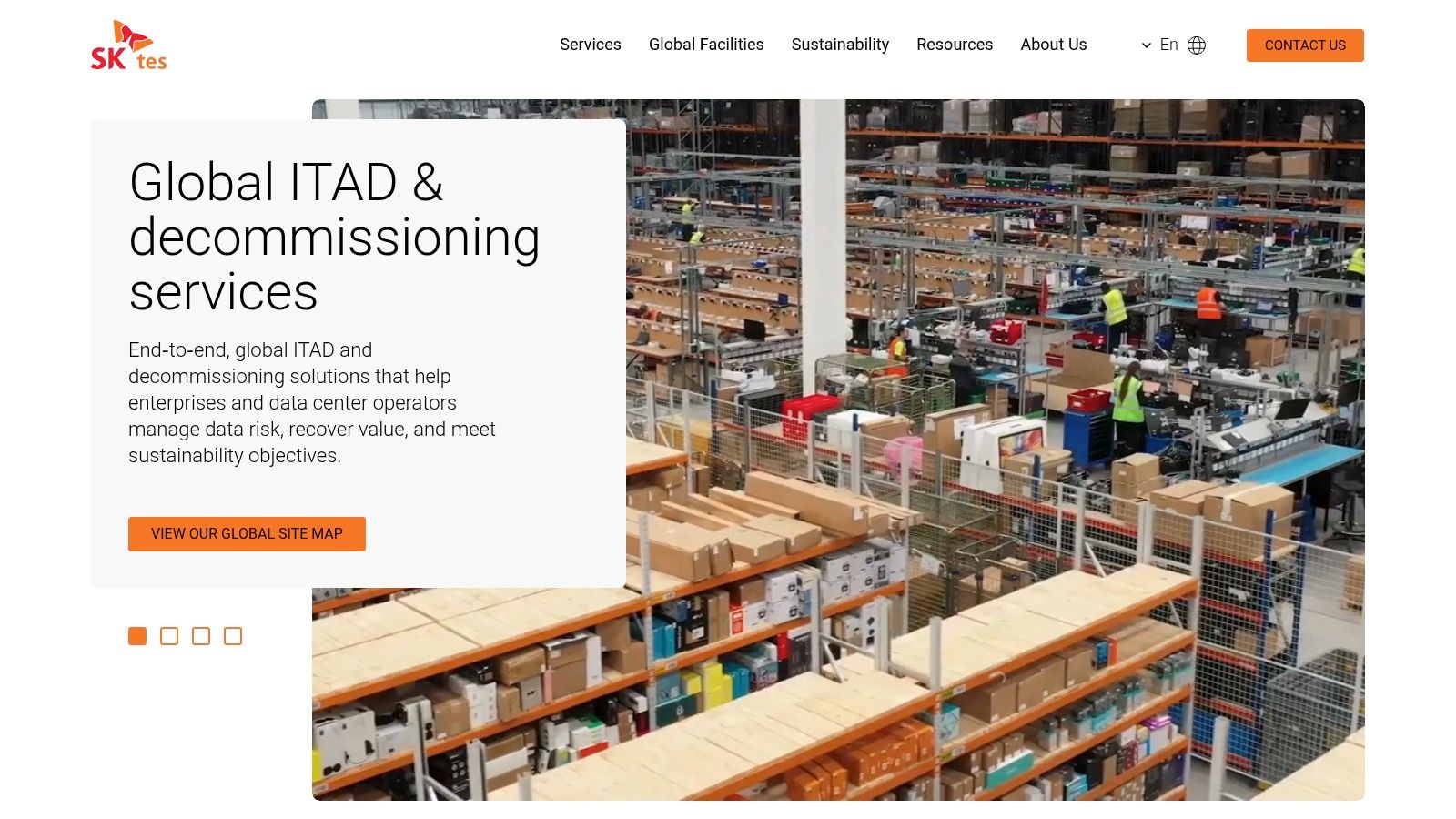
SK tes is a very different kind of player. This one is aimed much more at enterprises than at someone holding one old tablet and a bag of tangled chargers. If your company manages laptops, servers, storage devices, or battery-heavy equipment, SK tes belongs on the shortlist.
Its focus is structured IT asset disposition, asset recovery, and certified data sanitisation. You can find the company at SK tes.
Where SK tes fits best
Businesses often need more than collection. They need documentation, chain-of-custody control, and secure downstream handling. SK tes is built for that kind of environment, with a Singapore base and dedicated battery recycling capability.
That battery angle matters. In Singapore, the waste management market is valued at USD 1.4 billion in 2026 and projected to reach USD 1.73 billion by 2031, reflecting how much infrastructure is building up around waste, recycling, and device lifecycle services.
If your organisation is still treating e-waste like general clutter, it's worth reading about e-waste and its negative effects on the environment. That's often the mindset shift teams need before they set up a better disposal programme.
Here's where SK tes is strongest:
- Enterprise-grade handling: Strong fit for OEMs, data centres, and large organisations with complex fleets.
- Certified sanitisation: Useful when retired assets contain sensitive business information.
- Battery capability: Relevant for mobility, energy storage, and battery-intensive operations.
- Asset recovery mindset: Better than simple disposal if you need redeployment or structured processing.
The catch is straightforward. It's not really a consumer walk-in option, and project pricing is usually bespoke. For companies, that's normal. For individuals, it can feel out of scope.
4. Virogreen Singapore Pte Ltd
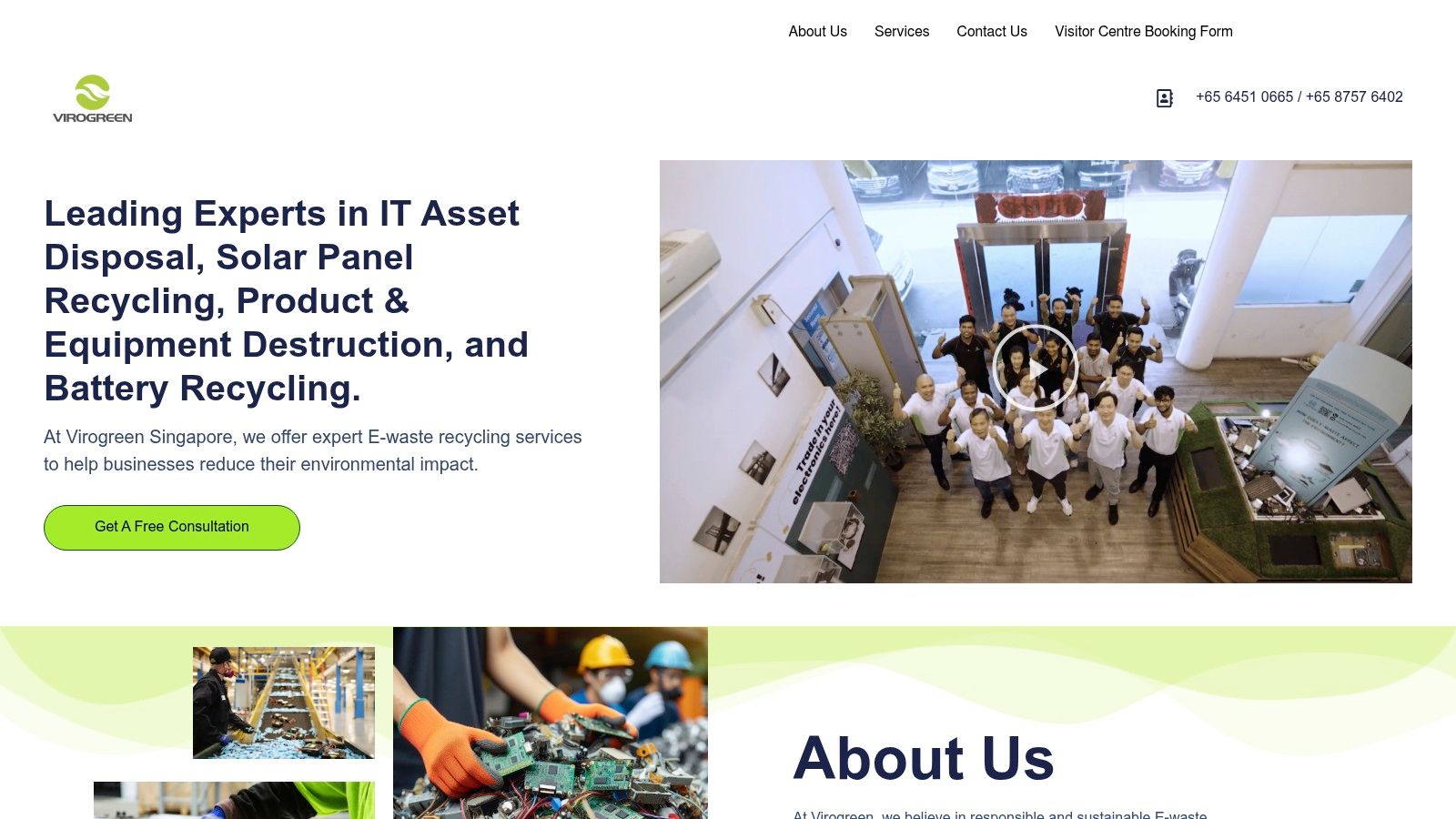
Virogreen is a practical name to know if your organisation needs secure e-waste recycling plus some specialist capability. It offers IT asset disposition support, documented data destruction, and also works in solar panel recycling, which makes it more versatile than a standard office-tech recycler.
You can review its services at Virogreen Singapore.
A practical fit for specialised business needs
One reason Virogreen stands out is range. Some businesses need help with laptops and drives. Others also need support for end-of-life photovoltaic modules from rooftop systems. Having both under one provider can make administration simpler.
Singapore's overall recycling rate remained stable at 52% in 2025, which shows the country has a functioning baseline but still plenty of room to improve recovery and circular use. That's why reuse and refurbished purchasing matter too, not just end-stage recycling. This piece on buying second-hand or refurbished devices to protect Earth captures that idea nicely.
Worth remembering: The greenest device is often the one you keep in use longer, or the one someone else can keep using after you.
Virogreen's profile makes sense for:
- Corporate ITAD: Documented data sanitisation and compliance-oriented handling.
- Pick-up flexibility: Useful for offices that need collection rather than public drop-off.
- Solar panel recycling: A notable extra for organisations with PV assets.
- Mixed waste streams: Better fit when your old tech isn't limited to phones and laptops.
Its limitations are mostly about accessibility. Consumer walk-in options are not the core service, and many details are quote-based rather than listed plainly online. For business users, that's manageable. For households, it may feel less straightforward than public collection routes or trade-in services.
5. Metalo International Pte Ltd
Metalo International leans hard into secure handling. If your biggest fear is less “where do I put this old device?” and more “who can prove the data is gone?”, this is one of the more relevant names in the Singapore market.
The company offers ITAD-related support, secure destruction methods, collection services, and data-centre decommissioning. Its website is Metalo International.
Why secure handling matters here
A lot of old devices don't just contain old files. They hold logins, client records, archived messages, financial documents, and years of forgotten personal information. That's why proper destruction standards matter.
In Singapore, certified data destruction should follow NIST 800-88-based practices such as software overwrites, degaussing, or physical shredding. On completion, businesses should receive a Certificate of Destruction, which provides documented proof that the data has been irreversibly removed.
That makes Metalo a sensible option for organisations that care about audit trails as much as recycling outcomes.
A few reasons companies consider this route:
- Secure destruction focus: Good match for devices carrying sensitive or regulated data.
- End-to-end handling: Includes collection through to compliant downstream processing.
- Data-centre support: Relevant for larger office moves, hardware refreshes, and decommissioning.
- Public programme links: Some convenience comes through partnerships rather than only direct enterprise work.
The main drawback is discoverability. Consumer pricing and walk-in details aren't prominent, so this feels more business-oriented than resident-friendly. If you're an SME retiring office equipment, though, that security emphasis can be exactly what you need.
6. KGS Pte Ltd
KGS has an interesting mix of industrial capability and resident-facing programmes. It's known for solar-panel recycling and also for making small-scale e-waste drop-off more approachable through its TakeBag programme.
You can explore it at KGS.
Why KGS is interesting
If most recycling companies in Singapore feel either too industrial or too generic, KGS sits somewhere in the middle. It supports business recycling services, but it also tries to make household drop-off simpler with a bag-and-locker style flow.
That kind of convenience matters because public understanding is still catching up. People often ask whether they should repair or sell a broken device before discarding it, and many recycling-focused pages still don't explain that profitable repair-to-resale path clearly. That gap in awareness is one reason zero e-waste education is so important.
KGS is especially notable for these reasons:
- Solar-panel recycling: Helpful for end-of-life PV modules, a specialised niche in Singapore.
- TakeBag flow: Gives residents a more structured way to hand over e-waste.
- Business support: Suitable for companies handling batteries and general e-waste.
- Assurance messaging: Data destruction and secure handling are part of the conversation.
Small habit, big impact: Before you book disposal, ask one question. Can this be repaired, traded in, or reused first?
The limitation is that programme coverage can depend on locker access and local availability, while solar-panel projects are naturally more bespoke. Still, KGS brings something useful to the space. It meets residents where they are while also serving a more technical recycling need.
7. Veolia Singapore
A lab manager clearing chemical containers, expired materials, and regulated waste has a very different problem from a household trying to dispose of one old tablet. Veolia Singapore serves that first group. Its focus is large-scale environmental services for industrial sites, laboratories, and organisations with stricter waste controls.
You can explore its regional site at Veolia Singapore.
Best fit for regulated and large-volume waste
In a zero e-waste mindset, recycling is only one step, and often the last one. Devices that still work should be repaired, traded in, or reused first. Services like myhalo sit closer to that consumer-friendly side of the hierarchy, where convenience, data safety, and extending device life matter. Veolia operates further downstream. It helps organisations handle waste that is harder to reuse and requires formal processes.
That distinction matters. A consumer e-waste bin is built for simple items and simple decisions. Veolia works more like a managed system for waste streams that need sorting plans, storage controls, collection schedules, treatment paths, and documentation.
For businesses dealing with regulated materials, that can be useful in several ways:
- Compliance support: Suitable for hazardous, industrial, and laboratory waste that needs careful handling.
- Tracking and reporting: Helpful for audits, internal controls, and documented disposal processes.
- Scale: Better matched to plants, research facilities, and companies operating across multiple sites.
- Broader environmental services: Relevant if waste management overlaps with water treatment or resource recovery.
For a family decluttering drawers at home, Veolia will usually be more than you need.
For industrial operators, though, that heavier setup can be the right tool. If zero e-waste is a ladder, Veolia belongs near the lower rungs where materials need specialist treatment after the higher-value options, repair, resale, and reuse, are no longer realistic.
Top 7 Recycling Companies in Singapore, Comparison
| Service / Provider | Implementation complexity 🔄 | Resource requirements ⚡ | Expected outcomes ⭐📊 | Ideal use cases 💡 | Key advantages |
|---|---|---|---|---|---|
| myhalo | 🔄 Medium, hybrid online + in‑store ops with component‑level repairs and AI pricing | ⚡ Moderate, local technicians, parts inventory, AI pricing engine, retail counters | ⭐📊 High reuse and measurable carbon avoided (~2,020 MTCO2e in 2024); fast consumer turnaround | 💡 Consumers seeking same‑day repairs/trade‑ins; businesses needing IT lifecycle & compliant buyback | AI‑instant quotes; ISO‑aligned data handling; zero‑e‑waste focus; strong social proof |
| ALBA E‑Waste Smart Recycling | 🔄 Low, national PRS operations (public bins, retailer take‑back, drives) | ⚡ Low, public bins, depot, collection logistics; optional fee‑based doorstep pickup | ⭐📊 Broad public coverage for small regulated e‑waste; clears EPR obligations | 💡 Consumers and producers needing convenient, NEA‑aligned disposal and EPR support | NEA‑appointed PRS operator; widest public collection network; clear accepted‑item guidance |
| SK tes | 🔄 High, enterprise ITAD with certified chain‑of‑custody and battery facility | ⚡ High, certified facilities, specialist battery recycling plant, global logistics | ⭐📊 Enterprise‑grade data sanitisation, large‑scale asset recovery and battery recycling | 💡 OEMs, data centres and enterprises with battery‑intensive fleets | Certified ITAD; dedicated Li‑ion recycling; international footprint |
| Virogreen | 🔄 Medium, corporate ITAD plus specialist solar‑panel recycling workflows | ⚡ Medium, corporate pick‑up, recycling partners, PV recycling capability | ⭐📊 Secure corporate disposal and PV end‑of‑life processing | 💡 Businesses with IT assets and rooftop/large PV systems | Solar/PV recycling capability; flexible corporate pick‑up and destruction options |
| Metalo International | 🔄 Medium, end‑to‑end ITAD (shredding, degaussing, erasure) and decommissioning | ⚡ Medium, local collection points, ISO‑aligned systems, data‑destruction equipment | ⭐📊 Documented secure disposal and local compliance for corporate clients | 💡 SMEs to large enterprises needing certified ITAD and data‑centre decommissioning | Strong secure‑handling focus; multiple public collection touchpoints via partners |
| KGS | 🔄 Medium, automated PV recycling line plus consumer TakeBag locker flow | ⚡ Medium, PV recycling automation, locker network, logistics | ⭐📊 Local PV material recovery; traceable resident drop‑off for small e‑waste | 💡 PV owners and residents seeking convenient, traceable drop‑off; corporate PV projects | Automated PV recycling; TakeBag consumer convenience and traceability |
| Veolia Singapore | 🔄 High, complex industrial and hazardous waste treatment with on‑site services | ⚡ High, specialized treatment facilities, scalable operations, detailed reporting | ⭐📊 Comprehensive regulated waste and hazardous treatment with audit‑grade reporting | 💡 Manufacturers, laboratories and industrial clients needing compliant hazardous waste solutions | Scalable B2B services; hazardous waste expertise; integrated circular solutions |
Beyond Recycling Join the Zero E-Waste Movement
A drawer full of old phones, cables, and laptops can feel small until you open it and realize each item needs a decision. Keep it. Fix it. Pass it on. Break it down safely. That is where a zero e-waste mindset helps, because it gives you a clear order instead of a guessing game.
Start with the option that keeps the device useful for the longest time. Repair comes first if the item still works or can work again with a battery swap, screen replacement, or simple servicing. Trade-in or resale comes next if someone else can still use it. Upcycling follows when parts such as memory, chargers, or screens can support another device. Recycling comes last, once the item has reached end-of-life.
That order matters because recycling is helpful, but it is not magic. A functioning laptop has more value as a repaired laptop than as separated materials. A phone with recoverable data needs careful handling before it leaves your hands. For businesses, the same logic applies at a larger scale. Good disposal decisions should protect data, document custody, and avoid destroying reusable equipment too early. If you manage returns or recovery flows, this reverse logistics guide for operations managers adds helpful context.
Data safety is often the sticking point. People delay clearing old devices because they worry about family photos, work files, client records, or saved passwords. That concern is reasonable. In Singapore, secure disposal providers may use destruction or erasure practices aligned with recognized standards such as NIST 800-88. Audited systems can also support traceability and process control, as shown in this reference on ISO 9001:2015 and ISO 14001:2015. For another example of secure erasing and destruction practices described by an NEA-licensed collector, REDUX's e-waste recycling overview is a useful benchmark.
The emotional side matters too.
A cleared shelf feels lighter. A safely wiped laptop feels safer. A repaired or rehomed device feels far better than tossing something aside and hoping for the best.
That spirit sits at the heart of zero e-waste. Community matters. Convenience matters. Safe handling matters. myhalo's approach reflects that idea by helping people handle tech clutter step by step, from data support and repair to reuse, trade-in, upcycling, and only then recycling when no better path remains.
If you are staring at a pile of old tech and do not know where to start, begin with one device. Check whether it can be repaired. If not, see whether it still has trade-in or reuse value. If neither fits, choose a safe recycling route with proper data handling. Small choices add up, and each one keeps Singapore a little closer to a zero e-waste future.